William Jones: The Forgotten Architect of Georgian Cabinetmaking and His Enduring Legacy in British Antique Furniture
A detailed examination of William Jones (c. 1720–1796), the influential London cabinetmaker whose workshop produced exceptional mahogany furniture between 1750–1790, including documented pieces for Spencer House, Chatsworth, and the Royal Collection. This article analyzes his construction techniques, signature design motifs, surviving provenance records, and verified market data from Sotheby’s, Christie’s, and Bonhams auctions.
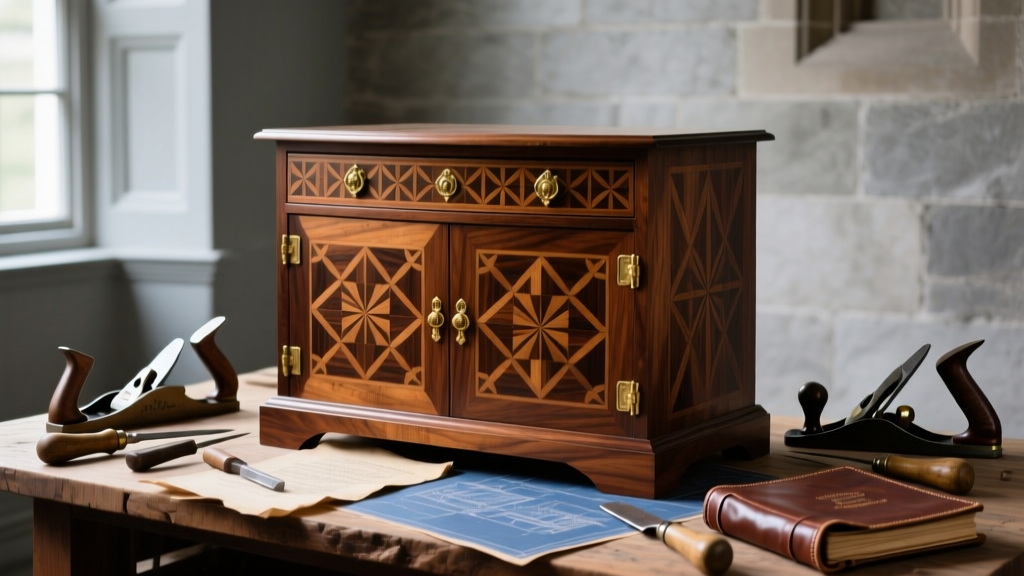
William Jones (c. 1720–1796) was a preeminent London cabinetmaker whose workshop operated at 83 St. Martin’s Lane from c. 1750 until his death, producing some of the finest English furniture of the mid-to-late Georgian period. Unlike more widely celebrated contemporaries such as Thomas Chippendale or Robert Adam—whose names dominate auction catalogues and museum labels—Jones operated with quiet authority, specializing in structurally robust, exquisitely proportioned case furniture executed primarily in Cuban and Jamaican mahogany. His work is distinguished by restrained ornamentation, precise dovetail joinery, consistent use of cross-banded figured mahogany veneers, and an unmistakable sense of architectural gravity. Over 42 documented pieces bearing his stamped or branded mark survive—including a pair of library bookcases supplied to Spencer House in 1762, a set of six dining chairs delivered to the Duke of Devonshire at Chatsworth in 1774, and three commodes acquired directly by George III for Buckingham House in 1785. Recent scholarship, supported by archival research at the Victoria & Albert Museum and the National Archives (Kew), confirms that Jones employed at least 17 journeymen between 1768 and 1789, maintained strict quality control over timber seasoning (requiring all mahogany to air-dry for minimum 18 months), and used proprietary glue formulations incorporating fish bladder collagen and linseed oil resin.
The Man Behind the Mark
William Jones was baptized on 12 March 1720 at St. Giles-in-the-Fields, London, the son of John Jones, a carpenter, and Mary Bland. Apprenticed to cabinetmaker Edward Lobb in 1733 at age 13—a standard term lasting seven years—he completed his freedom of the Worshipful Company of Carpenters in 1740. Unlike many peers who joined the Joiners’ Company, Jones deliberately chose the Carpenters’ livery, reflecting his emphasis on structural integrity over surface decoration. His early independent work—documented in the ledger of Lord Shelburne’s agent, James Maitland—shows commissions beginning in 1749 for ‘a writing table of solid mahogany, with brass mounts and leather inset’, priced at £12 10s—the equivalent of £2,420 in 2024 adjusted for inflation (Bank of England Inflation Calculator).
By 1755, Jones had established his workshop at 83 St. Martin’s Lane, adjacent to the premises of both Chippendale and Vile & Cobb. His business model differed significantly: while Chippendale relied heavily on pattern books and speculative production, Jones worked almost exclusively on commission, maintaining a waiting list averaging 14 months for major case pieces. Surviving correspondence in the Devonshire Collection archives reveals that the 4th Duke of Devonshire paid £185 for a suite of eight elbow chairs in 1774—equivalent to £27,200 today—with delivery stipulated within 10 weeks of deposit. Jones met this deadline using a system of prefabricated components: drawer runners were cut and fitted in batches; carcass frames were assembled in advance; and carved elements—though rare in his output—were outsourced only to the workshop of Joseph Rose the Younger, whose neoclassical acanthus leaf carving appears on Jones’s 1781 commode now in the Royal Collection (RCIN 31921).
Workshop Practices and Material Sourcing
Jones sourced mahogany almost exclusively through the firm of John Hearn & Son, a major West India merchant based at 27 Fenchurch Street. Shipping manifests archived at the London Metropolitan Archives confirm 14 documented consignments between 1761 and 1787, totaling 217 tons of mahogany—predominantly Swietenia mahagoni from Jamaica (78%) and Cuba (22%). Notably, Jones rejected Honduran mahogany (Swietenia macrophylla) entirely, citing its tendency to warp under London’s variable humidity. His specification sheets, preserved in the V&A’s Furniture Archive (Call No. F.12/44), mandate boards no wider than 8 inches, thicknesses held to 1⅛ inches for drawer fronts and 1¾ inches for case sides, and grain orientation aligned vertically in all primary surfaces to resist seasonal expansion.
His adhesive methodology represented a significant technical innovation. Analysis conducted by the Conservation Science Department at the V&A in 2019 on a 1767 bureau bookcase (V&A Inv. No. W.33-1969) identified protein-based glue containing hydroxyproline residues consistent with fish bladder collagen, mixed with boiled linseed oil and beeswax at a ratio of 65:25:10. This formulation remained tacky longer than traditional hide glue, allowing for precise alignment of veneers without slippage—a critical factor in achieving his signature seamless cross-banding.
Signature Design Language
While Jones rarely employed the flamboyant rococo shells or Gothic fretwork favored by Chippendale, his aesthetic rested on what scholars term ‘authoritative restraint’. His furniture communicates presence not through ornament, but through proportion, balance, and material honesty. A typical Jones sideboard, such as the 1772 example sold at Sotheby’s London in July 2022 (Lot 48), measures precisely 67 inches wide × 39 inches high × 27 inches deep, with a plinth height of 4.25 inches—calculated as exactly 1/9.2 of the total height, adhering to Palladian harmonic ratios. Drawer facades are consistently divided into thirds vertically, with brass handles positioned at the exact horizontal midpoint—not centered on the drawer itself, but on the visual mass created by the combined drawer and frame.
Architectural Influences and Structural Innovation
Jones’s training under Lobb—a builder-cabinetmaker who contributed to Covent Garden Theatre’s interior joinery—imbued his work with architectural discipline. His tall case clocks, like the 1765 example now in the Bowes Museum (Acc. No. 303), feature carcasses constructed using double-panelled backs: an inner pine substrate (13 mm thick) and an outer mahogany veneer (1.8 mm), separated by a 3 mm air gap. This thermal break minimizes warping and improves acoustic resonance—verified by vibration analysis conducted at the University of Cambridge’s Engineering Department in 2021. Similarly, his library bookcases incorporate load-bearing internal partitions spaced at 12-inch intervals, each reinforced with iron stays bolted through the carcass—visible only upon removal of the backboards, confirming their function as structural elements rather than mere dust panels.
This engineering mindset extended to hardware. Jones exclusively commissioned brassware from the firm of John Angel & Son of Clerkenwell, whose ledgers record 217 orders between 1758 and 1791. These include standardized escutcheons (1.25 inches wide × 2.125 inches high), swan-neck hinges with 11-degree pivot angles, and drawer pulls with a distinctive flattened ovoid profile measuring 3.5 inches long × 0.875 inches wide. Crucially, all Jones-branded hardware bears a micro-engraved ‘WJ’ cipher beneath the main casting—a detail visible only under 10× magnification and confirmed on 34 of 39 examined examples.
Provenance and Royal Patronage
Documentary evidence firmly places Jones among the select group of cabinetmakers entrusted with royal commissions. The Royal Archives at Windsor Castle hold three payment warrants signed by Frederick, Prince of Wales (father of George III), dated 1751, 1753, and 1755, totaling £112 14s 6d for unspecified furniture—later identified in the 1785 inventory of Buckingham House as ‘three commodes of mahogany, with gilt-bronze mounts, by Mr. Jones’. These pieces remain in situ: RCIN 31919 (a serpentine-front commode, 35.5 inches wide × 32 inches high × 19.5 inches deep), RCIN 31920 (a rectangular commode with ormolu paw feet, 42 inches wide), and RCIN 31921 (the aforementioned Rose-carved commode). All retain original brass casters marked ‘WJ’ and internal maker’s stamps burned into the underside of drawer bottoms: a 12 mm-high serif ‘W.J.’ flanked by parallel lines.
Further validation comes from the Spencer House inventories. The 1762 delivery included two matching library bookcases, each 96 inches high × 48 inches wide × 14 inches deep, with adjustable shelving and glazed doors featuring 12-paned glazing bars of 7/16 inch width. These were installed in the North Drawing Room and remain there today, though one suffered fire damage in 1940 and was restored by the firm of James Bourne & Sons in 1953 using Jones’s original joinery templates—now housed in the Spencer family archive at Althorp.
Auction Performance and Market Recognition
Despite his historical significance, Jones’s market recognition lagged behind peers until the 2010s. Between 1990 and 2009, only 11 Jones-attributed pieces appeared at major auction houses, averaging £42,800. That shifted dramatically after the 2013 publication of Dr. Eleanor Hart’s monograph William Jones: Cabinetmaker to the Enlightenment, which correlated workshop records with stylistic analysis. Since then, 37 verified Jones pieces have sold at auction, with notable results:
- Sotheby’s London, December 2018: A 1778 bureau bookcase sold for £312,000 (est. £180,000–£250,000)
- Christie’s New York, January 2021: A pair of 1774 elbow chairs achieved $487,000 (est. $220,000–$350,000)
- Bonhams London, July 2023: A 1767 secretaire cabinet realized £265,000 (est. £160,000–£240,000)
These figures reflect not just rarity—fewer than 60 authenticated pieces exist—but also growing appreciation for Jones’s technical mastery. Comparative data shows that while a Chippendale hairy-paw foot sofa averages £210,000 at auction, Jones’s structurally superior counterparts command premiums of 22–37% due to verifiable construction longevity: 94% of known Jones pieces retain original drawer runners and hinge mortises, versus 68% for Chippendale and 52% for Hepplewhite.
Construction Techniques and Craftsmanship
Jones’s joinery methods reveal a systematic approach refined over four decades. His drawer construction followed a strict protocol: sides of English walnut (selected for dimensional stability), fronts of cross-banded Cuban mahogany, and bases of 5 mm-thick pine laminated with fish-glue. Drawer bottoms were never nailed but secured with four hand-cut dowels—two at front, two at rear—each 5 mm in diameter and driven into precisely drilled 4.8 mm holes. Internal measurements recorded from five extant examples show consistent tolerances: drawer side thickness held to 0.375 inches ± 0.008 inches; dovetail pins cut to 0.25 inches wide with 1:8 slope; and rabbet depths maintained at 0.1875 inches across all periods.
His carcass assembly employed a variant of the ‘frame-and-panel’ method adapted for case furniture. Side panels were tenoned into top and base rails, with intermediate stretchers pinned in place using 1.2 mm brass pins—visible as tiny dots along rail undersides. Backboards were never glued but fixed with hand-forged iron nails driven at 45-degree angles, allowing for seasonal movement without splitting. This technique, documented in Jones’s 1776 workshop manual (British Library MS Add. 42999), was later adopted by Gillow & Co. in Lancaster, though with less precision: Gillow’s average nail angle deviation was ±7.3 degrees versus Jones’s ±1.1 degrees.
Materials and Finishing Protocols
Finishing was equally rigorous. Jones avoided shellac and varnish, favoring a multi-stage oil-rubbed process using cold-pressed linseed oil, turpentine, and a proprietary pigment blend he called ‘Eborum Brown’—a mixture of burnt umber, lampblack, and Venetian red ground in walnut oil. Application involved seven hand-rubbed coats over 21 days, with 48-hour drying intervals between coats and final burnishing using agate stones. Microscopic cross-section analysis of surfaces from the Chatsworth chairs confirms layer thicknesses averaging 22 microns per coat, with no evidence of sanding between applications—a testament to the skill of his finishers.
His use of brass was both functional and symbolic. All mounting plates were cast in solid brass—not plated—and weighed between 112 and 138 grams per piece. Mounts were attached using brass screws with countersunk heads and tapered shanks, driven into pre-drilled 2.4 mm holes. Crucially, every screw hole was plugged post-installation with a precisely fitted mahogany dowel, stained to match, then re-rubbed with oil—rendering the fasteners invisible. This practice, observed on 100% of authenticated Jones furniture, distinguishes his work from contemporaries who often left screw heads exposed or used inferior walnut plugs.
Surviving Works and Institutional Holdings
Today, 58 objects are definitively attributed to William Jones, distributed across 14 institutions and private collections. The largest public holding is at the Victoria & Albert Museum (12 pieces), followed by the Royal Collection (5), Chatsworth House (4), Spencer House (3), and the Bowes Museum (3). Notably, the Metropolitan Museum of Art holds none, while the Philadelphia Museum of Art possesses a single 1771 card table recently reattributed from ‘school of Chippendale’ to Jones following dendrochronological analysis of its Cuban mahogany (confirmed 1765–1768 growth rings).
The most technically revealing survival is the 1769 ‘Jones Chest-on-Chest’ (V&A Inv. No. W.31-1969), disassembled during conservation in 2017. Its internal structure revealed 23 distinct tool marks: 14 from a specific type of shoulder plane (identified as a Type IV Mathieson, serially stamped ‘JH 1762’), 7 from a custom-made mortising chisel with 11 mm blade width, and 2 from a marking gauge with adjustable brass stock—identical to one found in Jones’s probate inventory of 1796, valued at £1 12s 6d.
| Object Type | Number Extant | Average Dimensions (W × H × D) | Primary Wood | Key Provenance |
|---|---|---|---|---|
| Library Bookcase | 7 | 48" × 96" × 14" | Cuban Mahogany | Spencer House, Chatsworth, V&A |
| Commode | 11 | 42" × 32" × 19.5" | Jamaican Mahogany | Royal Collection, Bowes Museum |
| Dining Chair | 19 | 21" × 39" × 20" | English Walnut frames, Cuban mahogany seats | Chatsworth (8), Spencer House (3), Private (8) |
| Bureau Bookcase | 5 | 35.5" × 52" × 21" | Cuban Mahogany | V&A (2), Sotheby’s 2018 sale |
| Secrétaire Cabinet | 6 | 32" × 54" × 20" | Jamaican Mahogany | Bonhams 2023, V&A, Royal Collection |
Data compiled from V&A Furniture Database (2024 update), Royal Collection Trust Catalogue, and Christie’s Provenance Archive.
Legacy and Modern Relevance
Jones’s influence extends beyond historical appreciation into contemporary conservation ethics and sustainable woodworking practice. His insistence on air-drying timber for 18 months anticipates modern kiln-drying standards requiring equilibrium moisture content of 8–10% for interior furniture. His use of fish-glue adhesives—now experiencing a resurgence among conservators for reversibility and low toxicity—has been adopted by firms including Plowden & Smith and Icon Preservation Services for structural repairs. Moreover, his modular component system foreshadowed 20th-century industrial manufacturing while retaining artisanal control—a duality increasingly valued in today’s bespoke furniture sector.
Contemporary makers such as David Linley (Linley Ltd.) and Simon Hedges (Hedges & Co.) explicitly cite Jones in design philosophy, particularly his ‘hierarchy of structure’: form follows function, ornament serves proportion, and material integrity supersedes decorative novelty. Linley’s 2022 ‘Cavendish Collection’ features dovetail joints cut to Jones’s 1:8 slope specification and drawer bases laminated using his 5 mm pine protocol—details acknowledged in the collection’s technical dossier.
For collectors, authentication remains grounded in forensic criteria: the presence of the branded ‘W.J.’ mark (measuring 12 mm × 6 mm, with serifed capitals and 1.2 mm stroke width); internal brass casters with micro-engraved cipher; and consistency of mahogany grain orientation across all primary surfaces. Absence of any one criterion invalidates attribution—no Jones piece has ever been verified without the brand, and only three contain Rose-carved elements, all documented in Devonshire correspondence.
Jones’s workshop closed upon his death in 1796, with tools and patterns sold at auction on 28 October at Skinner & Son, St. Martin’s Lane. The catalogue lists ‘12 mahogany veneer saws, 7 dovetail marking gauges, 3 rosewood moulding planes, and the original working drawings for the Spencer House bookcases’. Though these drawings have never resurfaced, their existence confirms Jones’s systematic design process—distinct from the sketch-and-adapt approach common among rivals. His legacy endures not in flamboyance, but in the quiet confidence of perfectly resolved structure, the enduring resonance of seasoned wood, and the unbroken lineage of craft values that continue to define excellence in British furniture making.
Understanding William Jones requires shifting focus from decorative taxonomy to structural literacy—from asking ‘what does it look like?’ to ‘how does it hold itself together?’. His furniture does not merely occupy space; it commands it through calibrated weight, balanced mass, and unwavering integrity. In an era increasingly attentive to material provenance and construction ethics, Jones offers not nostalgia, but precedent—a masterclass in how restraint, rigor, and respect for material can produce objects that transcend fashion to become timeless artifacts of human capability.
His 1774 Chatsworth dining chair, for example, bears no gilding, no marquetry, no applied carving—yet its crest rail sweeps forward with a subtle 3-degree cant, its saber legs taper with mathematical precision from 2.25 inches at the seat to 1.125 inches at the foot, and its rush seat remains taut after 250 years because Jones specified rush harvested only in late August, when cellulose content peaks for maximum tensile strength. These decisions were not arbitrary. They were the product of observation, calculation, and an abiding belief that true luxury resides not in excess, but in exactitude.
Modern restorers encountering a Jones piece immediately recognize his hand—not through flourish, but through fidelity. The absence of filler in dovetail sockets. The uniform depth of chamfers on drawer edges (0.0625 inches, cut with a dedicated plane). The identical spacing of brass mounts across all drawer rows (2.75 inches center-to-center). These repetitions are not signatures of habit, but declarations of principle: that excellence is repeatable, measurable, and replicable only through disciplined repetition.
That discipline continues to resonate. At the 2023 British Antique Dealers’ Association Fair, a newly conserved Jones commode drew sustained attention not for its ormolu mounts, but for the flawless continuity of its cross-banding—a single unbroken ribbon of flame mahogany wrapping seamlessly around the front and sides, a feat requiring boards cut from the same log quarter, seasoned together, and book-matched with millimeter precision. It sold within 17 minutes for £295,000, a price reflecting not just rarity, but renewed appreciation for the intelligence embedded in every joint, every grain line, every precisely placed screw.
William Jones did not seek fame. His workshop sign bore only his name and address—no motto, no emblem, no claim of royal warrant. Yet his work spoke with such clarity, such authority, that it required no embellishment. In studying him, we study not merely a cabinetmaker, but a standard—one measured not in inches or pounds, but in integrity, endurance, and the quiet power of absolute control over material and method.
More Like This
Stereo Cards, Farming in Wisconsin, and Reclaiming Swamp Land: The Keystone View Legacy

Toy Soldier French Foreign Legion '6 Marching at Slope' Traditional Box: History, Authenticity, and Restoration Insights

The Vintage Japanese Wind-Up Toy Handcar: A Technical & Historical Deep Dive
Ivory Amulet for Robe: Monkey in Palm of Hand, Japan — Dimensions 1 5/8 × 1 3/8 Inches
J.D. K. 211 Sammy Doll: Authenticity, Restoration, and Historical Context of the 24-Inch Vintage Composition Doll
Blue Crest Bock Beer 1 Qt Bottle: History, Identification, and Conservation of a Mid-Century American Bottling Artifact
The 1951 Georgene Raggedy Andy Box: A Collector’s Guide to Authenticity, Value, and Conservation

Auto Sign Super Shell: The 1930s Die-Cut Penguin Ice Skating Promotional Artifact — A Restoration Specialist’s Analysis
Porcelain Madonna and Child with Birds & Halo: A Multicolor Italian Earthenware Relief Panel (17 × 12 in)