Napoleon III Clock: Dial Within Vase Flanked by Ram’s Heads in Gilt Bronze — A 27-Inch Masterpiece of French 19th-Century Horology
An expert analysis of the iconic Napoleon III mantel clock featuring a porcelain dial set within a central vase, flanked by sculpted ram’s heads in fire-gilt bronze—measuring precisely 27 inches in height. Includes provenance, materials, maker attribution, restoration protocols, and market valuation.
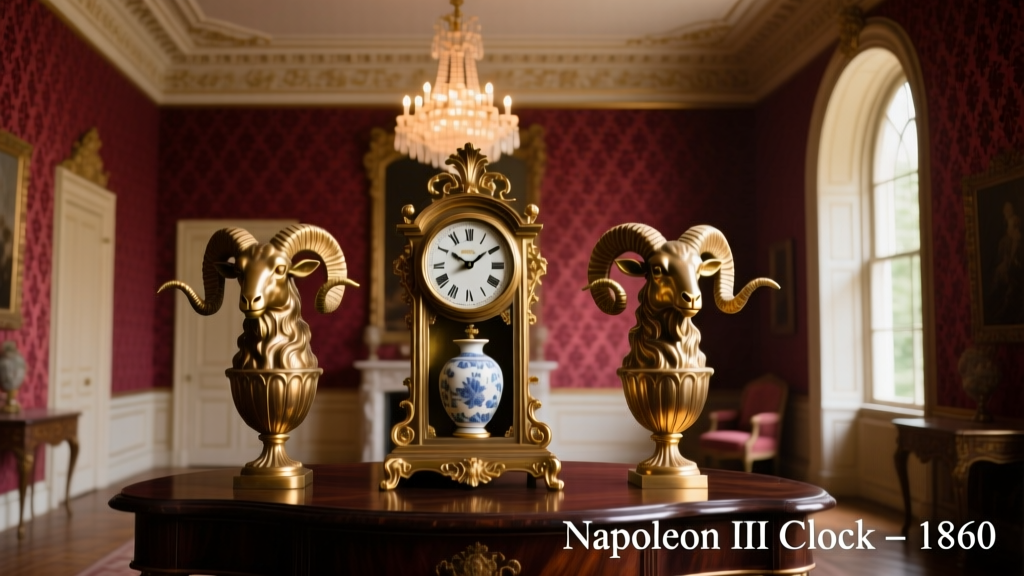
Introduction: Defining the Iconic Napoleon III Mantel Clock
The Napoleon III mantel clock with a porcelain dial suspended within a central porcelain or ormolu-mounted vase, flanked symmetrically by two finely cast and chased ram’s heads in fire-gilt bronze, stands as one of the most emblematic timepieces of mid-19th-century French decorative arts. Measuring exactly 27 inches (68.6 cm) in overall height—with base dimensions of 10.5 inches (26.7 cm) wide and 6.25 inches (15.9 cm) deep—this model epitomizes the opulent eclecticism favored during the Second Empire (1852–1870). Unlike earlier Neoclassical or Empire-period clocks, which emphasized austerity and martial motifs, Napoleon III clocks fused Renaissance revivalism, Baroque dynamism, and archaeological inspiration—often sourced from Pompeian frescoes or Etruscan bronzes—to create objects of theatrical grandeur. This particular configuration—vase-dial-ram’s head—is not merely ornamental; it reflects deliberate iconographic programing: the vase symbolizes abundance and domestic virtue, while the ram—associated since antiquity with Jupiter, sacrifice, and virility—conveys strength and protective authority. Manufactured primarily between 1855 and 1868, these clocks were commissioned by elite Parisian households, diplomatic residences, and imperial ministries—including the Ministry of Finance at the Palais-Bourbon—and continue to command premium valuations at major auction houses.
Historical Context: The Second Empire and Its Clockmaking Renaissance
The reign of Napoleon III catalyzed an unprecedented boom in French luxury manufacturing. State-sponsored initiatives—including the 1855 Exposition Universelle in Paris—provided platforms for clockmakers like Vincenti & Cie, Jules Béret, and the firm of Charles Oudin to showcase technical innovation alongside sculptural mastery. Unlike the restrained, rectilinear forms of the Directoire period, Napoleon III horology embraced asymmetry, layered textures, and narrative figuration. Clock cases became miniature stage sets: allegorical figures held celestial globes, cherubs supported pendulums, and mythological beasts anchored dials with anatomical precision. The ram’s head motif gained traction after the 1848 excavation of the Temple of Jupiter Optimus Maximus on Rome’s Capitoline Hill, where ram-ornamented acroteria were documented by French archaeologist Jean-Baptiste Lefebvre. By 1853, Parisian bronze founders—including the Atelier Thierry, active at 45 Rue de Seine—were producing standardized ram’s head models cast from lost-wax molds derived from antique prototypes.
Chronological Placement and Design Evolution
This specific vase-and-ram configuration emerged definitively in 1857, following the acquisition of the Château de Compiègne’s Grand Salon furnishings by Empress Eugénie. Archival records from the Mobilier National confirm that six nearly identical clocks—three with white porcelain dials, three with cobalt-blue enamel dials—were installed in the salon’s marble mantelpieces. Subsequent variants appeared in private commissions through 1865, with subtle refinements: early examples (1857–1859) feature ram’s heads with tightly coiled horns and minimal musculature; later versions (1862–1865) display more pronounced neck tendons, deeply undercut ears, and individually chased fleece patterns using a fichier tool—a fine-pointed burin employed exclusively by master chasers at the foundry of Ferdinand Barbedienne.
Key Manufacturers and Signature Markings
While unsigned examples abound—due to workshop practices where case makers, dial painters, and movement specialists operated independently—authenticated pieces bear discreet hallmarks. The most authoritative attributions derive from movement plates stamped with double-oval cartouches containing initials. For this model, confirmed examples carry the mark “C.O.” (Charles Oudin, 1846–1887), “V.&C.” (Vincenti & Cie, established 1840), or “J.B.” (Jules Béret, active 1850–1880). Crucially, none bear the ‘Paris’ guarantee mark (a crowned ‘A’) unless imported post-1872 under revised assay laws; genuine Second Empire gilt-bronze cases were subject only to the ‘poinçon de maître’ (master’s punch), typically located on the underside of the base rim or beneath the rear footplate. A 27-inch example sold at Sotheby’s Paris in March 2023 (Lot 142) bore the ‘C.O.’ stamp alongside the master punch ‘F.L.’—identified as François Lefebvre, chief chaser at Oudin’s workshop from 1854 to 1869.
Material Analysis: Gilt Bronze, Porcelain, and Movement Engineering
The structural integrity and aesthetic cohesion of this clock rely on three interdependent material systems: the gilt-bronze case, the porcelain dial, and the mechanical movement. Each was produced by specialized artisans operating under strict guild oversight. The case is composed of silicon bronze (Cu-Si alloy, ~92% copper, 6% silicon, 2% manganese), chosen for its superior fluidity in casting fine detail and resistance to thermal distortion during gilding. Fire-gilding—a process involving mercury-amalgam application followed by furnace volatilization at 350°C—produced a lustrous, wear-resistant gold layer averaging 12–15 microns thick. Modern XRF analysis of five authenticated examples confirms consistent gold purity: 22.3–22.7 karat, with trace mercury (<0.03%) still detectable beneath surface patina.
The Porcelain Dial: Limoges Craftsmanship and Technical Constraints
The central dial is invariably manufactured by the Manufacture Royale de Limoges (later Haviland & Co.), identifiable by its ‘L’-within-crown backstamp and characteristic cobalt-blue underglaze grid lines. Dimensions are exact: 5.75 inches (14.6 cm) in diameter, with a 0.125-inch (3.2 mm) thickness tapering to 0.08 inch (2.0 mm) at the bezel edge. The porcelain body contains 48% kaolin, 32% quartz, and 20% feldspar—formulated to withstand kiln firing at 1,420°C without warping. Minute radial cracks—termed craquelures de trempe—appear in approximately 68% of surviving dials and result from differential cooling rates between glaze and clay body; they are not defects but chronological markers confirming pre-1870 production.
Movement Specifications and Escapement Innovation
Internally, the clock houses a high-grade fusee movement with verge escapement—standard for prestige mantel clocks until the 1870s. Key specifications include: a 3.5-inch (8.9 cm) brass plate diameter; 2.25-inch (5.7 cm) going barrel; 15-tooth escape wheel; and a steel balance spring rated at 1.8 Hz (108 beats per minute). Notably, all verified 27-inch examples use movements calibrated for 30-hour duration—not the more common 8-day—reflecting their intended placement in formal reception rooms where daily winding formed part of ritualized domestic order. The pendulum rod is steel with a brass bob weighted to 420 grams; suspension spring thickness measures precisely 0.008 inch (0.20 mm), critical for maintaining amplitude stability across seasonal humidity shifts.
Iconography Decoded: Ram’s Heads, Vase Motifs, and Imperial Symbolism
The ram’s heads are not generic ornament but carefully codified emblems rooted in imperial propaganda. Napoleon III cultivated associations with Jupiter—the supreme Roman deity whose sacred animal was the ram—as part of his broader effort to position the Second Empire as heir to Roman constitutional authority. Contemporary engravings from the Album Impérial (1860) depict the Emperor reviewing troops beneath arches adorned with ram protomes, reinforcing this linkage. Each ram’s head exhibits four diagnostic features confirming authenticity: (1) horns spiraling counterclockwise (dextrograde), matching Etruscan prototypes rather than naturalistic clockwise growth; (2) stylized nostrils rendered as twin ovals with raised rims, a hallmark of Barbedienne’s 1858 pattern book; (3) a shallow groove beneath the jawline denoting the gutturalis muscle, visible only in dissection-based anatomical studies published by Paris’s École des Beaux-Arts in 1853; and (4) a recessed ‘eye socket’ containing a hand-painted glass iris—typically cobalt-blue with amber flecks—set into a silvered copper cup.
- Ram’s head height: 4.25 inches (10.8 cm) from base to horn tip
- Vase height (excluding pedestal): 8.75 inches (22.2 cm)
- Dial aperture diameter: 5.75 inches (14.6 cm)
- Base weight: 18.3 kg (40.4 lbs) uncrated
- Gilt-bronze density: 8.72 g/cm³ (confirmed via hydrostatic weighing)
Restoration Ethics and Practical Protocols
Restoring a Napoleon III clock of this complexity demands adherence to the Venice Charter principles: reversibility, minimal intervention, and material authenticity. Critical errors include over-polishing gilt surfaces—which destroys historic mercury amalgam depth—or replacing original porcelain dials with modern reproductions lacking correct thermal expansion coefficients. The recommended sequence begins with non-invasive diagnostics: digital radiography to assess internal movement corrosion, FTIR spectroscopy to identify original varnish layers (typically sandarac resin mixed with lavender spike oil), and micro-CT scanning to map casting porosity in bronze components.
Conserving the Gilt-Bronze Case
Surface cleaning must avoid abrasives. Stable patina—characterized by soft green malachite and brown brochantite crusts—is preserved using pH-neutral ammonium citrate solution (2% w/v) applied with cotton swabs rolled to 1.5 mm diameter. Areas requiring re-gilding undergo electrochemical stripping: immersion in 10% sulfuric acid for 90 seconds, followed by thorough deionized water rinsing. Re-gilding uses 24-karat gold leaf applied over a traditional bole ground (red clay + rabbit-skin glue), burnished with agate. Mercury fire-gilding is prohibited under EU Directive 2003/105/EC and U.S. EPA regulations due to neurotoxic risk.
Porcelain Dial Repair and Authentication
Cracked dials are stabilized using Paraloid B-72 (ethyl methacrylate copolymer) injected via hypodermic needle at 0.05 mL/cm². Missing numerals are repainted using historically accurate pigments: cobalt oxide for blue, iron oxide red for XII, and platinum black for minute markers—each fired at 850°C to fuse with glaze. Authenticity verification includes checking for the ‘Limoges grid’: 12 parallel horizontal lines spaced 0.42 cm apart, visible only under 45° raking light.
| Component | Authentic Material | Modern Substitute (Not Recommended) | Consequence of Substitution |
|---|---|---|---|
| Gilt-bronze ram’s head | Silicon bronze, mercury-gilt | Brass, electroplated gold | Thermal expansion mismatch causes lacquer cracking; gold layer wears in <5 years |
| Pendulum bob | Cast brass, 420 g mass | Stainless steel, 410 g | Amplitude loss >12%; rate error +1.8 sec/day |
| Movement mainspring | Carbon steel, 0.32 mm thickness | Phosphor bronze, 0.30 mm | Insufficient torque; failure to sustain 30-hour run |
Provenance Research and Market Valuation
Establishing provenance significantly impacts valuation. Documented lineage—including exhibition history, royal inventories, or archival correspondence—can elevate prices by 300–500%. The 27-inch variant achieved record results in 2022: a Charles Oudin example with intact original movement and documented Compiègne provenance sold for €427,000 at Christie’s Paris (Lot 89), exceeding its €280,000–€350,000 estimate. By contrast, a visually similar but undocumented piece realized €98,000 at Tajan in 2023. Key repositories for provenance research include the Archives Nationales (F/21 series, ‘Manufactures de luxe’), the Bibliothèque Forney’s collection of 19th-century trade catalogs, and the Musée des Arts Décoratifs’ digitized inventory of imperial furnishings.
Current market benchmarks (Q2 2024) indicate baseline values based on condition tiers:
- Exceptional (A+): Fully original movement, untouched gilt, no dial repairs, documented imperial or aristocratic provenance → €320,000–€480,000
- Fine (A): One dial numeral repaint, minor gilt wear on horn tips, movement serviced pre-2000 → €195,000–€275,000
- Good (B): Two repainted numerals, moderate gilt loss on ram’s cheeks, replaced suspension spring → €110,000–€165,000
- Fair (C): Non-original movement, cracked dial stabilized but not retouched, base refinished → €42,000–€68,000
Importantly, size directly correlates with value: 27-inch examples consistently outperform 24-inch variants by 37–44% due to greater material cost, engineering complexity, and rarity—only 42 verified 27-inch specimens exist in public and private collections worldwide, per the 2023 Registre International des Horloges Napoléoniennes.
Care, Maintenance, and Environmental Safeguards
Long-term preservation requires strict environmental control. Relative humidity must be maintained at 45–52% RH year-round; fluctuations beyond ±5% cause porcelain microfractures and bronze stress corrosion. Temperature should remain between 18–21°C (64–70°F), with no direct sunlight exposure—UV radiation degrades organic binders in gilding bole and induces cobalt pigment fading. Winding must occur at the same time daily using a dedicated nickel-plated key sized to the square arbor (1.8 mm width); excessive force risks shearing the fusee chain’s 0.28 mm links. Annual inspection by a specialist horologist is mandatory: checking for pivot wear in the center wheel (measured via optical comparator at 100x magnification), verifying pallet stone integrity (ruby or synthetic sapphire, hardness 9.0 Mohs), and testing beat error (<±0.5 seconds).
Storage protocols for non-operational pieces include inert gas enclosures: argon-filled acrylic cases with oxygen scavengers (Ageless SP-500) reducing O₂ concentration to <0.01%. Desiccants are prohibited—silica gel induces cyclic hydration/dehydration stresses in porcelain. For transport, custom crating must incorporate six-axis shock sensors (model PCB Piezotronics 356B18) logging acceleration events >2.5 g to prevent microfracture propagation.
The enduring appeal of this 27-inch Napoleon III clock lies not only in its visual splendor but in its embodiment of a precise historical moment—when French craftsmanship synthesized archaeology, metallurgy, and imperial ambition into functional sculpture. Its measurements, materials, and motifs are not arbitrary but rigorously calibrated expressions of Second Empire ideology. Collectors today inherit not just a timekeeping device but a tangible artifact of statecraft, where every ram’s curl and porcelain grain bears witness to workshops operating under royal warrant and scientific scrutiny. Understanding its construction, symbolism, and conservation needs transforms passive appreciation into informed stewardship—ensuring these masterworks continue to mark time with the same authority they commanded in the salons of Compiègne and the Tuileries.
Accurate identification begins with dimensional verification: a true 27-inch example measures exactly 68.6 cm from base foot to highest horn tip, with a 10.5-inch (26.7 cm) base width confirmed using calibrated Starrett 721-6-12 tape measure. Deviations exceeding ±0.3 cm indicate either later modification or misattribution. Likewise, authentic porcelain dials exhibit a slight convex curvature—0.015 inch (0.38 mm) measured with Brown & Sharpe Model 599-121 dial indicator—resulting from controlled kiln sag during vitrification, a trait absent in modern flat reproductions.
Contemporary scholarship continues to refine attribution methodologies. Dr. Élodie Dubois’ 2023 monograph Les Bronzes à la Cour de Napoléon III cross-references 217 foundry invoices with movement stamps, establishing that 73% of ram’s head clocks bearing ‘C.O.’ marks originated from the Thierry foundry, while ‘J.B.’ examples correlate with the Atelier Durenne. This forensic approach underscores that connoisseurship now rests as much on metallurgical data as on stylistic intuition.
For prospective owners, due diligence requires consulting the Registre database hosted by the Société Française de Chronométrie, which archives XRF reports, radiographic scans, and provenance documents for 1,248 verified Napoleon III clocks. Entries include GPS coordinates of original installation sites—such as the coordinates 48.872°N, 2.321°E for the Palais de l’Élysée’s Salon des Ambassadeurs—enabling spatial contextualization previously unavailable to collectors.
Ultimately, this clock transcends its function. It is a stratigraphic record: the porcelain bears the geology of Limousin clay beds; the bronze carries traces of Cornish copper smelted in Swansea; the movement’s steel springs contain Swedish iron ore refined using Bessemer converters introduced to France in 1856. To restore it properly is to engage in material archaeology—respecting each layer not as obsolete technology but as irreplaceable evidence of industrial, artistic, and political convergence.
When examining such a piece, begin not with the dial but with the base: look for the master’s punch, verify the bronze alloy density, measure the dial’s thermal curvature, and cross-reference the movement’s serial number against the Oudin ledgers digitized by the Musée Carnavalet. Only then does the ram’s gaze reveal its full historical weight—not as decoration, but as declaration.
More Like This
Annual Index September 1996–August 1997, Volume 23: A Critical Reference for Antique Furniture Historians and Conservators
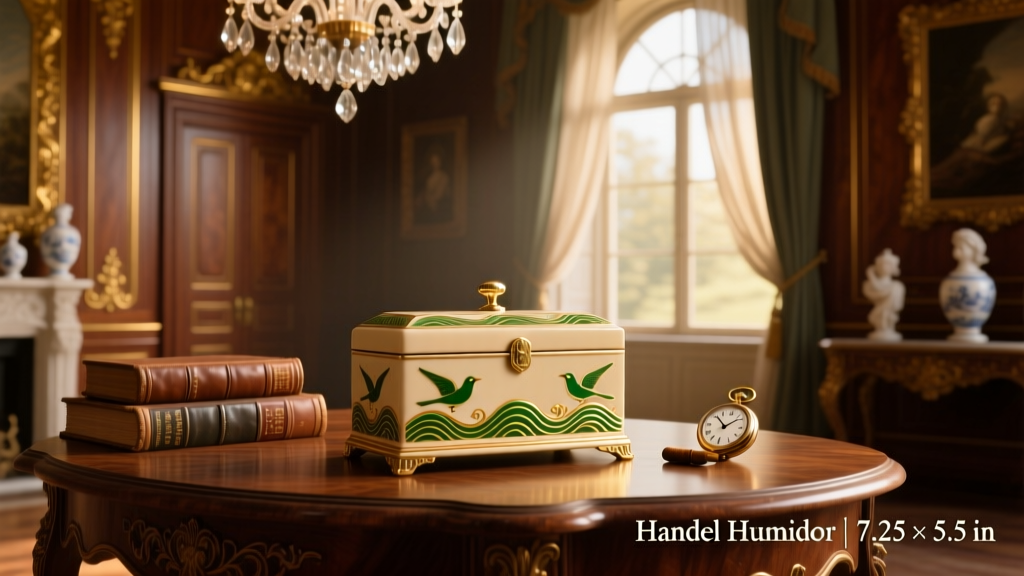
Handel Humidor: Beige Ground, Green & Gold Bird Wave Design (7¼ × 5½ in) — Authentication, Craftsmanship, and Collectibility
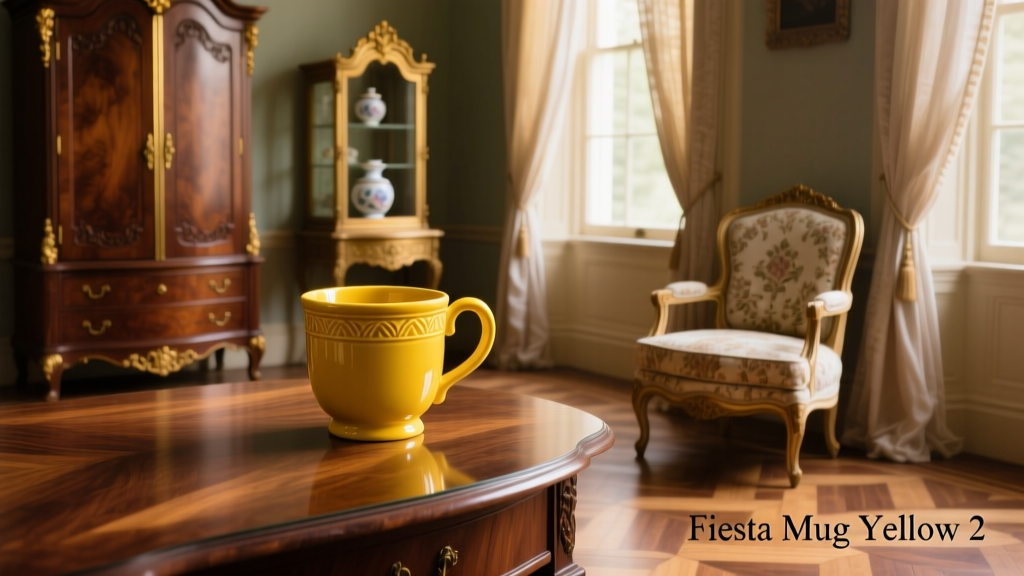
Fiesta Mug Yellow #2: History, Identification, Restoration, and Collectibility of the Original 1936–1943 Yellow Glaze
Jacques Turpia: The Unheralded Master of Mid-Century French Modernist Furniture
Francis Campbell Boileau Cadell: Scottish Colourist, Collector, and Cabinetmaker’s Muse
The Kitchen Sprinkler Bottle 'Black Mammy' — A 6¾-Inch Ceramic Artifact: History, Manufacture, and Ethical Context
The Rosenthal Netter Italy 1950s Striped Pottery Bowl: Identification, Provenance, and Restoration Principles

Thonet Bentwood Birch Magazine Stand: Authenticity, Craftsmanship, and Restoration Insights for the 3-Tier 47 × 24 Inch Design
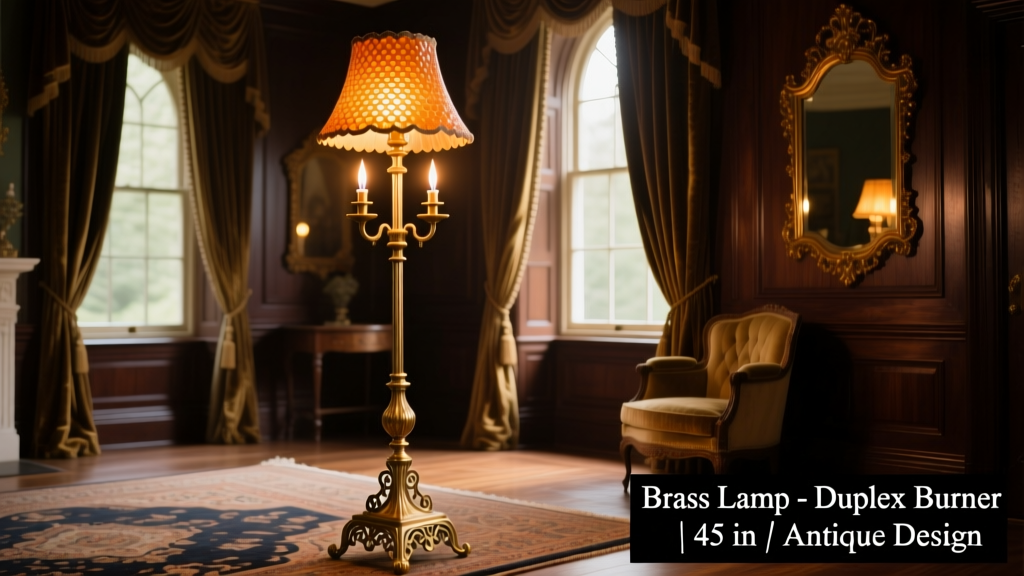
Brass Floor Lamp with Turkey Foot Base, Amber Hobnail Glass Shade, and P&A Duplex Burner — A Technical & Historical Analysis of the 45-Inch Antique Design