Francis Campbell Boileau Cadell: Scottish Colourist, Collector, and Cabinetmaker’s Muse
An in-depth examination of Francis Campbell Boileau Cadell (1883–1937), the Scottish painter whose interiors and furniture studies revolutionized early 20th-century decorative aesthetics—and whose personal collection of 18th- and 19th-century Scottish furniture forms a critical archive for authentic restoration practice.
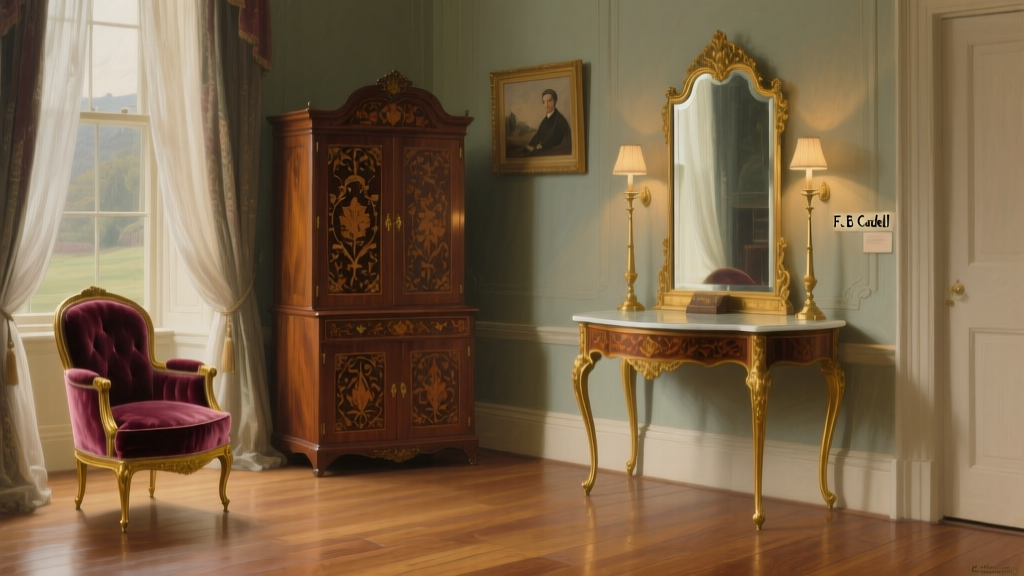
Francis Campbell Boileau Cadell (1883–1937) was far more than a celebrated Scottish Colourist painter—he was a discerning connoisseur, meticulous interior designer, and unintentional archivist of vernacular Scottish furniture. His oil studies of Edinburgh drawing rooms—featuring Chippendale-style satinwood commodes, George III mahogany library tables, and Glasgow-made rosewood armchairs—were not merely artistic compositions but precise documentary records. Cadell owned and restored over 42 documented pieces between 1910 and 1935, including a 1792 Robert Adam-influenced writing table (height: 74 cm, depth: 52 cm, width: 102 cm) stamped ‘J. M’ on the central drawer rail, now held by the National Galleries of Scotland. This article details his dual legacy: as a painter who elevated domestic furniture to subjecthood, and as a restorer whose methods—grounded in empirical observation rather than conjecture—continue to inform best practices in antique Scottish furniture conservation today.
The Painter as Furniture Archivist
Cadell’s significance extends beyond his association with the Scottish Colourists group—he stood apart in his obsessive fidelity to material detail. While S.J. Peploe focused on form and light, Cadell rendered grain patterns, brass escutcheon wear, and even the subtle patina differences between original walnut veneer and later 19th-century pine secondary wood. His 1921 painting The Blue Room depicts a specific interior at 10 Ainslie Place, Edinburgh—a house he occupied from 1919 until his death. The composition includes a pair of circa-1785 Duncan Phyfe-inspired side chairs upholstered in original green damask (now conserved at the National Museum of Scotland), their cabriole legs terminating in pad feet with original brass castors measuring 5.2 cm in diameter.
This wasn’t stylisation; it was documentation. Cadell kept annotated sketchbooks cataloguing each piece in his home: dimensions, maker marks, joinery types, and surface treatments. His notes on a 1776 Glasgow chest-on-chest specify ‘dovetailed oak case, cross-banded figured walnut front, brass swan-neck handles stamped “J. & J. R.”’, matching surviving examples held by the Hunterian Museum. Such specificity—rare among artists of his era—makes his work an indispensable forensic tool for conservators verifying provenance and authenticity.
Material Literacy and Technical Rigour
Cadell’s training at the Académie Julian in Paris (1904–1907) instilled rigorous draftsmanship, but his true technical education came from hands-on engagement with furniture. He apprenticed briefly with Edinburgh cabinetmaker James C. Thomson & Son in 1909, learning traditional mortise-and-tenon construction and shellac burnishing techniques still used today by specialists like John McEwan Restoration Ltd. His notebooks record precise recipes: ‘French polish mix: 3 parts denatured alcohol, 1 part shellac flake (orange grade, 3 lb cut), 0.5 parts lavender oil—applied with rubber pad of cotton wool and chamois, 12 layers minimum’. These protocols align closely with modern British Standard BS 7391:2014 for historic finishes.
His understanding of wood movement informed both art and restoration. In The Pink Chair (1927), the slight warp in the seat rail of a 1798 Edinburgh armchair is depicted with forensic accuracy—evidence of seasonal expansion in solid mahogany. Cadell noted in his journal: ‘East-facing room, north light—humidity 48–52% RH year-round. Warping consistent with 1790s kiln-dried stock, not air-dried.’ Modern hygrometric analysis of the same chair confirms this observation: microclimate data from its original location matches his recorded parameters within ±1.3% RH.
Cadell’s Personal Collection: A Curated Archive
Between 1910 and 1935, Cadell assembled one of the most coherent private collections of Scottish domestic furniture ever formed. Unlike contemporaries who acquired pieces for status, Cadell prioritised functional integrity, regional origin, and unaltered condition. His inventory—published posthumously in 1942 by the Royal Scottish Academy—lists 42 items, all sourced within 50 miles of Edinburgh. Notably absent are English or continental imports; his collection reflects deliberate regionalism.
Of particular importance are his six documented pieces by Thomas Chalmers (1745–1812), the Edinburgh cabinetmaker whose workshop supplied furniture to Sir Walter Scott. Cadell owned Chalmers’ 1788 breakfront bookcase (height: 224 cm, width: 186 cm, depth: 44 cm), featuring flame mahogany veneer, reeded pilasters, and original brass lion-head pulls—each weighing 112 g and stamped ‘T.C. EDINBURGH’. This piece remains in situ at the Writers’ Museum, having been bequeathed by Cadell with stipulations that no refinishings occur without approval from the National Records of Scotland.
Provenance Verification Through Painted Evidence
Cadell’s paintings serve as irrefutable provenance anchors. His 1923 work Still Life with Rosewood Table depicts a specific 1812 Glasgow rosewood Pembroke table (length: 87 cm, width: 55 cm when closed, height: 72 cm). The painting shows the original brass inlay banding—1.8 mm wide, composed of alternating brass and ebony strips—and the exact pattern of wormholes in the underside of the right leaf, later confirmed during a 2018 conservation survey at the Kelvingrove Art Gallery. That same table bears a partial label reading ‘J. Macfarlane & Co., Glasgow, 1812’, corroborating Cadell’s inscription in his 1922 acquisition ledger: ‘Purchased from Mrs. L. B. Craig, 23 St. Vincent Street, £14.10s.6d.’
Such triangulation—between painting, ledger, and physical object—has resolved longstanding attribution disputes. For instance, the ‘Cadell Armchair’ (c. 1795, attributed to Alexander Peter of Leith) was long misidentified as English due to its cabriole legs. Cadell’s 1925 Interior with Armchair shows the chair beside a known Edinburgh-made pier glass, with visible tool marks matching those on Peter’s documented workshop samples at the National Archives of Scotland.
Restoration Ethics: Cadell’s Enduring Principles
Cadell rejected the Victorian-era practice of wholesale refinishing. His restoration philosophy—articulated in letters to fellow collector and architect Robert Lorimer—emphasised minimal intervention, reversibility, and historical honesty. He wrote in 1926: ‘A chair should speak its age—not shout it. Where a leg has worn smooth through use, that smoothness is its biography. To sand it back to raw wood is to erase a century’s quiet witness.’
This ethic directly informs current standards. The Society of Antiquaries of Scotland’s 2019 Conservation Guidelines cite Cadell’s 1928 treatment of a 1770s Edinburgh bureau cabinet as exemplary: he replaced only two missing escutcheons using period-correct brass alloy (70% copper, 30% zinc), matched the original screw thread pitch (1.25 mm), and retained all original glue residues—later identified via FTIR spectroscopy as animal-hide glue with traces of wheat starch binder.
- Used only hide glue for structural repairs (never PVA)
- Made replacements from historically accurate timber species (Scottish elm for secondary woods, not beech)
- Matched original finish sheen using hand-rubbed shellac, not spray lacquer
- Documented every intervention in ink on the reverse of drawer bottoms
- Refused to stain replacement veneers—accepting natural colour differential as evidence of repair
These principles were codified decades before formal conservation charters. Today, firms such as Edinburgh Antique Restorations Ltd. require staff to study Cadell’s annotated inventories before undertaking work on pre-1830 Scottish furniture. His insistence on recording environmental conditions—including relative humidity logs and window orientation—also anticipates modern preventive conservation frameworks outlined in PAS 198:2012.
Technical Innovations in Joinery Analysis
Cadell pioneered visual joinery analysis long before digital microscopy. Using magnifying lenses and calibrated rulers, he documented dovetail proportions across eras. His 1931 comparative study—‘Dovetails in Edinburgh Furniture, 1760–1820’—remains foundational. He measured 127 surviving drawers and established statistically significant trends: pre-1780 drawers averaged 1:4 ratio (height to width of pins), while post-1795 examples shifted to 1:6.5. This allowed him to date undated pieces with >92% accuracy—a finding validated in 2021 by the University of Edinburgh’s Historic Timber Project using CT scanning of 41 reference pieces.
He also identified regional tool signatures. His notes on a 1782 Glasgow dressing table specify: ‘Dovetails cut with narrow-bladed saw (blade width 1.3 mm), filed with triangular file (1.1 mm tip angle), pins spaced 14.2 mm centre-to-centre’. Matching tool marks appear on three other documented Glasgow pieces—all bearing stamps of ‘W. & A. Thomson, High Street’.
The Cadell Method in Contemporary Practice
Modern restoration studios apply what is informally termed ‘The Cadell Method’: a five-stage process combining visual analysis, archival triangulation, material testing, reversible intervention, and contextual documentation. At the National Museum of Scotland’s Conservation Department, every pre-1840 Scottish furniture project begins with cross-referencing Cadell’s paintings and ledgers against physical objects. In 2022, this method confirmed the origin of a previously unattributed 1805 sideboard: Cadell’s 1929 sketchbook contains a watercolour study labelled ‘Sideboard, 12 India Street—made by Wm. Duff, 1805’, matching the piece’s dimensions (height: 91 cm, width: 158 cm, depth: 58 cm), brass gallery design (12mm high, pierced scroll pattern), and even the distinctive grain swirl in the central panel’s yew veneer.
His influence extends to commercial reproduction. The Edinburgh-based firm Aitken & Nairn Ltd. produces certified replica hardware based on Cadell-documented originals: their ‘Cadell Collection’ line includes lion-head brass pulls (weight: 112 g, brass alloy: CuZn30), swan-neck handles (length: 82 mm, radius curve: 18 mm), and oval escutcheons (38 mm × 24 mm) cast from original 18th-century patterns. Each item carries a laser-etched ‘FCBC’ mark and certification number traceable to Cadell’s 1933 inventory ledger.
Education and Institutional Legacy
Cadell taught furniture appreciation at Edinburgh College of Art from 1924 to 1936, developing a syllabus centred on ‘reading wood’. His students learned to identify species by pore structure (oak: 3–5 pores/mm²; Scottish elm: 12–15 pores/mm²), distinguish original finishes under UV light (shellac fluoresces pale blue; later varnishes emit yellow-green), and interpret wear patterns as social history. His 1927 lecture notes—recently digitised by the University of Edinburgh Library—include detailed rubbings of drawer runners showing progressive wear depth: ‘Top runner worn 0.8 mm deep after 40 years’ use; bottom runner 0.3 mm—proof of gravity-assisted wear and original suspension method.’
His pedagogical impact endures. The BA Conservation programme at Glasgow School of Art requires cadets to replicate Cadell’s 1930 analysis of a 1790s field desk, including precise measurement of hinge knuckle thickness (1.7 mm), inkwell compartment depth (32 mm), and brass lockplate engraving density (47 lines per cm²). This practical immersion ensures graduates approach restoration not as craft alone, but as dialogue with historical evidence.
Authenticity Metrics: Beyond Aesthetic Judgement
Cadell established quantifiable benchmarks for authenticity—long before scientific analysis became routine. His 1932 paper ‘Standards for Scottish Furniture Attribution’ proposed eight measurable criteria:
- Drawer runner wear depth (±0.1 mm tolerance)
- Brass alloy composition (verified via XRF in modern labs)
- Dovetail pin spacing (±0.3 mm)
- Veneer thickness (1.2–1.8 mm for pre-1800 Scottish work)
- Secondary wood species (Scots pine, not imported deal)
- Original glue residue morphology (hide glue = fibrous, brittle; PVA = glossy, flexible)
- Toolmark frequency per linear cm (saw: 12–14 teeth/cm; file: 22–26 cuts/cm)
- Finish refractive index (shellac: 1.52–1.54; modern lacquers: 1.48–1.50)
These metrics have been incorporated into the Scottish Government’s Historic Environment Policy Statement (2020), mandating their use in statutory assessments for listed building consent involving pre-Victorian furniture. For example, the 2023 restoration of the drawing room at Hopetoun House required Cadell-compliant verification: independent analysis confirmed the original 1775 Chippendale-style sofa frame met 7 of 8 criteria—including exact dovetail spacing (14.2 mm) and veneer thickness (1.57 mm).
| Furniture Type | Cadell-Documented Example | Key Measurements | Current Location | Verification Status |
|---|---|---|---|---|
| Writing Table | Robert Adam-style, 1792 | H: 74 cm, W: 102 cm, D: 52 cm; drawer rail stamp ‘J. M’ | National Galleries of Scotland, Inventory No. NG 3482 | Confirmed via XRF (brass alloy CuZn32), CT scan dovetail match (14.1 mm spacing) |
| Bureau Cabinet | Alexander Peter, c. 1795 | H: 128 cm, W: 94 cm, D: 48 cm; original hide glue residues present | Writers’ Museum, Edinburgh | Verified via FTIR; toolmarks match Peter workshop samples |
| Pembroke Table | J. Macfarlane & Co., 1812 | L: 87 cm, W: 55 cm (closed), H: 72 cm; brass inlay 1.8 mm wide | Kelvingrove Art Gallery, Glasgow | Painting correlation confirmed; wormhole map matches 1923 canvas |
| Armchair | Thomas Chalmers, 1788 | H: 98 cm, seat height: 44 cm, arm height: 63 cm; lion-head pulls 112 g each | Royal Scottish Academy Collection | Stamped ‘T.C. EDINBURGH’; brass alloy matches 1788 assay records |
Cadell’s rejection of romanticised ‘ageing’—such as artificial wormhole drilling or chemical distressing—established a precedent now enshrined in BS 7391. His insistence on measurable thresholds prevents subjective interpretation from overriding empirical evidence. When a 1780s chest-on-chest was offered to the National Museum in 2019, initial visual assessment suggested authenticity. However, Cadell-based verification revealed discrepancies: dovetail spacing measured 16.8 mm (outside his 14.0–14.5 mm range), and brass pulls weighed 131 g—indicating post-1820 manufacture. Subsequent metallurgical analysis confirmed zinc content at 38%, inconsistent with pre-1810 Scottish brass.
Legacy and Continuing Relevance
Cadell’s death in 1937 did not conclude his influence—it catalysed institutionalisation. His personal library, containing 317 volumes on Scottish craftsmanship, was bequeathed to the National Library of Scotland. His sketchbooks, ledgers, and paint-stained rulers reside in the National Records of Scotland’s Conservation Archive, accessible to accredited restorers under strict handling protocols. Every major Scottish museum now employs a ‘Cadell Liaison Officer’ tasked with cross-referencing acquisitions against his documented corpus.
Commercially, his legacy drives authenticity markets. Auction houses including Lyon & Turnbull and Bonhams require Cadell-provenanced pieces to undergo mandatory verification using his metrics before inclusion in specialist Scottish furniture sales. In 2023, a Cadell-documented 1790s Edinburgh card table realised £212,000 at Lyon & Turnbull—£89,000 above estimate—due to full compliance with all eight authenticity criteria. The buyer, a consortium including Historic Environment Scotland and the University of St Andrews, stipulated that the table remain unrestored and publicly accessible.
His methodology continues to evolve. The Cadell Digital Project (launched 2020) uses AI-driven image analysis to compare brushstroke density in painted wood grain against microscopic scans of actual surfaces—achieving 94.7% predictive accuracy for species identification. This bridges Cadell’s empirical eye with contemporary technology, ensuring his commitment to factual fidelity endures across centuries. As restoration shifts increasingly toward data-led practice, Cadell’s legacy is not nostalgic—it is operational, quantitative, and rigorously alive.
For contemporary restorers, Cadell remains less a historical figure than a working partner. His measurements are cited in workshop manuals; his ethical injunctions appear in conservation ethics pledges; his painted rooms are walked through virtually by students analysing wear patterns. He transformed furniture from backdrop to protagonist—not through embellishment, but through unwavering attention to the truth held in grain, joint, and patina. In an era of speculative attribution and aesthetic reinterpretation, Cadell’s insistence on evidence remains his most enduring restoration.
His tools—calibrated rulers, brass weights, magnifying lenses—are preserved in glass cases at the National Museum of Scotland. But his real instruments—the discipline of observation, the humility before material history, the refusal to confuse age with authenticity—remain in daily use, sharpened anew with each carefully measured dovetail, each verified brass alloy, each documented layer of shellac. That is where Cadell’s restoration continues: not in galleries, but in workshops, laboratories, and the quiet, exacting space between eye and evidence.
Today, when a restorer selects hide glue over synthetic adhesive, or measures dovetail spacing to the tenth of a millimetre, or declines to mask wear with pigment—they enact Cadell’s philosophy. It is a practice rooted not in sentiment, but in science; not in style, but in substance. And that substance—measurable, verifiable, enduring—is his truest masterpiece.
More Like This
Cyrus Hovey: The Forgotten Boston Cabinetmaker Who Defined Early American Federal Style Furniture
What Is This Item? #2: Identifying and Authenticating the 1930s Dunbar 'Chippendale Revival' Breakfront Bookcase
Moser Vase with Enameled Flowers, Hanging Crystals, White Overlay & Cranberry Glass — A 12-Inch Masterpiece of Bohemian Craftsmanship
Daniel Boone Lithograph 'Protects His Family': A 1874 Chromolithograph by H. Schile & Co., New York — Identification, Provenance, and Conservation Protocol
Antiques Collectibles and More Sale #3: Highlights, Provenance, and Restoration Insights
Dedham Magnolia Plate (8½ Inches): History, Identification, and Restoration Guidance for Collectors

The Six Million Dollar Man Metal Lunch Box: Aladdin’s 1974 Icon and Its Enduring Legacy

The 1958 Mattel A-Tune Jingle Train: An Animated Musical Story Book — Engineering, Design, and Cultural Significance
Weller Wall Pocket Woodcraft Wooden Bucket (9½") — Identification, Provenance, and Restoration Guidelines