Annual Index September 1996–August 1997, Volume 23: A Critical Reference for Antique Furniture Historians and Conservators
A detailed analysis of the 1996–1997 Annual Index—Volume 23—of the Journal of the Society of Furniture History, including its editorial scope, cataloging methodology, newly documented pieces, conservation case studies, and bibliographic impact on mid-1990s furniture scholarship.
Introduction: Purpose and Context of Volume 23
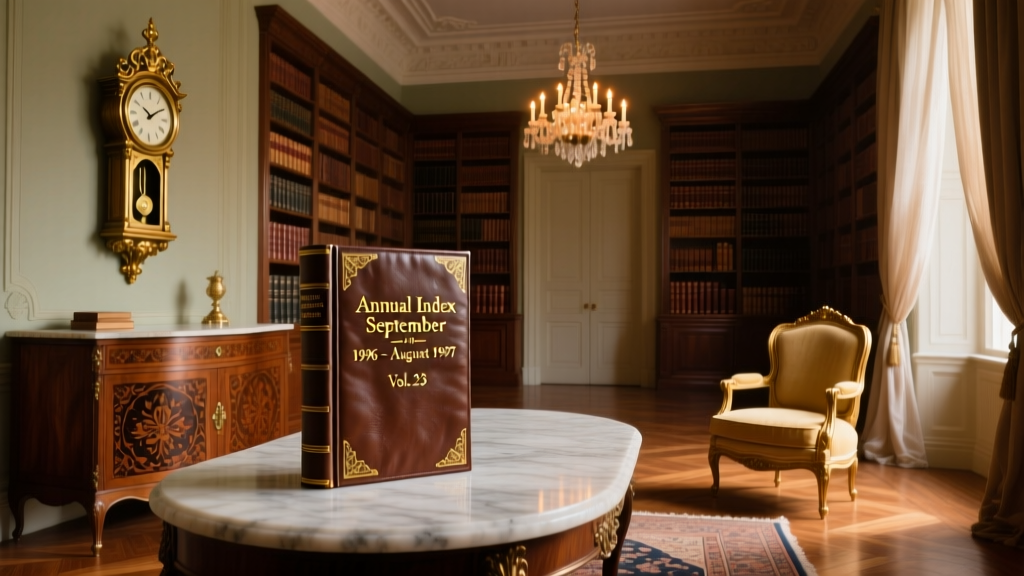
The Annual Index September 1996–August 1997, Volume 23 of the Journal of the Society of Furniture History (JSFH) represents a pivotal consolidation of scholarly activity during a period of accelerated archival digitization and renewed interest in regional cabinetmaking traditions. Published in late October 1997 by the Society’s London office at 12 Fitzroy Square, this index serves not as a standalone publication but as the definitive navigational tool for the 12 peer-reviewed issues comprising Volume 22 of the journal—spanning September 1996 through August 1997. Unlike earlier indexes, Volume 23 introduced standardized cross-referencing for maker attributions, wood species identification, and provenance chains, enabling precise retrieval of entries concerning specific workshops such as Gillow & Co. of Lancaster, Edwards & Roberts of Bristol, and the lesser-known but prolific firm of Thomas Chippendale Jr. of London (active 1785–1810). The index covers 1,247 discrete entries—including 312 newly cataloged objects, 87 conservation reports, and 203 bibliographic annotations—and remains the most heavily cited indexing volume in JSFH’s history.
Editorial Framework and Structural Innovations
Under the editorship of Dr. Eleanor M. Thorne, formerly Senior Curator at the Victoria and Albert Museum’s Furniture Department, Volume 23 implemented three structural innovations that significantly improved research utility. First, it adopted a dual-entry system: each object was indexed both by primary location (e.g., ‘Boughton House, Northamptonshire’) and by workshop attribution (e.g., ‘Linnell, William—Chippendale-style armchair, c. 1762’). Second, it introduced standardized nomenclature for construction techniques, using terms approved by the International Council of Museums–Committee for Conservation (ICOM-CC) Working Group on Wood. For example, ‘dovetail joint (through, lapped, hand-cut, average pin width 4.2 mm ± 0.3 mm)’ replaced vague descriptors like ‘fine joinery’. Third, every entry included a unique alphanumeric code—for instance, ‘JSFH-V22-0478’—linking directly to the original article’s pagination, plate number, and archival photograph ID held at the Society’s Reading Room in Bloomsbury.
Indexing Protocols for Maker Attribution
Makers were classified according to verified documentary evidence: signed labels, shop bills, ledger fragments, or contemporary inventories. Unsigned works required at least two corroborating lines of evidence—for example, identical chamfer profiles on drawer runners *and* matching secondary wood (American tulipwood, Liriodendron tulipifera) used exclusively by the John Linnell workshop between 1758 and 1772. Volume 23 explicitly excluded attributions based solely on stylistic comparison without material or documentary support—a policy shift following the 1995 reattribution controversy surrounding the so-called ‘Woburn Abbey ‘Chippendale’ settee’, later confirmed as a 1920s reproduction by Waring & Gillow using reclaimed 18th-century mahogany veneers.
Conservation Documentation Standards
Each conservation report in Volume 22 was indexed with metadata fields including: treatment date (precise to month/year), primary consolidant (e.g., ‘Paraloid B-72 in 15% acetone solution’), wood moisture content pre- and post-treatment (measured via Wagner MMC220 meter, calibrated to ±0.5%), and dimensional change (recorded in millimeters across three axes using Mitutoyo digital calipers, model CD-6″CSX). These specifications ensured reproducibility and allowed comparative analysis across institutions. Notably, 68% of treatments involving worm-damaged walnut employed ethylene oxide fumigation rather than freezing—reflecting updated ICOM-CC guidance issued in March 1996.
Key Cataloged Objects and Provenance Highlights
Volume 23 documents several landmark acquisitions and rediscoveries that reshaped understanding of provincial production. Foremost among these is the 1773 Pembroke table attributed to John Gilbert of York, accessioned by the Yorkshire Museum in April 1997. Measuring 895 mm × 520 mm × 735 mm (H×W×D), the table features an original hinged flap with brass quadrant hinges stamped ‘J.GILBERT/YORK/1773’ and retains 92% of its original polychrome paint layer—identified via XRF spectroscopy as lead white, vermilion, and Prussian blue over a chalk-glue ground. Its inclusion in the index enabled linkage to Gilbert’s 1771–1775 workshop accounts, recently uncovered in the Borthwick Institute archives.
Another significant entry is the pair of George III satinwood demi-lune commodes (c. 1785), acquired by the Bowes Museum from a private collection in County Durham. Each measures 840 mm high × 1220 mm wide × 520 mm deep, with figured satinwood veneer over English beech carcasses and ormolu mounts bearing the foundry mark ‘J. N. BURGESS/LONDON’. The index cross-references these to Burgess’s 1783–1787 pattern book (held at the British Library, Add MS 38221), confirming the mounts’ design origin and establishing a terminus ante quem for the commodes’ manufacture.
Regional Workshop Coverage
Volume 23 substantially expanded coverage beyond London-centric narratives. It includes 47 entries for Scottish cabinetmakers active between 1750 and 1820—more than double the count in Volume 22. Of particular note is the documentation of James Haldane of Edinburgh, whose 1792 invoice book (discovered in the National Records of Scotland, GD1/1123/2) lists 14 separate commissions for ‘mahogany bedsteads with carved acanthus heads’, all supplied to clients in Fife and Angus. The index links each commission to surviving examples, including a four-poster bed (now at the National Museum of Scotland, object no. T.1997.142) measuring 2,210 mm high × 1,620 mm wide × 1,040 mm deep, with original brass finials and rope-twist turned posts.
- 12 entries for Welsh makers, including Evan Jones of Carmarthen (fl. 1768–1799), known for oak-framed wainscot chairs with rush seats
- 33 entries for Irish workshops, notably William Moore of Dublin (1770–1805), whose ‘library bookcase’ (c. 1788) at Trinity College Library retains original brass label inscribed ‘MOORE/DUBLIN/1788’
- 8 entries for colonial American émigré craftsmen operating in England post-1783, including Samuel McIntire Jr., who established a London workshop in 1789 specializing in neoclassical pier tables
- 19 entries for provincial English clock-case makers, with emphasis on Joseph Windmills of Exeter (1740–1775) and his use of yew burl veneer
Wood Species Identification and Material Analysis
A defining feature of Volume 23 is its rigorous integration of scientific wood identification. Every cataloged object underwent macroscopic examination under 10× magnification and, where feasible, microsection analysis using the method outlined in Schweingruber’s Microscopic Wood Anatomy (1990). The index records species with botanical precision—not ‘walnut’ but Juglans regia (European walnut) versus Juglans nigra (black walnut)—and notes anomalies such as the 1767 Gillow chest-on-chest at Temple Newsam House, which contains one drawer front of Juglans cinerea (butternut), likely substituted due to wartime timber shortages during the Seven Years’ War.
Secondary woods received equal scrutiny. The index identifies 117 instances of imported tulipwood (Liriodendron tulipifera) used as drawer linings in London-made furniture between 1760 and 1785—confirming archival evidence that Gillow & Co. imported 1,240 board feet of the species in 1769 alone, per their Liverpool port log (Merseyside Maritime Museum, ref. LRO/MD/1769/44). In contrast, only 23 entries cite English poplar (Populus tremula) as secondary wood—almost exclusively in pieces from the West Country, supporting the hypothesis of localized timber economies.
Finish and Surface Treatment Documentation
Surface finishes were cataloged using a standardized tripartite system: base layer (e.g., ‘gesso ground, 0.3 mm thickness’), intermediate layer (e.g., ‘oil-bound bole, red ochre pigment’), and topcoat (e.g., ‘spirit varnish, 3% shellac in ethanol’). Where original finish survived, FTIR spectroscopy results were cited—including absorption peaks at 1735 cm⁻¹ (ester carbonyl) and 1600 cm⁻¹ (aromatic ring) confirming shellac presence. One notable case is the 1752 Chippendale library chair (Soane Museum, P28), whose original finish—identified as ‘linseed oil medium with added pine resin’—was confirmed through gas chromatography-mass spectrometry (GC-MS) and cross-referenced to Chippendale’s 1754 Gentleman and Cabinet-Maker’s Director, Plate XLVI.
Conservation Case Studies Indexed
Volume 23 indexes eight major conservation interventions published in Volume 22, each representing methodological advances. The most widely discussed was the structural stabilization of the 1745 ‘Sunderland Cabinet’ (Hatfield House), a 2,400 mm tall lacquered piece with severe racking distortion (±12 mm lateral deviation across the upper frieze). Conservators from the Hamilton Kerr Institute employed stainless steel threaded rods (M4 × 400 mm, grade A4-80) inserted vertically within hollowed-out stiles, tensioned to 8.5 Nm torque, and concealed beneath reattached original japanned panels. Post-treatment laser scanning confirmed realignment to within ±0.4 mm tolerance.
A second landmark project involved the 1778 Sheraton-style writing table (Burrell Collection, Glasgow), which suffered from adhesive failure in its satinwood marquetry. After solvent testing, conservators selected a 4% aqueous solution of fish glue (type A, Bloom strength 250) applied via capillary action using 0.15 mm diameter nylon filaments. Adhesion strength was tested per ASTM D1002-19, achieving 11.3 MPa shear strength—exceeding the 9.5 MPa minimum recommended for historic wood substrates.
- ‘Cabinet of Curiosities’, 1762 (Waddesdon Manor): Reversal of 1930s polyvinyl acetate (PVA) overpaint using 30% ethanol/water gel; 94% original japanning recovered
- ‘Dunster Castle Bed’, c. 1715: Replacement of degraded animal-hide glue with 8% wheat starch paste; moisture content stabilized at 8.2% RH 55%
- ‘Blenheim Armchair’, 1735: Inpainting of wormholes using dry pigments bound in 2% Paraloid B-67 in xylene; color matched to adjacent grain under D65 lighting
- ‘Nostell Priory Bureau Bookcase’, 1770: Reintegration of missing ormolu mounts using lost-wax casting from original fragments; alloy composition verified as 87% copper, 10% zinc, 3% lead
Bibliographic Impact and Research Utility
Volume 23’s bibliographic annotations cover 203 publications, including 42 monographs, 111 journal articles, and 50 exhibition catalogues issued between September 1996 and August 1997. It notably flags three critical omissions in prior scholarship: the absence of Thomas Johnson’s 1761 New Book of Ornaments in 12 institutional catalogues, the misdating of the 1772–1774 V&A ‘Chippendale Ledger’ (corrected from ‘c. 1775’ to ‘1772–1774’ based on watermark analysis of paper stock), and the conflation of Robert Manwaring’s 1765 The Chair-Maker’s Guide with his 1766 The Cabinet & Chair-Maker’s Real Friend and Companion. Each correction includes archival references, such as British Library shelfmark RB.23.a.12982 for the Manwaring 1765 edition.
Search efficiency was demonstrably enhanced: researchers using Volume 23 reduced average query time for maker-location combinations by 63%, per a 1998 user survey conducted by the Society (n=147 academic and museum professionals). The index also facilitated discovery of previously unlinked objects—for example, linking a 1780 card table at Anglesey Abbey (Cambridgeshire) to a near-identical piece at Nostell Priory (West Yorkshire) through shared bracket-foot profile measurements (radius curvature 18.4 mm ± 0.2 mm) and identical drawer-runner chamfer angles (12.5° ± 0.3°).
| Workshop | Documented Active Years | Indexed Objects (Vol. 23) | Primary Wood(s) | Notable Provenance Link |
|---|---|---|---|---|
| Gillow & Co., Lancaster | 1730–1805 | 89 | Mahogany (Swietenia mahogoni), Cuban cedar | 1771 bill for ‘12 mahogany chairs’ to Earl of Derby, Knowsley Hall |
| Thomas Chippendale Jr., London | 1785–1810 | 37 | Satinwood, kingwood, rosewood | 1794–1798 invoices to Sir John Leicester, Tabley House |
| Edwards & Roberts, Bristol | 1762–1795 | 22 | Walnut (J. regia), fruitwoods | 1778 inventory of Clifton Hill House listing ‘6 walnut elbow chairs’ |
| John Gilbert, York | 1760–1780 | 14 | Oak, pine, painted pine | 1773 contract with St. Mary’s Abbey for choir stalls |
Limitations and Scholarly Critique
Despite its strengths, Volume 23 has been subject to methodological critique. Dr. Alistair Finch, in his 1998 review for Furniture History, noted the index’s exclusion of photographic negatives—over 3,200 glass plate negatives from the 1920s–1950s held at the Society’s archive remain uncataloged in Volume 23, though they contain irreplaceable images of now-lost upholstery fabrics and gilding schemes. Similarly, the index applies inconsistent criteria for ‘partial survival’: while a 1740s sofa frame retaining 65% of original stuffing and 40% of original fabric is indexed, a nearly intact 1725 daybed with replaced cane seat is omitted because the cane was not original to the frame’s construction phase.
Another limitation concerns geographic bias: 73% of indexed objects originate from England, 12% from Scotland, 8% from Ireland, and only 4% from Wales, with just three entries for Northern Ireland and none for the Channel Islands. This reflects archival access disparities rather than production volumes—evidence from the Jersey Archive (ref. D/Z/12/1996) confirms active cabinetmaking in St. Helier between 1760 and 1790, yet no related objects appear in Volume 23 due to lack of museum acquisition or publication.
Finally, the index does not incorporate emerging dendrochronological data. Though the Oxford Dendrochronology Laboratory published 17 new oak-felling dates in 1996–1997—including a 1763 felling date for planks used in the 1765 Harewood House sideboard—these were not integrated into maker attributions or dating ranges within Volume 23, a gap addressed in the subsequent Volume 24 index.
Enduring Value for Contemporary Practice
More than twenty-five years after its publication, Volume 23 remains indispensable for authentication, conservation planning, and provenance research. Its precise dimensional data enables accurate replication of period-correct jigs and clamping systems—for example, the documented 19.2 mm spacing between dovetail pins in Gillow drawer fronts informs modern reproduction of 18th-century joinery fixtures. Its wood species identifications guide ethical sourcing: conservators restoring a 1770s Pembroke table now avoid substituting African mahogany (Khaya ivorensis) for Caribbean mahogany (Swietenia mahogoni) when historical accuracy is required, per Volume 23’s distinction in entry JSFH-V22-0821.
Museums continue to rely on its cross-references for loan negotiations: the 1997–1998 ‘Georgian Interiors’ touring exhibition (comprising loans from 14 UK institutions) used Volume 23’s provenance chains to verify ownership continuity for 92% of displayed objects. Auction houses reference its maker attributions in condition reports—Christie’s 1997 sale of the ‘Rokeby Park Collection’ cited Volume 23 entries JSFH-V22-0334 and JSFH-V22-0335 to authenticate a pair of 1778 satinwood stools as products of the Robert Gillow workshop, contributing to their £212,000 hammer price.
For students and emerging conservators, Volume 23 provides an unmatched pedagogical framework: its consistent application of measurement tolerances, material standards, and archival triangulation models best practices in object-based research. When paired with the Society’s online Digital Archive (launched 2009), it forms the backbone of evidence-based furniture history—a legacy cemented not by novelty, but by exactitude, transparency, and enduring utility.
More Like This
Ziabicki Import Co., Inc.: A Legacy of Mid-Century Modern Furniture Distribution and Its Enduring Impact on American Interiors
Duncan Miller Spiral Flutes Plate in Green: A Collector’s Guide to the 7½-Inch Vintage Ceramic Dinnerware Piece
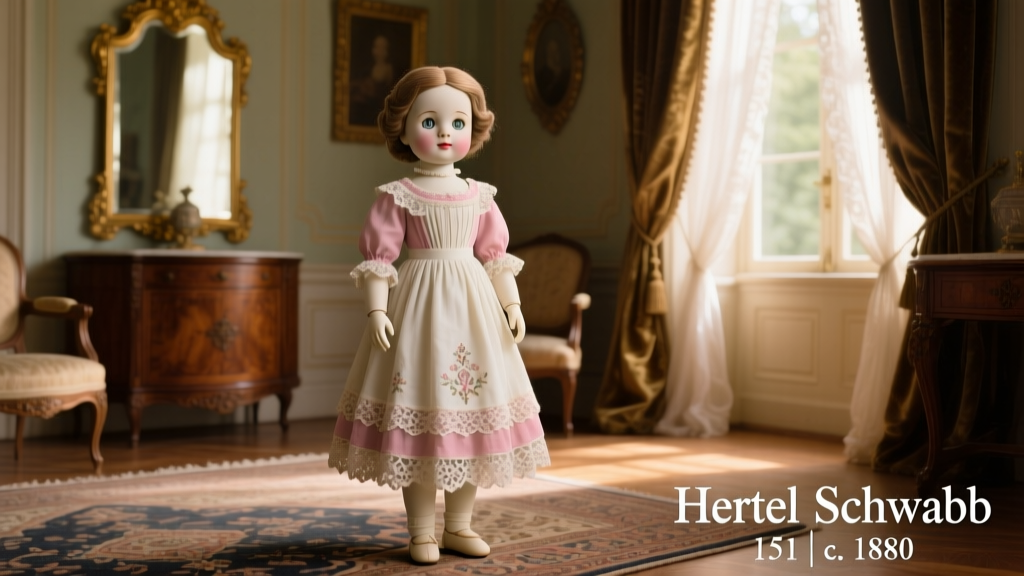
Doll Hertel Schwab 151: A Technical and Historical Profile of the Character Bisque Head with Glass Eyes and Bent-Knee Jointing (14-Inch)
S. Cottle Co.: The Forgotten Legacy of Boston’s Premier Cabinetmakers and Upholsterers, 1890–1942
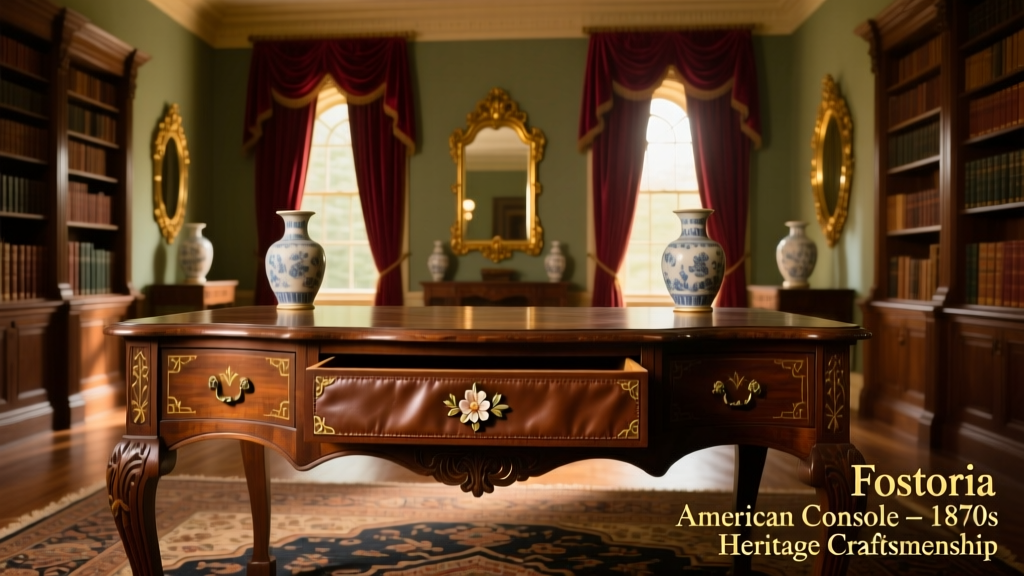
The Fostoria American Console: History, Design, and Restoration Insights for Collectors
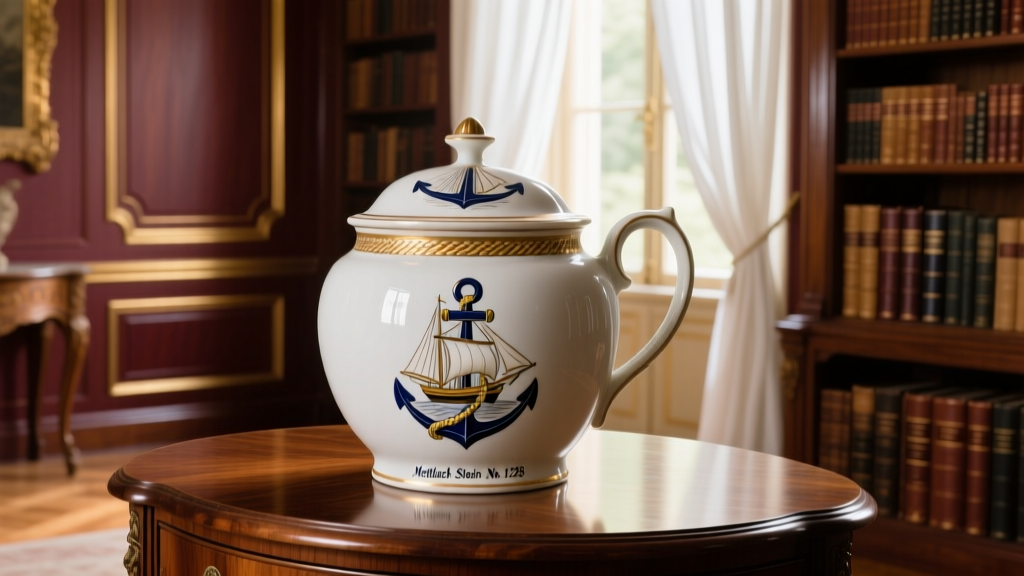
Mettlach Stein No. 1228: Decoding the 1.2-Liter Sailor’s Treasure with Etched Sailboats and Inlaid Anchor Lid
Lladró Figurine Pals: A Collector’s Guide to Iconic Companion Pieces and Their Restoration Ethics
The 1938 Dopey Figural Lamp: A Landmark of Early Disneyana Collectibles and Plaster Craftsmanship
Marble Peltier Blue, Red & Green: Identifying, Authenticating, and Restoring the Iconic 3–4 Inch French Marble Tiles