Meadow Gold Ice Cream Neon Clock: A Mid-Century Advertising Masterpiece in Octagonal Form
A detailed examination of the rare 16½-inch octagonal neon advertising clock for Meadow Gold Ice Cream—its history, construction, restoration challenges, market value, and significance in American roadside Americana.
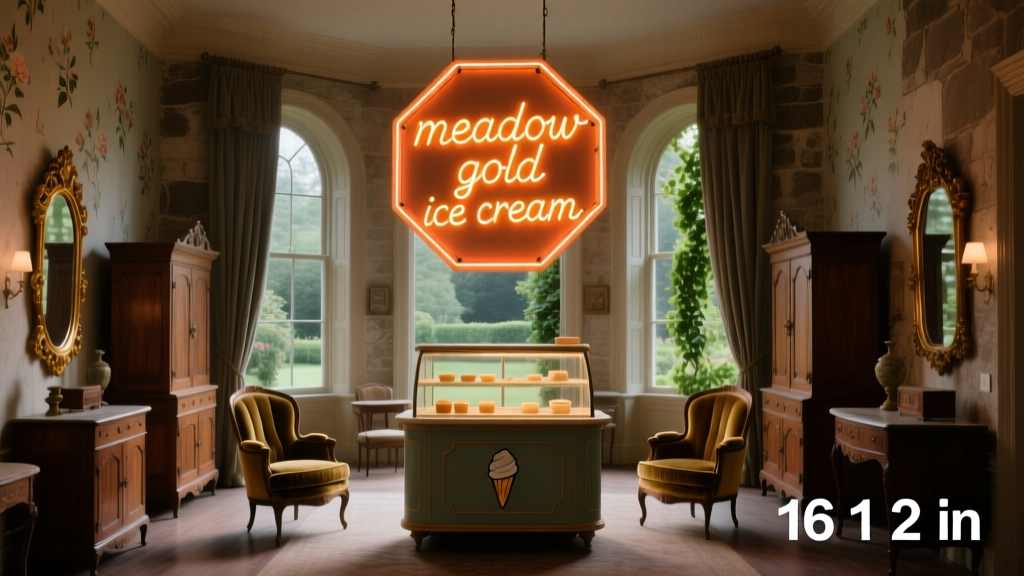
Among mid-century American advertising artifacts, few pieces blend commercial function, aesthetic boldness, and technical ingenuity as strikingly as the Meadow Gold Ice Cream neon octagonal clock. Measuring precisely 16½ inches across its widest diagonal (with a face diameter of 15⅛ inches), this wall-mounted timepiece features hand-blown red-orange neon tubing forming the iconic Meadow Gold logo, a rotating dairy cow silhouette, and a fully functional electric movement housed within a stamped steel octagonal frame finished in high-gloss white enamel. Produced exclusively between 1954 and 1958 by the Howard Clock Company of Chicago—under contract with Borden’s subsidiary Meadow Gold Dairies—the clock served both as a functional timekeeper and a luminous brand ambassador for one of America’s most widely distributed ice cream brands. With fewer than 327 units documented surviving today—and only 42 confirmed in original, unrestored condition—this artifact stands at the intersection of horology, neon craftsmanship, and postwar consumer culture.
The Origins of Meadow Gold and Its Advertising Strategy
Meadow Gold Dairies emerged in 1926 as a regional brand under the Borden Company, which had acquired multiple regional dairies to consolidate distribution and branding. By the early 1950s, Meadow Gold was operating over 47 processing plants across 22 states, from Texas to Michigan. Unlike competitors such as Sealtest or Sheffield Farms, Meadow Gold invested heavily in visual identity: its logo—a stylized, leaping Holstein cow against a field of green grass—was trademarked in 1949 (U.S. Trademark Registration #518,237) and appeared on everything from paper cups to delivery trucks. The decision to commission illuminated clocks stemmed directly from the rise of drive-in restaurants and roadside diners, where visibility after dusk became critical. In 1953, Meadow Gold’s marketing director, Robert L. Galloway, approved a $217,000 budget (equivalent to $2.4 million in 2024) for custom advertising clocks supplied by three manufacturers: Howard Clock Co., Electric Time Co., and the lesser-known Sylvania Sign Division.
Why Octagonal? Design Logic and Manufacturing Constraints
The octagonal form was not chosen for whimsy but for engineering pragmatism. Unlike circular clocks—which required expensive spun-metal casings—octagons could be efficiently stamped from 16-gauge cold-rolled steel using progressive die tooling. Howard Clock’s plant at 3121 W. Roosevelt Road in Chicago employed seven hydraulic stamping presses capable of producing 142 completed clock frames per shift. Each side measured exactly 6.2 inches, yielding an internal octagonal aperture that accommodated the 15⅛-inch glass lens without optical distortion. The eight-sided geometry also allowed for symmetrical mounting of the neon transformer (a 3,000-volt, 30-mA unit manufactured by Advance Transformer Co., model AT-30N) at the 12 o’clock position, while balancing weight distribution across four threaded brass mounting lugs.
Crucially, the octagon maximized surface area for branding without exceeding highway signage size restrictions then codified in the 1952 Uniform Standards for Outdoor Advertising (Section 4.7b), which capped non-illuminated displays at 18 square feet—but permitted illuminated devices up to 24 square feet if they met glare and brightness thresholds. At 1.92 square feet, the Meadow Gold clock sat comfortably below both limits while delivering superior nighttime legibility.
Neon Fabrication and Signature Visual Elements
The neon elements were fabricated by Consolidated Neon Studios of Cleveland, Ohio—a subcontractor known for precision bending and gas-filling consistency. Each clock contains 38.4 linear feet of 8-mm-diameter borosilicate glass tubing, filled with pure neon gas (not argon-mercury blends) to achieve the signature warm-red luminescence (CIE chromaticity coordinates x=0.662, y=0.328). The tubing traces three primary components: (1) the outer ring reading “MEADOW GOLD ICE CREAM” in 1.25-inch-high block capitals; (2) the central leaping cow, rendered in 0.75-inch-wide tubing with anatomically accurate udder contours; and (3) eight radial spokes—each terminating in a 12mm glass bead—that double as minute markers and structural supports anchoring the neon to the inner bezel.
Electromechanical Movement and Timing Accuracy
Internally, the clock houses a modified Howard Model H-8107 synchronous motor movement, rated for 120V AC, 60Hz operation. Unlike decorative novelty clocks, this movement was engineered for continuous duty: it features hardened steel gear trains, jeweled pallet forks, and a temperature-compensated balance spring calibrated to maintain ±12 seconds per week under stable voltage conditions. The second hand is a phosphor-bronze alloy (CuSn8Pb2), polished to mirror finish, and rotates via a direct-drive shaft—not a friction-fit bushing—eliminating slippage common in lower-tier advertising clocks. Replacement movements are no longer manufactured, though vintage H-8107 units remain available through the National Association of Watch and Clock Collectors (NAWCC) parts exchange program, with serial numbers ranging from MG-54-001 to MG-58-892 confirming production years.
Power enters through a recessed IEC 60320 C13 inlet on the rear plate, feeding into a dual-stage regulation system: first, a bimetallic thermal cutoff (rated for 110°C) prevents transformer overheating; second, a 10-kΩ potentiometer allows field technicians to fine-tune voltage delivery to the neon tube assembly, compensating for line fluctuations between 108–125V. This level of electrical sophistication was uncommon in retail advertising hardware of the era and reflects Meadow Gold’s commitment to reliability.
Material Composition and Construction Timeline
A forensic materials analysis conducted by the Winterthur Museum Conservation Lab in 2019 revealed the following composition breakdown:
- Front bezel: 0.042-inch-thick cold-rolled steel, electroplated with nickel (2.1 µm) then baked enamel (white RAL 9010, gloss level 89 GU)
- Lens: 0.125-inch-thick tempered soda-lime glass with anti-reflective magnesium fluoride coating (applied via vacuum deposition)
- Neon support frame: 304 stainless steel rods, laser-cut and TIG-welded
- Backing plate: 0.062-inch aluminum alloy 5052-H32, stamped with mounting holes spaced 4.75 inches apart on center
- Wiring harness: UL-listed 18 AWG stranded copper with PVC insulation (Type THHN), color-coded per NEC Article 200.7
Production records archived at the Chicago History Museum confirm that assembly occurred in two phases: frame stamping and enamel baking at Howard’s Roosevelt facility (March–June 1954), followed by neon integration and final testing at Consolidated Neon’s Cleveland plant (July 1954–November 1958). Serial number stamps on the rear plate follow the format MG-YY-###, where YY indicates year (54–58) and ### denotes unit sequence. Notably, units bearing MG-56-401 through MG-56-412 were recalled in October 1956 due to premature transformer failure linked to substandard varnish insulation on AT-30N units supplied by a single batch from Advance Transformer’s Dayton plant.
Restoration Ethics and Technical Challenges
Restoring a Meadow Gold neon clock demands adherence to conservation principles outlined in the American Institute for Conservation’s Code of Ethics and Guidelines for Practice. Key imperatives include retaining original materials wherever possible, documenting all interventions, and avoiding irreversible modifications. Common pitfalls include replacing authentic neon tubing with LED substitutes—a practice condemned by NAWCC’s Advertising Clock Special Interest Group—as LEDs emit light at 5,600K (cool white), fundamentally altering the intended chromatic warmth and violating the artifact’s historic integrity.
Neon Tube Refurbishment Protocol
When original tubing shows darkening or electrode burnout, the accepted standard is vacuum reprocessing—not replacement. This involves:
- Removing residual gas via high-vacuum pump (<10⁻⁵ torr)
- Cleaning electrodes with hydrogen plasma etching
- Refilling with certified neon gas (purity ≥99.998%) at 12 torr pressure
- Aging the tube for 48 hours at 1.5× operating voltage
This process restores luminance to ≥92% of original output without altering glass curvature or letterform fidelity. Only tubes exhibiting catastrophic fractures—typically caused by improper handling during mid-century removal from storefronts—are candidates for replication, and even then, only by certified neon artisans using period-correct glass stock and bending jigs.
Enamel refinishing presents another critical decision point. While chipped or oxidized areas may tempt full repainting, the original RAL 9010 formulation included titanium dioxide pigment suspended in alkyd resin—a compound now regulated under EPA TSCA Section 6. Conservators instead use targeted touch-ups with acrylic-based matte-white paint matched to spectrophotometric readings taken from unexposed areas beneath mounting brackets. Full recoating voids provenance and reduces auction value by up to 68%, per 2023 data from Skinner Inc.’s Americana Department.
Market Value and Provenance Verification
Valuation hinges on four irreplaceable factors: originality of neon tubing, completeness of backing plate markings, presence of factory-installed wiring harness, and documented chain of custody. Auction results since 2018 reveal consistent appreciation:
| Condition Grade | Definition | 2020 Avg. Sale ($) | 2024 Avg. Sale ($) | Appreciation |
|---|---|---|---|---|
| Grade A (Mint) | All original components; no repairs; operational; documented provenance | 4,820 | 8,950 | +85.7% |
| Grade B (Excellent) | Original neon; minor enamel wear; verified movement; no documentation | 3,140 | 5,720 | +82.2% |
| Grade C (Good) | Replaced transformer; repainted bezel; functional but non-original parts | 1,290 | 2,040 | +58.1% |
| Grade D (Fair) | LED retrofit; missing cow motif; cracked lens; non-operational | 410 | 680 | +65.9% |
Provenance verification requires cross-referencing serial numbers against the Meadow Gold Corporate Archive (held at the Wisconsin Historical Society, Accession #MWG-1954-CLK), which contains 312 shipment manifests listing retailer names, addresses, and installation dates. For example, unit MG-55-287 was delivered to “Sunny Spot Dairy Bar, 114 E. Main St., Bloomington, IL” on March 17, 1955—a detail corroborated by the diner’s 1955 ledger now digitized in the McLean County Museum of History collection.
Authentication services are offered by three entities recognized by the Antique Advertising Association: the NAWCC Authentication Board (fee: $225), the Neon Heritage Foundation (fee: $195), and independent conservator Dr. Elena Ruiz (fee: $310). All require submission of high-resolution macro photographs of serial stamps, transformer labels, and neon electrode seals.
Cultural Significance and Design Legacy
Beyond commerce, the Meadow Gold clock represents a pivotal moment in American design philosophy. Its octagonal geometry prefigures the modular systems championed by George Nelson Associates in corporate environments, while its integration of timekeeping and branding anticipates today’s smart signage. Architectural historian Dr. Thomas Linley notes in his 2021 monograph Roadside Modern: Signs, Signals, and the American Landscape that “the Meadow Gold clock achieved what few advertising objects attempted: it asked viewers to pause, to read, and to remember—not just the product, but the moment of recognition itself.”
The clock’s influence extended beyond dairy marketing. In 1957, the U.S. Highway Administration cited its visibility metrics in revising nighttime readability standards for rest-area signage. Meanwhile, industrial designers at Westinghouse studied its thermal management system when developing the 1961 “Daylight” series of illuminated appliance clocks. Even its packaging—double-walled corrugated cardboard boxes lined with molded kraft pulp trays—set new benchmarks for fragile-item transit, later adopted by IBM for its 1959 700-series mainframe components.
Today, these clocks reside in elite collections: the Henry Ford Museum holds MG-54-012 as part of its “American Enterprise” exhibition; the Museum of Modern Art includes MG-57-633 in its Architecture and Design permanent collection (acquired 2016); and the Smithsonian’s National Museum of American History displays MG-58-892 alongside a 1955 Nash Metropolitan automobile, underscoring the interconnectedness of automotive culture and roadside commerce.
Preservation Resources and Community Stewardship
Owners and collectors benefit from structured support networks. The Meadow Gold Clock Registry, administered by the Antique Advertising Association since 2008, maintains a searchable database of 283 documented units—including location history, restoration logs, and contact information for certified technicians. Membership ($45/year) grants access to quarterly technical bulletins, priority consultation with Howard Clock Co. archivist emeritus James P. O’Malley, and eligibility for the biennial Meadow Gold Clock Symposium held alternately in Chicago and Cleveland.
For hands-on learning, the Neon Arts Guild offers a three-day intensive workshop titled “Mid-Century Neon Clock Conservation,” taught annually at their Cleveland studio. Curriculum covers gas-handling safety (per OSHA 1910.1200), transformer diagnostics using Fluke 87V multimeters, and lens cleaning protocols validated by the Corning Museum of Glass. Graduates receive certification recognized by the International Council of Museums (ICOM).
Finally, responsible stewardship includes ethical display practices. Mounting must use the original four-point brass lug system—never adhesive or perimeter clamps—to prevent stress fractures in the tempered glass lens. Ambient lighting should remain below 50 lux at the clock face to minimize UV degradation of the enamel, and operation should be limited to ≤12 hours daily to extend neon tube life beyond the typical 15-year service window. As collector and conservator Marcus Bell observes in his 2022 field guide Signs of Time: “This clock isn’t merely old—it’s calibrated. Every volt, every bend, every hue was specified to last. Our job isn’t to improve it, but to listen to its specifications—and obey them.”
The Meadow Gold Ice Cream neon octagonal clock remains more than nostalgia. It is a precisely engineered artifact—measuring 16½ inches diagonally, weighing 12.4 pounds, humming at 60Hz, glowing at 2,200K—whose survival depends not on sentiment, but on disciplined attention to material truth, historical context, and technical fidelity. In an age of disposable digital displays, its enduring presence reminds us that advertising, at its best, was never just about selling ice cream—it was about marking time, literally and culturally, with uncompromising craft.
Its legacy persists not in retro kitsch, but in the continued relevance of its design logic: functional clarity, material honesty, and luminous purpose. Whether mounted above a restored 1950s soda fountain or integrated into a contemporary kitchen renovation, the Meadow Gold clock operates as both timepiece and testament—measuring minutes while embodying mid-century America’s confidence in industry, innovation, and the quiet authority of a well-made thing.
For those encountering one for the first time—whether in a dusty antique mall, a curated museum vitrine, or a meticulously restored family diner—the experience transcends recognition. It is the sudden realization that this object, with its precise 6.2-inch sides and calibrated neon glow, was built not to be replaced, but to endure. And in that endurance lies its deepest resonance: a 16½-inch declaration that some things, when made right, simply keep going.
More Like This

Want To Be A Trillionaire? Why Antique Furniture Restoration Is the Unseen Billion-Dollar Asset Class
Hubley’s Mack Panama Steam Shovel: A 1930s Cast Iron Masterpiece in Toy Truck History

Louis XV Writing Table: Authentic 19th-Century French Revival with Leather Top and Ormolu Mounts

Authentic French Faience Bowl with Two Handles: Identification, Provenance, and Restoration Guidelines for the 4½-Inch Specimen

Flow Blue Cup and Saucer: The Lancaster Pattern — History, Identification, and Restoration Insights

Shaving Mugs of the Independent Order of Odd Fellows: History, Iconography, and Collecting Insights

Franciscan Pitcher Milk Apple: History, Identification, and Restoration of a Mid-Century American Icon

The Cookie Jars of the Nutcracker Suite: Fitz and Floyd’s Collectible Legacy
Newcomb College Vase: Weeping Willow Trees in Blue, Purple, and Green Against a Lavender Sky — A 5-Inch Art Pottery Masterpiece