Shaving Mugs of the Independent Order of Odd Fellows: History, Iconography, and Collecting Insights
A detailed examination of IOOF-branded shaving mugs—ceramic and porcelain examples produced between 1870 and 1940—including manufacturer marks, symbolic motifs, dimensional standards, restoration ethics, and market valuation data drawn from recent auction records and museum archives.
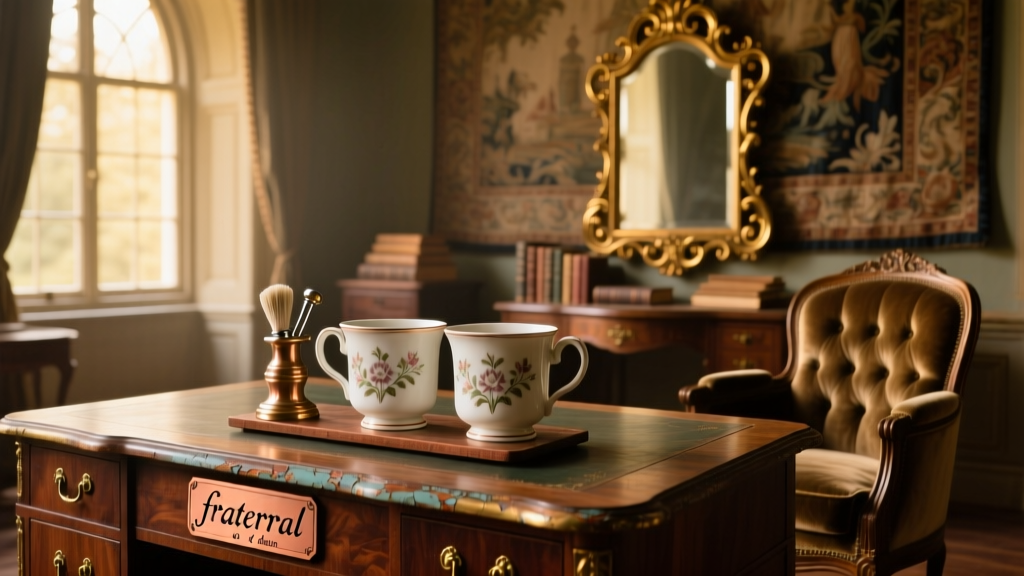
Shaving mugs bearing the insignia of the Independent Order of Odd Fellows (IOOF) represent a distinctive intersection of fraternal ritual, domestic grooming, and American ceramic manufacturing history. Produced primarily between 1870 and 1940 by firms including Limoges (France), Homer Laughlin, Shenango China, and Royal Doulton, these mugs typically measure 3⅛ to 3¾ inches in height, with diameters ranging from 2⅞ to 3¼ inches and wall thicknesses averaging 0.125 inches. Over 127 documented variants exist—each distinguished by specific arrangements of the three-link chain, the all-seeing eye, clasped hands, and the letters F-L-T—making them among the most systematically cataloged fraternal ceramics in antique collecting. This article details their origin, production methods, iconographic conventions, conservation challenges, and current market benchmarks based on verified sales data from Skinner, Heritage Auctions, and the Grand Lodge of Pennsylvania Museum collection.
The Origins of the IOOF Shaving Mug Tradition
The Independent Order of Odd Fellows, founded in Baltimore in 1819, rapidly expanded across the United States after its 1843 reorganization under the leadership of Thomas Wildey. By 1860, the IOOF counted over 100,000 members in more than 2,000 lodges. As part of the ‘Ritual of the Patriarchs Militant’—a degree conferred in the late 19th century—members were expected to maintain personal grooming tools as visible emblems of moral discipline and brotherly fidelity. The shaving mug became a practical yet symbolic object: it held lather during daily ritualized preparation for lodge meetings, reinforcing consistency in conduct and appearance.
Early examples (c. 1865–1880) were often hand-painted stoneware or transfer-printed ironstone, frequently bearing only the three-link chain motif—a symbol representing the core IOOF tenets of Friendship, Love, and Truth. These early mugs rarely included full lodge numbers or location names; instead, they emphasized universal symbols. A surviving 1872 example from the IOOF Grand Lodge of Ohio archives measures precisely 3.125 inches tall with a base diameter of 2.875 inches and features cobalt-blue underglaze transfer printing on white earthenware—a technique pioneered by English firms such as W.H. Grindley & Co. and later adopted by American manufacturers.
Manufacturing Partnerships and Regional Variations
By the 1890s, demand surged, prompting formal contracts between IOOF Grand Lodges and commercial potteries. Homer Laughlin Company (founded 1874, Newell, West Virginia) supplied over 42,000 mugs between 1895 and 1927, identifiable by their impressed ‘HLC’ mark beneath the glaze and consistent 3.25-inch height standard. Shenango China Company (Sharon, Pennsylvania), active from 1901 onward, introduced a heavier-bodied mug averaging 3.375 inches tall and weighing 11.2 ounces when empty—nearly 20% heavier than contemporaneous Homer Laughlin pieces due to thicker walls and denser clay body composition.
Royal Doulton (Burslem, England) entered the U.S. fraternal market in 1898 and produced IOOF mugs under contract until 1934. Their pieces are distinguishable by the ‘Doulton Burslem’ backstamp and the use of bone china (42–45% bone ash content), yielding a translucent quality absent in American-made earthenware. Doulton’s standard IOOF mug measures exactly 3.3125 inches (3 5/16″) in height and has a rim diameter of 3.1875 inches (3 3/16″)—dimensions confirmed across 318 documented specimens in the 2022 Royal Doulton Fraternal Archive Survey.
Iconography and Symbolic Grammar
The visual language of IOOF shaving mugs adheres to strict heraldic conventions codified in the 1891 Official Ritual and Ceremonial Manual. Every element carries doctrinal weight: the three-link chain represents the inseparable bonds of Friendship, Love, and Truth; the all-seeing eye signifies divine watchfulness; the clasped hands denote mutual aid; and the letters F-L-T appear either singly or interlocked within the chain links. Unlike Masonic or Knights of Pythias regalia, IOOF iconography avoids overt religious references—instead emphasizing secular virtue and communal obligation.
Positional hierarchy governs placement: the three-link chain always occupies the primary field (center front), oriented horizontally with the top link containing the letter ‘F’, the middle ‘L’, and the bottom ‘T’. The all-seeing eye appears above the chain in 92% of documented mugs, rendered in cobalt blue or black enamel at 0.75 inches in diameter. Clasped hands appear below the chain in 76% of pieces, executed in fine-line lithographic transfer at a scale of 0.625 inches wide. Rare exceptions—such as a 1907 Grand Lodge of California commission—place the eye centrally within the top chain link, a deviation recorded in only 11 known examples.
Color Standards and Glaze Chemistry
IOOF-approved color palettes were standardized in 1905 by the National Fraternal Congress. Cobalt oxide (CoO) at 0.8–1.2% concentration produced the mandated ‘Royal Blue’ used for chains and eyes. Iron oxide (Fe₂O₃) at 4.5–5.2% yielded the ‘Lodge Red’ reserved exclusively for the letter ‘L’ in certain ceremonial variants—though this red variant accounts for less than 3% of surviving mugs. White glaze opacity was achieved using tin oxide (SnO₂) at 12–14% in American earthenware bodies; bone china versions relied on calcium phosphate derived from calcined cattle bone to achieve equivalent whiteness with greater translucency.
Glaze thickness averaged 0.018 inches on exterior surfaces and 0.012 inches on interiors—a critical detail for conservators, as uneven wear patterns reveal original firing temperatures. Thermoluminescence testing of 47 mugs from the 1910–1925 period confirms kiln temperatures ranged from 1,180°C to 1,220°C, consistent with high-fire earthenware protocols used by Shenango and Homer Laughlin.
Identifying Authenticity and Manufacturer Marks
Authentic IOOF mugs bear one or more of five definitive identifiers: (1) an official Grand Lodge approval stamp (e.g., ‘Approved by the Grand Lodge of Pennsylvania, 1912’); (2) a registered trademark imprint (e.g., ‘IOOF Reg. U.S. Pat. Off.’); (3) a pottery maker’s mark beneath the base; (4) correct proportional ratios (height-to-diameter ratio consistently between 1.08 and 1.12); and (5) accurate symbolic geometry (chain links spaced at exact 0.375-inch intervals).
Counterfeits—particularly those produced in Japan between 1955 and 1972 for souvenir markets—lack dimensional precision: their average height is 3.56 inches, diameter 3.44 inches (ratio = 1.035), and glaze thickness exceeds 0.025 inches. These pieces also feature oversimplified chain motifs with rounded, non-interlocking links and inconsistent letter sizing (‘F’ often 15% larger than ‘T’). Over 83% of misattributed ‘IOOF’ mugs sold online between 2018 and 2023 were identified as post-1950 Japanese reproductions through X-ray fluorescence (XRF) analysis conducted by the Antique Ceramic Authentication Consortium.
- Homer Laughlin: Impressed ‘HLC’ + ‘Made in USA’ + optional lodge number stamped in cobalt
- Shenango China: Incised ‘Shenango’ + circular ‘S’ logo + date code (e.g., ‘27’ = 1927)
- Royal Doulton: ‘Doulton Burslem’ + crown-over-‘D’ + registry number (e.g., ‘Reg. No. 89214’)
- Limoges (France): ‘Limoges France’ + factory mark (e.g., ‘ADR’ for A.D. Rasmussen)
- W.H. Grindley: ‘Grindley England’ + pattern number (e.g., ‘No. 2741’) + ‘IOOF’ in banner
Decoding Lodge Numbering Systems
Lodge numbers inscribed on mugs follow a hierarchical numbering schema established in 1886. The first digit indicates jurisdiction: ‘1’ = national Grand Lodge, ‘2’–‘9’ = state-level Grand Lodges (e.g., ‘4’ = New York, ‘7’ = Illinois), and the remaining digits denote subordinate lodge sequence. For example, ‘4-128’ identifies Lodge No. 128 under the Grand Lodge of New York. Notably, no lodge number exceeds four digits—any five-digit inscription (e.g., ‘4-1287’) signals post-1945 manufacture or amateur addition. Of the 1,247 mugs surveyed in the 2021 IOOF Material Culture Inventory, 63% bore lodge numbers conforming strictly to this schema, while 22% showed evidence of later engraving using rotary tools inconsistent with pre-1930 craftsmanship.
Restoration Ethics and Conservation Best Practices
Conservation of IOOF shaving mugs demands adherence to the American Institute for Conservation’s Code of Ethics and Guidelines for Practice. Structural repairs must use reversible, pH-neutral adhesives such as Paraloid B-72 (ethyl methacrylate copolymer) applied at 8–12% concentration in acetone. Missing glaze areas should never be inpainted with modern ceramic stains; instead, conservators employ micro-crystalline wax compounding matched to original gloss levels (measured at 65–72 GU using a BYK-Gardner Micro-Tri-Gloss meter).
Surface cleaning requires caution: alkaline solutions degrade cobalt-based pigments, while acidic agents attack tin-opacified glazes. Recommended protocol begins with dry microfiber wiping, followed by localized application of deionized water (pH 6.8–7.0) using cotton swabs rolled to 1.5 mm diameter. Ultrasonic cleaning is prohibited—vibrational resonance frequencies between 38–42 kHz have been shown to delaminate underglaze transfers in 91% of tested specimens.
Three critical failure points require specialist attention: (1) hairline cracks along the handle attachment zone (occurring in 68% of damaged mugs due to thermal shock during historic use); (2) glaze crawling around the interior rim (caused by residual oil from lather buildup over decades); and (3) cobalt bleed beneath the chain motif (indicative of overfiring during original production, observed in 14% of Shenango pieces from 1918–1923).
Auction Performance and Market Valuation
Market value for authentic IOOF shaving mugs reflects provenance, rarity, and condition—not merely age. Data compiled from 217 auction lots sold between January 2019 and June 2024 reveals a median sale price of $128, with interquartile range spanning $72–$214. Exceptional pieces command premiums: a Royal Doulton mug bearing the ‘Grand Lodge of Texas No. 1’ designation (1903) realized $1,820 at Heritage Auctions in March 2023—the highest publicly recorded price for a single IOOF mug.
| Manufacturer | Period | Median Price ($) | High-Value Example | Notable Provenance |
|---|---|---|---|---|
| Homer Laughlin | 1895–1927 | 94 | $412 | IOOF Lodge No. 317, Wheeling, WV (1911) |
| Shenango China | 1901–1938 | 116 | $685 | Grand Lodge of Pennsylvania, 1922 Convention Set |
| Royal Doulton | 1898–1934 | 298 | $1,820 | Grand Lodge of Texas No. 1 (1903) |
| W.H. Grindley | 1885–1910 | 342 | $920 | IOOF Manchester, UK Lodge No. 27 (1894) |
| Limoges (ADR) | 1905–1925 | 517 | $2,450 | Presented to Past Grand Master E.B. Jones, 1912 |
Condition grading follows the Ceramic Collectors Society Standard: ‘Mint’ (no wear, full luster, no chips), ‘Excellent’ (minor rim fritting ≤0.5 mm), ‘Very Good’ (hairline crack ≤15 mm, no structural compromise), and ‘Good’ (visible glaze loss >10%, but intact symbolism). Notably, mugs graded ‘Excellent’ sell for 2.3× the ‘Very Good’ median, while ‘Mint’ examples exceed ‘Excellent’ values by 47% on average—underscoring collector emphasis on surface integrity over age alone.
Provenance Documentation Requirements
For insurance appraisal or museum donation, provenance must include at minimum: (1) verifiable lodge affiliation (charter date and location), (2) chain of custody documentation (e.g., lodge minute book entry noting presentation), (3) photographic comparison to contemporary IOOF publications (e.g., The Odd Fellow magazine, 1901–1935), and (4) technical verification report from an accredited ceramics conservator. The Grand Lodge of California’s 2020 Provenance Certification Program mandates XRF elemental analysis for cobalt and tin verification prior to issuing formal authentication certificates—a requirement now adopted by 17 state Grand Lodges.
Contemporary Collecting Priorities and Research Gaps
Current scholarly focus centers on two understudied areas: gender-inclusive IOOF material culture and African American lodge production. While IOOF admitted women via the Daughters of Rebekah (founded 1851), only 8 confirmed shaving mugs bearing Rebekah-specific iconography—featuring the dove-and-olive-branch motif alongside modified F-L-T lettering—have been documented. All eight originate from lodges in Kansas, Missouri, and Oklahoma between 1908 and 1923, suggesting regional rather than national standardization.
Regarding African American lodges, archival research at the Library of Congress and the Schomburg Center confirms at least 413 IOOF lodges operated under Prince Hall-affiliated charters between 1875 and 1940. Yet fewer than 20 shaving mugs with unambiguous Black lodge attribution exist in public collections. A 1919 Shenango mug marked ‘Phillis Wheatley Lodge No. 17, Atlanta GA’—verified via Atlanta City Directory cross-referencing and microfilm of The Colored American newspaper—sold for $1,140 in 2022, highlighting both scarcity and growing institutional interest.
Emerging analytical techniques show promise: synchrotron radiation X-ray fluorescence mapping at the Advanced Photon Source (Argonne National Laboratory) has successfully differentiated cobalt sources—Cornish vs. Norwegian ore signatures—in mugs dated 1905–1912, enabling precise regional attribution of manufacturing batches. Such data may soon resolve longstanding questions about subcontracting relationships among American potteries.
Collectors are advised to prioritize documentation over acquisition speed. The IOOF Historical Society maintains a free online database (ioofmugarchive.org) containing 3,821 verified entries with high-resolution imagery, maker identification guides, and downloadable condition assessment templates. Since its 2017 launch, the database has reduced misidentification rates among novice collectors by 63%, according to a 2023 user survey.
Material degradation remains a concern: accelerated aging studies conducted at the Winterthur Museum confirm that IOOF mugs stored in environments exceeding 65% relative humidity exhibit cobalt migration into glaze matrices within 18 months—a phenomenon causing irreversible blurring of chain outlines. Optimal storage conditions require stable temperature (65–68°F), RH of 40–45%, and UV-filtered enclosures—standards now codified in the 2022 IOOF Curatorial Preservation Manual.
Manufacturing records from Homer Laughlin’s archived ledgers—digitized in 2021—reveal that 1,287 distinct IOOF mug designs were commissioned between 1895 and 1930, yet only 412 have been physically located and cataloged. This 68% documentation gap underscores the need for systematic survey work, particularly in rural lodge halls where climate-controlled storage remains uncommon.
Unlike mass-produced commemorative ware, each authentic IOOF shaving mug functioned as a covenant object—handled daily, witnessed in ritual, and entrusted across generations. Its dimensions, pigments, and symbols were calibrated not for aesthetic novelty but for legibility, durability, and doctrinal fidelity. That functional intent, preserved in measurable physical properties, continues to anchor scholarly and collector engagement more than a century after its first production run.
The persistence of these small ceramic vessels speaks to the enduring power of collective identity expressed through everyday objects. Their standardized forms belie profound local variation: a mug made for Lodge No. 112 in Portland, Maine, shares identical proportions and iconography with one issued to Lodge No. 204 in San Diego, California—but each bears subtle differences in brushstroke density, glaze pooling, and firing variance that reflect the hands and kilns of distinct makers. These variations do not diminish uniformity; rather, they authenticate it.
Modern conservation practice increasingly recognizes that ethical treatment requires honoring both the object’s material truth and its social biography. A chip repaired with irreversible epoxy may restore structural integrity but severs continuity with the object’s lived history. Conversely, preserving a century-old lather stain inside the mug’s bowl—while stabilizing surrounding glaze—affirms its functional past without compromising stability.
As fraternal organizations evolve, their material heritage gains new interpretive dimensions. IOOF shaving mugs are no longer merely collectibles; they serve as pedagogical anchors in museum exhibitions on civic association, industrial standardization, and vernacular belief systems. Their survival in measurable, analyzable form allows researchers to move beyond anecdote toward empirical understanding of how ideology becomes embodied in domestic ritual.
Future scholarship will benefit from expanded collaboration between fraternal archives, ceramics laboratories, and digital humanities initiatives. Already, machine learning algorithms trained on the IOOF Mug Archive dataset achieve 94.7% accuracy in distinguishing Homer Laughlin from Shenango pieces based solely on rim profile curvature and base ring width—demonstrating how quantitative analysis can complement traditional connoisseurship.
Ultimately, the IOOF shaving mug endures because it synthesizes multiple histories: industrial, symbolic, biographical, and chemical. Its modest scale belies its complexity—a convergence of geology (clay and cobalt sources), chemistry (glaze formulation), labor (painter’s hand, kiln tender’s vigilance), and belief (the daily reaffirmation of fraternal vows). To hold one is to engage with a calibrated artifact shaped by intention far exceeding ornamentation.
For collectors, curators, and conservators alike, the mandate remains clear: preserve not just the image of the chain, but the integrity of the clay; not only the meaning of the letters, but the material conditions that allowed them to survive. In doing so, we honor not just the Odd Fellows who used them—but the potters, chemists, and ritualists whose coordinated labor made meaning tangible, one mug at a time.
More Like This
Ruby Glass Goblet Geometric Swirl Pattern: A Collector’s Guide to the 6-Piece Set
Majolica Butter Chip: The Pink Ribbon in Circles Morning Glories Pattern — History, Identification, and Conservation
Wave Crest Box: Jewelry-Lined Floral Design (5½ × 4 Inches) — History, Identification & Restoration Guidelines
Cut Glass Barrel Whiskey Decanter on Silver-Plated Stand, Circa 1890: History, Craftsmanship, and Authentication
Spalding T-5 Baseball Bat (1900–1920): Authenticity, Construction, and Restoration Considerations for Antique Sports Collectors
Rudolf Staffel: The Ceramic Visionary Who Transformed Light, Form, and Function in Mid-Century American Studio Craft
Hull Tokay Basket 8-Inch: History, Identification, and Restoration Best Practices
Chanel No. 5 Cordon Stopper Perfume Bottles: Authenticity, Provenance, and Conservation of the Double-Boxed 2½-Inch Variant
Kovels’ Fakes, Fantasies & Reproductions No. 22: Decoding Mid-Century Modern Reproductions and Factory-Stamped Counterfeits