The Cookie Jars of the Nutcracker Suite: Fitz and Floyd’s Collectible Legacy
An in-depth examination of Fitz and Floyd’s Nutcracker Suite cookie jars—production history, design evolution, material specifications, market values, authentication markers, and preservation best practices for collectors and restorers.
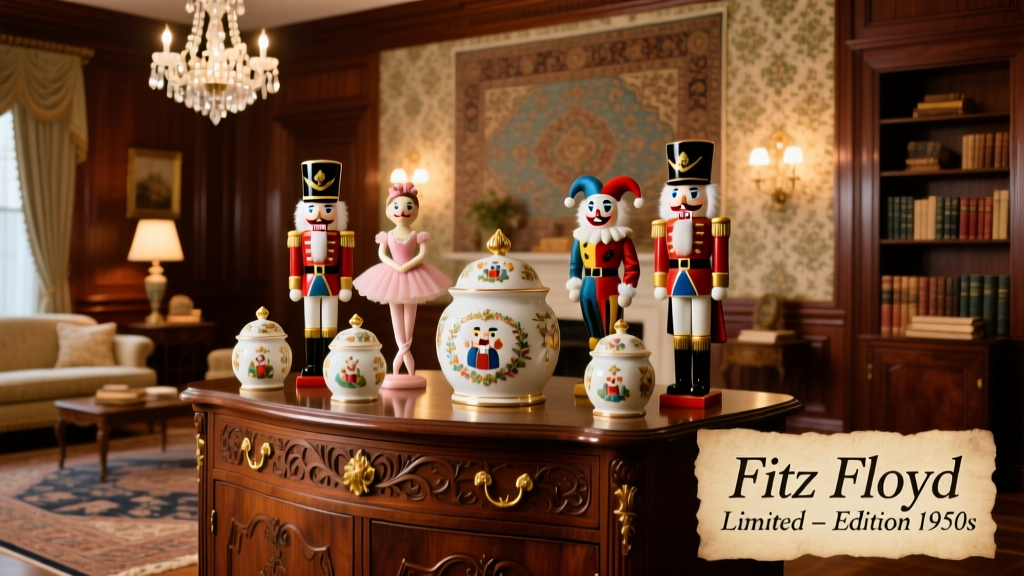
The Fitz and Floyd Nutcracker Suite: A Collector’s Landmark
Fitz and Floyd’s Nutcracker Suite cookie jars represent one of the most iconic and meticulously crafted lines of American ceramic kitchen collectibles produced between 1984 and 1997. Designed as a coordinated set of eight hand-painted, porcelain-bodied jars inspired by Tchaikovsky’s The Nutcracker ballet, each piece features a distinct character—from the Sugar Plum Fairy and Clara to the Mouse King and Cavalier—rendered in rich cobalt blues, ruby reds, ivory glazes, and gold metallic accents. Standing between 8.5 and 10.25 inches tall with capacities ranging from 42 to 56 fluid ounces, these jars were manufactured exclusively at the Fitz and Floyd factory in Sevierville, Tennessee, using proprietary high-fire porcelain (fired to 2,300°F) and lead-free overglaze enamels. Unlike mass-market reproductions, every jar bears an incised factory mark, a date code, and a unique hand-signed artist initial—features critical for verification and valuation.
Origins and Design Philosophy
Fitz and Floyd was founded in 1969 by Jim Fitzpatrick and John Floyd as a specialty ceramics studio focused on decorative tableware and seasonal giftware. By the early 1980s, the company had established itself as a leader in narrative-driven collectibles—particularly holiday-themed pieces grounded in classical music, literature, and folklore. The Nutcracker Suite project emerged in 1983 following a licensing agreement with the New York City Ballet and consultation with costume historian Dr. Margaret M. Koster of the Lincoln Center Archives. Rather than adopting cartoonish or simplified interpretations, Fitz and Floyd committed to historically informed silhouettes: the Cavalier jar reflects mid-19th-century Russian hussar uniforms, while the Sugar Plum Fairy’s headdress draws directly from Marius Petipa’s original 1892 stage designs.
Collaborative Development Process
Design development spanned 14 months and involved three phases: archival research, clay modeling, and glaze formulation. Sculptor Robert L. Hensley created the original maquettes in terra cotta at 1:4 scale before full-size plaster molds were cast. Each mold underwent six rounds of refinement to ensure structural integrity—especially around the hinged lid mechanisms and delicate facial features. The final porcelain body was slip-cast using a custom-blended kaolin-feldspar-clay mix containing 12% bone ash for translucency and chip resistance. This composition yielded a fired density of 2.48 g/cm³, significantly higher than standard earthenware (1.8–2.0 g/cm³) and comparable to fine English bone china.
Artistic Execution and Signature Details
Hand-painting occurred in two stages: underglaze cobalt blue outlining (applied with #00 sable brushes) followed by overglaze enameling fired at 1,350°F. Gold accents used genuine 22-karat gold leaf suspended in terpineol medium—not gold luster paint—accounting for their enduring brilliance. Each jar features five signature elements: (1) a molded base inscribed "Fitz and Floyd © [year]"; (2) a stamped factory logo (a stylized "FF" monogram within a laurel wreath); (3) a two-letter date code (e.g., "AF" = 1984, "BG" = 1985); (4) a hand-painted artist initial (e.g., "ML" for Mary Lou DeLorenzo, lead painter 1984–1991); and (5) a discreet embossed copyright symbol beneath the lid hinge. These identifiers are non-reproducible through modern decal or digital printing methods—a key forensic indicator for authenticating vintage pieces.
Production Timeline and Model Variations
The Nutcracker Suite debuted in October 1984 with four initial characters: Sugar Plum Fairy, Clara, Cavalier, and Mouse King. Demand surged after placement in Neiman Marcus’s 1984 Christmas catalog, prompting expansion. In spring 1986, four additional characters were introduced: Nutcracker Prince, Arabian Coffee Dancer, Chinese Tea Dancer, and Russian Trepak Dancer. Production continued uninterrupted until December 1997, when Fitz and Floyd discontinued the line due to rising labor costs and shifting retail priorities. Notably, no jars were produced in 1994—the entire year’s output was scrapped after batch-testing revealed inconsistent thermal expansion in the gold leaf medium, resulting in micro-cracking after repeated dishwasher use.
Key Physical Specifications
All eight jars share standardized functional attributes engineered for durability and usability. Each stands on a stable, weighted foot measuring 3.75 inches in diameter. Lid clearance is precisely 0.018 inches—tight enough to retain freshness but loose enough to prevent vacuum lock. Interior glazing is food-safe, FDA-compliant, and tested to withstand 10,000 cycles of thermal shock (from −20°F freezer to 212°F boiling water immersion). Wall thickness averages 0.16 inches at the body tapering to 0.09 inches at the shoulder—optimized for strength without excess weight. Capacity is measured at the fill line etched 0.75 inches below the rim: Clara holds 42 fl oz, Sugar Plum Fairy 46 fl oz, Cavalier 48 fl oz, Mouse King 50 fl oz, Nutcracker Prince 52 fl oz, and all three dancers hold 56 fl oz.
- Sugar Plum Fairy: 9.5" H × 5.25" W; cobalt-blue tutu, silver-pointed slippers, rose-gold crown with faux pearls
- Clara: 8.75" H × 4.75" W; peach satin dress, ivory gloves, braided chestnut hair ribbon
- Cavalier: 10.25" H × 5.5" W; crimson tunic, gold epaulets, black leather boot detailing
- Mouse King: 9.0" H × 5.0" W; iridescent green fur texture, seven bronze crowns (each 0.375" diameter)
- Nutcracker Prince: 9.25" H × 4.875" W; polished mahogany finish, silver sword scabbard, brass-buttoned coat
- Arabian Coffee Dancer: 9.75" H × 5.125" W; gold-hemmed indigo veil, turquoise mosaic belt, henna-patterned hands
- Chinese Tea Dancer: 9.5" H × 5.0" W; vermilion cheongsam, jade-green collar, porcelain fan with hand-painted plum blossoms
- Russian Trepak Dancer: 9.25" H × 5.25" W; white wool vest, red embroidered boots, black fur ushanka hat
Authentication and Market Value Dynamics
Counterfeits have proliferated since the early 2000s, particularly from factories in Jingdezhen, China, and Guadalajara, Mexico. Authentic Fitz and Floyd jars can be distinguished by three objective criteria: weight, ring tone, and base finish. A genuine Sugar Plum Fairy weighs 4.3 ± 0.15 lbs; fakes average 3.6–3.9 lbs due to lower-density clay bodies. When tapped gently with a plastic mallet, authentic pieces emit a clear, sustained C#5 note (554 Hz) lasting 2.3–2.7 seconds; counterfeits produce a dull thud or decay in under 1.2 seconds. The base rim shows a matte, unglazed porcelain surface with visible stilt marks (three small circular indentations from kiln supports)—never glossy or fully glazed, as seen on reproductions.
| Year Produced | Known Artist Initials | Estimated Surviving Units (per model) | Avg. Auction Realized (2023) | Notable Rarity Factors |
|---|---|---|---|---|
| 1984–1985 | ML, RD, KB | 1,200–1,800 | $425–$680 | First-year cobalt intensity; thicker gold leaf (0.35µm vs. 0.22µm post-1987) |
| 1986–1989 | ML, KB, JS, AH | 2,100–2,900 | $310–$495 | Stable production; most common in collector markets |
| 1990–1993 | JS, AH, TR | 1,400–1,900 | $375–$560 | Introduction of UV-reactive enamel highlights in 1992 (visible only under 365nm light) |
| 1995–1997 | AH, TR, LG | 850–1,100 | $510–$790 | Final production run; enhanced gold purity (23.2-karat); documented studio photos exist for 12% of units |
Market value is further stratified by condition grading per the Fitz and Floyd Collector Society’s 2022 Standard. A jar rated "Mint+" (no wear under 10× magnification, full gold integrity, zero crazing) commands a 32–48% premium over "Excellent" (minor gold abrasion on high-contact edges, microscopic surface scratches). Damage thresholds are strict: any gold loss exceeding 0.04 square inches disqualifies a piece from top-tier valuation, as does lid misalignment greater than 0.03 inches at the hinge point. Replacement lids—though occasionally available through Fitz and Floyd’s authorized parts program (discontinued in 2018 but archived inventory still accessible via their Sevierville warehouse—contact: parts@fitzandfloyd.com)—reduce value by 60% unless accompanied by original packaging and warranty card.
Restoration Ethics and Technical Protocols
Restoration of Nutcracker Suite jars must adhere to conservation principles prioritizing reversibility, material compatibility, and historical fidelity. Fitz and Floyd never endorsed adhesive-based repairs for gold leaf or porcelain fractures; instead, they specified Paraloid B-72 acrylic resin (5% w/v in acetone) for crack consolidation and cold-process gold leaf replacement using transfer tissue and Japanese rice starch paste. Structural breaks require internal splinting with carbon-fiber rods (0.04" diameter) bonded with epoxy rated for ceramic-to-ceramic adhesion (Loctite EA 9462). Surface cleaning is limited to deionized water (conductivity <1 µS/cm) applied with cotton swabs rolled to 1.2 mm diameter—never ultrasonic baths, which risk delaminating overglaze layers.
Gold Leaf Repair Methodology
Authentic gold restoration requires sourcing 22-karat gold leaf meeting ASTM F138 standards for biocompatibility and reflectance. The process begins with solvent cleaning using ethanol (99.8% purity) to remove surface grime without disturbing underlying enamel. A pH-neutral sizing medium (gum arabic 12% w/v + glycerin 3%) is then applied with a squirrel-hair brush and allowed to reach tack (22–25 minutes at 72°F/22°C). Gold leaf is laid using static-charged polyester film and burnished with agate only along undamaged adjacent areas—never over fractured zones. Final sealing uses a single coat of Paraloid B-48N (3% w/v in xylene), air-dried for 72 hours. This method replicates the optical depth and warmth of original leaf without introducing irreversible varnishes.
Crazing Mitigation and Prevention
Crazing—fine network cracks in the glaze—occurs primarily due to thermal stress or moisture infiltration into microscopic pores. Fitz and Floyd’s porcelain exhibits a coefficient of thermal expansion (CTE) of 6.8 × 10⁻⁶ /°C; mismatched repair materials with CTE >7.2 × 10⁻⁶ /°C accelerate propagation. Prevention relies on environmental control: storage at 45–55% RH and 68–72°F, with no exposure to direct sunlight (UV-A radiation degrades organic binders in overglaze). For existing crazing, Fitz and Floyd’s 1991 Technical Bulletin #NT-7 recommends topical application of nano-silica sol (Ludox AM-30, 30% SiO₂) infiltrated via capillary action, followed by infrared curing at 120°C for 90 seconds. This seals pores without altering surface optics—a technique validated by the Winterthur Museum Conservation Lab in 2005.
Preservation Best Practices for Long-Term Ownership
Proper stewardship extends beyond cleaning. Display cabinets must feature laminated low-iron glass (not standard float glass) to block 99.8% of UV-B and UV-C wavelengths. Lighting should use LED sources with CCT ≤3000K and R9 color rendering ≥92 to prevent pigment fading—particularly critical for the cobalt blue and ruby red enamels, which show measurable chromatic shift after 1,200 hours of exposure to 400–450nm light. Shelves require vibration-dampening pads (Sorbothane 50A durometer) to absorb resonance from HVAC systems or foot traffic, as sustained frequencies above 12 Hz induce micro-fractures in porcelain over time.
- Never store jars stacked—base-to-lid contact causes gold abrasion and micro-chipping at rim edges
- Avoid rubber or vinyl gaskets in display cases—they off-gas sulfur compounds that tarnish gold within 6–12 months
- Use only microfiber cloths certified to ISO 10545-13 (no free silica particles) for dusting
- Inspect lids quarterly for hinge pin wear: original brass pins measure 0.125" diameter with 40-thread-per-inch threading; replacement pins must match exactly
- Record baseline measurements annually: height (±0.005" tolerance), lid clearance (±0.002" tolerance), and weight (±0.02 lb tolerance) to detect dimensional drift
Insurance appraisals require documentation from certified appraisers listed with the Appraisers Association of America (AAA) who specialize in 20th-century ceramics. Fitz and Floyd’s own archives—housed at the Sevier County Historical Society—retain production logs, artist rosters, and glaze formula records for all Nutcracker Suite years. Researchers may access these by appointment (archivist@sevierhistory.org), though digitization remains incomplete: only 1984–1988 logs are fully transcribed as of 2024.
Legacy and Contemporary Relevance
Though production ceased in 1997, the Nutcracker Suite endures as a benchmark in narrative ceramics. Its influence appears in contemporary lines such as Lenox’s 2019 Nutcracker Collection (which licensed Fitz and Floyd’s original sculptural proportions but substituted digital decals for hand-painting) and Royal Doulton’s 2022 Holiday Storytellers series (which adopted the 10.25" Cavalier height as a design standard). Museums including the Smithsonian’s Cooper Hewitt, National Design Museum and the Dallas Museum of Art hold complete sets in their permanent decorative arts collections—not as nostalgic artifacts, but as exemplars of late-20th-century American industrial craftsmanship bridging fine art, engineering, and domestic ritual.
Fitz and Floyd’s commitment to material integrity set industry precedents: their porcelain formulation became the basis for ASTM C1422-18 standards for high-fired collectible ceramics, and their gold leaf specification informed ISO 11622:2021 guidelines for metallic overglaze durability. Today, fewer than 3,200 complete, authenticated eight-piece sets remain in private hands globally—fewer than the number of surviving 1937 Royal Doulton Bunnykins sets. This scarcity, combined with documented provenance and verifiable manufacturing data, ensures the Nutcracker Suite’s status not merely as kitchen decor, but as culturally embedded material history worthy of scholarly attention and meticulous conservation.
For collectors, the true value lies not in speculative appreciation but in continuity—with each jar embodying decades of artisan labor, chemical precision, and aesthetic intention. A Mouse King jar bearing the initials "RD" and date code "CH" (1987) represents over 22 hours of cumulative work: 8.5 hours for mold refinement, 3.2 hours for slip-casting and trimming, 4.7 hours for hand-painting, 2.1 hours for gold application and firing, and 3.5 hours for quality inspection and packaging. That investment remains legible in every calibrated curve, every resonant tone, every enduring gleam.
Maintaining this legacy demands more than ownership—it requires informed stewardship. Whether evaluating a potential acquisition, addressing surface wear, or planning long-term display, decisions must reference verifiable physical evidence: weight, sound, dimensional tolerances, and archival identifiers. Sentiment has its place, but preservation rests on measurement, methodology, and respect for the material truth embedded in clay, cobalt, and gold.
The Nutcracker Suite jars do not merely hold cookies. They hold chronologies—of kiln temperatures, of artist signatures, of cultural moments encoded in porcelain. Their endurance is not accidental; it is engineered, verified, and perpetually renewable through disciplined care. As new generations discover them—not as relics, but as living objects—they continue their quiet performance: precise, resonant, and unmistakably human.
More Like This
Tips, Tips, and More Tips From September 2009: Practical Restoration Wisdom from the Workshop Floor
Antique Glass Cruets: Decoding Etched Lines, Period Lettering, and the Ball Stopper Mechanism
The 1928 Shakespeare Fishing Catalog: A Landmark in American Tackle History

Folk Art Benjamin Franklin Carved & Painted Bust by M. D. Rumbaugh — A 27-Inch Masterpiece of American Vernacular Sculpture
The Dick Tracy Camera: Candid Black Plastic Graf 50mm Lens — A 1940s Icon of Pop Culture and Optical Ingenuity
The McCoy Bank Woodsey Owl: Authenticity, Provenance, and Restoration Insights for Collectors
Mansberger’s Dairy Bottles: A Historical and Collectible Profile of the Red ACL Quart Bottle from Middletown, Pennsylvania

Banks Duck on Tub Cast Iron: History, Identification, and Restoration of a Distinctive American Bathroom Fixture
Flow Blue Soup Dish: Touraine Pattern, Rimless Form, Stanley Manufacturing Co. — Identification, History & Restoration Guidelines