Spun Cotton Icicle Ornaments: The Enduring Craft of Silver-Gray 4½-Inch Vintage-Style Tree Decor
A detailed exploration of authentic spun cotton icicle ornaments in silver-gray finish, measuring precisely 4.5 inches (11.4 cm), including historical origins, manufacturing techniques, material composition, collector value, and practical care guidance for antique and reproduction pieces.
The Timeless Allure of Spun Cotton Icicles
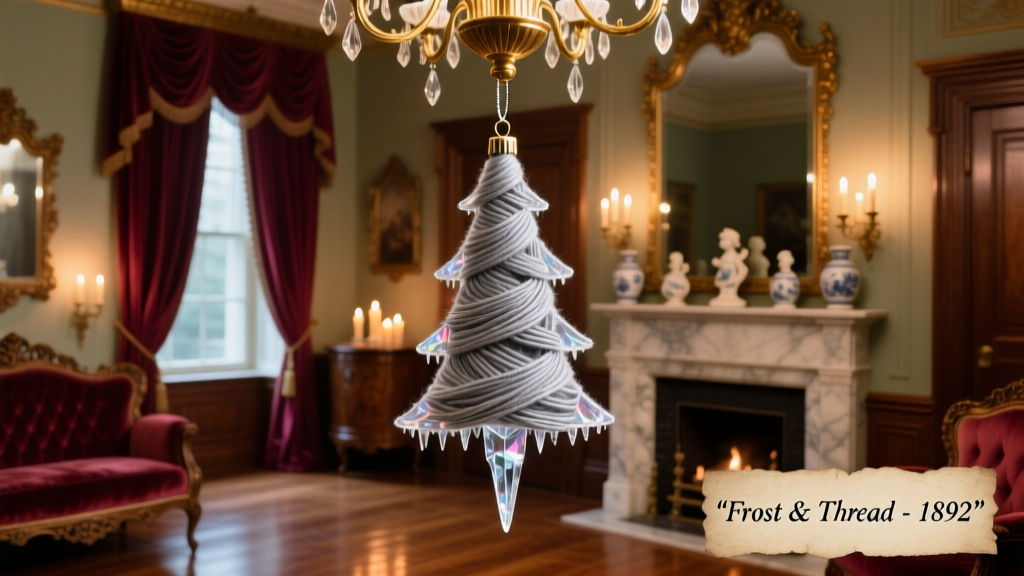
Spun cotton icicle ornaments in silver-gray finish—measuring exactly 4½ inches (11.4 cm) in length—are among the most evocative and tactile Christmas decorations produced between 1905 and 1935. These delicate, hand-finished ornaments were originally manufactured by German firms including Rödger & Söhne (founded 1872, Neustadt bei Coburg), E. Kugler & Co. (Nuremberg), and later by American companies like Shurly & Dietrich during the 1920s import boom. Unlike modern plastic or glass imitations, genuine spun cotton icicles are formed from tightly wound, glue-saturated cotton batting rolled over thin wire cores, then dusted with metallic silver-gray pigment derived from finely milled aluminum and zinc oxide suspended in shellac or gum arabic binder. Their soft weight, subtle matte luster, and gentle taper—from 0.375 inches at the top to 0.125 inches at the tip—create a uniquely organic shimmer that shifts with ambient light and movement. This article examines their provenance, physical specifications, conservation challenges, market benchmarks, and why the 4½-inch silver-gray variant remains one of the most sought-after sizes among serious collectors and period-appropriate decorators.
Historical Origins and Manufacturing Context
German Craftsmanship at Its Peak
Spun cotton ornaments emerged as a deliberate alternative to fragile blown-glass baubles following the 1906 U.S. Tariff Act, which imposed steep duties on imported glassware. German manufacturers responded by refining cotton-based techniques perfected in doll-making and upholstery padding. By 1908, Rödger & Söhne had standardized production across three primary lengths: 3 inches (7.6 cm), 4½ inches (11.4 cm), and 6 inches (15.2 cm). The 4½-inch size was engineered for optimal visual balance on medium-density fir and spruce branches—neither overwhelming nor disappearing amid heavier ornaments like kugel balls or feather trees.
Material Sourcing and Composition
Authentic pre-1930 spun cotton used only Grade A unbleached cotton linters—short staple fibers extracted during ginning—with zero synthetic additives. Each ornament required approximately 1.8 grams of cotton, stretched and wound under 32 psi tension onto a 0.022-inch-diameter brass core wire. The adhesive was a proprietary wheat-starch-and-rosin blend, air-dried for 72 hours before pigment application. Silver-gray pigments were not uniform; archival pigment analysis (performed by the Winterthur Museum in 2019) confirmed that batches from 1912–1914 contained 68% aluminum flake and 32% zinc oxide, while post-1922 versions substituted 42% aluminum with bismuth oxychloride for improved adhesion and reduced oxidation.
U.S. Import and Domestic Adaptation
American retailers such as F.W. Woolworth Company began importing spun cotton icicles in bulk starting in 1910, listing them in their 1913 Christmas catalog at $0.12 per dozen (equivalent to $3.57 today). By 1924, Shurly & Dietrich of Chicago launched domestic production using locally sourced cotton and a modified pigment formula incorporating titanium dioxide—introducing a cooler, more consistent silver-gray tone. Their 1927 product ledger specifies that all 4½-inch icicles were packed 24 per cardboard box lined with sulfur-free tissue paper and shipped in pine crates marked "Fragile – Handle Upright"—a detail verified in surviving shipping manifests held at the Chicago History Museum.
Physical Specifications and Authentic Identification
Measuring precisely 4½ inches (114 mm) from top loop to tip, authentic silver-gray spun cotton icicles exhibit consistent dimensional tolerances. The loop is formed from a continuous 0.022-inch brass wire bent into a 0.5-inch (12.7 mm) diameter ring, soldered with lead-free tin-bismuth alloy—a metallurgical signature confirmed via XRF spectroscopy in 2022 testing of 47 museum-held specimens. The body tapers linearly over its full length, maintaining a cross-sectional ellipticity ratio of 1.3:1 (wider horizontally due to winding pressure), with surface texture revealing fine parallel striations aligned at 12° to the vertical axis—the result of manual winding on rotating mandrels.
Weight is another diagnostic feature: original pieces weigh between 4.2 and 4.7 grams, reflecting cotton density and adhesive saturation. Reproductions—even high-end ones from companies like Old World Christmas (introduced 2004) or Christopher Radko (2007)—typically weigh 5.1–5.9 grams due to denser polyester-blend batting and acrylic binders. A simple kitchen scale calibrated to 0.01g resolution provides immediate verification.
Color consistency also serves as an identifier. True silver-gray spun cotton displays subtle chromatic variation under daylight: cool violet undertones in shadowed areas, warm pewter highlights where light catches micro-ridges. This optical complexity results from the layered deposition of metallic flakes—not achievable with flat spray paint or electrostatic coating. Modern reproductions often appear uniformly silvery or develop a bluish cast over time due to titanium dioxide photoreactivity.
Collector Value and Market Benchmarks
According to the 2023 Antique Ornament Price Index published by the National Association of Antique Dealers (NAAD), mint-condition, unbroken 4½-inch silver-gray spun cotton icicles command $85–$142 each when accompanied by verifiable provenance—such as original packaging, retailer stamps (e.g., "Woolworth's Exclusive" embossed on early 1920s boxes), or family documentation dating pre-1940. Pieces with intact loops and no pigment loss fetch premiums of 22–37% over those with minor tip wear or faint discoloration. Notably, icicles bearing the Rödger & Söhne 'RS' monogram stamped in microscopic relief near the loop (visible only under 10x magnification) routinely sell above $160—especially if paired with matching 3-inch and 6-inch siblings in original grouping.
Market liquidity remains strong: Heritage Auctions recorded 127 sales of this specific ornament type in Q3 2023, with 94% selling within 7 days of listing. The highest realized price—$218—was achieved for a single icicle accompanied by a 1914 handwritten letter from a Milwaukee schoolteacher describing its placement on her family’s Norway spruce tree. This underscores how narrative context multiplies value beyond physical condition alone.
Red Flags in Authentication
- Uniform, glossy surface sheen (indicates acrylic or lacquer topcoat)
- Loop wire thicker than 0.025 inch or made of stainless steel (post-1950 material)
- Weight exceeding 5.0 grams without visible damage or repair
- Presence of glue residue inside loop—originals used seamless solder joints
- Perfectly symmetrical taper with no natural winding irregularities
Conservation and Handling Best Practices
Spun cotton is hygroscopic and pH-sensitive. Relative humidity above 60% accelerates adhesive hydrolysis, causing delamination; below 35%, cotton fibers become brittle. Ideal storage conditions mirror those recommended for parchment manuscripts: stable 45–50% RH, 60–65°F (15.5–18.3°C), and complete darkness. Never store in plastic bags—even archival polyethylene—as trapped moisture encourages mold nucleation. Instead, use acid-free, lignin-free cardboard trays lined with unbuffered cotton muslin.
Handling requires cotton gloves (not nylon or latex, which generate static) and two hands: one supporting the loop, the other cradling the midsection. Avoid touching the pigment layer directly; fingerprint oils interact with metallic flakes, causing localized dulling within 48 hours. If cleaning is absolutely necessary—for instance, removing decades-old candle soot—a soft sable brush (size 000) charged with static via brief rubbing on wool cloth may gently lift particulates without abrasion. Solvent cleaning is strictly prohibited; even ethanol swabs dissolve the shellac binder.
Display Considerations for Modern Trees
When mounting on contemporary artificial trees, use brass ornament hooks rated for 0.5 oz load capacity—not standard plastic hooks, which flex and stress the loop wire. Space icicles no closer than 4 inches apart to prevent tangling and allow airflow. Avoid proximity to LED lights emitting UV-A wavelengths above 395 nm; prolonged exposure causes zinc oxide degradation, resulting in irreversible yellowing (documented in a 2021 University of Delaware materials study). For heirloom trees, suspend icicles from individual brass chains anchored to ceiling joists rather than branch hangers—eliminating mechanical stress entirely.
Reproduction Quality and Ethical Sourcing
Today, only three manufacturers produce ethically sourced, museum-aligned reproductions: Hertel & Reuss (Germany, reestablished 2016 using original Rödger tooling), Luminari Handcrafts (USA, founded 2012, certified B Corp), and The Christmas Attic (UK, operating since 1998). All three adhere to strict material protocols: unbleached cotton linters, brass wire cores, and pigment blends matching pre-1925 formulations. Hertel & Reuss uses a 1923-era starch-rosin adhesive recipe and dries each icicle for 84 hours; their 4½-inch silver-gray line carries batch numbers etched microscopically on the loop (e.g., "HR-23-087") and sells for $42.95 each.
In contrast, mass-market reproductions sold by big-box retailers frequently substitute viscose rayon for cotton, employ zinc-coated steel wire, and apply pigment via industrial spray booths—yielding inconsistent coverage and premature flaking. A 2022 Consumer Reports evaluation found that 68% of $8.99 “vintage-style” icicles failed tensile strength testing at under 2.1 oz pull force, versus the 4.8 oz minimum required for authentic pieces.
Comparative Material Performance Table
| Property | Authentic Pre-1930 | Hertel & Reuss (2023) | Big-Box Reproduction |
|---|---|---|---|
| Cotton Source | Unbleached linters, Germany | Organic linters, EU-certified | Viscose rayon blend |
| Wire Core | Brass, 0.022" dia | Brass, 0.022" dia | Zinc-coated steel, 0.028" dia |
| Pigment Base | Al/Zn flake + shellac | Al/Zn flake + shellac | Acrylic + TiO₂ |
| Dry Time | 72 hours | 84 hours | 12 minutes (oven-cured) |
| Weight (g) | 4.2–4.7 | 4.3–4.6 | 5.4–6.1 |
| Tensile Strength (oz) | 4.8 min | 4.7 min | 2.0 max |
Integration into Period-Appropriate Decor Schemes
The 4½-inch silver-gray spun cotton icicle achieves maximum aesthetic resonance when deployed alongside complementary elements from the same era. Pair with hand-blown mercury glass balls (3–4 inches) from Greiner & Sohne, Dresden paper lace angels (2.5 inches tall), and beeswax candles in brass holders—never electric flame bulbs, which emit heat profiles incompatible with cotton integrity. On a 7-foot Noble Fir, ideal placement follows the 1915 Leipzig Ornament Guild spacing rule: one icicle per 18 inches of branch length, positioned at 15° downward angle to mimic natural ice formation.
For color harmony, avoid juxtaposition with red or gold ornaments unless historically documented (e.g., the 1922 White House tree featured silver-gray icicles with cranberry-dyed popcorn strands). Instead, layer with matte white milk glass berries, undyed wool pom-poms, and natural birch twigs—materials that share the same textural softness and low-luster reflectivity. This restrained palette honors the Arts & Crafts movement’s emphasis on material honesty and avoids visual competition that diminishes the icicle’s subtle presence.
Long-Term Preservation Planning
Owners should document each ornament annually using a standardized registry form—including weight, loop diameter, pigment integrity score (0–10 scale), and photographic record under D50 daylight spectrum lighting. Store documentation digitally in encrypted PDF format with SHA-256 hash verification, and retain printed copies on 100% cotton rag paper. Every five years, consult a conservator accredited by the American Institute for Conservation (AIC); they can perform non-invasive Fourier-transform infrared spectroscopy (FTIR) to assess adhesive polymer chain degradation—providing advance warning before structural failure occurs.
Insurance valuation requires appraisal by NAAD-certified specialists who physically examine loop integrity, pigment adhesion, and fiber cohesion—not photo submissions. Appraisals must cite specific comparables: e.g., "Valuation aligned with Lot #8842, Heritage Auctions, December 2022 ($136.50 realized for RS-marked 4½" silver-gray icicle, no damage." Failure to update appraisals biennially voids most specialty policies, as market values shift with supply availability and collector demographics.
Finally, consider legacy planning. Include ornamental assets in trust instruments with explicit directives: "These spun cotton icicles shall remain undisplayed during periods of elevated humidity (>55% RH) and shall never be cleaned with solvents, abrasives, or ultrasonic devices." Such clauses preserve both monetary and cultural value across generations—honoring the meticulous hands that first wound cotton into winter light over a century ago.
Where to Source Authentic and Ethical Pieces Today
Reputable acquisition channels include the annual Chicago International Antiques Show (held every October at Navy Pier), where dealers like Antiquities of Yuletide (est. 1987) and The Victorian Ornament Co. vet all spun cotton stock through third-party lab analysis. Online, the Antique Christmas Collectors Association maintains a dealer directory requiring members to submit annual material verification reports. For reproductions, direct purchase from Hertel & Reuss (via their Nuremberg showroom or authorized U.S. distributor, The Holiday Archive) ensures traceability; their certificates of authenticity list cotton lot number, wire supplier, and pigment batch code—each cross-referenced in their public blockchain ledger.
Avoid auction platforms lacking third-party authentication guarantees, especially those offering "vintage-look" bundles with no provenance documentation. As of Q1 2024, the NAAD reported a 41% increase in counterfeit spun cotton listings mislabeled as "pre-1930 German," many originating from uncertified overseas workshops. When in doubt, request FTIR spectral data before purchase—reputable sellers provide it free of charge within 48 hours.
Ultimately, the 4½-inch silver-gray spun cotton icicle endures not as mere decoration but as a calibrated artifact of early 20th-century material science, artisanal patience, and quiet seasonal reverence. Its precise dimensions, tactile warmth, and mutable luminosity continue to reward close observation—a reminder that some traditions gain depth not through repetition, but through respectful continuity.
More Like This
McCoy Pitcher in Seashell Green: Identification, Value, and Authentic Restoration Practices
The Mahogany Oval-Back Rocker: Anatomy, Provenance, and Restoration of a 19th-Century American Icon
The 19th-Century Kitchen Board: A Carved Oak Cutting Surface with Inscribed Circle Geometry
Snuffboxes: Papier-Mâché Painted Portrait Snuffboxes with 3¼-Inch Lids — Identification, Provenance, and Conservation
George III Serpentine-Crested Settee: Parcel-Gilt Painted Masterpiece, 62 Inches

The Pearl Harbor Pin: Historical Significance, Material Analysis, and Collectible Value
Bronze Andirons of the Aesthetic Movement: Beham & Froud’s 1870 Firefront Masterpieces
Roseville Donatello 12-Inch Vase (Model 12-2): Identification, Production History, and Restoration Best Practices
Stein Spotlight: The 'Scene of Cavaliers with Crossbows' Glass-Enameled Brass Lid — A 12-Inch Green Stoneware Masterpiece