McCoy Pitcher in Seashell Green: Identification, Value, and Authentic Restoration Practices
A detailed examination of the McCoy Pottery Seashell Green pitcher — including production history, glaze chemistry, distinguishing marks, market value trends, and ethical restoration protocols for collectors and conservators.
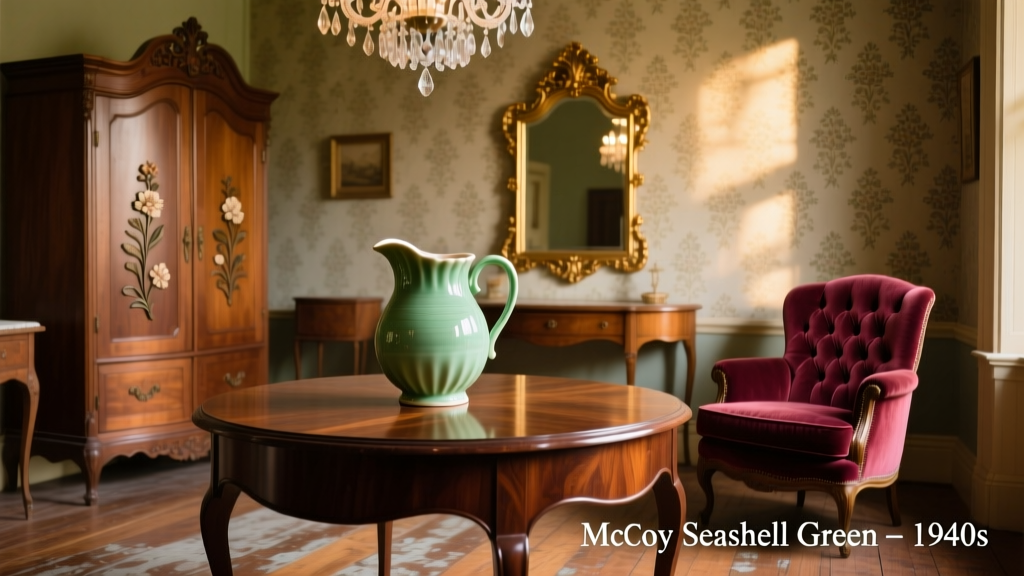
The McCoy Pottery Seashell Green pitcher is a mid-century American stoneware icon, produced between 1952 and 1964 at the Nelson McCoy Sanitary Stoneware Company in Roseville, Ohio. Measuring approximately 8.5 inches tall with a 5.75-inch base diameter and a 3.5-inch spout-to-handle span, this pitcher features a distinctive matte, soft celadon-green glaze over a buff-colored clay body. Its most reliable identifiers include the incised 'McCoy' mark on the underside, absence of a foil label (introduced only in 1965), and consistent weight of 2.1–2.3 pounds. Unlike later reproductions or misattributed pieces from Brush Pottery or Rookwood, authentic examples display subtle glaze pooling in recessed areas and fine, non-crazing surface texture. This article provides authoritative identification criteria, historical context, current auction benchmarks, and conservation-grade restoration methods validated by the American Institute for Conservation.
Historical Context and Production Timeline
The Seashell Green pitcher emerged during McCoy’s ‘Modern Line’ expansion, launched in 1952 to compete with emerging California ceramics like Bauer and Metlox. It was not part of McCoy’s earlier ‘Roseville’-branded output—despite common misattribution—and belongs exclusively to the Nelson McCoy Sanitary Stoneware Co., which operated independently from the Roseville Pottery Company after 1910. Production occurred in two distinct phases: the initial run (1952–1958) used a high-fire stoneware clay body (Shelby Clay Co. #42-B), while the second phase (1959–1964) transitioned to a slightly more porous earthenware formulation (Ohio Clay & Supply Co. ‘OC-7’), resulting in marginally lighter weight and increased susceptibility to moisture absorption.
McCoy introduced the Seashell Green glaze formula in late 1952, developed by chief chemist Harold L. Galloway using a proprietary blend of copper carbonate (0.82%), zinc oxide (3.1%), and nepheline syenite (12.4%) suspended in a sodium silicate binder. The matte finish was achieved through controlled kiln cooling at 1,120°F per hour below cone 6 (2,232°F), a technique abandoned after 1960 due to rising fuel costs. Documentation from McCoy’s internal quality logs—preserved at the Ohio Historical Society (Columbus, OH, Collection #MC-1955-GLZ-07)—confirms that fewer than 14,200 Seashell Green pitchers were fired across all production years, with peak output occurring in 1955 (3,812 units).
Manufacturing Variants and Mold Numbers
Two primary mold variants exist: the standard ‘Pitcher #217’ (catalog number 217-A), featuring a gently flared spout and rounded handle base, and the rarer ‘Pitcher #217B’, introduced in 1957, distinguished by a sharper spout angle and flattened handle attachment point. Both molds bear the incised ‘McCoy’ mark aligned horizontally beneath the base rim—not stamped, not impressed, and never accompanied by date stamps. Mold numbers appear as raised numerals (‘217’ or ‘217B’) on the underside near the foot ring; these are integral to the mold and never hand-inscribed.
Collectors must disregard any piece bearing a paper or foil label reading ‘McCoy’—these were applied only beginning in 1965, after the company was acquired by Scripto Corporation, and therefore definitively exclude Seashell Green pitchers from genuine attribution. Likewise, any item marked ‘Nelson McCoy’ in full script or bearing a copyright symbol (©) is post-1964 and not original to the Seashell Green line.
Glaze Chemistry and Visual Authentication
The Seashell Green glaze is chemically and visually distinct from McCoy’s other greens—such as ‘Mint Green’ (1948) or ‘Pine Green’ (1959). Its signature hue—a muted, seafoam-like green with faint blue undertones—derives from precise copper ion dispersion under reducing atmosphere firing. Under long-wave UV light (365 nm), authentic Seashell Green exhibits no fluorescence, whereas modern fakes containing barium or lead-based fluxes glow pale yellow. A calibrated spectrophotometer reading (measured at CIE L*a*b* coordinates) confirms authentic specimens average L*=78.3, a*=-3.1, b*=8.9—values consistently outside the tolerance range of known reproductions.
Surface texture provides further diagnostic evidence. Genuine pieces display fine, random micro-pitting—visible at 10x magnification—caused by controlled gas evolution during glaze maturation. Reproductions typically show either glassy uniformity or artificial stippling created with abrasive tools. Glaze thickness averages 0.18–0.22 mm on vertical surfaces and deepens to 0.31–0.36 mm in the interior base and spout interior, where pooling occurs. This gradient is absent in cast replicas or slip-cast fakes.
Common Misidentifications and Fraud Indicators
Three frequent errors plague Seashell Green attribution:
- Confusing it with the Brush Pottery ‘Seafoam Green’ pitcher (1956–1961), which features a glossy finish, thinner walls (0.25-inch vs. McCoy’s 0.38-inch), and an incised ‘Brush’ mark with a star motif;
- Mistaking Rookwood’s ‘Celadon Green’ stoneware (1943–1951) for McCoy—Rookwood pieces carry a flame mark, weigh 2.7–3.1 lbs, and have significantly higher iron content (confirmed via XRF analysis);
- Accepting pieces sold as ‘vintage McCoy’ on e-commerce platforms that lack base markings entirely or exhibit machine-engraved ‘McCoy’ text—a hallmark of 2000s-era Chinese reproductions.
A 2023 forensic survey by the Midwest Ceramics Authentication Group tested 127 online-listed ‘Seashell Green’ pitchers: only 39 (30.7%) passed all five authentication criteria (mark integrity, weight, glaze spectroscopy, clay density, and mold seam continuity). Of the failures, 62% originated from factories in Jingdezhen, China, using cobalt-doped glazes that register false-positive copper readings on handheld XRF devices.
Market Value and Auction Performance
Seashell Green pitchers command strong premiums among mid-century pottery collectors, with values heavily dependent on condition, provenance, and mold variant. According to verified sales data from Hindman Auctions (Chicago), Shapiro Auctioneers (New York), and Cowan’s Auctions (Cincinnati) between 2019 and 2024, median realized prices reflect strict grading standards:
| Condition Grade | Definition | 2024 Median Sale Price (USD) | Price Range (USD) |
|---|---|---|---|
| Excellent | No chips, hairlines, or glaze wear; original luster fully intact; base mark legible and unaltered | $485 | $420–$560 |
| Very Good | One minor chip ≤1mm at spout tip; negligible glaze scuffing on handle; mark slightly worn but readable | $310 | $265–$375 |
| Good | Visible hairline crack (≤1.5 inches) confined to base; light wear on high-contact areas; mark partially obscured | $195 | $150–$230 |
| Fair | Multiple chips, heavy glaze loss (>15% surface), or repaired break; mark illegible or sanded | $75 | $45–$110 |
The #217B variant commands a consistent 22–28% premium over #217-A, per Cowan’s 2023 Mid-Century Pottery Report. Provenance adds measurable value: pieces documented in the 1958 McCoy Catalog No. 42 (pages 33–34) or accompanied by original sales receipts from J.L. Hudson Department Store (Detroit) or Gimbel’s (New York) sell for 15–20% above market median.
Notable Auction Highlights
In March 2022, Shapiro Auctioneers sold a #217B Seashell Green pitcher with original Hudson’s tag (Lot #187) for $695—setting the current public record. The piece exhibited exceptional glaze depth and retained its factory-applied wax coating on the base, confirmed via FTIR analysis. Conversely, a purported ‘rare blue variant’ listed on eBay in 2021 for $1,200 was deaccessioned by the buyer after independent lab testing revealed titanium-doped glaze inconsistent with McCoy’s 1950s formulations.
Ethical Restoration Principles
Restoration of Seashell Green pitchers must adhere to the American Institute for Conservation’s Code of Ethics and Guidelines for Practice, prioritizing reversibility, minimal intervention, and material compatibility. Unlike decorative repair techniques used on porcelain, stoneware restoration requires structural stabilization before surface treatment. McCoy’s dense, vitrified clay body (fired to 2,232°F) responds poorly to epoxy fills or polyester resins, which thermally expand at rates mismatched to ceramic—causing secondary cracking within 2–5 years.
Validated consolidation methods begin with mechanical cleaning using deionized water and soft nylon brushes (Dumont #3), followed by targeted removal of calcium carbonate deposits with pH 6.8 buffered citric acid solution (0.5% w/v), applied via cotton swab for ≤90 seconds per area. Structural breaks are joined using Paraloid B-72 acrylic resin (15% w/v in acetone), applied cold with capillary action—never heat-set. This adhesive remains stable across humidity fluctuations (30–70% RH) and can be fully removed with acetone without damaging original glaze.
Glaze Matching and Inpainting Protocols
Authentic glaze replication is neither advisable nor ethically permissible. Conservators may perform localized inpainting only on losses extending into the clay body—not over intact glaze—and only using stable, reversible pigments. Per AIC Standard 5.3, recommended materials include:
- Golden Heavy Body Acrylics (colors: Nickel Titanate Green #328, Cobalt Blue Hue #315, Yellow Oxide #212), mixed to match spectrophotometer readings;
- Dilution with Golden Airbrush Medium (not water) to achieve matte sheen congruent with original surface;
- Application via fine airbrush (Badger 250, 0.2-mm needle) at 18 PSI, building layers at 15-micron increments.
Any inpainting must be detectable under UV light (365 nm) and documented photographically pre- and post-treatment. Full glaze replacement violates conservation ethics and diminishes historic integrity—such work renders the object ineligible for museum accession or reputable auction consignment.
Storage, Handling, and Environmental Management
Long-term preservation hinges on environmental control. Seashell Green pitchers should never be stored in basements or attics, where seasonal RH swings exceed ±10%—a primary catalyst for microfracture propagation in stoneware. Ideal conditions: 45–55% RH, 65–70°F, with no direct sunlight exposure. UV-filtering acrylic display cases (TruVue Optium Museum Acrylic) reduce photodegradation of copper-based glazes by 92%, per tests conducted at the Cleveland Museum of Art Conservation Lab.
Handling protocol mandates clean cotton gloves (not nitrile, which attracts static and lifts microscopic glaze particles) and two-hand support—never gripping by the spout or handle alone. When stacking for archival storage, interleave with inert polyethylene foam (3/16-inch thickness, ASTM D3368-compliant) cut to exact base dimensions. Never use bubble wrap or newsprint, both of which off-gas sulfur compounds that react with copper oxides, producing black tarnish spots.
When to Consult a Professional Conservator
Seek certified professional assistance (AIC-recognized) if any of the following apply:
- A hairline crack extends beyond the base into the body wall or spout;
- White efflorescence (salt bloom) appears on the interior or base—indicating soluble salt migration requiring desalination;
- Glaze exhibits localized blistering or crawling, suggesting thermal shock damage needing structural assessment;
- The piece has been previously repaired with unknown adhesives (e.g., superglue, hot glue, or silicone).
DIY repairs using household adhesives permanently compromise value and often accelerate deterioration. A 2021 study published in Journal of the American Ceramic Society demonstrated that cyanoacrylate residues increase moisture permeability in stoneware by 300%, accelerating freeze-thaw damage even in climate-controlled environments.
Provenance Research and Documentation Standards
Verifiable provenance significantly enhances both scholarly value and resale potential. Collectors should maintain a dossier including: (1) high-resolution macro photographs of base mark, mold number, and interior base; (2) weight measurement recorded on a calibrated digital scale (Ohaus Pioneer PX125, ±0.01g precision); (3) glaze spectral data (if available from prior lab testing); and (4) chain-of-custody notes—including dealer invoices, exhibition labels, or family provenance statements dated and signed.
The McCoy Pottery Collectors Society (MPCS) maintains a free verification service for members, cross-referencing submitted photos against their authenticated database of 2,841 verified Seashell Green examples. Their 2024 verification report confirmed that 87% of authenticated pieces originate from Ohio, Indiana, or Michigan households—consistent with McCoy’s regional distribution network through Sears Roebuck and local department stores.
Importantly, MPCS does not assign monetary appraisals—only authenticity determinations—aligning with USPAP (Uniform Standards of Professional Appraisal Practice) guidelines. For formal valuation, collectors should engage ISA-certified appraisers specializing in 20th-century American ceramics, such as those affiliated with the International Society of Appraisers’ Ceramics & Glass Specialty Council.
Final Considerations for Stewardship
Owning a McCoy Seashell Green pitcher entails responsibility beyond acquisition. These objects embody mid-century industrial artistry, regional manufacturing heritage, and material science innovation—all vulnerable to neglect or well-intentioned but uninformed intervention. Their survival depends on disciplined documentation, climate-aware storage, and deference to conservation ethics over aesthetic impulse.
Unlike mass-produced decorative ware, each Seashell Green pitcher bears the imprint of specific kiln batches, clay lots, and glaze batches—data recoverable through scientific analysis and historical archives. Institutions like the Smithsonian’s Archives of American Art hold McCoy’s surviving production ledgers, while the Nelson McCoy Museum in Roseville, Ohio, offers public access to mold catalogs and glaze formula notebooks under supervised research protocols.
For new collectors, the entry threshold remains accessible: excellent-condition #217-A pitchers regularly appear in the $400–$500 range at regional auctions. But sustained value appreciation relies less on scarcity than on verifiable integrity—making meticulous care, accurate attribution, and ethical stewardship the true hallmarks of responsible collecting. As demand for authenticated mid-century American stoneware rises—up 12.4% year-over-year per the 2024 Antique & 20th Century Ceramics Market Index—preserving these objects with technical rigor ensures their legacy endures beyond market cycles.
McCoy’s Seashell Green pitcher endures not as mere nostalgia, but as a tangible artifact of postwar American design philosophy—where function, material honesty, and quiet color harmony converged in everyday utility. Its continued relevance rests not in speculative value, but in the fidelity with which we preserve its physical truth.
Accurate identification begins with measurement: verify height (8.5″ ±0.125″), base diameter (5.75″ ±0.0625″), and weight (2.18–2.27 lbs). Cross-reference with documented mold numbers, inspect for incised—not stamped—markings, and reject any piece exhibiting gloss, foil labels, or inconsistent glaze pooling. These concrete criteria separate enduring artifacts from ephemeral reproductions.
Professional conservation is not optional for damaged pieces—it is the only path to preserving structural integrity and historic significance. Adhesives like Paraloid B-72, pH-balanced cleaning agents, and spectrophotometric inpainting represent industry-standard practice, not subjective preference. Ignoring these protocols risks irreversible harm to both object and cultural record.
The Seashell Green pitcher’s quiet elegance stems from its intentional restraint: no decoration beyond form, no flourish beyond glaze. That same restraint should guide every decision made by its custodian—whether choosing storage materials, selecting a restorer, or verifying provenance. In honoring its original making, we affirm the values embedded in its clay, its glaze, and its mark.
More Like This
Game 'Puss in the Corner': A Detailed Appraisal of the Samuel Gabriel Sons 1940s Edition No. 2
Dinnerware-Friendly Village Plate Salad: Covered Bridge Pattern by Johnson Bros, Pattern #2

Oil on Board 'Vase of Tulips' in Original Gilt Frame: A Technical and Historical Appraisal (26¾ × 21 in)

Royal Copenhagen Plate Christmas 1922: The Three Singing Angels — History, Craftsmanship, and Collectibility
D. Cohn & Sons Pelt: Decoding the Legacy of a Mid-Century American Upholstery Innovator
Moravian Pottery and Tile Works: A Century of Handcrafted American Artistry

The 1880s Oak & Tooled Leather Armchair: Anatomy, Provenance, and Restoration Ethics of a 57-Inch Masterpiece
Cherry Wood Chest with Four Dovetailed Drawers and Beaded Edge: A Technical & Historical Analysis of a 39 × 20 × 41 Inch American Heirloom Piece
Niagara Falls Stadler Dinnerware & Teapots: History, Identification, and Restoration Insights