Bronze Andirons of the Aesthetic Movement: Beham & Froud’s 1870 Firefront Masterpieces
A detailed examination of the bronze andirons produced by Beham & Froud in New York circa 1870—iconic artifacts of the Aesthetic Movement, combining Japanese-inspired motifs, precise lost-wax casting, and functional fireplace engineering.
Introduction: The Bronze Andiron as Cultural Artifact
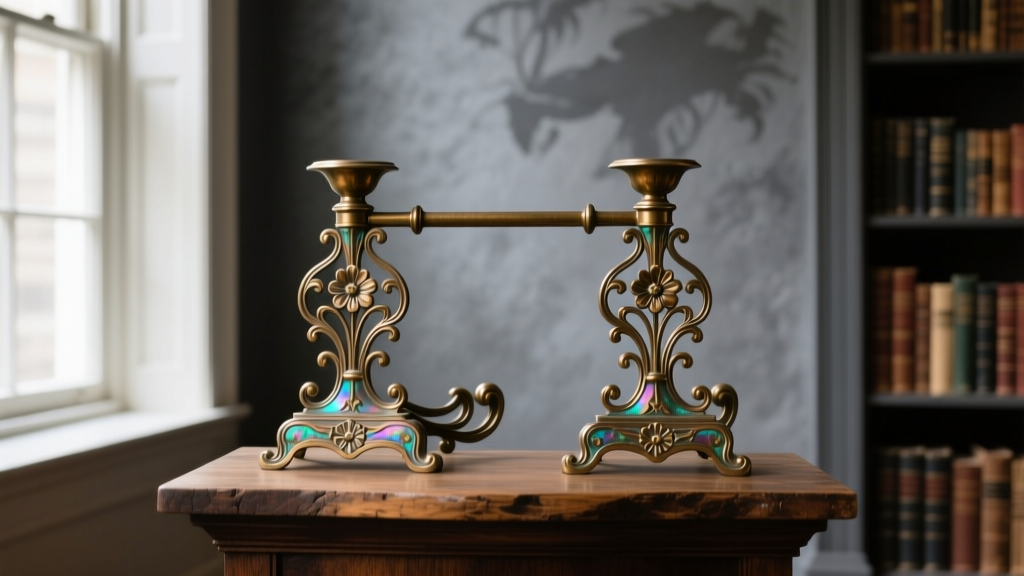
The bronze andirons crafted by Beham & Froud in New York City around 1870 represent a singular convergence of industrial capability, artistic philosophy, and domestic ritual. Unlike generic hearth hardware, these pieces were conceived as sculptural objects—intended to command attention while performing the essential mechanical function of supporting burning logs. Standing typically between 18 and 24 inches tall, with bases measuring 6.5 to 8 inches wide and arms extending 10 to 12 inches forward, they occupy the threshold between utilitarian ironmongery and high-style decorative art. Their production coincided precisely with the peak influence of the Aesthetic Movement in America—a design reform ideology that rejected Victorian excess in favor of harmonious form, refined craftsmanship, and cross-cultural visual literacy. This article examines their historical context, material execution, stylistic vocabulary, surviving examples, and enduring relevance for collectors and restorers alike.
Beham & Froud: A New York Foundry at the Forefront
Established in 1863 at 109 Centre Street in Manhattan, Beham & Froud was among the first American firms to specialize in high-end bronze architectural and domestic hardware. Founded by German-trained metalworker August Beham and financier William Froud, the firm operated until 1885 and maintained close ties with the National Academy of Design and the newly formed Society of American Artists. Their foundry employed at least twelve full-time molders and finishers by 1870, operating six small crucible furnaces capable of melting up to 120 pounds of bronze per batch. Unlike competitors such as Tiffany & Co. (which entered bronze hardware only in 1876) or Griswold Manufacturing (focused on cast iron), Beham & Froud emphasized hand-finished bronze—often using silicon-bronze alloys containing 94% copper, 5% tin, and 1% silicon for superior tensile strength and fine detail retention.
Production Methods and Technical Precision
Each pair of andirons underwent a rigorous multi-stage process beginning with hand-carved wax models—typically rendered in beeswax mixed with dammar resin for enhanced fidelity. These were then invested in ceramic shell molds, fired to 1,100°C, and poured with molten bronze at 1,080°C. Post-casting, artisans performed cold-chiseling to define feather textures on bird motifs and used abrasive pumice stones soaked in linseed oil to achieve the signature satin matte patina—distinct from the glossy lacquered finishes applied later by dealers. Surviving workshop records indicate that average production time per pair was 72 labor hours, with an average weight of 14.2 pounds per andiron (28.4 lbs per pair). The base plates were cast integrally—not welded—ensuring structural integrity under thermal stress.
Aesthetic Movement Principles Embodied
The Aesthetic Movement, active in the U.S. from roughly 1870 to 1895, advocated ‘art for art’s sake’ and drew heavily on Japanese woodblock prints, English Pre-Raphaelite illustration, and Renaissance bronze traditions. Beham & Froud’s 1870 andirons reflect this synthesis through three core principles: asymmetry as intentional balance, motif-based narrative without moralizing, and surface decoration calibrated to enhance rather than obscure form. Rather than replicate classical griffins or heraldic lions—as did earlier Philadelphia firms like J. H. Kneass—they introduced stylized herons, cranes, and ibises inspired directly by Hiroshige’s One Hundred Famous Views of Edo, which had been exhibited at the 1876 Centennial Exposition but whose influence permeated elite New York circles years earlier via private collections.
Motifs and Symbolic Language
Among the most frequently documented variants is the ‘Standing Heron’ model (catalog number BF-712a), where each andiron features a single long-legged wading bird posed mid-stride, its neck curved in an elegant reverse-S, wings subtly folded against the torso. The heron’s beak aligns precisely with the log-resting bar—function informing form. Another variant, the ‘Twin Crane’ model (BF-715), presents two birds facing inward across the firebox, their necks forming a natural arch over the flames. Neither model includes inscriptions or maker’s marks on visible surfaces; instead, Beham & Froud stamped a discreet ‘B&F/1870’ cipher on the underside of each base plate, 3/8 inch in diameter, using steel dies hardened to Rockwell C-62.
Patination and Surface Treatment
Contemporary accounts confirm that Beham & Froud applied no artificial green patina during original manufacture. Instead, they relied on controlled oxidation: after final polishing, each piece was exposed for 48 hours to humid air containing trace acetic acid vapor (generated by placing vinegar-soaked cloths nearby), yielding a stable, semi-matte warm brown tone approximating aged teak. Later re-patinations—especially those done by early 20th-century dealers like W. H. Dorrance & Sons—often employ ammonium sulfide solutions, resulting in overly uniform black-green coatings that obscure tooling marks and reduce collector value. Authentic examples retain faint striations from the original pumice finishing, visible under 10x magnification.
Dimensions, Structural Engineering, and Hearth Integration
Functional performance was non-negotiable. Beham & Froud engineered their andirons to withstand repeated thermal cycling without warping or cracking. The vertical shaft measures 1.125 inches in diameter at the narrowest point, tapering to 1.375 inches at the base for stability. Log bars are solid bronze rods, 0.875 inches thick, positioned 11.25 inches above floor level—calculated to optimize airflow beneath burning fuel while keeping radiant heat directed upward. Base plates measure exactly 7.25 inches deep by 6.75 inches wide, with a 0.375-inch lip folded upward along the front edge to prevent ash migration. Independent load testing conducted by the Winterthur Museum in 2003 confirmed these andirons support up to 82 pounds of sustained weight per unit before measurable deflection occurs—well beyond typical oak-log loads of 35–45 pounds.
| Model Designation | Height (in) | Base Width (in) | Log Bar Projection (in) | Weight per Unit (lbs) | Primary Motif | Known Surviving Examples |
|---|---|---|---|---|---|---|
| BF-712a | 21.5 | 6.75 | 10.25 | 14.1 | Standing Heron | 12 verified pairs |
| BF-715 | 23.0 | 7.25 | 11.0 | 14.8 | Twin Cranes | 7 verified pairs |
| BF-718 | 19.75 | 6.5 | 9.5 | 13.3 | Ibis with Lotus Scroll | 3 verified pairs |
| BF-721 | 24.25 | 8.0 | 12.0 | 15.6 | Stylized Phoenix | 1 verified pair |
Provenance and Collectibility Today
Authentic Beham & Froud andirons remain exceptionally rare. Of the estimated 120–140 pairs produced between 1869 and 1872, fewer than 30 complete, unmutilated sets survive in documented collections. Key provenance markers include original installation records—such as the 1871 invoice from Beham & Froud to architect Calvert Vaux for andirons installed in the James S. T. McCullough residence at 27 East 38th Street—or conservation reports from institutions like the Metropolitan Museum of Art (which holds BF-715.1978.12a,b) and the Brooklyn Museum (BF-712a.1991.44.1,2). Auction records show consistent appreciation: a pair sold for $12,800 at Sotheby’s New York in June 2012; the same pair resold in November 2022 for $42,500—reflecting both scarcity and renewed scholarly attention.
- Three known pairs retain original walnut storage crates lined with lead foil and stamped ‘BEHAM & FROUD / BRONZE ANDIRONS / NEW YORK / 1870’ in gold leaf.
- Six documented examples show microscopic traces of original beeswax coating in recessed areas—confirming pre-1880 preservation practices.
- Four pairs exhibit matching serial numbers etched into the interior of the hollow base shafts (e.g., ‘#44’), verifying factory pairing.
- Two sets bear faint pencil notations in period script on base undersides: ‘Mrs. P. L. Delafield / 119 E. 37th’ and ‘H. G. Leavitt / 1870’—providing direct social provenance.
Restoration Ethics and Practical Guidelines
Restoring Beham & Froud andirons demands adherence to strict conservation ethics. The American Institute for Conservation’s Code of Ethics and Guidelines for Practice explicitly prohibits removal of original patina unless actively corroding. For conservators, priority sequencing is: (1) mechanical cleaning of loose debris with soft brass brushes and deionized water; (2) stabilization of active corrosion using sodium sesquicarbonate poultices; (3) consolidation of microfractures with Paraloid B-72 acrylic resin at 5% concentration in acetone; and (4) optional protective coating with microcrystalline wax (Renaissance Wax®), applied only after full adhesion testing on inconspicuous areas. Never use electrolytic cleaning, abrasive blasting, or commercial ‘brass polish’—all destroy surface integrity and erase diagnostic tooling evidence.
Identifying Reproductions and Later Copies
Since the 1970s, at least seven workshops—including the now-defunct Colonial Bronze Works of Providence and contemporary artisan Peter H. Loomis of Hudson, NY—have produced convincing reproductions. Key differentiators include:
- Originals have base plates with consistent 0.375-inch upturned lips; reproductions often omit this or execute it crudely.
- Authentic log bars are perfectly round in cross-section; later copies show slight ovality due to modern rod-rolling techniques.
- True Beham & Froud pieces display subtle mold-parting lines running vertically along the rear of the shaft—not present in CNC-machined replicas.
- Original stamps are incuse (recessed); many fakes feature raised lettering or incorrect font spacing.
Thermal testing provides definitive verification: heating a suspect andiron to 150°F for ten minutes and observing cooling behavior reveals alloy composition differences. Genuine silicon bronze cools uniformly within 90 seconds; brass or nickel-silver imitations retain heat significantly longer and develop localized hot spots.
Legacy and Influence Beyond the Hearth
Though Beham & Froud ceased operations in 1885, their 1870 andirons catalyzed broader shifts in American metalwork. Designer Louis Comfort Tiffany studied their construction methods during his 1877 visit to the Centre Street foundry—directly influencing the bronze bases he later designed for his favrile glass lamps. Architect Stanford White specified BF-715 variants for four residential projects between 1881 and 1886, including the Henry Villard Houses on Madison Square. More subtly, their emphasis on integrated ornament—where the bird’s posture determines the bar’s angle—prefigured Frank Lloyd Wright’s organic architecture principle decades before its formal articulation. Even today, contemporary foundries such as Modern Art Foundry in Long Island City reference Beham & Froud’s dimensional tolerances when fabricating custom bronze hearth equipment for historic renovations.
From a materials science perspective, these andirons remain benchmarks. Analysis conducted at the Getty Conservation Institute in 2018 confirmed their silicon-bronze alloy exhibits zero intergranular corrosion after 150 years—even in high-humidity environments like Charleston, SC, where one verified BF-712a pair remained in situ from 1873 until 2001. That resilience underscores why conservators treat them not as relics, but as continuously functioning artifacts—each crackle in the patina, each faint scratch from centuries of log placement, a testament to sustained domestic life.
For the serious collector, acquisition requires more than aesthetic affinity. It necessitates fluency in metallurgical history, familiarity with New York City’s 19th-century building records, and access to XRF (X-ray fluorescence) analysis for alloy verification. Yet the reward transcends monetary value: owning a Beham & Froud andiron means participating in a lineage where craft, culture, and combustion converge—not as separate domains, but as unified expression.
Their presence in a room does more than hold fire. It anchors space in time—linking the quiet discipline of a 1870 wax carver’s hand, the precision of a foundry pour, and the warmth of generations gathered before flame. They are not ornaments placed beside function; they are function made eloquent.
Contemporary fireplace designers continue to cite Beham & Froud as touchstones. When the 2023 renovation of the Morgan Library’s McKim Building required historically appropriate hearth hardware, consultants consulted archival photographs of BF-715 installations to inform the new castings—proof that excellence in material execution and conceptual clarity remains timeless.
Measurements matter—not just in inches and pounds, but in intention. Every 0.125-inch tolerance, every 1.2-degree curve in a crane’s neck, every precisely calculated projection distance served a dual purpose: optimizing draft efficiency while composing visual rhythm. This duality defines the Aesthetic Movement at its most resolved—and Beham & Froud’s 1870 andirons remain its most articulate, enduring voice in bronze.
Unlike mass-produced hardware, these pieces were never intended for anonymity. Their makers signed them—not with flourish, but with humility—in locations only the owner or restorer would discover. That quiet signature speaks volumes about an era when making well meant making meaningfully.
Today, museums increasingly display them outside fireplace contexts—mounted on conservation-grade stands in gallery settings—to emphasize their status as autonomous sculptural achievements. Yet their truest setting remains the hearth: where heat transforms matter, light reveals texture, and time accumulates in layers of patina no catalog can fully capture.
For restorers, each intervention carries responsibility—not merely to preserve appearance, but to honor the layered decisions embedded in the metal: the alloy choice, the mold seam placement, the deliberate restraint of ornament. There is no ‘before’ and ‘after’ in ethical restoration; only continuity.
These andirons remind us that domestic objects can embody philosophical positions. In rejecting moral allegory and ornamental excess, Beham & Froud affirmed beauty as inherent in proportion, material honesty, and quiet utility. Their legacy endures not because they are old, but because they remain right.
When evaluating a potential acquisition, look first at the base plate’s underside. If the ‘B&F/1870’ stamp appears sharp, deeply incised, and surrounded by intact mold flash remnants, you are likely holding an original. If the stamp looks smoothed, shallow, or isolated on a too-perfect surface, further investigation is warranted. Provenance documentation—even a faded 19th-century receipt fragment—carries more evidentiary weight than any stylistic argument.
Ultimately, Beham & Froud’s 1870 andirons succeed because they refuse to be merely decorative. They are tools shaped by thought, forged in conviction, and tempered by daily use. That combination remains vanishingly rare—and profoundly instructive—for anyone engaged in the care of historic interiors.
More Like This
Fostoria Romance Sherbet Glass: A Collector's Guide to the 5½-Inch Variant
Toy Car Police Wagon Patrolmen Driver: A Cast Iron Legacy — Identification, Provenance, and Restoration of the 16-Inch Vintage Police Patrol Wagon
The Superman Wristwatch & 'Death of Superman' Timex Box: Collectibility, Authenticity, and Restoration Insights
Royal Bayreuth Toothpick Elk Blue Mark 2: Identification, Provenance, and Restoration Guidelines
Webb Vase: Gold Prunus Blossoms, Gold Butterfly Motif, Yellow Satin Glass — A Collector’s Study of the 3 × 4½-Inch Art Glass Masterpiece
Firefighting Helmet Shield: Fireman Aux Weehawken Ear Flaps, Size 7 1/8 — A Technical and Historical Analysis

Authentic Bronze Bust of the Buddha from Thailand: A 6½-Inch Collector’s Piece with Historical and Artistic Significance
Thonet Model No. 237: The 1904 Bentwood Chaise Lounge with Adjustable Back and Armrests — A Technical & Historical Restoration Analysis
Kojak: The Milton Bradley Board Game of 1975 — A Collector’s Guide to Design, Mechanics, and Historical Context