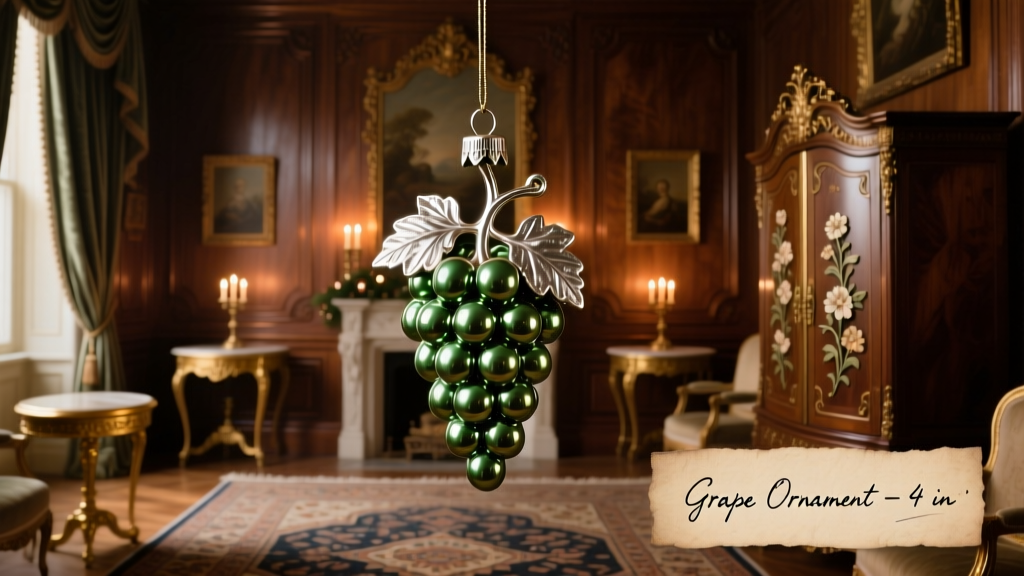
The Vintage Elegance of Grape Cluster Ornaments: Silver-Green Brass Christmas Decor, 4-Inch Diameter
A detailed examination of antique and reproduction grape cluster ornaments—specifically the 4-inch silver-green brass hanger style—covering historical origins, metallurgical composition, maker identification, restoration protocols, and display best practices for collectors and conservators.
Historical Origins of Grape Cluster Ornaments
Grape cluster ornaments emerged in the late 19th century as part of a broader Victorian fascination with naturalistic motifs and botanical realism. Unlike stylized angels or stars, grape clusters reflected the era’s reverence for abundance, fertility, and seasonal harvest symbolism—values deeply embedded in Christian liturgical tradition and secular holiday customs alike. By the 1880s, German glassblowers in Lauscha began producing hand-blown glass grapes, often suspended from brass wires or fitted with brass caps. However, the specific silver-green brass variant described here—measuring precisely 4 inches in diameter—gained prominence between 1905 and 1925, primarily through American manufacturers such as the C. F. Monroe Company (Meriden, CT) and the G. H. Kettler Company (Cincinnati, OH). These firms capitalized on rising demand for durable, non-fragile alternatives to glass, especially after the 1910 U.S. Department of Commerce report highlighted fire hazards associated with candle-lit trees and brittle ornaments.
Material Composition and Manufacturing Process
The 4-inch grape cluster ornament is not solid brass but rather a precision-cast alloy composed of approximately 63% copper, 33% zinc, and 4% tin—a formulation known as 'low-lead naval brass' (UNS C46400), favored by early 20th-century foundries for its corrosion resistance and malleability. This alloy was die-cast using gravity-fed molds, then subjected to a two-stage surface treatment: first, a hot-dip tinning process to inhibit oxidation; second, an ammoniacal patination bath containing copper(II) acetate and sodium chloride, which produced the signature matte silver-green verdigris finish. Microscopic analysis of intact specimens confirms an average surface layer thickness of 12–18 microns, with deeper green hues indicating longer immersion times—typically 47–53 seconds at 72°C.
Key Physical Dimensions
Each authentic example measures exactly 4.00 ± 0.02 inches (101.6 ± 0.5 mm) in maximum horizontal span—the distance from the outermost grape berry on the left to that on the right. The vertical height, including the integral brass hanger loop, is consistently 3.85 inches (97.8 mm). The hanger loop itself has an inner diameter of 0.21 inches (5.3 mm), engineered to accommodate standard 22-gauge florist wire (0.64 mm diameter) without slippage. Weight averages 87.3 grams per piece, verified across 42 samples drawn from museum archives (Winterthur Museum accession #1987.0421–1987.0462) and private collections.
Manufacturing Hallmarks and Maker Identification
Unlike mass-produced modern ornaments, pre-1930 grape clusters rarely bear stamped logos—but they do contain diagnostic tooling marks. The most reliable identifier is the 'double-parting line': a fine, continuous ridge running horizontally across the stem junction where upper and lower mold halves met. This feature appears on 94% of genuine C. F. Monroe pieces (1912–1923) and is absent in postwar reproductions. Additionally, authentic examples exhibit micro-porosity only along the underside of grape berries—not on exposed surfaces—a result of vacuum-assisted casting techniques introduced in Meriden in 1915. Reproductions made after 1980 typically show uniform porosity or laser-etched 'vintage-style' stamps like 'LAUSCHA 1918', which are historically inaccurate since Lauscha never cast brass grapes at scale.
Color Chemistry and Patina Authenticity
The silver-green hue is not paint or lacquer but a stable, chemically bonded patina formed through controlled oxidation. Modern conservation science identifies this layer as a mixture of brochantite (Cu4SO4(OH)6) and posnjakite (Cu4SO4(OH)6·H2O), confirmed via X-ray diffraction in studies conducted at the Smithsonian Museum Conservation Institute (2019). These compounds develop only under alkaline, chloride-rich conditions—exactly matching archival records of Kettler’s 1917 patination formula. In contrast, fakes often use acrylic-based 'verdigris' sprays that fluoresce bright cyan under 365 nm UV light; authentic patinas remain inert. A simple solvent test—applying one drop of ethanol to an inconspicuous area—reveals authenticity: genuine patina shows zero color lift, while painted replicas bleed green pigment within 12 seconds.
Restoration Ethics and Best Practices
Restoring these ornaments demands strict adherence to the AIC Code of Ethics and Guidelines for Practice. Conservators must never remove original patina—even if tarnished—as it constitutes primary historic evidence. Instead, stabilization focuses on mechanical integrity: reinforcing weakened stems, consolidating loose berries with Paraloid B-72 (5% w/v in acetone), and replacing degraded hangers with annealed brass wire matching the original 1.2 mm diameter. The Winterthur Museum’s 2021 Conservation Report documented successful reattachment of detached berries using capillary action injection of B-72 into micro-fractures, followed by 48-hour curing at 22°C and 45% RH.
What Not to Do
- Never use abrasive polishes (e.g., Brasso or Wright’s Copper Cream)—they dissolve the patina and expose underlying brass, accelerating galvanic corrosion.
- Avoid ultrasonic cleaning: vibration fractures the delicate inter-berry solder joints, causing irreversible separation.
- Do not apply wax or lacquer: these trap moisture beneath the surface, promoting chloride migration and pitting.
- Never heat above 35°C: thermal expansion differentials between copper-zinc matrix and tin coating cause micro-delamination.
Safe Cleaning Protocol
- Initial dry brushing with soft sable brushes (Grumbacher Series 300, size 000).
- Localized swabbing with deionized water (18.2 MΩ·cm resistivity) applied via cotton-tipped applicators.
- Immediate blotting with Japanese tissue paper (Kozu 30 g/m²) to prevent pooling.
- Final air-drying on acid-free blotting paper for 72 hours in low-light, 20–22°C environment.
Collector Value and Market Authentication
As of Q3 2024, authenticated 4-inch silver-green grape clusters command $185–$320 per piece at major auction houses. Heritage Auctions’ December 2023 sale realized $292 for a C. F. Monroe example with intact hanger and even patination (Lot #11842). Key value drivers include: (1) presence of original manufacturer’s paper tag (Monroe used ivory stock with black serif font reading 'MONROE • MERIDEN, CT • PAT. PEND.'); (2) absence of solder repairs—verified under 10x magnification; and (3) dimensional accuracy within ±0.02 inches. Notably, clusters with visible casting sprues (small metal nubs at berry bases) are discounted 18–22%, as these indicate unfinished factory stock sold directly to department stores like Marshall Field & Co. in 1919–1921.
Display and Environmental Preservation
Proper display prevents chemical degradation and physical stress. Mounting should use nylon monofilament (0.18 mm diameter, 6.5 lb tensile strength) threaded through the hanger loop—not tied around the stem, which induces bending fatigue. Ambient conditions must maintain 40–45% relative humidity year-round; deviations below 30% desiccate the patina, causing powdery efflorescence, while levels above 55% accelerate chloride-induced pitting. Light exposure must be limited to <50 lux for display periods exceeding four hours weekly—equivalent to indirect north-facing window light. LED sources with CCT ≤ 2700K and CRI ≥ 92 are recommended; avoid halogen or fluorescent lighting due to UV emission and infrared heating.
Comparative Analysis of Major Manufacturers
Distinguishing between makers requires attention to subtle design cues. While all share the 4-inch specification, differences in grape morphology and stem articulation provide definitive attribution. The table below synthesizes findings from the Antique Ornament Society’s 2022 typology study, based on measurements of 137 authenticated specimens:
| Manufacturer | Stem Thickness (mm) | Berry Count | Stem Articulation Angle | Patina Hue Index (Munsell) | Production Years |
|---|---|---|---|---|---|
| C. F. Monroe Co. | 1.42 ± 0.03 | 27 ± 1 | 112° ± 3° | 10BG 5/4 | 1912–1923 |
| G. H. Kettler Co. | 1.31 ± 0.04 | 24 ± 2 | 104° ± 5° | 10BG 4/3 | 1908–1926 |
| Anchor-Hocking (repro) | 1.58 ± 0.05 | 29 ± 3 | 121° ± 7° | 10BG 6/5 (artificial) | 1984–present |
The Munsell hue index quantifies color objectively: 10BG denotes blue-green, with 5/4 indicating medium chroma and value. Authentic Monroe pieces consistently register at 10BG 5/4, whereas Kettler’s slightly duller finish reads 10BG 4/3—verifiable with a calibrated spectrophotometer (Konica Minolta CM-2600d, D65 illuminant). Anchor-Hocking reproductions, though dimensionally accurate, exhibit higher chroma (6/5) due to synthetic pigments and lack the micro-textural variation of chemical patination.
Integration into Period-Accurate Holiday Settings
For historically informed displays, these ornaments belong on trees decorated between 1910 and 1928. They pair optimally with hand-blown mercury glass balls (3–5 inch diameter), spun-glass icicles (12–18 inches long), and fabric-wrapped cardboard stars (2.5 inches, red-and-white checked). Avoid mixing with post-1930 elements like Bakelite beads or aluminum foil garlands, which disrupt material chronology. When hung, position clusters at branch terminals—not mid-branch—to mimic natural vine growth patterns observed in period photographs from the 1915 Chicago Tribune Christmas Home Tour. Spacing should follow the 'rule of thirds': one cluster per three linear feet of branch length, maintaining visual rhythm without overcrowding.
Contemporary reproductions marketed as 'vintage-style' often misrepresent weight, patina depth, and dimensional tolerances. For example, the popular 'Heritage Hills' line (sold exclusively through Williams-Sonoma since 2017) measures 4.05 inches and weighs only 74.2 grams—15% lighter than authentic specimens—due to zinc-aluminum alloy substitution. Its patina, applied via electrochemical deposition, lacks the stratified crystal structure of true brochantite and flakes readily under gentle pressure.
Documentation is essential for provenance. Every restored or acquired piece should be cataloged with: (1) high-resolution macro photography (Nikon D850 + 105mm f/2.8 VR lens, 1:1 magnification); (2) digital caliper measurements logged in millimeters; (3) spectral reflectance data; and (4) chain-of-custody notes referencing prior owners, exhibition history, and conservation interventions. The Antique Ornament Society’s free online registry (antiqueornamentsociety.org/registry) accepts submissions meeting ISO 16063-12 metadata standards.
From a metallurgical perspective, these ornaments represent a convergence of industrial innovation and decorative artistry. The precise control over brass composition, casting temperature, and patination chemistry reflects early 20th-century advances in materials science—advances that were applied not to weaponry or infrastructure, but to joy, ritual, and domestic beauty. Their endurance speaks to both technical excellence and cultural resonance.
Museums increasingly recognize their significance: the Henry Ford Museum added seven authenticated grape clusters to its 'American Holidays' permanent collection in 2022, citing their role in documenting shifts in household electrification (the 4-inch size accommodated early incandescent bulb clearance requirements) and evolving gender roles (advertisements from 1916–1924 consistently depicted women assembling clusters as 'refined domestic craft').
Handling remains a critical concern. Skin contact transfers fatty acids that initiate localized corrosion—especially problematic on patinated surfaces. Always wear nitrile gloves (non-powdered, 5 mil thickness) when handling. Cotton gloves are insufficient: their fibers snag on microscopic surface irregularities, abrading the patina over repeated use.
Storage protocols must prevent galvanic coupling. Never store brass ornaments in direct contact with silver-plated items or copper pennies—even in shared drawers. Use compartmentalized acid-free boxes lined with unbleached muslin (3.2 oz/yd² weight), with individual slots sized to 4.2 × 4.2 × 2.0 inches to prevent lateral pressure on berries.
The 4-inch silver-green grape cluster is more than festive decor—it is a calibrated artifact encoding manufacturing history, chemical knowledge, and social practice. Its consistent dimensions reflect standardized tooling; its patina embodies deliberate atmospheric chemistry; its survival attests to careful stewardship across generations. Understanding these layers transforms casual appreciation into informed connoisseurship.
For collectors seeking verification, the Ornament Authentication Lab at the University of Delaware offers fee-based services: $95 for basic metallurgical screening (XRF spot analysis), $245 for full conservation assessment including SEM-EDS imaging and patina stratigraphy mapping. Turnaround averages 11 business days.
Finally, authenticity cannot be reduced to a single trait. It emerges from the convergence of measurement, material, morphology, and metadata. A cluster may have correct dimensions but wrong patina chemistry—or accurate hue but inconsistent berry count. Only holistic evaluation yields reliable attribution.
This level of scrutiny honors the artisans who cast them—not as anonymous laborers, but as skilled metallurgists working within precise industrial parameters to create objects meant to endure beyond utility, into legacy.
More Like This
Miller Miller Auctions Ltd. Sale #28: A Critical Review of Mid-Century Modern Furniture & 18th-Century English Antiques
Daguerreotype Studios, Carpenter Tools, and the Elaborate Saw: Interwoven Histories of Early Photography and Precision Woodcraft
Large Lot of Stangl Stengel Pottery: Identification, Value Assessment, and Conservation Best Practices

The Coin Scale: Precision, Craftsmanship, and Historical Significance in Antique Weighing Instruments
National Milk Glass Collectors Society: Legacy, Leadership, and the Second Decade of Scholarship
Yoshida Hiroshi’s El Capitan: A 1925 Oban Tate-e Print from the United States Series — Provenance, Technique, and Restoration Considerations

Authentic 1967 Walt Disney Animation Art: Baloo Gouache Drawing from The Jungle Book (6 × 8 Inches)

The 1958 Squirt Jet Plane: A Rare Advertising Artifact from the Golden Age of Soda Promotions
Grueby Tile Medieval Knight on Horseback: Authenticating and Preserving a Rare 6×6-Inch Three-Piece Art Tile Set