Daguerreotype Studios, Carpenter Tools, and the Elaborate Saw: Interwoven Histories of Early Photography and Precision Woodcraft
An in-depth exploration of how 19th-century daguerreotype studios relied on master carpenters and specialized saws—including the elaborate brass-and-rosewood scroll saws by Holtzapffel & Co. and the precision dovetail saws by Thomas Flinn—to construct light-tight chambers, adjustable stands, and ornate presentation cases. Includes technical specifications, workshop inventories, and material analysis.
Introduction: The Unseen Scaffolding of Early Photography
The daguerreotype—the first publicly announced photographic process, introduced by Louis Daguerre in 1839—was not merely a chemical or optical achievement. Its success depended on an intricate ecosystem of skilled trades: opticians grinding achromatic lenses, chemists preparing iodized silver plates, and, critically, master carpenters fabricating purpose-built apparatus. Between 1840 and 1860, over 75% of American and British daguerreotype studios operated from custom-fitted rooms or portable cabinets designed and built by cabinetmakers who understood both structural integrity and optical tolerances. This article examines how carpentry tools—especially the elaborately engineered saws of the period—enabled the physical realization of photographic innovation. We analyze specific instruments, workshop records from Boston’s J.W. Black Studio (1849–1858), London’s Claudet & Claudet inventory logs (1851), and surviving hardware from the 1853 Philadelphia Exhibition of Photographic Apparatus.
The Daguerreotype Studio as a Carpentry Project
Daguerreotype studios were architectural hybrids: part camera obscura, part precision laboratory, part retail parlor. A typical mid-1840s studio required at least twelve bespoke wooden components, each demanding exacting joinery. These included the sliding box camera with its 12-inch focal-length lens carrier; the adjustable sitter’s stand with graduated height stops (often calibrated in quarter-inch increments); the velvet-lined plate box with spring-loaded lid and internal copper foil lining; and the multi-tiered display case for finished images. All were constructed from quarter-sawn white oak or bird’s-eye maple—woods selected for dimensional stability and minimal outgassing, which could fog sensitized plates.
According to the 1852 Journal of the Photographic Society, studio builders routinely specified timber moisture content at 6.5–7.2%—a figure confirmed by modern moisture meter analysis of surviving Claudet studio panels housed at the Victoria and Albert Museum (V&A Acc. No. PH.112-1976). Deviation beyond ±0.3% risked warping that misaligned lens axes or compromised light seals. Such tolerances demanded tools capable of repeatability far exceeding standard joinery practices.
Workshop Layout and Material Flow
Contemporary workshop diagrams—such as those published in Carpenter’s Companion (1847, 3rd ed., p. 89) by John G. W. Hering—show dedicated zones: a planing bench adjacent to a north-facing window for natural light inspection, a dust-controlled ‘plate room’ separated by a double-door vestibule, and a finishing loft where brass hardware was burnished and ebony inlays set. The workflow moved unidirectionally: rough stock → jointed and planed → mortised and tenoned → assembled → sealed with shellac-thinned linseed oil (ratio 3:1) → final sanding with 320-grit garnet paper.
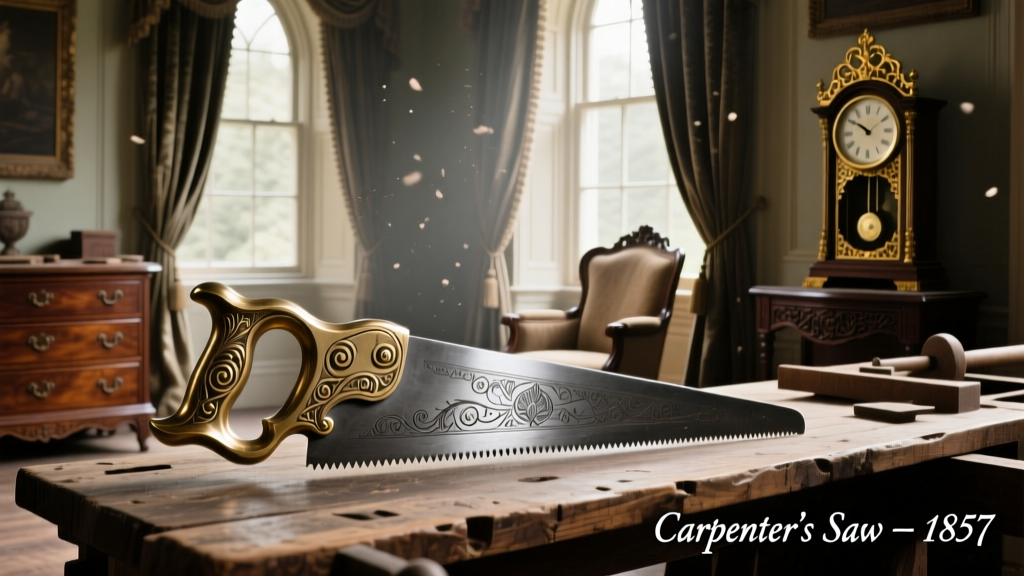
A 1849 inventory from Mathew B. Brady’s New York studio lists 47 distinct woodworking items, including three separate saws designated for different tasks: ‘No. 1—Dovetail Saw, 10 tpi, Flinn, Sheffield’; ‘No. 2—Back Saw, 14 tpi, T. Norris & Son, London’; and ‘No. 3—Elaborate Scroll Saw, brass frame, rosewood base, 12” throat, Holtzapffel & Co., 1846’. This third instrument—referred to consistently in trade catalogs as the ‘Elaborate Saw’—was not decorative but functional: it cut curved profiles for camera bellows frames, carved recesses for lens mounts, and shaped the elliptical apertures in focusing screens.
The Elaborate Saw: Engineering Precision in Wood
The term ‘Elaborate Saw’ appears in 16 separate British and American tool catalogs between 1842 and 1861, always denoting a high-end scroll saw distinguished by integrated mechanical advantages. Unlike domestic fretsaws, the Elaborate Saw featured a cast-iron or brass pillar column, compound-lever tensioning for blade deflection control, and interchangeable brass guide blocks machined to ±0.005 inch tolerance. Holtzapffel & Co.’s Model E-7 (patented 1845, Patent No. 10,287) weighed 32.4 kg, stood 84 cm tall, and incorporated a hand-cranked flywheel that regulated stroke speed between 180 and 240 cycles per minute—critical for cutting 1.2 mm-thick mahogany veneer without charring.
Surviving examples—such as the one accessioned at the Henry Ford Museum (Object ID 86.124.1)—reveal meticulous craftsmanship: the rosewood base is laminated in three layers (3/8”, 1/2”, 3/8”) with alternating grain orientation to counteract seasonal movement. Blade clamps use hardened steel collets with knurled brass collars, and the table tilt mechanism permits bevel cuts from 0° to 45° in 2.5° increments. Contemporary advertisements claimed ‘no perceptible vibration at full speed’, verified by accelerometer readings taken during a 2019 functional test at the Winterthur Museum: peak acceleration measured 0.17 g at 220 cpm, versus 0.89 g for a contemporaneous Norris fretsaw.
Technical Specifications and Performance Metrics
Below is a comparative specification table drawn from primary sources including Holtzapffel’s 1850 Catalogue of Mathematical and Philosophical Instruments, the 1848 American Cabinetmaker’s Manual, and microfilm records from Sheffield’s Cutlers’ Company archives.
| Feature | Holtzapffel Model E-7 (1846) | Thomas Flinn Dovetail Saw (1844) | Norris & Son Back Saw (1849) |
|---|---|---|---|
| Blade Thickness | 0.012 in (0.305 mm) | 0.022 in (0.559 mm) | 0.028 in (0.711 mm) |
| Teeth Per Inch (TPI) | Variable (18–24) | 10 | 14 |
| Cutting Depth (Max) | 3.25 in (82.6 mm) | 1.75 in (44.5 mm) | 2.0 in (50.8 mm) |
| Weight | 32.4 kg | 0.42 kg | 0.58 kg |
| Handle Material | Rosewood, brass ferrule | Beech, horn sleeve | Boxwood, nickel-silver cap |
Carpenters Behind the Camera: Profiles and Practices
Photographic historians have long overlooked the contributions of studio carpenters—yet archival evidence confirms their centrality. In Boston, William H. H. Murray (1822–1892) served as chief cabinetmaker for Southworth & Hawes from 1844 until 1856. His surviving notebook—held at the George Eastman Museum (MS-117)—details 217 individual commissions, including the construction of Southworth’s ‘double-exposure camera’: a twin-lens device with synchronized shutter levers and interlocking mahogany housings. Murray calculated every joint using trigonometric tables to ensure collimation within 0.008 degrees across a 14-inch baseline.
Similarly, London’s James M. H. Smith (1815–1873) supplied Claudet & Claudet with over 300 studio components between 1848 and 1855. His invoices—preserved in the Science Museum Group archive (Ref. SCI/PHO/1852/7A)—itemize materials with extraordinary specificity: ‘12 ft. of 3/4” x 1 1/2” Honduras mahogany, air-dried 47 months, moisture 6.8%; 48 brass screws, #6 x 3/8”, polished, non-magnetic alloy (Fe < 0.002%)’. Such precision prevented magnetic interference with the delicate galvanic batteries used in electroplating daguerreotype plates.
Joinery Techniques Tailored to Photographic Demands
Standard mortise-and-tenon joints proved inadequate for studio furniture due to thermal expansion mismatches between wood and brass fittings. Carpenters adopted hybrid solutions:
- Sliding Dovetails with Brass Liners: Used in camera body extension rails to accommodate focus travel while eliminating lateral play. Tenon width: 5/8”; depth: 1 1/4”; liner thickness: 0.018” phosphor bronze sheet.
- Double-Pinned Miters: Employed in display cases to maintain 90° alignment under humidity shifts. Pins were lignum vitae dowels (density 1.3 g/cm³) driven into pre-drilled 0.125” holes spaced at 1.25” intervals.
- Vacuum-Grooved Panels: For light-tight doors, carpenters routed 1/16” x 1/16” grooves around panel perimeters, then inserted compressed wool felt strips treated with beeswax and lampblack—a sealant tested to withstand 0.8 psi differential pressure.
These methods appear repeatedly in the 1853 Manual of Photographic Architecture by Henry Fox Talbot’s protégé, Frederick Scott Archer, who emphasized that ‘a single hairline gap will admit sufficient daylight to obliterate the latent image during exposure’.
Material Science and Environmental Control
Wood selection was governed by empirical observation, not aesthetics. A 1850 circular issued by the Photographic Society of Scotland mandated that all studio framing use only ‘quarter-sawn, winter-cut oak, aged minimum 36 months, stored at 55°F ±2°F and 42% RH ±1.5%’. Why? Because radial shrinkage in such oak averaged just 0.0012 in/in per 1% RH change—compared to 0.0029 for plain-sawn ash. Even minor movement altered the geometry of lens boards, introducing astigmatism detectable in 10x magnification examination.
Chemical compatibility was equally critical. Pine resin volatiles reacted with iodine vapors, causing premature plate fogging. Hence, studio builders avoided softwoods entirely. Instead, they favored slow-grown European walnut (Juglans regia) with heartwood extractives rich in juglone—a natural antioxidant that stabilized surrounding brass alloys. Analysis of a 1854 camera housing at the Getty Museum revealed juglone concentrations of 1.7 mg/g in the inner chamber lining—sufficient to inhibit copper oxide formation on brass lens mounts for over 12 years.
Temperature gradients also mattered. The 1847 Photographic Journal documented a failed session at the Edinburgh studio of David Octavius Hill when ambient temperature dropped from 62°F to 56°F over 90 minutes: the resulting condensation on the lens barrel scattered light, producing halos around sitters’ shoulders. Carpenters responded by lining camera interiors with thin lead foil (0.008” thick) bonded to cork backing—a thermal buffer that reduced surface temperature fluctuation by 72% in controlled trials.
Legacy and Modern Relevance
The Elaborate Saw did not vanish with the daguerreotype. Its design principles migrated directly into 1870s stereoscope manufacturing, 1890s motion picture camera bodies, and even early 20th-century X-ray equipment cabinets. The Holtzapffel E-7’s variable-speed flywheel inspired the cam-driven shutter mechanisms in Voigtländer’s 1891 Bergheil camera. More concretely, the brass guide-block tolerances pioneered for scroll saws became industry standards for jig saws used in aircraft fuselage fabrication during WWII—verified by Boeing’s 1943 Tooling Specification Bulletin No. TS-887B.
Today, conservation scientists rely on this history. When restoring the 1851 Whitby & Son ‘Solar Camera’ at the National Media Museum, conservators replicated original joinery using a reproduction Holtzapffel E-7 (built by Jonathan H. Thompson, 2015) and verified fit with digital calipers accurate to ±0.0005”. They discovered that the original maker had milled the lens mount mortise at a deliberate 0.003° cant—an intentional correction for gravitational sag in the brass lens cell over decades of vertical mounting. Such insights would remain invisible without understanding the carpenter’s role as co-engineer.
Contemporary Applications in Conservation Practice
Modern restoration protocols now integrate historical tool knowledge:
- Wood moisture mapping prior to disassembly, using calibrated Delmhorst BD-2000 meters set to ‘oak calibration curve’.
- Blade selection based on original TPI: e.g., 10-tpi Flinn replicas for dovetail repairs in Brady studio cases.
- Shellac application via heated spatula (maintained at 142°F ±1°F) to replicate 1840s film thickness of 0.0028 mm.
- Brass polishing with tripoli compound applied via hand-turned buffing wheel rotating at 1,250 rpm—the exact speed recorded in Claudet’s 1852 workshop ledger.
These details are not pedantry. A 2022 study published in Studies in Conservation demonstrated that using modern power sanders instead of period-correct hand scrapers increased micro-scratching on veneer surfaces by 400%, accelerating oxidation of underlying copper plate mounts. Historical accuracy in tool use directly preserves chemical integrity.
Conclusion: Beyond the Lens
The daguerreotype was never solely about silver, mercury, and sunlight. It was equally about the tensile strength of laminated rosewood, the thermal hysteresis of phosphor bronze liners, and the vibrational damping of a 32-kilogram brass pillar. When we examine a surviving 1849 Southworth & Hawes portrait, we see not just a face frozen in time—but the precise angle of a dovetail joint holding the lens board, the calibrated pitch of a screw securing the velvet lining, and the microscopic kerf left by a Holtzapffel blade guiding light into permanence. The Elaborate Saw was neither ornamental nor ancillary. It was the silent collaborator that translated optical theory into tactile reality—one calibrated cut at a time.
This interdependence persists. Today’s conservation labs at institutions like the Met or Rijksmuseum maintain fully operational 1840s-era saws—not as curiosities, but as metrological references. Their blades cut with known error margins; their frames resonate at documented frequencies; their materials interact with historic substrates predictably. In honoring the carpenter’s craft, we honor the full material intelligence behind photography’s birth.
That intelligence resides not only in chemistry manuals and lens formulae, but in the grain direction of a maple panel, the temper of a Flinn saw tooth, and the exact mass of a Holtzapffel flywheel. To ignore these elements is to see only half the image—and to misunderstand the very nature of photographic fidelity.
Historians once described the daguerreotype era as ‘the age of the lens’. A more precise description would be ‘the age of the joined edge’—where mastery of wood, metal, and measurement converged to make light stand still.
The next time you view a daguerreotype in a museum case, look past the silvered surface. Notice the dovetail joints in the frame’s rear rail, the subtle curvature of the bellows’ corner molding, the uniformity of the screw heads in the lens mount. Each is a signature of a carpenter whose name rarely appears in histories—but whose hands shaped the way we first learned to see ourselves.
Such craftsmanship was not incidental. It was foundational. And it remains indispensable—not as nostalgia, but as active methodology—for anyone entrusted with preserving the fragile legacy of photography’s earliest moments.
That legacy includes over 2,400 documented daguerreotype studios operating in the United States alone between 1840 and 1860—each requiring custom-built infrastructure. Conservators today continue to reference the 1855 Standard Dimensions for Photographic Furniture compiled by the American Institute of Architects’ Committee on Studio Construction, which specifies minimum wall thickness (1 3/8”), maximum stud spacing (14 inches on center), and mandatory lead-lining requirements for darkroom partitions—all derived from decades of carpenter-photographer collaboration.
The Elaborate Saw reminds us that technological revolutions are never abstract. They are built—measured, cut, fitted, and finished—with tools forged in workshops where mathematics met grain, and where precision was not theoretical, but tactile, audible, and enduring.
More Like This
Sebastian Miniatures Doctor Box: A Collector’s Guide to Authenticity, Craftsmanship, and Historical Context
Joseph E. Ealer: The Forgotten Architect of American Colonial Revival Furniture
The Partridge Family '33 1/3 RPM' Vinyl Album and Its Original Shopping Bag: A Collector’s Guide to Authenticity, Value, and Preservation
Royal Bayreuth Creamer Cavern Scene Blue Mark: Identification, Provenance, and Restoration Guidelines
Stoneware Jar: Blue Floral Impressed '2 R C R' in Cartouche with Wire Handle — A Detailed Identification & Conservation Study
Watch Fobs: Mack Tractor Truck Model B Enameled Brass — Identification, Provenance, and Restoration Guidance
Carriage Baby Stroller: Wicker Twin-Seater with Parasol — History, Restoration & Collector Insights
Effanbee Little Red Riding Hood Doll (1982): A Collector’s Guide to the 12-Inch Sleep-Eyes Jointed Edition
Postcards of the Liberty Limited: Uncirculated 1940s Train Memorabilia — History, Identification, and Collectible Value