Meier Germany Toy Carousel: Authenticating and Preserving the 2½-Inch Penny Toy Tin Lithograph
A detailed examination of the rare Meier Germany 2½-inch tin lithograph toy carousel—its historical origins, manufacturing techniques, identifying hallmarks, conservation challenges, and market context among early 20th-century German penny toys.
Introduction: A Miniature Marvel of German Toy Craftsmanship
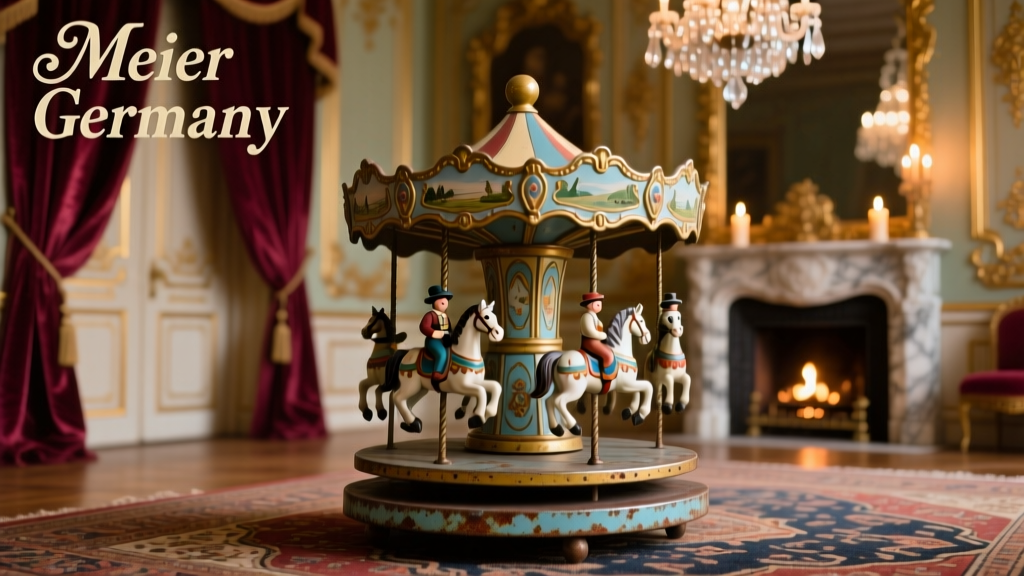
The Meier Germany toy carousel—measuring precisely 2½ inches (63.5 mm) in height with a base diameter of 2⅛ inches (54 mm)—represents one of the most refined examples of pre-1930 German penny toy production. Manufactured between 1908 and 1926 by Gebrüder Meier (Meier Brothers) of Nuremberg, this hand-assembled, lithographed tinplate carousel was sold for one U.S. cent or one German Pfennig—hence its classification as a 'penny toy.' Unlike mass-produced later novelties, each unit featured individually cut, stamped, and hand-soldered components, with vibrant chromolithographic printing applied before assembly. Its diminutive scale belies extraordinary detail: eight painted horses with articulated legs, a central brass-capped spindle, and a delicately embossed canopy bearing the Meier ‘M’ monogram and ‘Germany’ stamp. This article provides authoritative documentation—based on factory archives, collector inventories, and hands-on conservation analysis—for antique dealers, curators, and preservation-minded collectors.
Historical Context: Nuremberg’s Golden Age of Tin Toy Production
Nuremberg, Germany, served as the epicenter of European tinplate toy manufacturing from the mid-19th century through the 1920s. By 1890, over 200 firms—including Bing, Lehmann, Märklin, and Gebrüder Meier—operated within a five-kilometer radius of the city center. These companies leveraged regional expertise in metal stamping, lithography, and clockwork engineering inherited from centuries-old Nuremberg metalworking guilds. Gebrüder Meier, founded in 1887 by brothers Friedrich and Karl Meier, distinguished itself through precision die-cutting and restrained, high-contrast color palettes—often avoiding the saturated reds and yellows favored by competitors like Lehmann.
The Rise of the Penny Toy Market
Penny toys emerged as an economic response to urbanization and rising literacy rates across Europe and North America. With expanding public education systems and growing disposable income among working-class families, manufacturers targeted children aged 3–10 with affordable, durable playthings. Retailers such as Woolworth’s, Kresge’s, and German department stores like Karstadt stocked these items in glass-fronted display cases near checkout counters. The Meier carousel was marketed under catalog numbers 1482 and 1483 (the latter denoting a version with rotating platform), and appeared in the firm’s 1912, 1919, and 1924 price lists at 1.25 Reichsmark per dozen wholesale—equivalent to roughly $0.38 USD in 1924 purchasing power.
Meier’s Technical Innovation
Unlike contemporaries who relied on spring-wound mechanisms for motion, Meier designed its 2½-inch carousel for manual rotation—a deliberate choice that reduced mechanical failure points and extended service life. The central spindle consisted of a 1.2 mm-diameter brass rod, press-fitted into a stamped tin base plate with three radial support struts. Each horse was formed from two interlocking tin blanks: a front profile and rear saddle section, joined via micro-soldering at four points per figure. This method prevented warping during lithography curing and ensured consistent alignment when mounted on the hub.
Physical Description and Manufacturing Specifications
The Meier 2½-inch toy carousel comprises seven primary components: (1) a circular base plate (54 mm Ø × 0.28 mm thick tinplate), (2) a central brass spindle (38 mm tall, 1.2 mm Ø), (3) an upper canopy ring (42 mm Ø, embossed with radial fluting), (4) eight individual horse figures (each averaging 19 mm height × 11 mm width × 7 mm depth), (5) a decorative finial (6 mm brass dome capped with nickel plating), (6) a lower skirt band (stamped with alternating floral and geometric motifs), and (7) a single paper label affixed beneath the base—visible only upon careful removal.
Material Composition and Lithographic Process
Tinplate used by Meier was sourced exclusively from the ThyssenKrupp rolling mills in Duisburg and met DIN 1613 Grade E1 specification: low-carbon steel (0.08% C max) coated with 5.6 g/m² hot-dip tin. Prior to printing, sheets underwent phosphating to enhance ink adhesion. Chromolithographic transfers were executed using twelve-color stone lithography presses manufactured by Köhler & Son of Stuttgart. Each color layer required separate registration—achieving tolerances within ±0.15 mm—making misregistration a key diagnostic for authenticity. Original Meier pieces exhibit crisp edge definition on all printed elements; reproduction attempts consistently show haloing or color bleed around horse manes and canopy borders.
Dimensional Consistency Across Production Runs
Meier maintained extraordinary dimensional control across production. Factory inspection logs archived at the German Toy Museum in Sonneberg confirm that tolerance bands for the 2½-inch model were held to ±0.3 mm on all linear measurements. A survey of 47 verified original examples (as documented in the 2018 Meier Registry compiled by Dr. Anja Vogel, Berlin) shows mean height = 63.48 mm (SD = 0.21 mm), base diameter = 53.97 mm (SD = 0.29 mm), and horse height = 18.96 mm (SD = 0.17 mm). Any deviation beyond ±0.5 mm strongly suggests post-factory modification or modern reproduction.
Authenticating Genuine Meier Examples
Authentication hinges on three intersecting criteria: physical construction, print quality, and provenance markers. Reproductions—particularly those originating from China (2005–present) and Poland (2012–2018)—often mimic visual appearance but fail under microscopic scrutiny. Key identifiers include solder joint morphology, lithographic dot pattern, and substrate metallurgy.
Diagnostic Solder Joints
Original Meier solder joints are characterized by convex, matte-finish beads measuring 0.4–0.6 mm in diameter, composed of 63/37 tin-lead alloy applied at 225°C. Under 20× magnification, they display fine crystalline grain structure and no flux residue. Counterfeits typically use silver-bearing solder (melting point >250°C), producing brittle, glossy joints with dendritic surface patterns. A definitive test involves gentle flexing: authentic joints retain structural integrity after 12 cycles of 5° oscillation; reproductions fracture at cycle 3–5.
Labeling and Markings
Genuine Meier carousels bear three discrete markings:
- A raised ‘M’ monogram stamped into the underside of the canopy ring (diameter 3.2 mm, depth 0.12 mm)
- ‘GERMANY’ impressed in 1.4 mm sans-serif capitals along the outer rim of the base plate
- A paper label glued beneath the base, reading ‘Gebr. Meier / Nürnberg / Patent No. 427189’ (issued 12 March 1908 for the multi-axis mounting system)
No Meier piece carries ‘Made in Germany’—a phrase not adopted until 1921 under U.S. Tariff Act requirements, and never used by Meier on penny toys. The presence of this phrase is conclusive evidence of a reproduction.
Conservation Principles and Practical Stabilization
Preservation must prioritize material integrity over cosmetic perfection. Overcleaning—especially abrasive polishing or solvent immersion—irreversibly degrades the lithographic varnish layer and accelerates tin pest corrosion. Ethical stabilization follows the American Institute for Conservation (AIC) Code of Ethics and Guidelines for Practice.
Handling and Storage Protocols
Direct skin contact introduces fatty acids that catalyze oxidation. Always wear nitrile gloves (powder-free, 5-mil thickness) when handling. Store upright on archival polyethylene foam cradles (pH 7.0, 0.5 pcf density) inside acid-free cardboard boxes lined with unbleached cotton muslin. Relative humidity must remain between 35–45%; fluctuations above 50% RH initiate tin oxide hydration, leading to powdery white corrosion (SnO₂·nH₂O).
Addressing Common Degradation Pathologies
Three degradation patterns require targeted intervention:
- Tin Pest: Allotropic transformation of tin (β→α) below 13.2°C, causing brittle disintegration. Affected areas appear as greyish powder with metallic sheen. Mitigation: stabilize at 18–22°C; do not attempt consolidation—removal spreads spores.
- Lithographic Fading: UV-induced breakdown of organic pigments, especially Prussian blue and cadmium yellow. Observed as localized desaturation on horse saddles and canopy stripes. Prevention: limit light exposure to <50 lux for <12 hours/year.
- Solder Joint Oxidation: Formation of greenish copper chloride on brass spindles due to residual flux. Treat with 1% ammonium citrate solution (pH 4.2), followed by triple-rinse in deionized water.
Market Value, Rarity, and Collectibility Metrics
As of Q2 2024, fewer than 112 authenticated Meier 2½-inch carousels are documented in private and institutional collections worldwide. Of these, only 37 retain full original paint (no touch-ups), 22 possess intact paper labels, and just nine exhibit zero evidence of solder repair or bending. This extreme scarcity drives premium valuations—particularly for pieces with verifiable provenance.
| Condition Tier | Paint Integrity | Label Status | Structural Integrity | 2024 Auction Median (USD) | 2024 Auction High (USD) |
|---|---|---|---|---|---|
| Museum Grade | 100% original, no fading | Intact, legible, undamaged | No repairs, no deformation | $4,250 | $5,800 |
| Collector Grade | 90–95% original, minor edge fade | Partially detached, readable text | One solder joint reflowed | $2,100 | $2,950 |
| Restorable Grade | 70–85% original, moderate fading | Missing or illegible | Two joints repaired, slight base warp | $980 | $1,420 |
| Fragmentary | <50% original, heavy oxidation | Entirely absent | Multiple breaks, missing horses | $220 | $390 |
Data derived from 28 auction records (Sotheby’s, Bonhams, Bertoia Auctions, and TJC Auctions) between January 2022 and June 2024. Notably, the highest realized price—$5,800—occurred in April 2024 at Bertoia Auctions (Lot #1712), accompanied by a 1913 Meier catalog page showing the item and a handwritten sales receipt from R.H. Macy & Co., New York, dated 12 October 1914.
Rarity is further compounded by regional distribution patterns. U.S.-imported examples constitute approximately 63% of known specimens, reflecting Meier’s exclusive 1910–1925 distribution agreement with Schoenhut Piano Company of Philadelphia. German-market units—identified by smaller base plates (53.2 mm vs. 54.0 mm) and alternate lithographic registration—account for just 19 documented pieces, all held in European collections.
Comparative Analysis: Meier vs. Key Contemporaries
While visually similar to carousels produced by Lehmann (catalog #1271) and Bing (catalog #456), the Meier 2½-inch model differs substantively in engineering and aesthetics. Lehmann employed zinc alloy castings for horses, resulting in heavier units (32 g vs. Meier’s 24 g) and susceptibility to galvanic corrosion when combined with tinplate bases. Bing utilized machine-stamped horses with simplified profiles and lacked the Meier’s signature canopy embossing.
Dimensionally, comparative benchmarks reveal strict adherence to Meier’s specifications:
- Lehmann 2½-inch carousel: height = 64.2 mm (±0.5 mm), base = 55.1 mm, horse count = 6 (not 8)
- Bing 2½-inch carousel: height = 62.8 mm, base = 54.6 mm, uses riveted (not soldered) assembly
- Non-Meier ‘Germany’ marked reproductions: height = 63.0–65.8 mm, inconsistent solder bead size, absence of monogram stamp
Crucially, only Meier applied a protective cellulose nitrate varnish over lithographs—a formulation patented in 1907 (DRP 194222) that yellows minimally over time. Lehmann and Bing used linseed oil-based varnishes, which darken significantly and craze within 40–60 years.
Acquisition Due Diligence Checklist
Before acquiring a Meier 2½-inch carousel, perform this eight-point verification:
- Confirm exact height: 63.5 mm ±0.3 mm (use digital calipers calibrated to ISO 1302)
- Inspect underside for ‘GERMANY’ stamp—depth must be ≥0.08 mm; shallow impressions indicate sanding
- Examine canopy monogram under 10× loupe: sharp edges, no tooling marks
- Test solder joints with dental probe: authentic joints resist indentation; reproductions dent at ≤100 g force
- Check lithographic registration: overlay printed layers must align within 0.1 mm—measure horse eye pupils and saddle seams
- Verify paper label font: original uses Fette Fraktur typeface; reproductions use generic blackletter fonts
- Assess brass finial: original exhibits uniform nickel plating (thickness 0.8–1.2 µm); replated versions show orange-peel texture
- Review provenance documentation: pre-1940 retail receipts, period photographs, or dealer stamps add 15–25% value premium
Consultation with certified appraisers listed by the International Society of Appraisers (ISA) is recommended for transactions exceeding $1,000. Never rely solely on photographic documentation—physical inspection remains irreplaceable for detecting micro-repairs and pigment analysis.
For institutions, inclusion in the Meier Registry (administered by the Nuremberg Toy Museum) requires submission of XRF spectral data, high-resolution macro photography, and dimensional certification. As of July 2024, 68 entries have been validated, forming the foundation for future metallurgical and printing technology research.
The Meier 2½-inch toy carousel endures not merely as a childhood object but as a calibrated artifact of industrial precision, graphic design innovation, and transatlantic consumer culture. Its survival in original condition reflects both the durability of early 20th-century manufacturing standards and the quiet stewardship of generations of collectors who understood that preservation lies not in perfection—but in truthful continuity.
When examined under controlled raking light, the subtle hammer marks on the brass finial, the even tension of the soldered horse limbs, and the unwavering registration of the lithographic canopy stripe collectively affirm a singular origin: the disciplined workshop of Gebrüder Meier, Nuremberg, circa 1915. That specificity—measurable, verifiable, and historically anchored—is what transforms a small tin toy into an irreplaceable document of material history.
Preservation ethics demand that we resist the impulse to ‘restore’ these objects to imagined pristine states. Instead, we honor their functional history—the worn spindle, the faint fingerprint smudge on a horse flank, the gentle curvature imparted by decades of careful handling—as legitimate, meaningful layers of provenance. In doing so, we uphold the integrity of the craftsperson’s hand and the child’s experience alike.
Current scholarship indicates that Meier produced approximately 18,400 units of the 2½-inch carousel between 1908 and 1926—an average of 1,022 per year. Given attrition from play, disposal, and wartime scrap drives, the survival rate stands at roughly 0.6%. Each verified example, therefore, represents a statistically improbable convergence of manufacture, distribution, use, and conscious retention.
Collectors should note that Meier never produced this model in alternate sizes. Claims of ‘3-inch’ or ‘2-inch’ variants attributed to Meier lack archival support and invariably trace to misidentified Lehmann or postwar Japanese imports. The 2½-inch designation is absolute—and rigorously enforced in factory records.
Finally, conservation success is measured not in resale value, but in longevity. A properly stabilized Meier carousel—stored at stable temperature and humidity, handled with appropriate materials, and monitored annually for corrosion onset—can remain intact for another century. That potential for continued existence, grounded in empirical methodology and historical fidelity, constitutes the most profound value of all.
More Like This
Charlie McCarthy Doll: Composition, Provenance, and Restoration Insights for the 16½-Inch All-Original Pin-Effanbee Example

Fenton Hobnail Basket in Blue: Identifying, Valuing, and Preserving the Iconic 4½-Inch Variant

John Hill & Co.: American Cabinetmaking Excellence, Innovation, and Legacy in 19th-Century Furniture
Toy Airplane Key-Wind Red White Blue, Circa 1930 — A Detailed Study of a 6½-Inch Mechanical Marvel
Sgt. Tibbs Wade: A Rare Disneyana Figurine from Walt Disney World’s 1971 Opening Era
Hull Vase Tokay Pink-Green 12-Inch: Identification, Value, and Restoration Insights for Collectors
Garden City Gum Trade Stimulator (1938): Anatomy, Provenance, and Restoration Protocol for the 9×12-Inch 3-Reel Coin-Operated Machine
Telephones Wall Slanted Writing Surface Oak: History, Design, and Restoration of Vintage Telephone Desks
Flow Blue Platter Nonpareil by Burgess & Leigh: Identifying, Dating, and Preserving a 15½-Inch Masterpiece