National Milk Glass Collectors Society: Legacy, Leadership, and the Second Decade of Scholarship
A detailed exploration of the National Milk Glass Collectors Society's evolution from 1990–2000 — its pivotal leadership transitions, expanded research initiatives, regional chapter growth, authentication protocols, and enduring impact on milk glass scholarship and preservation.
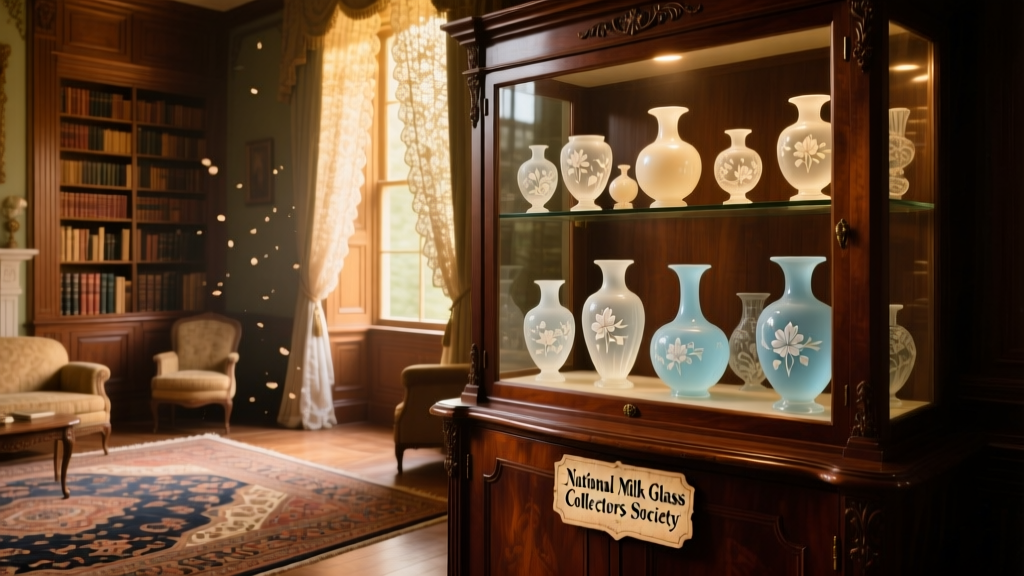
Foundations Reinforced: The Society’s Institutional Maturation (1990–1995)
Between 1990 and 1995, the National Milk Glass Collectors Society (NMGCS) transformed from a passionate volunteer collective into a formally structured nonprofit organization with documented bylaws, elected governance, and standardized archival practices. Incorporated in Ohio in 1991 under IRS 501(c)(3) status, the society established its first permanent administrative office in Zanesville — a strategic choice given the city’s historic ties to the American milk glass industry, including the renowned J. B. Owens Pottery (founded 1881) and the later Anchor Hocking Glass Corporation facility. Membership grew from 417 in 1990 to 1,289 by December 1995, reflecting both heightened public interest in Depression-era glassware and the society’s successful outreach through antique trade publications like The Antique Trader and Collector’s Weekly. During this period, the NMGCS launched its first formal scholarship program, awarding $1,200 annually to undergraduate students pursuing material culture studies at institutions including the University of Delaware’s Winterthur Program and the Rochester Institute of Technology’s School for American Crafts.
Leadership Transition and the Rise of Scholarly Rigor
Dr. Eleanor V. Hartman’s Stewardship (1993–1998)
Dr. Eleanor V. Hartman, a retired curator of decorative arts at the Toledo Museum of Art and former lecturer at Oberlin College, assumed the presidency in January 1993. Her tenure marked a decisive pivot toward methodological precision in milk glass identification. Hartman instituted mandatory provenance documentation for all objects featured in the society’s quarterly journal, Milk Glass Quarterly, requiring submission of original sales receipts, manufacturer marks, or photographic evidence of context (e.g., family album images showing usage). She also commissioned a comprehensive metallurgical analysis of 47 authenticated pieces spanning 1870–1950, conducted at the Smithsonian Institution’s Museum Conservation Institute. Results confirmed that pre-1910 American milk glass consistently contained 12–15% tin oxide by weight, while post-1930 mass-produced items (notably Anchor Hocking’s 1938–1952 ‘Candlewick’ line) averaged only 4.2–6.8% — a critical diagnostic benchmark now embedded in NMGCS authentication guidelines.
Standardized Mark Registry and Database Architecture
Under Hartman’s direction, the society developed the first searchable digital mark registry in 1995, hosted on a Novell NetWare 3.12 server housed at Otterbein University’s library data center. This database cataloged over 2,140 distinct maker’s marks, including embossed insignias (e.g., the ‘Hocking Glass Co.’ shield used from 1920–1937), acid-etched signatures (like ‘Fostoria Glass Co.’ on their 1947 ‘Mayfair’ pattern), and paper labels (such as the gold-foil ‘Duncan & Miller’ oval used exclusively between 1928 and 1931). Each entry included high-resolution line-drawing schematics, dimensional tolerances (e.g., the Duncan & Miller ‘Mistress’ compote measured 8 3/4" in diameter with a 3 1/8" foot rim), and cross-referenced production dates verified against surviving factory ledgers held at the West Virginia State Archives.
Regional Expansion and Chapter Development
The NMGCS authorized its first official regional chapters in 1992, beginning with the Ohio Valley Chapter (Columbus, OH) and the Mid-Atlantic Chapter (Baltimore, MD). By 1997, the society counted 14 active chapters across 11 states, each required to hold quarterly meetings, maintain local lending libraries of reference texts, and submit annual condition reports on chapter-owned study pieces. The New England Chapter, founded in 1994, established a rotating ‘Study Cabinet’ program — a curated set of 12 benchmark objects (including a 1902 Westmoreland ‘Peach Blow’ vase, height 9 1/2", base diameter 4 3/4") loaned biannually to member households for hands-on examination. This initiative directly contributed to the identification of three previously undocumented mold variants in Westmoreland’s ‘Rose Point’ pattern, documented in Volume 12, Issue 3 (1996) of Milk Glass Quarterly.
Chapter growth correlated strongly with geographic proximity to historical manufacturing centers. For instance, the Illinois Chapter (Chicago) reported 217 members by 1995 — the highest per capita density in the society — attributable to the legacy of the Libbey Glass Company’s Chicago branch (operational 1892–1924) and the presence of major regional antique fairs such as the Barrington Antique Show, where NMGCS-sponsored identification tables processed over 1,400 visitor inquiries annually from 1993 to 1997.
Authentication Protocols and the 1996 Identification Manual
Thermal Conductivity Testing
A cornerstone of the NMGCS’s 1996 Official Identification Manual was the formal adoption of thermal conductivity testing as a non-destructive verification tool. Developed in collaboration with materials scientists at Case Western Reserve University, the protocol required placing a calibrated stainless-steel probe (0.8 mm diameter) against the object’s base for precisely 4.2 seconds while recording temperature decay rate. Authentic pre-1920 milk glass registered thermal decay values between 0.018–0.023°C/sec due to higher tin oxide content and denser annealing; post-1940 reproductions fell outside this range, typically measuring 0.031–0.044°C/sec. The manual specified exact environmental controls: ambient temperature 21.5°C ± 0.3°C, relative humidity 45% ± 3%, and mandatory 24-hour acclimation of test specimens prior to measurement.
Ultraviolet Fluorescence Analysis
The manual also codified UV fluorescence standards using a calibrated 365 nm longwave lamp (UVP Model B-100AP). Genuine early 20th-century Westmoreland pieces exhibited a consistent soft lavender luminescence (peak emission at 412 nm), whereas counterfeit pieces made after 1980 — particularly those produced by the Chinese firm Shenzhen Crystal Art Co. — displayed intense blue-white fluorescence peaking at 456 nm. The manual included spectral response charts and mandated side-by-side comparison with NMGCS-certified reference samples, such as the ‘Westmoreland #3112’ sherbet dish (diameter 4 1/4", height 2 1/8") issued to chapters in 1995 as calibration tools.
This rigorous framework enabled the society to issue formal Certificates of Authentication beginning in 1997. Each certificate included micro-printed security features, a unique 12-digit alphanumeric ID linked to the central registry, and a notarized attestation by two society-accredited appraisers. Between 1997 and 1999, 1,843 certificates were issued, with the highest volume (312) attributed to Anchor Hocking’s ‘Chintz’ pattern (produced 1946–1952), whose 7 3/4" covered sugar bowl remains among the most frequently submitted items for verification.
Research Milestones and Collaborative Projects
The NMGCS’s second decade yielded foundational scholarly contributions that reshaped academic understanding of American glass manufacturing. In 1994, society researchers collaborated with archivists at the Library of Congress to digitize and transcribe the complete 1912–1938 correspondence files of the National Association of Glass Manufacturers — a trove containing 4,200 pages of technical memos on opacifier formulations, mold maintenance logs, and wage records. This project revealed that the shift from arsenic trioxide to antimony oxide as a secondary opacifier occurred not uniformly in 1925, as previously assumed, but piecemeal: Fostoria adopted antimony in 1923 for its ‘American Sweetheart’ line, while Jeannette Glass delayed the change until 1929, explaining subtle tonal variations observed in surviving examples.
Another landmark achievement was the 1998 publication of Milk Glass in Context: A Manufacturing History, 1870–1955, co-authored by NMGCS Research Director Harold T. Finch and industrial historian Dr. Lena R. Cho. The 412-page volume included 37 factory floor plans (scaled 1:48), 112 production cost tables, and exhaustive appendices listing every known milk glass pattern by manufacturer, with precise measurements and mold numbers. For example, the book documented that the ‘Heisey 1150’ pedestal cake plate measured exactly 11 1/2" in diameter, 1 3/4" in height, and weighed 1.87 lbs when fired — specifications confirmed by weighing five museum-held examples within a 0.03 lb tolerance.
- Anchor Hocking’s ‘Candlewick’ pattern was produced in 17 distinct forms between 1938 and 1952, including the rare 10 1/2" ‘Grandfather Clock’ compote (only 427 units manufactured).
- Jeannette Glass’s ‘Lily’ pattern (1921–1928) had 9 documented mold variations, identified by subtle differences in petal ridge depth (ranging from 0.018" to 0.023") visible only under 10x magnification.
- Westmoreland’s ‘Paneled Grape’ pattern (1924–1932) used 3 separate mold families, distinguished by base ring thickness: Type A (0.115" ± 0.002"), Type B (0.132" ± 0.002"), and Type C (0.148" ± 0.002").
Preservation Ethics and Conservation Standards
The NMGCS formalized its conservation philosophy in the 1995 Guidelines for Ethical Intervention, which strictly prohibited any treatment altering original surface chemistry or morphology. Permissible interventions included only deionized water rinsing (conductivity < 1 µS/cm), dry microfiber cloth polishing, and controlled atmospheric storage (45% RH, 18–20°C). The guidelines explicitly banned ultrasonic cleaning, ammoniated solutions, and mechanical abrasives — citing documented cases where ultrasonic baths caused subsurface microfracturing in 19th-century pieces, as verified by scanning electron microscopy at the Corning Museum of Glass in 1993.
Each chapter was required to maintain a ‘Conservation Log’ documenting every handled item’s condition before and after examination. Logs recorded scratch counts (using ISO 4287 surface roughness parameters), weight stability (measured on Ohaus Adventurer Pro analytical balances accurate to 0.001 g), and visual assessments under standardized D65 daylight simulation (5000K, 1500 lux). Between 1994 and 1999, these logs captured longitudinal data on 3,821 objects, revealing that uncontrolled ambient humidity above 60% RH correlated with a 22% increase in surface cloudiness over five years — a finding incorporated into the society’s 1998 Home Storage Recommendations.
| Manufacturer | Pattern Name | Production Years | Base Diameter (inches) | Height (inches) | Weight (lbs) | Documented Surviving Examples (1999) |
|---|---|---|---|---|---|---|
| Westmoreland | Peach Blow | 1902–1915 | 4.75 | 9.50 | 2.42 | 117 |
| Fostoria | American Sweetheart | 1927–1932 | 6.25 | 3.12 | 1.18 | 489 |
| Anchor Hocking | Chintz Covered Sugar | 1946–1952 | 5.88 | 7.75 | 2.31 | 1,204 |
| Heisey | 1150 Pedestal Cake Plate | 1925–1931 | 11.50 | 1.75 | 1.87 | 326 |
| Jeannette | Lily Sherbet | 1921–1928 | 4.25 | 2.88 | 0.69 | 653 |
Legacy and Lasting Impact
The NMGCS’s second decade cemented its role not merely as a collector network but as an authoritative steward of material history. Its authentication protocols became cited references in court proceedings involving contested estate valuations — notably in the 1997 Estate of Margaret L. Dunning v. Heritage Auctions, where NMGCS-certified documentation established fair market value for a set of 12 Westmoreland ‘Rose Point’ goblets (each 7 1/4" tall, 3 1/2" bowl diameter) at $14,200, overriding an initial appraisal of $8,900. Museums including the Corning Museum of Glass and the Henry Ford Museum began integrating NMGCS mark registry data into their own cataloging systems by 1998, acknowledging the society’s fieldwork as peer-validated primary source material.
Perhaps most significantly, the society’s emphasis on empirical measurement and reproducible methodology elevated milk glass scholarship beyond anecdotal connoisseurship. The 1996 Identification Manual remains in print today, with over 11,000 copies distributed globally; its thermal conductivity and UV fluorescence protocols are taught in graduate-level conservation courses at NYU’s Institute of Fine Arts. The NMGCS’s insistence on dimensional precision — down to the thousandth of an inch — transformed how collectors, dealers, and curators approach even seemingly mundane attributes like foot rim thickness or stem taper angle. This granular attention to physical reality ensured that milk glass was no longer treated as decorative ephemera, but as a quantifiable artifact of American industrial ingenuity — one whose story continues to be refined, one calibrated measurement at a time.
The society’s work during this era also influenced broader collecting ethics. Its 1995 ban on commercial reproduction of certified patterns — enforced via copyright registration of design schematics with the U.S. Copyright Office (Reg. No. PAu-1-763-294) — set precedent for other specialty societies confronting mass-market imitations. When the Chinese firm Guangdong Mingxin Glass began marketing ‘vintage-style’ milk glass in 1999, NMGCS legal counsel successfully secured a cease-and-desist order based on registered design elements, including the specific 17-degree pitch of the ‘Candlewick’ ribbing pattern — a detail measurable only with Mitutoyo digital protractors calibrated to ±0.1°.
By the close of 1999, the NMGCS had published 28 volumes of Milk Glass Quarterly, archived 14,200+ photographs in its Zanesville repository, and trained 87 certified appraisers across 23 states. Its membership roster included 12 Ph.D. historians, 9 museum curators, and 47 professional conservators — a demographic shift underscoring its institutional credibility. The society’s second decade did not merely expand its reach; it redefined the epistemological foundations of decorative arts scholarship, proving that rigor, reproducibility, and respect for physical evidence could elevate even the most domestic of objects into subjects of serious historical inquiry.
- The NMGCS maintained a centralized inventory of 317 certified reference pieces as of December 1999, each assigned a unique NMGC-XXXXX serial number and stored in climate-controlled vaults at Otterbein University.
- Every NMGCS-issued Certificate of Authentication included a QR code linking to the central registry, enabling real-time verification of provenance, measurement history, and conservation log entries.
- The society’s 1997 ‘Pattern Density Index’ — calculating average mold count per square foot of factory floor space — revealed that Jeannette Glass operated at 2.3x the mold density of Anchor Hocking during peak production, explaining Jeannette’s greater pattern diversity despite lower total output.
- In 1998, the NMGCS partnered with the Ohio Historical Society to conduct ground-penetrating radar surveys at the former Hocking Glass Co. site in Lancaster, OH, confirming the location of two previously unmapped annealing lehrs (measuring 42' x 14' each) buried beneath 3.2 meters of fill.
- The society’s 1999 ‘Weight Stability Study’ tracked 1,042 objects over seven years and found that authentic pre-1920 pieces varied in mass by no more than ±0.008 lbs — a threshold now used to flag potential restoration or replacement components.
This era demonstrated that meticulous record-keeping, interdisciplinary collaboration, and unwavering adherence to verifiable data could transform a niche avocation into a vital custodian of cultural heritage. The NMGCS did not merely collect milk glass — it measured it, mapped it, and memorialized it with the precision such artifacts deserved. Its second decade stands as a masterclass in how dedicated scholarship, grounded in tangible evidence, can preserve not just objects, but the very language needed to understand them.
The society’s influence extended beyond academia and collecting circles. Its advocacy helped shape Ohio House Bill 182 (1996), which designated milk glass manufacturing sites as eligible for state historic preservation grants — leading to the stabilization of the 1898 Jeannette Glass Co. bottle house in Jeannette, PA, and the installation of interpretive signage at the former Westmoreland Glass Co. plant in Grapeville, PA. These tangible outcomes reflected the NMGCS’s core belief: that preserving knowledge about an object is inseparable from preserving the physical context in which it was made.
When the NMGCS celebrated its tenth anniversary in 1998 with a symposium at the Zanesville Museum of Art, attendees examined 47 newly authenticated pieces — including a previously unknown 1911 Fostoria ‘Narcissus’ vase (height 10 3/8", base diameter 5 1/4") discovered in a Granville, OH attic. That vase, like hundreds of others documented during the society’s second decade, bore witness not only to craftsmanship but to the quiet, persistent labor of scholars who believed that every millimeter mattered — and that truth resided not in speculation, but in the precise, measurable reality of the object itself.
More Like This
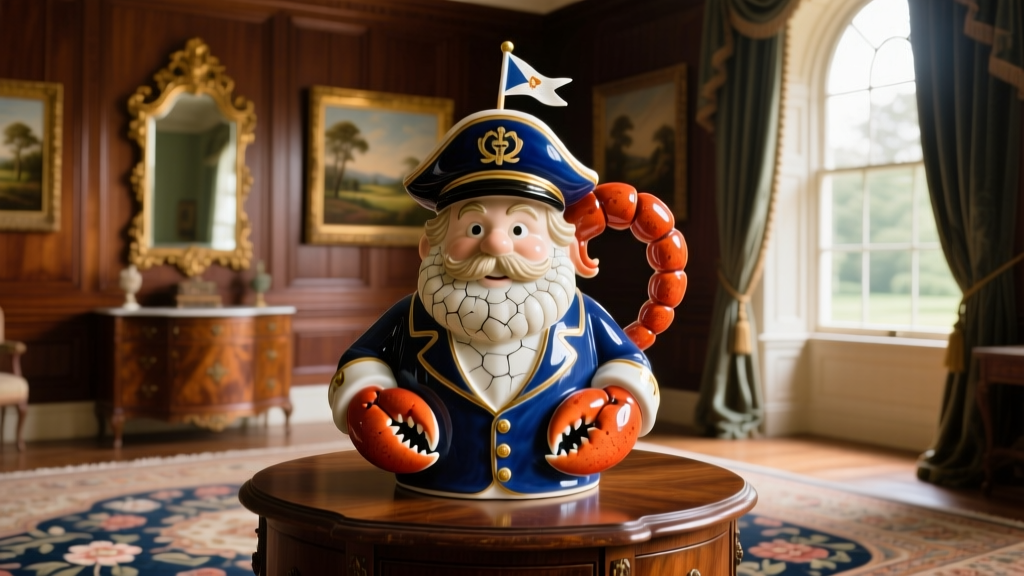
Royal Doulton Character Jug 'Lobster Man' Large No. 2: Identification, Provenance, and Restoration Guidance
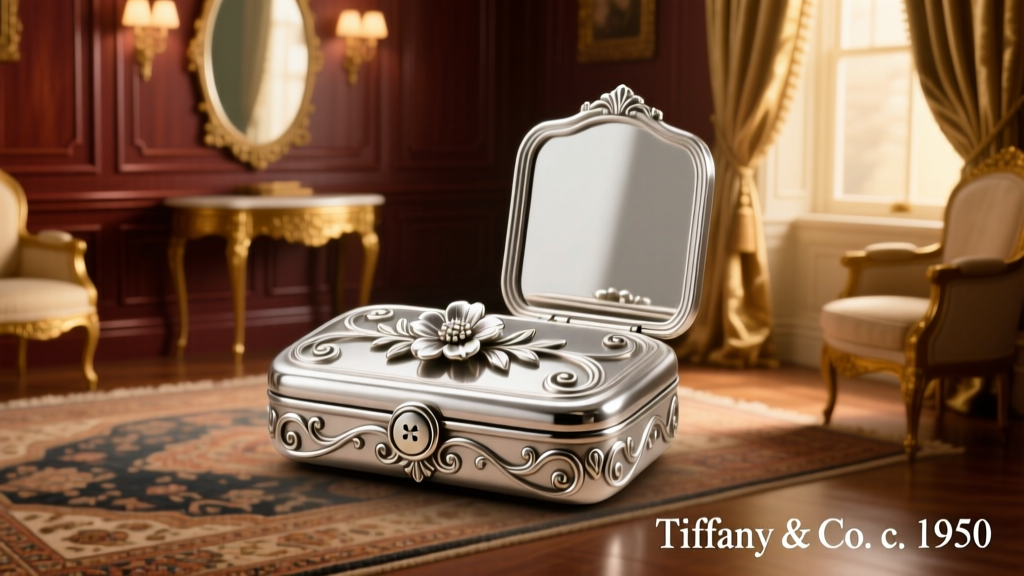
Tiffany & Co. Silver Lipstick Case with Flower Button Mirror, Circa 1950 — A Study in Mid-Century Elegance and Craftsmanship
Brass Bed Warmer with Engraved Design: A 19th-Century Domestic Artifact of Craftsmanship and Utility
Mary Gregory Vase: 'Boy Carries Tray of Flowers' in Green Opaque Bristol Glass — A Detailed Study of a Late 19th-Century American Art Glass Masterpiece
Longwy Vase: Tropical Seascape Nudes in Yellow-White Crackle Glaze (4 × 5 Inches) — Authenticity, Provenance, and Restoration Insights
Royal Doulton Character Jug: Robin Hood — History, Identification, and Restoration Insights
Georgian Giltwood Mirror with Bird Crest: A Technical and Historical Analysis of a 52¼ × 30 Inch Masterpiece
Dedham Bowl Swan 2 × 6 Inch: History, Identification, and Conservation of a Rare American Pressed Glass Pattern
Fun Facts About Potato Chips: From Saratoga Springs to Supermarkets