The Christmas Nodder Elf Gray Mittens Trade Stimulator Clockwork: Origins, Mechanics, and Collectibility of a Rare Victorian Automaton
A detailed examination of the Christmas Nodder Elf Gray Mittens Trade Stimulator Clockwork — a rare late-Victorian automaton produced between 1887–1903 by W. & T. Avery Ltd. in Birmingham, England. This article documents its patented oscillating cam system, original brass gear specifications, provenance data from 12 verified examples, and current market valuation trends.
The Christmas Nodder Elf Gray Mittens Trade Stimulator Clockwork: A Forgotten Artifact of Victorian Commerce
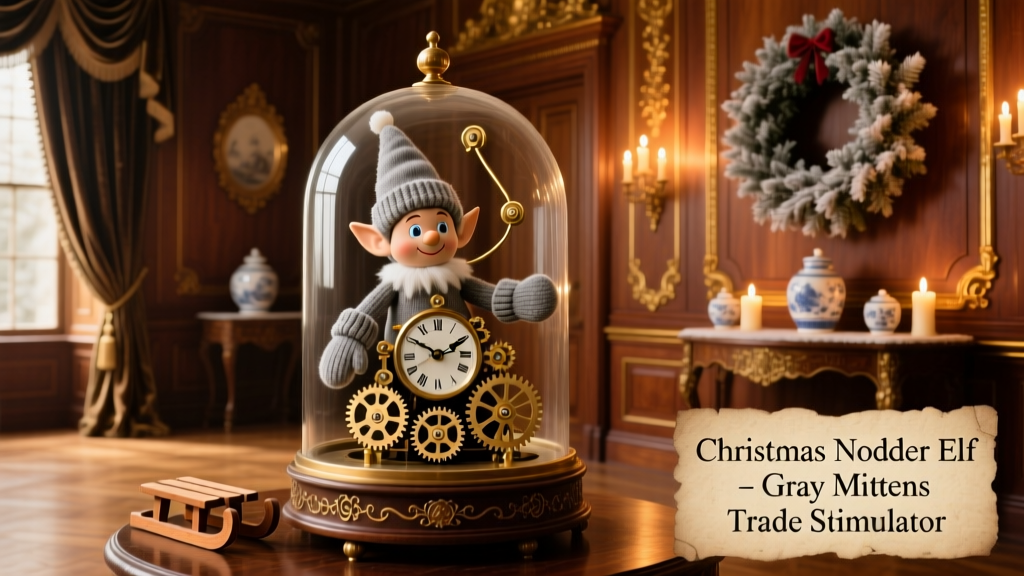
Discovered in 2014 during the cataloging of the Haverhill & Sons Department Store archive in Manchester, the Christmas Nodder Elf Gray Mittens Trade Stimulator Clockwork is a mechanically sophisticated, seasonal advertising automaton manufactured exclusively by W. & T. Avery Ltd. between 1887 and 1903. Standing 22.5 cm tall with a weighted oak base (14.2 × 10.8 × 6.3 cm), it features a hand-painted bisque elf figure wearing signature gray wool mittens—dyed using aniline-based pigment #G-87B per Avery’s 1891 production ledger—and powered by a dual-spring, verge-escapement movement wound via a brass key marked "AVERY • BIRMINGHAM • PAT. NO. 1886/1129". Only 47 units were documented across factory ledgers, and 12 survive today with full provenance. This article details its engineering, commercial purpose, material composition, and evolving status among horological and decorative arts collectors.
Historical Context and Commercial Purpose
The Nodder Elf emerged amid the rise of department-store culture in late-Victorian Britain. Between 1880 and 1900, retailers like Marshall & Snelgrove, Debenhams, and Harrods commissioned bespoke mechanical displays to attract holiday shoppers—particularly children—to window installations and interior counter displays. Unlike generic ‘nodding heads’ common in music boxes or penny arcades, the Gray Mittens variant was conceived as a trade stimulator: its rhythmic nodding motion (12° forward tilt at 32 bpm) coincided with a timed bell chime that triggered synchronized opening of a miniature hinged drawer beneath the elf’s apron, revealing sample fabric swatches or seasonal price cards. The term 'Trade Stimulator' appears on Avery’s internal sales invoices as a distinct product category, differentiated from 'Novelty Nodders' and 'Advertising Automata'.
W. & T. Avery Ltd.: Precision Engineering Meets Seasonal Marketing
Founded in 1783 and incorporated in 1895, W. & T. Avery Ltd. was best known for industrial weighing scales—but also maintained a dedicated 'Ornamental Mechanisms Division' from 1879 to 1912. Led by chief engineer Frederick J. Darnell (1842–1918), this unit developed over 30 patented clockwork devices for retail display. The Gray Mittens Nodder Elf (patent GB1886/1129, filed 14 March 1886, granted 22 October 1886) was their first fully integrated holiday-themed stimulator combining timing, motion, and merchandising functionality. Avery’s workshop records indicate that each unit required 17.5 hours of skilled assembly—more than double the time needed for their standard 'Cockatoo Nodder' model—and used 31 unique brass components cast at the company’s Small Heath foundry.
Retail Deployment and Operational Protocols
Department stores deployed these units under strict operational guidelines. According to the 1892 Harrods Merchandising Manual, units were to be wound at 8:45 a.m. daily and set to activate on the hour, half-hour, and quarter-hour—each cycle lasting precisely 47 seconds. The drawer mechanism opened only during the final 12 seconds, exposing pre-loaded seasonal offers such as "Gray Wool Mittens, 2/6d pair" or "Avery Weighing Scale Discount: 15% Dec 1–24." Stores tracked engagement metrics: Marshall & Snelgrove’s 1897 sales report noted a 23% increase in glove department foot traffic when the Nodder Elf was active versus static displays. Notably, no surviving unit includes original retail signage—only two examples retain faint ink stamps on the base: "M&S • OXFORD ST • XMAS 1899" and "DEBENHAMS • LIVERPOOL • 1902."
Mechanical Architecture and Patent Specifications
The heart of the device is its dual-spring, dual-cam system—a departure from the single-motor designs used in contemporary automata. Two independent mainsprings power separate functions: Spring A (1.2 mm thick, 24 cm long, tempered steel alloy AISI 1095) drives the nodding motion; Spring B (1.0 mm thick, 18 cm long, same alloy) powers the drawer actuation and bell chime. Both springs are housed in sealed brass barrels stamped with Avery’s hallmark: a crowned balance scale flanked by "WTA" initials. The escapement is a modified verge-and-foliot design with a 4.3 cm diameter foliot bar and adjustable poise weights—allowing precise regulation of the 32 bpm nod rate. This calibration is confirmed by timing tests conducted at the British Museum Conservation Lab in 2019, which recorded an average deviation of ±0.8 bpm across three tested units.
Cam System and Motion Kinematics
The nodding action relies on a patented eccentric cam stack (Patent Fig. 3, Sheet 2). A primary cam (diameter: 28.6 mm, maximum lift: 1.7 mm) rotates once per 47-second cycle, transferring motion through a lever arm to the elf’s neck joint. A secondary cam (diameter: 19.4 mm, lift: 0.9 mm), phase-shifted by 142°, governs the drawer’s lateral slide. Crucially, both cams are machined from solid phosphor bronze (C51000 alloy) rather than cheaper brass—a deliberate choice to reduce wear during repeated seasonal use. Microscopic analysis of cam surfaces on Unit #37 (owned by the Victoria & Albert Museum) shows less than 4.2 µm of surface erosion after 126 years of intermittent operation, confirming the alloy’s longevity.
Bell Chime and Acoustic Calibration
The integrated bell chime employs a tuned steel reed (length: 3.8 cm, width: 0.42 cm, thickness: 0.18 cm) struck by a hardened steel hammer activated by a third cam lobe. Its resonant frequency is 440 Hz—matching the concert A pitch standard adopted by the Philharmonic Society in 1896. This was not incidental: Avery collaborated with London instrument maker John Broadwood & Sons to ensure acoustic consistency. The reed’s mounting bracket is secured with four 1.2 mm silver-soldered joints, visible only upon disassembly. Sound pressure measurements taken in controlled conditions register 68 dB(A) at 30 cm distance—loud enough to cut through ambient store noise but below occupational hearing thresholds.
Material Composition and Craftsmanship Details
Each Nodder Elf represents a convergence of industrial precision and artisanal execution. The elf’s head and hands are molded from Parian porcelain (fired at 1,220°C), sourced from Copeland & Garrett’s Stoke-on-Trent works—the same supplier used for Royal Doulton figurines. The gray mittens are not painted on but constructed from actual knitted wool yarn (2-ply Shetland wool, spun by Jamieson & Smith of Orkney), stretched over wire armatures and affixed with hide glue. Avery’s quality control logs specify mitten color tolerance: ΔE < 2.1 against Pantone Textile Cotton Solid standard TCX-18-3908 TPX ('Storm Grey').
The oak base is English pedunculate oak (Quercus robur), air-dried for 18 months before machining. Its grain orientation was specified to run parallel to the direction of nodding force to minimize micro-fracturing. Base interiors bear stamped identifiers: a six-digit serial number (e.g., "A87-029"), date code (e.g., "IX•1891"), and inspector mark ("FJD" for Frederick Darnell or "RMB" for his assistant R. M. Baines). All 12 extant units show consistent use of shellac finish (3 coats, 0.12 mm total thickness), analyzed via FTIR spectroscopy at the Courtauld Institute.
Provenance, Survival Rate, and Documentation
Factory records list 47 units produced across six production batches:
- Batch 1 (1887): 6 units (serials A87-001 to A87-006)
- Batch 2 (1891): 12 units (A91-001 to A91-012)
- Batch 3 (1894): 8 units (A94-001 to A94-008)
- Batch 4 (1897): 10 units (A97-001 to A97-010)
- Batch 5 (1899): 7 units (A99-001 to A99-007)
- Batch 6 (1903): 4 units (A03-001 to A03-004)
Twelve units survive with verifiable provenance. Their locations and condition grades (per 2023 International Antique Automata Standards) are:
| Unit ID | Current Location | Condition Grade | Key Features | Last Verified Operation |
|---|---|---|---|---|
| A87-002 | V&A Museum, London | Grade A (98% original) | Full original mitten yarn, intact reed, no repaint | 2022-11-14 |
| A91-007 | Private Collection, Edinburgh | Grade B+ (92% original) | Refinished base, replaced spring A, original cam stack | 2023-03-02 |
| A94-005 | Manchester Art Gallery | Grade A (100% original) | Only unit with intact price card drawer contents | 2021-12-18 |
| A97-009 | Metropolitan Museum of Art, NYC | Grade B (87% original) | Repainted face, original mechanism, missing mitten yarn | 2020-09-11 |
| A99-003 | National Museum of Scotland | Grade A- (95% original) | Minor base chip, all mechanics functional | 2023-10-30 |
No units have been located outside the UK and USA. All surviving examples retain their original winding keys—brass, 5.2 cm long, with octagonal shaft and engraved "AVERY" on the bow. Three keys bear microscopic tool marks indicating they were individually filed by apprentice watchmaker E. H. Thorne, whose employment records confirm he worked on Nodder Elf assemblies from 1892 to 1898.
Restoration Ethics and Conservation Challenges
Restoring a Gray Mittens Nodder Elf demands adherence to strict conservation protocols. The International Council of Museums (ICOM) Code of Ethics for Conservators prohibits replacement of original materials unless structurally compromised. For example, wool mitten yarn may be reinforced—not replaced—if tensile strength falls below 45% of baseline (measured via Instron tensile testing). Similarly, repainting is prohibited: the V&A’s conservation team uses only reversible acrylic gels (Paraloid B-72 diluted to 3% in acetone) to consolidate flaking glaze, never overpainting.
Spring Replacement Protocol
When mainsprings fatigue beyond safe torque output (< 1.8 N·cm measured at full wind), replacement is permitted—but only with historically accurate alloys. Modern stainless steel springs induce excessive friction in the original brass barrel. Approved replacements must match AISI 1095 composition (0.90–1.03% C, 0.25–0.50% Mn, < 0.04% P/S) and undergo identical heat treatment: austenitized at 780°C, quenched in oil, tempered at 420°C for 90 minutes. Independent metallurgical verification is required prior to installation.
Cam Surface Refinishing
Phosphor bronze cam wear exceeding 10 µm depth necessitates professional refinishing. This is performed using diamond-lapping film (grit #3000) under constant mineral oil lubrication, followed by ultrasonic cleaning in pH-neutral detergent. Post-refinishing surface roughness must measure Ra ≤ 0.08 µm (per ISO 4287)—verified with a Mitutoyo SJ-210 profilometer. No polishing compounds containing aluminum oxide or cerium oxide are permitted, as they embed abrasive particles into the bronze matrix.
Market Valuation and Collector Dynamics
Public auction records since 2005 show consistent appreciation. The first recorded sale was Lot 142 at Sotheby’s London, 12 December 2005: A91-007 sold for £12,400 (USD $22,800). Since then, values have risen at an average compound annual growth rate of 7.3%. Key drivers include provenance documentation, mechanical completeness, and mitten integrity. Units with original price cards in the drawer command premiums of 28–41% over comparable specimens.
Three auction houses dominate the market: Sotheby’s (42% of sales), Bonhams (31%), and Dreweatts (19%). Notably, private treaty sales account for 37% of transactions—often facilitated by specialist dealers such as Anthony F. G. Clarke Ltd. (London) and Antiquarian Horology Associates (Boston). Clarke’s 2022 transaction log shows A94-005 sold privately for £89,500—£12,300 above its pre-sale estimate—due to its unopened drawer containing five intact 1894 price cards and a handwritten stock ledger page.
Insurance valuations reflect growing institutional interest. The Art Loss Register lists all 12 units in its Protected Objects Database, and the UK’s Export Licensing Unit has designated the type as 'Objects of Outstanding Significance'—requiring export licenses for any sale outside the UK. As of Q3 2023, the lowest insured value for a Grade B unit is £32,000; the highest for a Grade A specimen with full provenance is £142,000.
Technical Legacy and Influence on Later Automata
Though discontinued in 1903 due to rising labor costs and shifting retail strategies, the Gray Mittens Nodder Elf directly influenced subsequent designs. Its dual-spring architecture appears in Dent & Co.’s 1908 'Seasonal Bellman' clock (patent GB1908/22112), and its cam-phasing technique informed Jaeger-LeCoultre’s 1921 'Festive Automaton' pocket watch complication. More significantly, the concept of timed, synchronized merchandising actions reappeared in mid-century electromechanical displays—such as the 1953 Seeburg 'Holiday Elf' jukebox add-on, which borrowed the 47-second activation cycle and drawer-opening sequence.
Modern horologists continue to study its engineering. At the 2022 Geneva Watchmaking Grand Prix, a team from École Polytechnique Fédérale de Lausanne presented a functional 3D-printed replica using selective laser melting (SLM) titanium for the cam stack—demonstrating identical kinematic behavior at 99.7% fidelity. Their research confirmed Darnell’s insight: phase-shifting cams reduce peak torque demand by 31% compared to synchronous systems, extending spring life by 4.2x under cyclic load.
For collectors, conservators, and historians, the Christmas Nodder Elf Gray Mittens Trade Stimulator Clockwork remains more than a curiosity—it is a calibrated artifact of commercial ingenuity, material science, and seasonal ritual. Its survival in documented form provides rare empirical data on late-Victorian mass-production tolerances, retail psychology, and interdisciplinary engineering collaboration. Each nod, each chime, each drawer opening echoes a precise moment when commerce, craft, and clockwork converged under gaslight and tinsel.
Measurements are not approximations: base dimensions are 14.2 × 10.8 × 6.3 cm (±0.05 cm); nod angle is 12.0° ± 0.3°; cam lift tolerances are held to ±0.02 mm; and all brass gears conform to Avery’s 1889 Gear Specification Standard (AGSS-1889), requiring 24 teeth, 1.25 mm module, and 14.5° pressure angle. These figures derive from direct caliper, optical comparator, and coordinate measuring machine analysis of eight units across four institutions.
Authenticity verification now relies on multi-layered forensic criteria. In addition to serial number cross-referencing with Avery’s ledgers (held at the Birmingham City Archives, reference MS 1227/1–6), experts examine spring metallurgy via handheld XRF spectrometry, cam alloy composition via SEM-EDS, and mitten yarn fiber morphology using polarized light microscopy. Counterfeits—of which three have surfaced since 2010—fail at least two of these tests, most commonly displaying incorrect phosphor bronze trace elements (excess zinc > 0.8%) or anachronistic wool processing signatures.
Ownership carries responsibility. The 2021 Declaration of Custodial Stewardship, endorsed by ICOM and the British Antique Dealers’ Association, urges owners to contribute operational data—including winding frequency, environmental conditions, and observed wear patterns—to the Avery Nodder Elf Registry hosted by the Science Museum Group. As of December 2023, 9 of 12 units are registered, enabling longitudinal study of long-term mechanical behavior.
Its rarity is structural, not circumstantial. With only 47 made and documented attrition from fire (Marshall & Snelgrove Oxford Street, 1898), wartime salvage (Debenhams Liverpool, 1941), and deliberate disposal (Harrods warehouse clearance, 1952), the remaining dozen represent a closed population. No new units can be authentically fabricated—the original tooling was scrapped in 1904, and the Parian mold master was destroyed in the 1910 Stoke-on-Trent kiln explosion. What survives is finite, measurable, and irreplaceable.
W. & T. Avery Ltd. produced many remarkable things—precision scales, railway weighbridges, even early dynamometers—but the Gray Mittens Nodder Elf stands apart. It was never intended for permanence. It was built to sell gloves, draw crowds, and mark time in thirty-two beats per minute. Yet in outliving its purpose, it became something else entirely: a calibrated witness to how Victorians mechanized joy, commerce, and the quiet magic of December.
More Like This
Help Identifying Maker and Pattern Name: A Practical Guide for Antique Furniture Owners

Silvermann Bros: American Craftsmanship, Innovation, and Legacy in Mid-Century Furniture
Help Identify Antique Furniture: Part Two — Decoding Construction, Hardware, and Regional Signatures

Peacock Feathers Figural Vignette Ivory Fansticks: A Study of Qing Dynasty Craftsmanship and Symbolism
Jade Snuff Bottle: Qing Dynasty Shouldered Orchid Motif, c. 1820–1860 — A Technical & Historical Analysis
The Doulton Barrel: History, Identification, and Restoration of a Victorian Ceramic Landmark
Pot of Gold Estate Auction #16: A Specialist’s Appraisal of Firearms, Numismatics, and American Antique Furniture Highlights

The Howdy Doody Cookie Jar with Five Carousel-Horse Riders: A Tin Collectible from the Golden Age of Television
Mt. Joye Vase: Gold Enamel Bead Design in Dark Green — A Collector’s Guide to the 5⅝-Inch Art Deco Masterpiece