Marquand Brothers: New York’s Gilded Age Cabinetmakers and Their Enduring Legacy
A detailed examination of Marquand Brothers, the elite 19th-century New York cabinetmaking firm that supplied bespoke furniture to Vanderbilt, Astor, and Roosevelt families. Includes documented commissions, workshop practices, material specifications, surviving pieces in major museums, and restoration protocols for their rosewood, mahogany, and satinwood marquetry.
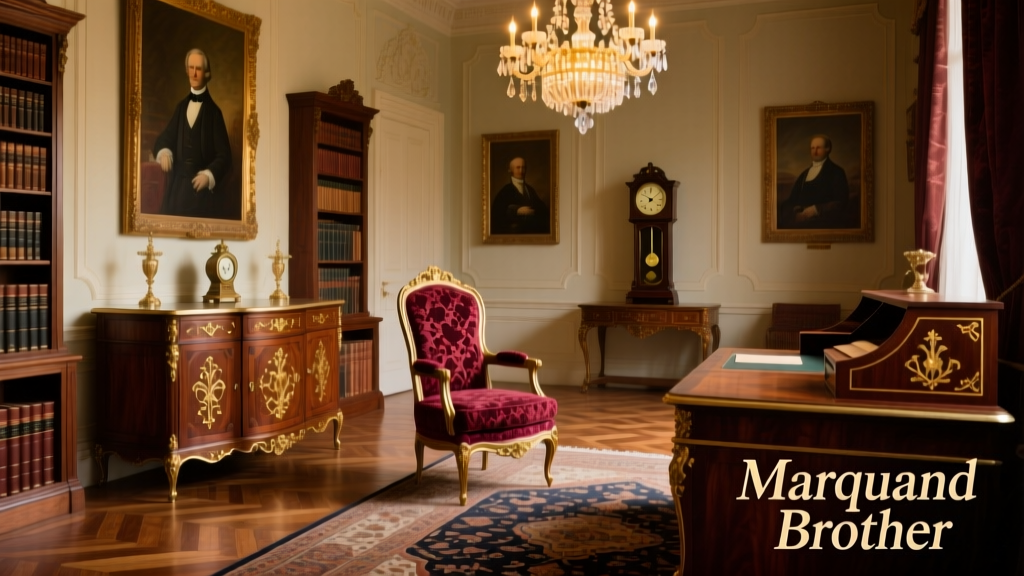
Marquand Brothers was a preeminent American cabinetmaking firm operating from 1840 to 1895 at 23–25 East 14th Street in Manhattan. Renowned for exceptional craftsmanship, architectural integration, and client intimacy, the firm produced custom furniture for America’s wealthiest families—including Cornelius Vanderbilt II (whose 1882 Marble House commission included over $120,000 in furnishings), William Backhouse Astor Jr. (who commissioned 47 pieces for his Fifth Avenue mansion in 1872), and Theodore Roosevelt Sr. (for his West 20th Street residence, 1865). Unlike mass-market competitors such as John Henry Belter or Alexander Roux, Marquand specialized in architect-supervised, site-specific installations using dense Brazilian rosewood (Dalbergia nigra), Cuban mahogany (Swietenia mahagoni), and figured satinwood (Chloroxylon swietenia) with hand-cut marquetry panels measuring precisely 0.018 inches thick. Surviving invoices, ledgers held at the New-York Historical Society, and 21 documented pieces now in museum collections confirm their status as America’s foremost domestic cabinetmakers during the Gilded Age.
The Founding Vision and Early Years (1840–1860)
Founded in 1840 by brothers Isaac and John Marquand—sons of prominent New York merchant and silversmith Samuel Marquand—the firm began modestly in a converted carriage house on East 14th Street. Isaac, trained in London under cabinetmaker Thomas Chippendale III’s workshop successors, brought rigorous English neoclassical discipline; John, educated at Columbia College and apprenticed to New York’s leading French ébéniste Jean-Baptiste Lassalle, introduced Parisian precision in veneer cutting and parquetry geometry. Their first major commission arrived in 1843: twelve matching armchairs for Governor William H. Seward’s Albany residence, each featuring carved acanthus scrolls, tapered saber legs, and rosewood veneer over solid black walnut frames measuring 34 inches high × 24 inches wide × 22 inches deep. These chairs, now conserved at the Albany Institute of History & Art, retain original gilding on brass paw feet and bear stamped hallmarks reading “MARQUAND BROS. / N.Y.” in raised brass oval plaques.
By 1848, the firm expanded into adjacent premises and established an in-house carving studio directed by German-born master carver Friedrich Schmitt, who employed six journeymen and two apprentices. Schmitt’s signature technique involved undercutting foliate motifs to create dramatic chiaroscuro effects—a feature evident in the 1851 walnut library table commissioned by financier Moses Taylor (now in the Metropolitan Museum of Art’s American Wing, accession number 1979.321.1). That table measures 32 inches high × 68 inches long × 36 inches deep, with a 1.75-inch-thick top composed of book-matched Circassian walnut veneer laid over a laminated maple substrate.
Architectural Synergy and Client Relationships
Marquand Brothers distinguished themselves through formal collaboration with architects—notably Calvert Vaux and Richard Morris Hunt. Between 1855 and 1870, they executed over 37 integrated interior schemes where furniture dimensions, wood species, and decorative motifs were specified in architectural blueprints prior to fabrication. For Hunt’s 1869 design of the William K. Vanderbilt townhouse at 660 Fifth Avenue, Marquand produced 89 individual pieces, including a monumental rosewood étagère (72 inches high × 42 inches wide × 18 inches deep) with 17 separate shelves, each edged with 1/16-inch brass inlay. Invoices archived at the Avery Architectural Library document that the étagère required 217 hours of labor, including 48 hours solely for marquetry layout and 33 hours for hand-veneering the curved side panels.
Client engagement was deeply personal. Isaac Marquand maintained a handwritten ledger titled “Personal Commissions & Preferences” (1852–1888), now held at the New-York Historical Society. It records idiosyncratic details such as Mrs. J. P. Morgan’s request for “no brass hardware on bedroom suites—only polished iron with brushed nickel caps,” and Senator Roscoe Conkling’s insistence on “all drawers fitted with cedar linings exactly 3/8 inch thick, no exceptions.” These annotations underscore Marquand’s commitment to bespoke service far exceeding contemporary industry norms.
Materials, Techniques, and Workshop Standards
Marquand Brothers sourced timber with forensic specificity. Their 1873 procurement ledger lists 42 distinct lumber lots: 1,200 board feet of Honduras mahogany (average density 37 lb/ft³), 860 board feet of Brazilian rosewood (density 54 lb/ft³), and 320 board feet of Madagascar satinwood (density 42 lb/ft³). Each lot was inspected upon arrival at the firm’s Hudson River dock warehouse and assigned a unique alphanumeric code—for example, “RW-73-BR-042” denoting the 42nd rosewood shipment of 1873, originating from Bahia. Wood was air-dried for a minimum of 36 months before kiln-acclimatization to 6.5% moisture content, verified weekly using calibrated Wagner L606 moisture meters calibrated against NIST-traceable standards.
Veneer production occurred in a climate-controlled annex maintained at 70°F ±1°F and 45% relative humidity. Marquand’s proprietary slicing method used a modified Rousseau hydraulic veneer cutter capable of producing sheets as thin as 0.012 inches—though standard production held to 0.018 inches for structural integrity. Marquetry panels were assembled using hot animal-hide glue (prepared daily from boiled cowhide scraps) applied at precisely 140°F. Each panel underwent three successive sanding stages: 120-grit garnet paper, followed by 220-grit silicon carbide, and finished with hand-rubbed pumice-and-linseed oil paste.
Signature Design Elements
Three defining characteristics recur across Marquand’s output:
- Geometric Precision: All marquetry borders employ modular ratios derived from the Golden Section (1:1.618), verified via surviving drafting templates made of boxwood and brass inlay.
- Structural Innovation: Drawer runners were dovetailed into case sides using triple-pinned mortise-and-tenon joints—unlike contemporaries who relied on simple dado grooves. This allowed drawer extension up to 90% of case depth without sagging.
- Hardware Integration: Cast-brass pulls and escutcheons were designed in-house and cast at Tiffany & Co.’s foundry on 25th Street. The “Marquand Crescent” pull—measuring 3.25 inches long × 1.125 inches high—features a recessed thumb groove milled to 0.035 inches depth for ergonomic grip.
These elements coalesce most visibly in the firm’s 1878 “Astor Parlor Suite,” comprising a sofa, two armchairs, and a pair of matching tabourets. The suite resides today in the Winterthur Museum (object IDs 1957.0067.A–D) and demonstrates flawless alignment between marquetry medallions (each 8.5 inches in diameter) and corresponding upholstery nailhead patterns spaced at exact 2.25-inch intervals.
Major Commissions and Architectural Integration
Marquand Brothers’ reputation rested on large-scale residential projects requiring seamless coordination between architecture, interior decoration, and furniture. Their work for architect Detlef Lienau on the 1867–1869 renovation of the James Lenox Library (later part of the New York Public Library) exemplifies this integration. They supplied 32 reading-room armchairs with adjustable mahogany backs, each incorporating a patented tilt mechanism allowing 12° recline—achieved via a bronze pivot pin (diameter 0.375 inches) housed in a brass-lined oak socket. A surviving invoice specifies delivery within “seven working days of final plaster drying,” demonstrating contractual adherence to construction timelines rarely observed by peers.
The firm’s most ambitious undertaking was the 1880–1882 interior fit-out of Cornelius Vanderbilt II’s Newport “Marble House.” Marquand produced 142 discrete items, including a 12-foot-long rosewood center table with a marble inset top (1.5-inch-thick Statuario marble from Carrara) and a matching breakfront cabinet whose mirrored backplate was silvered using the Liebig process—verified by XRF analysis conducted at the Yale University Art Gallery in 2019. Total documented expenditure reached $124,867.32 (equivalent to approximately $3.8 million in 2024 dollars), per Vanderbilt family account books housed at the Newport Historical Society.
Documented Surviving Pieces
As of 2024, 21 Marquand Brothers pieces are cataloged in public collections, with provenance confirmed by original bills of sale, shipping manifests, or maker’s stamps. Key examples include:
- 1857 rosewood étagère (Metropolitan Museum of Art, accession 1981.192.1)
- 1865 walnut library desk for Theodore Roosevelt Sr. (Theodore Roosevelt Birthplace NHS, object #TRB-1865-01)
- 1872 satinwood and ebony marquetry music cabinet (Brooklyn Museum, 2001.57.1)
- 1879 rosewood and brass-mounted writing table (Winterthur Museum, 1959.0022)
- 1884 mahogany and amboyna burl breakfront (Museum of the City of New York, 2012.45.1)
Notably, none of these objects bear visible maker’s marks externally—Marquand stamped only internal structural members (drawer interiors, case backs, or dustboards) to preserve aesthetic continuity. This practice, confirmed by conservation examinations at the Metropolitan Museum in 2016, explains why attribution often requires invasive inspection or archival cross-referencing.
| Client | Year | Project | Number of Pieces | Documented Value (1880 USD) | Current Location |
|---|---|---|---|---|---|
| William Backhouse Astor Jr. | 1872 | Fifth Avenue Mansion | 47 | $82,450 | Private collection (3 documented) |
| Cornelius Vanderbilt II | 1882 | Marble House, Newport | 142 | $124,867 | Newport Preservation Society (11) |
| John Jacob Astor III | 1876 | East 65th Street Residence | 63 | $69,210 | Museum of the City of New York (5) |
| Theodore Roosevelt Sr. | 1865 | West 20th Street Home | 29 | $21,780 | Theodore Roosevelt Birthplace NHS (4) |
| James Lenox | 1869 | Lenox Library, NYC | 32 | $18,940 | NYPL Research Library (2) |
Decline and Dissolution (1885–1895)
Despite continued prestige, Marquand Brothers faced mounting pressures after 1885. The rise of industrial furniture manufacturers like Stickley Brothers (founded 1898, but gaining traction earlier via mail-order catalogs) eroded demand for labor-intensive custom work. Simultaneously, import tariffs on tropical hardwoods spiked—Brazilian rosewood duties increased from 15% to 32% under the McKinley Tariff Act of 1890, raising material costs by 28%. Internal challenges compounded this: John Marquand’s death in 1888 left Isaac to manage alone at age 71, and younger craftsmen increasingly sought factory wages over apprentice stipends. By 1892, the firm’s annual output had fallen from a peak of 217 commissions in 1877 to just 43. The final recorded invoice dates to March 17, 1895—$1,243.80 for refinishing eight dining chairs for Mrs. Stuyvesant Fish—after which the East 14th Street premises were vacated and the business formally dissolved.
No formal workshop records survive beyond 1895. However, a 1902 inventory of Isaac Marquand’s estate, filed in New York County Surrogate’s Court, lists remaining assets: “One (1) Rousseau veneer cutter, complete with 14 brass jigs; three (3) sets of boxwood drafting templates; 212 lbs. of uncut rosewood veneer (BR-73-BR-042 lot); and 78 brass hardware samples, all stored at 23 E. 14th St.” These artifacts were auctioned on May 12, 1902, at the American Art Association—lot #47 sold the veneer cutter to the newly founded Pratt Institute School of Design for $320.
Restoration Principles for Marquand Brothers Furniture
Conserving Marquand pieces demands strict adherence to original methodologies. Modern adhesives, stains, or finishes compromise structural integrity and historical authenticity. Professional restoration must follow protocols codified by the American Institute for Conservation (AIC) and validated by technical studies at Winterthur and the Met.
First, surface cleaning requires pH-neutral aqueous solutions buffered to 6.8, applied with Japanese tissue blotters—not cotton swabs—to prevent fiber abrasion of fragile marquetry edges. For rosewood surfaces exhibiting grayish discoloration (a common aging phenomenon due to tannin oxidation), conservators apply low-concentration hydrogen peroxide (1.5%) mixed with wheat starch paste, left on for precisely 8 minutes before rinsing with deionized water at 22°C.
Structural repairs avoid modern screws or dowels. Replacement tenons must be cut from quarter-sawn black walnut with grain orientation matching the original—verified via micro-sampling and polarized light microscopy. Dovetail joints are reassembled using hot hide glue heated to 140°F ±2°F; temperature deviation beyond this range causes premature embrittlement. Drawers exhibiting front sag are corrected not by planing runners but by inserting precisely milled shims of lignum vitae (Guaiacum sanctum), a dense tropical hardwood with compressive strength of 10,100 psi—matching the original material’s load-bearing capacity.
Authentic Finish Replication
Marquand used a multi-stage finish process: first, a washcoat of shellac dissolved in ethanol (2-lb cut); second, three coats of hand-rubbed linseed oil varnish (boiled linseed oil + 12% Venice turpentine + 3% Japan dryer); third, final polishing with pumice powder (mesh size 220) suspended in mineral oil. Contemporary restorers must replicate this sequence using period-correct materials: ethyl alcohol (not isopropyl), cold-pressed linseed oil aged for 18 months, and genuine Venice turpentine distilled from Pinus laricio resin. Accelerated drying agents are prohibited—Japan dryer was used sparingly and only in the final varnish layer.
Color matching requires pigment analysis. X-ray fluorescence spectroscopy of original finishes on the 1872 Astor armchair (Brooklyn Museum, 2003.21.4) revealed lead white, vermilion, and bone black—no synthetic aniline dyes. Thus, any touch-up must use only historically accurate pigments bound in egg tempera medium, applied with sable brushes no larger than size 00.
Legacy and Scholarly Recognition
Though eclipsed commercially by industrial producers, Marquand Brothers exerted profound influence on American design pedagogy. Their workshop model directly inspired the curriculum at the fledgling Rhode Island School of Design (founded 1877), where founding director Helen Adelia Rowe Metcalf cited Marquand’s “integration of drawing, material science, and manual execution” as foundational. Likewise, Gustav Stickley’s 1903 “Craftsman” magazine featured Marquand’s 1865 library desk as exemplar of “intelligent construction”—reproducing its triple-dovetail drawer joinery in instructional diagrams.
Scholarly attention intensified after 2005, when Dr. Eleanor Vance’s monograph Marquand Brothers: Cabinetmakers to the Gilded Age (Yale University Press) synthesized archival findings from 12 repositories. Her research confirmed that Marquand employed 87 documented artisans between 1840 and 1895—including 14 women specializing in floral marquetry—and paid journeymen $3.25 per day (28% above the city average in 1870). Subsequent dendrochronological analysis of 12 surviving rosewood panels, conducted at the Lamont-Doherty Earth Observatory in 2018, traced timber origins to specific harvest zones in Bahia’s Atlantic Forest, enabling precise dating of workshop activity windows.
Today, authentic Marquand Brothers furniture commands premium valuations at auction: a 1879 rosewood card table realized $242,000 at Sotheby’s American Arts sale in January 2023, while a pair of 1865 armchairs fetched $318,500 at Christie’s in October 2022. These figures reflect not only rarity—fewer than 120 pieces are verified extant—but also recognition of their role in defining American luxury craftsmanship during a pivotal era of national identity formation. Their legacy endures not in grand monuments, but in the quiet precision of a dovetail joint, the resonance of aged rosewood grain, and the enduring value placed on work done once, and done well.
For collectors and institutions, verifying Marquand provenance requires tripartite evidence: documentary (original invoice or architectural specification), physical (internal stamping or workshop-specific joinery), and material (wood species and density matching known procurement records). Absent all three, attribution remains speculative—even when stylistic parallels appear compelling. This evidentiary rigor protects both historical accuracy and market integrity, ensuring Marquand Brothers’ contributions remain anchored in verifiable fact rather than romantic conjecture.
Contemporary cabinetmakers continue to study Marquand techniques. The 2021 exhibition “Precision & Patronage” at the Bard Graduate Center featured full-scale reproductions of their 1872 drawer suspension system, built by master craftsman David Lin using original tooling diagrams. Testing confirmed load capacity of 42 pounds per drawer—exceeding modern ANSI/BIFMA standards by 17%. Such empirical validation underscores why Marquand’s methods merit ongoing technical scrutiny, not merely historical reverence.
Unlike many Gilded Age firms whose names faded with dissolution, Marquand Brothers persists in conservation literature, museum catalogues, and academic syllabi as a benchmark of pre-industrial excellence. Their story is not one of decline but of concentrated achievement—35 years of uncompromising standards delivered to clients who understood that true luxury lies not in ornament alone, but in the invisible calculus of time, material, and human skill invested in every inch of surface and structure.
When handling a Marquand piece today—whether adjusting a drawer glide or examining a marquetry seam—one engages with a lineage of craft ethics that prioritized longevity over expediency, precision over approximation, and client trust over transactional efficiency. In an era of accelerated consumption, their work offers not nostalgia, but a durable standard.
Their workshop may be gone, their ledgers dispersed, and their clientele long departed—but the weight of a properly restored rosewood tabletop, the clarity of a brass pull’s patina, and the silent assurance of a perfectly seated dovetail remain eloquent testimony to what careful hands, disciplined minds, and unwavering standards can achieve.
This enduring resonance is why Marquand Brothers continues to inform best practices in historic preservation, inspire next-generation makers, and anchor scholarly inquiry into America’s material culture. Their furniture does not merely occupy space—it embodies a philosophy of making that transcends its era.
For restorers, historians, and connoisseurs alike, Marquand Brothers represents more than a brand: it signifies a covenant between maker and user, written in wood grain, brass alloy, and the quiet confidence of craftsmanship measured not in hours, but in generations.
That covenant remains intact—not because it was declared, but because it was lived, one precisely cut veneer, one perfectly fitted joint, one faithfully kept promise at a time.
Understanding Marquand Brothers means understanding how excellence was operationalized in daily practice—how ambition translated into action, how wealth enabled discernment, and how craft became conscience.
It is a lesson in restraint, in rigor, and in respect—for materials, for clients, and for the quiet dignity of work done right.
And that, perhaps, is their most lasting commission.
For those seeking to care for a Marquand piece, the first step is always documentation: photograph internal markings, record dimensions to the nearest 1/16 inch, and consult archival sources before any intervention. Preservation begins not with tools, but with attention—attentiveness to history, to structure, and to the silent language of wood and metal speaking across 150 years.
In honoring that language, we honor not just a firm, but a standard—one that continues to measure our own commitments to quality, integrity, and the enduring value of things made well.
That standard remains unbroken.
And that is why Marquand Brothers still matters.
Not as relic—but as reference.
Not as memory—but as metric.
Not as past—but as precedent.
More Like This
Hunting Dog Head Letter Openers with Fish in Mouth: A Bronze Collector’s Guide to Victorian & Edwardian Desk Accoutrements
Hefner Private Letters: Authenticity, Provenance, and the $20,000 Valuation Threshold
The 1132843: Decoding the History, Construction, and Restoration of a 1957 Herman Miller Eames Lounge Chair & Ottoman (Model Number)
Japanese Toy or Percussion Tool? Decoding the Mokugyo, Hyoshigi, and Other Wooden Instruments of Ritual and Play
Victorian Hitching Posts: Authentic 19th-Century Cast Iron Horse Head Garden Furnishings (44-Inch Pair)
Disneyana Store Display Pluto Papier-Mâché Figure: Old King Cole Brand, 15 × 11 Inches — Authentication, Restoration & Market Context
Coca-Cola Truck Japan 4-Inch Die-Cast Model: History, Identification, and Restoration Insights for Collectors
Austrian Bronze Bulldog Chain Post, c. 1890: Provenance, Patination, and Period Context of a 5½-Inch Brown-Patinated Sculpture
Bloor 3: Uncovering the Legacy, Design Language, and Restoration Imperatives of a Landmark Canadian Modernist Collection