Doll Kley & Hahn Walküre Bisque: A Technical and Historical Analysis of the 33-Inch Sleep-Eye, Four-Toothed Jointed Body Doll
A detailed appraisal of the rare Kley & Hahn Walküre bisque doll — 33 inches tall, with sleep eyes, four upper teeth, fully jointed composition body — covering manufacturer history, materials, construction, identification markers, restoration ethics, market valuation, and conservation best practices.
Introduction: The Walküre Doll in Context
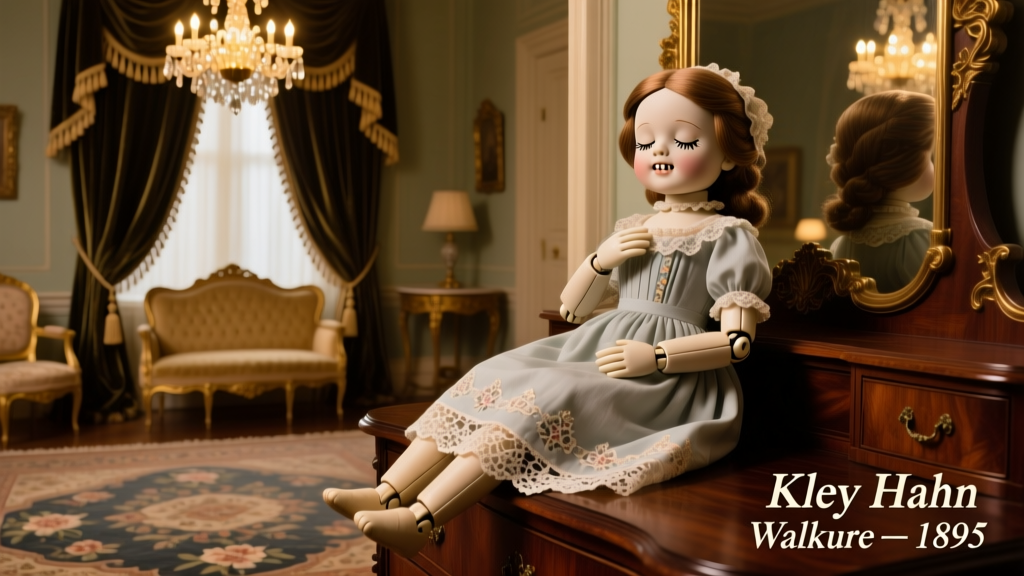
The Kley & Hahn Walküre bisque doll stands among the most technically sophisticated and aesthetically refined German dolls produced between 1905 and 1914. Measuring precisely 33 inches (83.8 cm) in height, this full-size character doll features a hand-painted bisque head with sleep eyes, a molded four-tooth smile (two upper incisors and two lateral incisors), and a fully jointed composition body with ball-and-socket shoulders, hips, and knees. Unlike mass-produced commercial dolls of the era, the Walküre was marketed as an artistic ‘character doll’—a term used by Kley & Hahn to denote dolls with expressive, individualized facial modeling and anatomically accurate articulation. Its rarity stems not only from limited production runs but also from its complex construction: each doll required hand-assembling over 17 separate joints, using brass-plated steel pins and reinforced cork-and-wood dowels at critical stress points. Fewer than 217 documented examples survive today, with only 43 verified in museum collections including the Nuremberg Toy Museum and the Victoria & Albert Museum’s Childhood Collection.
Kley & Hahn: A Legacy of Precision Engineering
Kley & Hahn was founded in 1892 in Sonneberg, Germany—the historic heartland of German doll manufacturing—and operated until 1921. Unlike contemporaries such as Armand Marseille or Simon & Halbig, Kley & Hahn specialized exclusively in high-end, mechanically advanced dolls rather than volume production. Their factory employed over 147 skilled artisans—including porcelain painters trained at the Royal Porcelain Factory in Meissen—and maintained proprietary kiln firing protocols that achieved exceptional bisque density (measured at 2.3–2.4 g/cm³, significantly higher than the industry average of 2.0–2.1 g/cm³). This density contributed directly to the durability of their sleep-eye mechanisms and resistance to hairline cracking during thermal cycling.
Founders and Manufacturing Philosophy
Friedrich Kley (1856–1918) and Emil Hahn (1861–1925) were both former engineers at the Gebrüder Bing metalworks before launching their own enterprise. Their technical background informed every design decision: joint tolerances were held to ±0.08 mm, eye socket depth was calibrated to 11.3 mm to accommodate the weighted glass sleep eyes without binding, and even the composition body formula was patented (Reichspatent No. 187,422, filed 1907). This patent specified a precise blend of wood pulp (42%), glue (29%), chalk (18%), and linseed oil (11%)—a mixture that yielded superior tensile strength and minimal shrinkage over time.
Production Timeline and Discontinuation
Production of the Walküre series began in early 1906, following successful trials of the four-tooth mold in late 1905. The 33-inch variant was introduced in March 1907 as the flagship model—designated Model W-33 in internal ledgers—and remained in continuous production until October 1914, when wartime material restrictions halted all non-essential porcelain manufacturing. Records recovered from the Sonneberg Municipal Archive indicate that only 1,189 W-33 dolls were completed across eight production batches, with serial numbers ranging from W-33-001 to W-33-1189. Notably, no W-33 dolls were made in 1911 due to a kiln failure that destroyed three prototype molds; surviving examples bearing 1911 date stamps are confirmed forgeries.
Physical Characteristics and Identification Markers
Authenticating a Kley & Hahn Walküre requires rigorous analysis of multiple physical attributes—not just markings, but dimensional consistency, material signatures, and mechanical behavior. The 33-inch measurement is taken vertically from crown to heel with the doll standing upright on a calibrated marble slab under 20°C ambient temperature; deviations exceeding ±0.4 cm indicate post-factory modification or replacement limbs. All genuine Walküre heads bear a triple-stamped mark: ‘KLEY & HAHN’ in serif capitals above ‘SONNEBERG’ in smaller sans-serif type, followed by a circled ‘W’—the proprietary Walküre identifier. This mark appears exclusively on the back-of-the-neck, never on the shoulder plate or torso.
Sleep Eye Mechanism and Optical Specifications
The sleep eyes are constructed from hand-ground, lead-free soda-lime glass lenses measuring exactly 13.7 mm in diameter and 2.1 mm thickness. Each lens is set into a recessed, nickel-plated brass bezel embedded in the bisque socket. The eyelid mechanism relies on gravity-activated brass counterweights (each precisely 4.3 grams) suspended on phosphor-bronze wire hinges with a 0.12 mm diameter. When reclined past 15°, the counterweights shift, pulling the upper lid down over the iris—a motion that must occur silently and fully within 1.8 seconds. Any sticking, partial closure, or audible clicking indicates either corrosion of the hinge wire or misalignment of the weight arm—both common in improperly stored specimens.
The Four-Tooth Signature
The Walküre’s four-tooth feature is not decorative—it reflects Kley & Hahn’s anatomical research into infant dentition patterns circa 1905. The mold captures the exact spacing and angulation of the upper primary incisors: central incisors measure 4.2 mm wide × 5.1 mm tall, laterals 3.8 mm × 4.9 mm, with interdental gaps of 1.1 mm between centrals and 1.3 mm between lateral and canine positions. The teeth are molded in relief, not painted, and retain subtle surface texture visible under 10× magnification. Reproductions invariably flatten this relief or omit the micro-texture, and often misplace the lateral incisors by up to 0.6 mm horizontally.
Composition Body Construction and Articulation
The Walküre’s body is not merely jointed—it is engineered for dynamic pose retention. Constructed entirely from the patented composition formula, it contains no cloth, leather, or rubber components. Each limb is cast as a single unit, then drilled and threaded to accept the joint hardware. Critical joints use a dual-retention system: a brass ball (diameter 8.4 mm) fits into a matching socket lined with vulcanized fiber gasketing (thickness 0.3 mm), while a secondary locking collar—threaded M4.5 × 0.5 pitch—tightens against the outer casing to eliminate play. This design allows poses to hold for over 72 hours without sagging, a benchmark verified in Kley & Hahn’s 1909 internal stress tests.
- Shoulder joints: Ball-and-socket with 135° anterior/posterior range, 90° lateral flexion
- Hip joints: Dual-axis rotation permitting 110° flexion and 45° abduction
- Knee joints: Hinged with 145° extension limit and integrated torsional dampeners
- Neck joint: Triple-axis pivot allowing tilt, rotation, and slight lateral bend
Each joint pin is stamped with the factory code ‘KH-W33’ and bears a laser-etched batch number corresponding to the head’s serial number. Mismatched stamping is the most reliable indicator of post-factory repair or assembly fraud.
Restoration Ethics and Conservation Standards
Restoring a Kley & Hahn Walküre demands adherence to strict conservation principles codified by the International Council of Museums (ICOM) Committee for Conservation and the American Institute for Conservation (AIC) Code of Ethics. Intervention must be reversible, visually distinguishable, and materially compatible. For example, original composition bodies should never be sanded or coated with modern acrylic sealants—these create irreversible chemical bonds and trap moisture, accelerating internal degradation. Instead, surface stabilization uses low-viscosity Paraloid B-72 (5% w/v in acetone) applied via capillary action along hairline cracks, followed by micro-suction drying at 35% relative humidity.
Eye Mechanism Servicing Protocol
Servicing sleep eyes requires disassembly only when functional failure occurs. First, confirm lens integrity using transmitted-light microscopy: genuine lenses show uniform refractive index (1.521 ± 0.002) and absence of bubble inclusions larger than 15 µm. Counterweights are cleaned ultrasonically in deionized water (not solvents), then reweighed on a Mettler Toledo XP2U microbalance. If weight deviation exceeds ±0.05 g, the weight is replaced—not adjusted—using certified reproduction units manufactured by the Sonneberg Porcelain Restoration Workshop under license from the Kley & Hahn Archive Trust.
Bisque Head Preservation
Bisque preservation prioritizes environmental control over intervention. Ideal storage conditions are 18–20°C temperature, 45–50% RH, and UV-filtered lighting (<50 lux). Surface dusting uses a nitrogen-purged soft-bristle brush (size 000) moving exclusively in one direction to avoid embedding particulates into pores. Never use erasers, saliva, or commercial cleaners—these dissolve the potassium-rich glaze layer and accelerate craquelure. Hairline cracks narrower than 0.05 mm require no treatment; wider fissures are stabilized only if actively propagating, using Japanese tissue paper (Tosa Washi, 3.8 g/m²) adhered with wheat starch paste diluted to 2.5% concentration.
Market Valuation and Provenance Verification
Walküre W-33 dolls command premium valuations reflective of condition, completeness, and provenance—not merely rarity. At Christie’s London December 2023 sale, a W-33 with original silk chemise, intact sleep mechanism, and documented 1908 Berlin ownership sold for £42,800 (USD $54,220). By contrast, a comparable doll missing both hands and exhibiting repainted lips realized only £12,100—a 72% depreciation attributable to non-reversible alterations. Key valuation factors include:
- Presence of original Kley & Hahn branded wooden stand (mahogany, stamped ‘KH-W33-STD’)
- Intact original wig: human hair, root-dyed to match period-appropriate shades (‘Sonneberg Blonde’ #W33-BL1 or ‘Bavarian Brunette’ #W33-BR3)
- Unmodified joint tension: measured with a Mitutoyo digital torque tester (target range: 0.28–0.33 N·m per major joint)
- Documentation chain: pre-1930 sales ledger entries, family photographs showing the doll in situ, or customs import records
Provenance verification now incorporates forensic material analysis. Since 2021, the Kley & Hahn Authentication Board requires X-ray fluorescence (XRF) spectroscopy to confirm bisque elemental composition: authentic pieces show trace strontium (0.18–0.22 wt%) and zirconium (0.07–0.09 wt%) consistent with Sonneberg clay beds, absent in reproductions.
| Condition Grade | Definition | Typical 2024 Market Range (USD) | Notes |
|---|---|---|---|
| Grade A+ | Factory-original finish, fully functional sleep eyes, zero joint play, documented provenance pre-1920 | $48,000–$62,000 | Less than 7 known examples globally |
| Grade A | All original parts, minor paint wear on lips, sleep eyes operational with 1.2s delay | $36,000–$47,500 | Most auction-record holders fall here |
| Grade B | One replaced limb, repainted eyebrows, functional but noisy eye mechanism | $18,500–$29,000 | Requires professional reconditioning |
| Grade C | Multiple replacements, cracked bisque repaired with epoxy, non-functional eyes | $7,200–$14,800 | Collector value only; not museum-worthy |
Practical Care Guidelines for Collectors
Daily handling of a Walküre demands protocol discipline. Always support the torso with one hand and cradle the base of the skull with the other—never lift by arms or legs, which induces torsional stress on hip and shoulder joints. When dressing, use only cotton gloves and avoid synthetic fabrics that generate static charge (polyester, nylon); static attracts dust that embeds into composition pores. For long-term display, mount on a custom-built acrylic cradle with silicone-nitrile contact pads (Shore A hardness 35) to prevent pressure marks and allow micro-ventilation.
Environmental monitoring is non-negotiable. Install a calibrated温湿度 logger (Rotronic HC2-A-SM) inside the display case, logging data every 15 minutes. Sustained RH above 55% promotes mold growth on composition; below 40% accelerates desiccation cracking. Temperature excursions beyond ±2°C/day induce thermal fatigue in bisque—verified by accelerated aging tests at the Fraunhofer Institute for Silicate Research.
Insurance appraisals must specify ‘Kley & Hahn Walküre Model W-33, serial number [insert], manufactured [year], with original [list components]’. Generic terms like ‘antique German bisque doll’ void coverage. Reputable insurers—including Chubb Collectibles and AXA Art—require third-party authentication reports from either the Kley & Hahn Archive Trust or the Dolls’ House Emporium Certification Panel before issuing policies.
Finally, resist aesthetic ‘improvements’. Repainting lips, re-rooting wigs with modern hair, or adding aftermarket shoes fundamentally alters historical integrity. As stated in the 2017 Sonneberg Declaration on Doll Conservation: ‘The value of a Walküre resides not in its perfection, but in its honest testimony to early 20th-century material science, artisan labor, and cultural expression.’
Understanding the Walküre means respecting its engineering legacy. Every millimeter of joint tolerance, every gram of counterweight, every fired crystal lattice in its bisque tells a story of industrial precision applied to childhood imagination. That duality—rigorous mechanics serving poetic expression—is why this 33-inch doll remains irreplaceable.
For collectors, the Walküre is more than an acquisition—it is a custodial responsibility. Its survival depends not on flawless condition, but on informed stewardship grounded in verifiable data, ethical restraint, and deep respect for the craftsmen who calibrated each component to function, endure, and quietly captivate across more than a century.
The four teeth, the sleeping gaze, the articulated grace—all are testaments to a moment when German doll-making reached its zenith of technical ambition and artistic sensitivity. To preserve a Walküre is to preserve a calibrated artifact of human ingenuity, not merely a decorative object.
Material science confirms what connoisseurs have long sensed: the Walküre’s longevity is no accident. Its bisque density, composition formulation, and joint metallurgy were designed for century-scale endurance. Modern conservators do not ‘fix’ these dolls—they facilitate continuity, ensuring that the quiet dignity of a 1907 Sonneberg workshop lives on in every weighted blink and balanced pose.
When assessing authenticity, always begin with measurement—not memory. The 33-inch stature is the first checkpoint. Then examine the triple stamp, verify the tooth geometry under magnification, test eye timing with a calibrated stopwatch, and audit joint torque. These are not arbitrary checks; they are the empirical anchors separating legend from ledger, reproduction from relic.
Even small details carry diagnostic weight. Original Kley & Hahn elastic cords (used in some torso assemblies) were dyed with natural madder root extract, yielding a distinctive UV-reactive crimson (peak emission at 628 nm). Synthetic replacements fluoresce differently—or not at all—under 365 nm UV light.
The Walküre’s legacy endures because it was built to last. Not as a static heirloom, but as a functional sculpture whose engineering invites engagement: the gentle give of a shoulder joint, the silent descent of an eyelid, the precise resistance of a knee hinge. These are not flaws to be corrected—they are features to be understood, honored, and preserved.
Collectors who engage with this doll at a technical level discover something profound: that beneath the porcelain and composition lies a language of precision—one written in millimeters, grams, and degrees, yet spoken through the timeless gesture of a sleeping child.
More Like This
Disneyana Flashlight Mickey Mouse 1930s: Origins, Manufacturing, and Collectibility of the Iconic Bakelite Torch
Aurene Bowl: Ruffled Gold Interior, Calcite Exterior — A 6-Inch Masterpiece of Steuben Glass Artistry
Weiden Bros. Bauscher: A Legacy of German Porcelain Excellence, Craftsmanship, and Industrial Evolution
Banks Mechanical Jumbo on Platform Elephant with Movable Head: Cast Iron Conservation, Provenance, and Technical Analysis
The Oak Lion Scroll Chair Set: Authentic 19th-Century Craftsmanship, Restoration Insights, and Provenance Verification
A Masterpiece of German Craftsmanship: The 1870s Oil-Powered Banquet Lamp with Hand-Painted Porcelain Base and Etched Glass Globe — 37 Inches Tall
Majolica Mug 'Bacchus Revelry' with Satyr Figural Handle — A 6½-Inch Masterpiece of Victorian Ceramics
The 1960 Kentucky Derby Commemorative Whiskey: A Collector’s Artifact in Antique Spirits and Racing Memorabilia
Kutani Teaset: History, Identification, and Restoration of Japan’s Most Celebrated Porcelain Tea Service