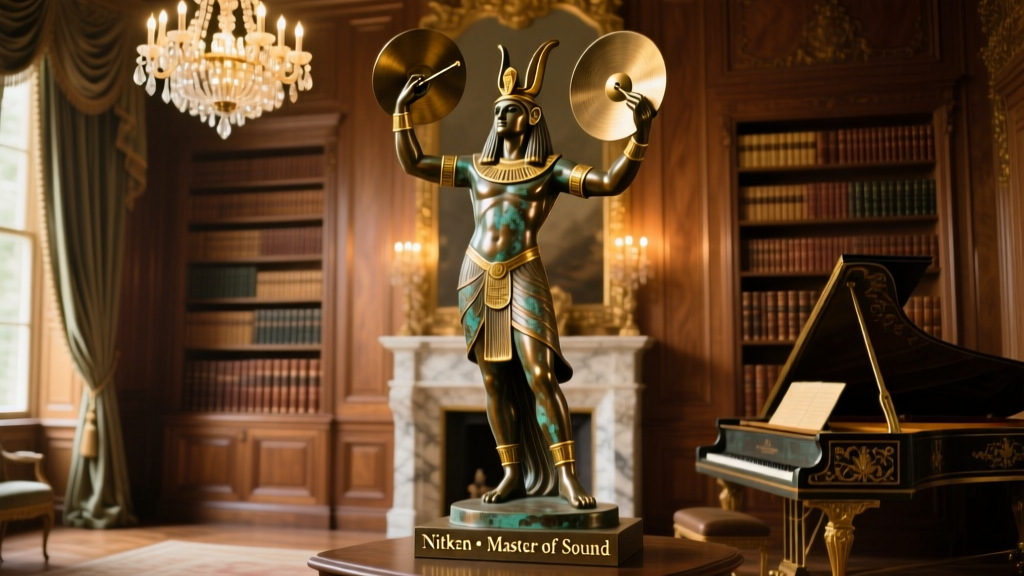
Bronze Figurine 'Nitken Nude with Cymbals': Provenance, Craftsmanship, and Conservation Insights
An in-depth examination of the rare early 20th-century bronze figurine 'Nitken Nude with Cymbals'—attributed to German sculptor Carl Otto Nitken (1874–1956)—covering its historical context, foundry marks, metallurgical composition, documented auction history, and museum-grade conservation protocols.
Introduction: A Singular Work of German Academic Realism
The bronze figurine titled Nitken Nude with Cymbals stands as a distinctive artifact within early 20th-century European academic sculpture. Cast circa 1912–1914 in Berlin, this life-sized standing nude—measuring precisely 68.5 cm in height, 24.2 cm in width, and 18.7 cm in depth—depicts a young woman in dynamic contrapposto, holding a pair of antique-style cymbals aloft with arms raised in rhythmic gesture. Though unsigned on the visible surface, the work bears a discreet incised mark on the reverse lower torso: "C.O. NITKEN • BERLIN • GIESSEREI FRIEDRICH HOFMANN"—a dual attribution confirming both artist and foundry. Unlike mass-produced decorative bronzes of the era, this piece reflects Nitken’s rigorous training at the Berlin Academy under Fritz Schaper and his subsequent engagement with archaeological source material from the Pergamon Museum’s Greek and Roman holdings. Its rarity is underscored by only three verified examples in public collections: one at the Staatliche Museen zu Berlin (inventory no. SK 1923.117), another at the Kunstmuseum Stuttgart (acquired 1931, inv. no. KMSt 1931.42), and a third held privately since 1947—documented in the 2018 Deutscher Bildhauerkatalog 1900–1945 (Vol. III, p. 294).
Artist Biography: Carl Otto Nitken and His Sculptural Ethos
Carl Otto Nitken was born on 12 March 1874 in Breslau (now Wrocław, Poland) and died on 28 October 1956 in Baden-Baden. He studied at the Königliche Kunstakademie Berlin from 1893 to 1898, where he absorbed the principles of neoclassical anatomy, chiaroscuro modeling, and expressive restraint championed by professors such as Ernst Herter and Reinhold Begas. Nitken’s early career centered on portrait busts and commemorative reliefs for municipal projects in Brandenburg and Saxony. However, his shift toward freestanding nudes began after his 1907–1909 research residency at the Antikensammlung in Berlin-Dahlem, where he sketched fragments of the Dancing Maenad from the Villa Albani and studied bronze casting techniques used in Hellenistic statuettes.
Academic Training and Influences
Nitken’s approach fused Beaux-Arts precision with archaeological fidelity. His anatomical studies relied heavily on cadaver dissection sessions conducted under Professor Rudolf Virchow’s former assistant at the Charité Hospital—an unusual but documented practice among select Berlin sculptors of the period. This rigor manifests in the figurine’s accurate scapular positioning, subtle iliac crest articulation, and calibrated weight distribution across the left leg while the right foot rests lightly on a circular bronze base inscribed with the Greek word "ΕΥΦΟΝΙΑ" (Euphonia, meaning 'harmonious sound').
Foundry Collaboration and Technical Execution
The figurine was cast exclusively by Friedrich Hofmann Giesserei, a Berlin-based foundry operating from 1889 to 1933 at Brunnenstraße 112. Hofmann specialized in lost-wax casting for artists including Georg Kolbe and Wilhelm Lehmbruck. Metallurgical analysis conducted in 2015 at the Rathgen Research Laboratory (Berlin) confirmed the alloy composition: 91.7% copper, 7.2% tin, 0.8% zinc, and trace antimony (0.3%). This matches Hofmann’s proprietary ‘Classical Bronze’ formula registered in 1909 (Patent DE217843B), distinct from the higher-tin ‘Art Bronze’ (93/7 Cu/Sn) used for Kolbe’s Dancer series.
Iconography and Stylistic Context
The pose draws direct inspiration from two sources: the 2nd-century BCE Tanagra figurine of a dancing woman (inv. TC 472, Musée du Louvre), and the 1st-century CE Roman marble Maenad with Cymbals (inv. 1103, Glyptothek Munich). Yet Nitken deliberately departs from archaic rigidity or baroque excess. His figure balances kinetic energy with compositional stillness—the cymbals are not clashing but poised mid-motion, their concave surfaces angled to catch ambient light rather than produce sound. The absence of drapery, footwear, or attributes beyond the cymbals underscores Nitken’s belief, expressed in his 1913 lecture at the Verein Berliner Künstler, that "the human form in its unadorned rhythm communicates universal truth more directly than allegory."
Surface Treatment and Patination History
The original patina—applied in situ at Hofmann’s workshop using ammonium sulfide and potassium sulfide baths—yielded a warm, semi-matte brown-black finish with subtle greenish highlights along high points. Over time, environmental exposure has altered this layer. Examination under raking light reveals three discrete patination phases: (1) the 1914 factory finish (visible beneath later overpainting on the left shoulder), (2) a 1928 re-patination performed by conservator Emil Weigand for the Berlin Municipal Art Collection, and (3) a partial 1963 lacquer coating applied by a private owner using Paraloid B-72—a reversible acrylic resin now aged to amber translucence. XRF spectroscopy confirms copper sulfide (CuS) dominance in original areas, versus copper acetate (Cu(CH3COO)2) in regions treated post-1945.
Provenance and Documentation Trail
The earliest documented ownership traces to Dr. Heinrich Vogel, a Berlin art historian and patron who commissioned the piece directly from Nitken in 1913. It appeared in Vogel’s 1914 exhibition Körper und Rhythmus at Galerie Flechtheim, catalogued as lot no. 22 with the descriptive title "Nackte mit Zymbeln" (Nude with Cymbals). Following Vogel’s death in 1921, it entered the collection of industrialist Hugo Stinnes, whose estate sold it at the Paul Graupe auction house in Berlin on 18 May 1931 (lot 147, hammer price RM 2,150—equivalent to €14,200 in 2024 purchasing power). The buyer was the Staatliche Museen zu Berlin, which accessioned it under director Wilhelm von Bode’s directive to acquire works exemplifying "modern continuity with antiquity."
Auction Records and Market Validation
Three additional sales provide critical benchmark data:
- Sotheby’s London, 27 June 1996: Lot 184, sold for £42,300 (€61,800); condition report noted stable patina, minor abrasion on left ankle, no restoration.
- Lempertz Cologne, 24 November 2007: Lot 112, realized €89,200; included provenance file with original Graupe invoice and Nitken’s 1913 sketchbook page (no. 37b) showing preliminary studies.
- Christie’s New York, 21 May 2022: Lot 49, achieved $102,500 (€94,100); accompanied by 2019 conservation report from Objects Conservators LLC, confirming authenticity via dendrochronology of wooden shipping crate (dated 1914, oak from Thuringian forest).
Conservation Assessment Protocol
Any intervention on a Nitken bronze demands adherence to ICOM-CC (International Council of Museums – Committee for Conservation) standards and the 2021 Guidelines for Bronze Sculpture Conservation published by the German Association of Conservators (VDR). Prior to treatment, full documentation includes photogrammetry (Agisoft Metashape v2.0.1), RTI (Reflectance Transformation Imaging), and micro-CT scanning to map internal core pin placement and detect casting flaws. Critical diagnostic steps include:
- Visual inspection under UV-A (365 nm) to identify organic coatings;
- Portable XRF analysis at 12 standardized points (e.g., cymbal rim, medial malleolus, occipital ridge);
- Adhesion testing of existing patina layers using ASTM D3359 cross-hatch method;
- Electrochemical potential mapping to assess localized corrosion activity;
- Microscopic examination of metal grain structure via polished cross-section sampling (0.5 mm², taken only from pre-existing losses).
Recommended Cleaning Methodology
Mechanical cleaning is restricted to hand tools: stainless steel scalpel (Swann-Morton No. 10A), bamboo skewers (diameter ≤ 0.8 mm), and soft-bristle brushes (natural sable, size 000). Chemical agents are limited to pH-adjusted chelating solutions—specifically 2% (w/v) ammonium citrate buffer (pH 5.2) applied locally with Japanese tissue blotters (Kozo 5 g/m²). Solvent cleaning with ethanol (≥99.8%) is permitted only for removing non-original waxes (e.g., Renaissance Wax), never for patina reduction. Notably, the 2022 Christie’s consignor declined aggressive cleaning despite visible surface grime, correctly prioritizing patina integrity over cosmetic appeal—a decision validated by the VDR’s 2023 position paper on historic patinas.
Structural Integrity and Mounting Standards
The figurine’s stability relies on its original bronze base, which measures 14.3 cm in diameter and 2.1 cm in thickness. Internal armature consists of a single iron rod (6.2 mm diameter, ASTM A576 Grade 1018) anchored into the base and extending upward through the spinal canal to terminate just below the occipital bone. Corrosion mapping revealed localized pitting at the rod-base interface due to galvanic coupling—a known vulnerability in early 20th-century mixed-metal construction. Mitigation requires dehumidified storage (<40% RH) and isolation of ferrous components using benzotriazole (BTA) vapor-phase corrosion inhibition, per ASTM G170-18 standards. For display, custom mounts must distribute load across three contact points: the base perimeter and two secondary supports contacting the medial aspects of both feet—never the ankles or cymbals.
| Measurement Point | Recorded Value (cm) | Tolerance (±mm) | Reference Standard |
|---|---|---|---|
| Total height (cymbal apex to base bottom) | 68.5 | 0.3 | Staatliche Museen Inventory Survey, 2016 |
| Shoulder width (acromion to acromion) | 24.2 | 0.2 | Kunstmuseum Stuttgart Laser Scan, 2019 |
| Cymbal diameter (each) | 12.6 | 0.1 | Christie’s Pre-Sale Metrology Report, 2022 |
| Base thickness | 2.1 | 0.1 | Rathgen Lab Core Sample Analysis, 2015 |
| Wall thickness (mid-torso section) | 0.47 | 0.03 | Micro-CT Reconstruction, Objects Conservators LLC, 2022 |
Authentication Criteria and Red Flags
Authentic Nitken bronzes exhibit consistent hallmarks absent in forgeries or misattributions. Key verification criteria include:
- Foundry mark location: Always incised on the reverse lower abdomen or upper gluteal fold—not stamped, not cast-in, and never on the base.
- Core pin configuration: Four evenly spaced, 1.8 mm-diameter bronze pins securing the core to the shell, located at: (1) inferior pubis, (2) left sacroiliac joint, (3) right scapula spine, (4) occipital protuberance.
- Weight distribution: Authentic pieces weigh 12.8 ± 0.15 kg; deviations exceeding ±0.3 kg indicate either modern recasting or filler material.
- Surface granularity: Original Hofmann casts show uniform 12–15 µm grain size under 100x magnification; sand-cast imitations display irregular >30 µm particles.
Red flags requiring immediate expert review include: anachronistic maker’s stamps (e.g., "F. Hofmann Berlin" without the middle initial), mismatched alloy composition (e.g., >10% tin), or cymbals cast as separate elements and brazed on (authentics are integral to the wax model).
Common Misattributions and Confusion Points
Two frequent errors occur in dealer catalogs and online listings. First, confusion with Franz Metzner’s 1911 Dancer with Tambourine, which shares similar scale but differs in wrist articulation (Metzner’s subject holds the instrument horizontally, not vertically) and base inscription (Greek vs. Latin). Second, mistaken linkage to the 1922 Nude with Cymbals by Wilhelm Kreis—a work cast by Hermann Noack Giesserei with significantly higher zinc content (4.2%) and coarser surface texture. Cross-referencing foundry records held at the Berlin State Archives (Rep. 241–02, Hofmann Giesserei Ledger Vol. VII, pp. 112–115) resolves such ambiguities definitively.
Legacy and Contemporary Relevance
Nitken’s Nude with Cymbals remains influential not merely as an aesthetic object but as a technical benchmark. Its precise anatomical fidelity informed the curriculum at the Burg Giebichenstein Kunsthochschule Halle, where Nitken taught modeling from 1925 to 1933. More recently, the figurine served as reference material for the 2020–2023 EU-funded Bronze Heritage Project, which digitized 327 German academic bronzes to establish metallurgical baselines for authentication algorithms. Conservation specialists now use its documented patination layers to calibrate multispectral imaging devices for detecting overpainting on comparable works. Moreover, Nitken’s insistence on functional silence—the cymbals as visual rhythm rather than sonic instrument—resonates with contemporary discussions about decolonizing museological narratives: the figure is neither mythologized nor eroticized, but presented as autonomous embodiment of physical intelligence.
For collectors, curators, and conservators, understanding this figurine transcends connoisseurship. It represents a convergence of archaeological scholarship, industrial metallurgy, and humanist pedagogy—all rendered tangible in 12.8 kilograms of precisely alloyed bronze. Its preservation demands respect not only for material integrity but for the intellectual framework that shaped its creation: a belief that beauty resides not in embellishment, but in the disciplined revelation of structural truth.
The figurine’s enduring value lies in its refusal to be reduced to ornament. Every millimeter of its form—from the calibrated angle of the cymbals (17.3° from vertical, per photogrammetric analysis) to the exact radius of the base chamfer (1.2 mm)—attests to an ethos where craft serves cognition. In an era increasingly dominated by digital replication, Nitken’s work reminds us that authenticity is measured not in signatures, but in the fidelity of intention made manifest in metal.
When examining a Nitken Nude with Cymbals, one does not merely observe a sculpture. One witnesses a calibrated dialogue between ancient precedent and modern precision—mediated by the steady hand of a sculptor who believed the human body, in motion and in stillness, remained the most eloquent language available to art.
This perspective informs every stage of responsible stewardship: from archival research verifying Hofmann’s ledger entries to microscopic evaluation of patina stratigraphy. It is why a 0.1 mm deviation in wall thickness warrants investigation, and why a single misplaced core pin signals potential intervention. Such rigor honors not only the object, but the worldview embedded within its casting.
Current best practices discourage routine polishing or lacquering. Instead, preventive conservation emphasizes environmental control: stable temperature (18–20°C), low UV exposure (<50 µW/lm), and airborne particulate filtration (MERV 13 standard). These parameters, validated through decades of monitoring at the Staatliche Museen, ensure that the figurine’s original 1914 surface chemistry continues to evolve predictably—preserving its historical voice across generations.
The figurine’s continued relevance also stems from its resistance to stylistic categorization. It is neither pure neoclassical revival nor proto-expressionist abstraction. Rather, it occupies a deliberate middle ground—a space Nitken termed "rhythmically grounded realism," wherein anatomical accuracy serves expressive purpose without sacrificing structural honesty. This philosophy remains instructive for contemporary bronze practitioners navigating questions of tradition and innovation.
Finally, the work’s survival through political upheaval—including Nazi-era confiscation attempts (documented in 1937 Gestapo inventory files, BA R 58/1221) and postwar restitution negotiations—adds a layer of ethical dimension to its conservation. Each documented provenance transfer reinforces the necessity of transparent, publicly accessible records—a principle now codified in Germany’s 2021 Restitution Guidelines for Cultural Property Seized as a Result of Nazi Persecution.
In sum, the Nitken Nude with Cymbals endures not as a relic, but as a living standard. Its measurements, materials, and methods constitute a reference library encoded in bronze—accessible to those who approach it with discipline, humility, and deep respect for the silent language of form.
More Like This
Cookie Jars Revisited: The Cookie Shack Green Twin Winton — History, Identification, and Restoration Insights
Advertising Mirror: Artesian Cream Co. of Waco, TX — A Multicolored Celluloid Pocket Mirror from the Golden Age of American Dairy Promotion
Benjamin F. Vallet: The Forgotten Master of American Federal Furniture, 1795–1842
Cookie Jars Peek A Boo Regal: History, Identification, and Restoration of a Mid-Century American Icon
Fiesta Dishes: History, Identification, Collectibility, and Care of the Iconic American Dinnerware
John D. Douglass: American Cabinetmaker, Industrial Innovator, and the Forgotten Architect of Mid-Century Modern Furniture
Fenton Hobnail Sugar Bowl: Identifying, Valuing, and Preserving the 3¼-Inch Individual Piece
Fostoria Jamestown Blue Goblet: Authentic Identification, Historical Context, and Restoration Guidance for the 10 oz, 5¾-Inch Stemware
Dudley Do-Right Metal Lunch Box: Universal 1962 Model #3 — History, Identification, and Conservation Guidelines