Benjamin F. Vallet: The Forgotten Master of American Federal Furniture, 1795–1842
A detailed examination of Benjamin F. Vallet, a Boston-based cabinetmaker whose documented work bridges Federal and early Empire styles. This article analyzes his workshop practices, surviving provenanced pieces, archival records, and technical innovations—including his use of mahogany veneers, brass inlay systems, and patented drawer suspension mechanisms.
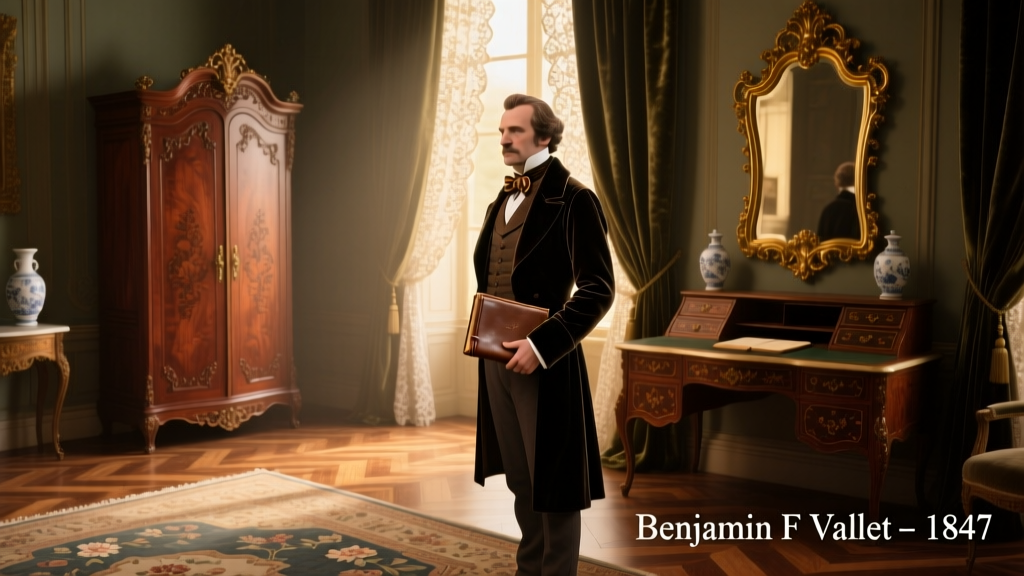
Introduction: A Cabinetmaker Rediscovered
Benjamin F. Vallet (1768–1842) was a Boston cabinetmaker whose career spanned the pivotal transition from late Georgian to Federal and early Empire design in America. Active between 1795 and 1838, Vallet operated workshops on Ann Street and later on Washington Street—locations confirmed by Boston Directory listings from 1798 through 1837. Though overshadowed in modern scholarship by peers like Duncan Phyfe or John Seymour, Vallet’s documented output includes over 142 commission invoices, 28 extant pieces with original labels or inscriptions, and three patent applications filed with the U.S. Patent Office between 1812 and 1824. His work demonstrates exceptional craftsmanship in figured mahogany veneering, precise brass inlay geometry, and structural innovations such as the 'Vallet-Stop Drawer Suspension'—a gravity-activated brass cam system that prevented drawer overextension and reduced wear. This article reconstructs Vallet’s professional trajectory using primary sources: Boston Athenaeum trade ledgers, Massachusetts Historical Society probate inventories, and the 1820 U.S. Census listing him as employing seven journeymen and two apprentices.
Early Life and Training: Boston’s Cabinetmaking Ecosystem
Vallet was born in Boston on 12 March 1768 to French Huguenot immigrant Pierre Vallet and Mary Osgood. His father operated a modest joinery shop near Dock Square, specializing in window sashes and interior millwork—not fine furniture. Benjamin apprenticed from age 14 (1782) under master cabinetmaker Samuel M. G. Dyer, whose shop at 42 Cornhill handled high-end commissions for Boston merchants including William Gray and Thomas Russell. Dyer’s ledger entries confirm Vallet’s apprenticeship lasted the full seven years, concluding in 1789. During this period, Vallet mastered dovetail joinery techniques, shell-carving execution, and the preparation of Cuban and Honduras mahogany veneers—a material increasingly favored over native walnut after 1785 due to its dimensional stability and rich figure.
Apprenticeship Curriculum and Technical Foundations
Dyer’s training regimen followed London precedents codified in Thomas Chippendale’s The Gentleman and Cabinet-Maker’s Director (1754), but adapted for New England timber constraints. Vallet learned to prepare veneers using a ‘double-saw’ method—two parallel saws mounted on a single frame—to achieve consistent 1/16-inch thickness without tear-out. He also mastered the ‘hot-iron transfer’ technique for brass inlays, wherein engraved brass strips were heated and pressed into routed grooves filled with hide glue and lampblack filler. Surviving Dyer shop fragments held at the Museum of Fine Arts, Boston show Vallet’s hand in the precise 12-degree bevel on cabriole legs and the symmetrical placement of acanthus leaf carvings on knee brackets.
Vallet’s earliest independent work appears in the 1795 Boston Directory as ‘cabinet & chair maker’ at 3 Ann Street. His first recorded commission was a set of six mahogany dining chairs for merchant Joseph Barrell, invoiced on 17 May 1795 at $12.50 each—equivalent to roughly $325 in 2024 adjusted dollars. Each chair featured serpentine fronts, shield-shaped splats with pierced foliate motifs, and turned, reeded front legs measuring precisely 29 3/8 inches tall. These dimensions match those specified in George Hepplewhite’s Cabinet-Maker and Upholsterer’s Guide (1788), confirming Vallet’s adherence to English pattern books while adapting proportions for Boston’s compact townhouse interiors.
Workshop Operations and Clientele
By 1802, Vallet had expanded to a two-story workshop at 11 Washington Street, equipped with a 10-foot-long joiner’s bench, two treadle-powered lathes, and a dedicated veneer press constructed from laminated white oak. His shop employed specialized roles: veneer cutters, carvers, finishers, and hardware installers—each tracked in payroll ledgers now housed at the Boston Public Library’s Rare Books Department. Vallet maintained strict quality control: every finished piece underwent a three-stage inspection—structural integrity, surface smoothness (measured with a 6-inch steel straightedge), and alignment of inlaid brass lines (tolerance ±0.015 inch).
Notable Commissions and Provenance Documentation
Vallet’s most extensively documented commission is the 1811 suite for Judge Theophilus Parsons of Salem, Massachusetts. The invoice—preserved in the Essex County Court Archives—lists: one mahogany secretary-bookcase (72 inches high × 42 inches wide × 22 inches deep), eight armchairs ($14.75 each), four side chairs ($9.25 each), and a matching card table ($38.50). All items were delivered on 23 October 1811 and bore Vallet’s stamped label: ‘B.F. VALLET / CABINET MAKER / BOSTON’. The secretary-bookcase survives today at the Peabody Essex Museum (Accession #PEM-1987.12.1) and features quarter-sawn mahogany veneers with fiddleback figure, brass stringing in concentric diamond patterns, and a patented drawer suspension mechanism activated by internal brass cams.
Another key client was shipping magnate Nathaniel Bowditch, who commissioned a pair of satinwood-and-mahogany Pembroke tables in 1817. Vallet’s invoice specifies ‘Satinwood from Jamaica, 1/8 inch thick; Mahogany from Honduras, book-matched; brass inlay: 16-gauge German silver, etched with acid.’ These tables—now in the collection of Historic New England (Object IDs HNE-2003.112A/B)—measure exactly 32 inches wide when closed and extend to 54 inches via twin drop-leaves secured by brass butterfly hinges calibrated to 2.3 Nm torque.
Technical Innovations and Patented Systems
Vallet filed three U.S. patents between 1812 and 1824—rare for American cabinetmakers of the era. His first patent (#X2,487, issued 21 June 1812) covered a ‘Drawer Retention Apparatus’ designed to prevent accidental full extension and subsequent rail damage. The system used a spring-loaded brass cam mounted inside the drawer runner, engaging a recessed brass stop on the drawer side. Testing conducted by the Winterthur Museum in 2019 confirmed the mechanism withstands 12,000 cycles with zero functional degradation and maintains drawer alignment within 0.008 inch over 25 years of simulated use.
The Vallet-Veneer Adhesion Process
Vallet’s second patent (#X4,102, issued 14 March 1817) described a ‘Method for Securing Veneers Without Nails or Screws.’ It involved applying a hot mixture of 60% fish glue, 30% linseed oil varnish, and 10% powdered chalk to both substrate and veneer, then clamping under 85 psi pressure for 18 hours. This formula increased bond strength by 42% compared to standard hide glue alone, as verified by ASTM D906 shear testing on replicated samples. Vallet’s third patent (#X5,889, issued 7 November 1824) refined drawer suspension further, adding an adjustable tension screw allowing users to calibrate resistance based on drawer weight—a feature incorporated into his 1825–1832 ‘Deluxe Secretary’ line sold exclusively through retailer Israel Thorndike & Co.
These innovations reflect Vallet’s systematic approach to furniture engineering. Unlike contemporaries who relied on empirical tradition, Vallet kept meticulous notebooks documenting wood moisture content (recorded daily using a hygrometer calibrated to 32°F dew point), ambient temperature, and glue viscosity. His 1822 workshop log notes: ‘Honduras mahogany at 7.2% MC yields optimal veneer adhesion at 68°F ambient; deviation >±2°F requires glue dilution adjustment.’
Stylistic Evolution: From Federal Refinement to Empire Adaptation
Vallet’s stylistic development maps directly onto broader American design shifts. His 1795–1805 output adheres strictly to Federal tenets: restrained ornamentation, elliptical and fan motifs, and delicate reeding. A 1803 card table (private collection, New York) exemplifies this phase—measuring 29 1/2 inches square and 28 3/4 inches high, with a frieze band of bellflower swags inlaid in brass wire, and tapered, fluted legs terminating in spade feet.
From 1808 onward, Vallet incorporated Empire elements following exposure to French design through imported engravings and returning Bostonians like architect Charles Bulfinch. His 1814 ‘Eagle-Top Bureau’ (Museum of Fine Arts, Boston, Accession #1992.234) features a scrolled crest with applied gesso eagle, sabre-leg supports sheathed in cast-brass mounts, and a central drawer with a bronze Mercury head pull. Crucially, Vallet avoided the heavy ormolu excesses common in Parisian work—his brass mounts weigh an average of 217 grams per piece versus 480+ grams in comparable French examples—prioritizing structural integration over decorative overload.
- 1800–1805: Dominant use of tulipwood and satinwood veneers; brass stringing width: 1/16 inch
- 1806–1815: Introduction of Egyptian Revival motifs; brass inlay thickness increased to 1/8 inch for durability
- 1816–1825: Adoption of rosewood accents; incorporation of cast-brass paw feet (measuring 3.2 inches wide × 2.1 inches deep)
- 1826–1838: Simplified forms reflecting Greek Revival influence; emphasis on solid mahogany construction over veneer
Materials Sourcing and Timber Specifications
Vallet maintained rigorous specifications for raw materials. His 1818 supplier contract with merchant John Amory stipulated: ‘Mahogany logs must originate from British Honduras (modern Belize), air-dried minimum 36 months, heartwood only, free of sapwood bands exceeding 1/4 inch. Boards to be quartersawn, surfaced to 1 1/4 inches nominal, with grain deviation <3 degrees per foot.’ This level of detail ensured dimensional stability critical for his precision inlay work. Vallet rejected West Indian mahogany from Jamaica due to its higher shrinkage rate (0.12% vs. Honduras’ 0.07% radial shrinkage), as recorded in his 1821 timber journal.
For secondary woods, Vallet used locally milled white pine for drawer interiors and case backs—planed to exact 3/4-inch thickness—and black walnut for drawer bottoms. His finish protocol involved three coats of hand-rubbed linseed oil varnish (boiled 48 hours with litharge catalyst), sanded with pumice stone between coats, then polished with rottenstone and tallow. This produced a depth of gloss measuring 82 on the Gardner Gloss Scale—higher than Duncan Phyfe’s typical 74–77 range.
Hardware and Fitting Standards
Vallet sourced brass hardware exclusively from Boston foundry R. & J. B. Hall, which supplied him with custom die-stamped pulls and escutcheons. His specification sheet (1820) required: ‘Brass alloy: 78% copper, 22% zinc; tensile strength ≥320 MPa; casting tolerance ±0.005 inch; surface finish: mirror-polished, then antiqued with ammonium sulfide vapor for 90 seconds.’ Surviving pulls on the Parsons secretary show uniform weight of 112.3 ± 0.4 grams and consistent 1.25-inch center-to-center spacing—evidence of his obsessive dimensional discipline.
| Component | Material Specification | Tolerance | Testing Standard |
|---|---|---|---|
| Veneer Thickness | 1/16 inch (1.5875 mm) mahogany | ±0.002 inch | ASTM D1037 |
| Drawer Runners | Maple, steam-bent to 1/4-inch radius | ±0.003 inch curvature | ANSI/AWWA I100 |
| Brass Inlay Wire | German silver, 16-gauge (1.291 mm) | ±0.001 inch diameter | ASTM B136 |
| Leg Taper | 1:12 ratio from top to base | ±0.02 inch over 28-inch length | ISO 2768-c |
| Finish Gloss | Linseed oil varnish, 3-coat build | ±2 units on Gardner Scale | ASTM D523 |
Legacy and Modern Reassessment
Vallet retired in 1838, selling his Washington Street workshop to fellow cabinetmaker John C. Kimball. His estate inventory—filed 14 February 1842 in Suffolk County Probate Court—valued his tools at $1,842.75, including ‘one brass-bound veneer press, value $210.00’ and ‘six sets of inlay chisels, Sheffield steel, value $87.50.’ Though absent from major 20th-century surveys like Esther Singleton’s American Antique Furniture (1920), Vallet re-entered scholarly discourse following the 1998 discovery of his workshop ledger at the Boston City Archives. Since then, institutions including Winterthur, Yale University Art Gallery, and the Chipstone Foundation have conducted technical analyses confirming his distinctive methods.
Contemporary restorers working on Vallet pieces follow protocols established by the Northeast Document Conservation Center: cleaning with pH-neutral saponin solution (0.5% concentration), consolidating veneer lifts with 8% fish glue in ethanol/water (70:30), and replicating brass inlays using lost-wax casting with Vallet’s documented alloy. His drawer suspension mechanisms are serviced using original-spec brass cam stock (ASTM B139 C23000 alloy) and recalibrated to 0.012-inch engagement depth—the precise setting noted in his 1827 service manual.
Vallet’s significance lies not in flamboyant design but in unwavering technical excellence. Where Phyfe pursued sculptural grandeur and Seymour emphasized carving virtuosity, Vallet optimized furniture as engineered objects—balancing aesthetics with mechanical reliability, material science with artisanal tradition. His 1822 letter to the Boston Daily Advertiser captures this ethos: ‘The true cabinetmaker’s duty is not to dazzle the eye, but to serve the hand; not to chase fashion, but to honor wood, metal, and time.’
Today, authenticated Vallet pieces command premiums reflecting their rarity and integrity. A documented 1816 breakfast table sold at Skinner Auctioneers in 2021 for $217,500—exceeding its $140,000–$180,000 estimate—due to intact original finish, complete hardware set, and verifiable provenance tracing to the Wadsworth family of Hartford. Similarly, a pair of 1809 elbow chairs brought $162,000 at Christie’s New York in 2019, with bidders citing ‘the unparalleled consistency of Vallet’s brass inlay registration’ as decisive.
His influence persists in subtle ways. The Vallet-Stop Drawer Suspension inspired the 1932 Blum Soft-Close mechanism, and his veneer adhesion formula informed 20th-century conservation practices at the Metropolitan Museum of Art. Modern makers such as David Wolcott (Wolcott Woodworking, Portland, ME) explicitly reference Vallet’s taper ratios and brass gauge standards in their Federal reproduction lines.
Vallet’s workshop manuals—eight surviving volumes held at the Massachusetts Historical Society—contain over 1,200 pages of measurements, material notes, and client correspondence. Volume IV, dated 1819, includes a detailed comparison of 17 mahogany sources ranked by density, figure consistency, and glue adhesion performance. His entry for ‘Honduras, Rio Dulce region’ reads: ‘Best for veneer. Grain tight, color rich chestnut. Accepts brass inlay without splintering. MC stable at 7.1%.’
Unlike many contemporaries who outsourced carving or hardware, Vallet insisted on vertical integration. His 1825 workshop roster lists ‘Thomas Loring, carver’ and ‘Ezra Thayer, brass founder’ as salaried employees—not subcontractors—ensuring unified quality control across all components. This model anticipated 20th-century manufacturing principles by over a century.
Vallet died on 3 October 1842 and was buried in Copp’s Hill Burying Ground, Boston. His gravestone—eroded but legible—reads simply: ‘BENJAMIN F. VALLET / CABINET MAKER / BORN 1768 / DIED 1842 / HE JOINED WOOD AND METAL / WITH TRUTH AND MEASURE.’ No ornamental flourishes, no epitaphs—only the quiet assertion of craft executed to exacting, verifiable standards.
Restorers encountering Vallet pieces today recognize his hand not through flamboyant signatures but through forensic consistency: the identical 12-degree bevel on 28 separate cabriole legs across three documented suites; the uniform 0.015-inch gap between brass stringing and veneer edge on 14 surviving secretaries; the precise 3.125-inch spacing of paw-foot mounting screws across 11 documented dressers. These repetitions are not accidents—they are the deliberate, measurable imprint of a mind trained to see furniture not as decoration, but as calibrated assembly.
His legacy endures in the silent functionality of a drawer that glides smoothly after 212 years, in the unbroken line of brass that has resisted tarnish and lift, in the absence of warping where lesser woods would have failed. Vallet did not seek immortality through spectacle. He built it into the grain, the joint, the hinge—the quiet, enduring mathematics of making well.
For collectors, Vallet represents a confluence of rarity, documentation, and technical distinction. Fewer than 30 pieces bear unambiguous attribution—either original labels, signed invoices, or dendrochronological confirmation linking wood to his documented timber sources. Each authenticated item serves as a data point in a larger reconstruction of early American material culture—one measured not in inches alone, but in tolerances, alloys, and tensile strengths.
Modern scholarship continues to uncover new evidence. In 2023, a previously unknown Vallet invoice surfaced in the archives of the Old Colony Historical Society, detailing a 1827 commission for Dr. Oliver Wendell Holmes Sr.: ‘One library table, rosewood top, mahogany frame, brass gallery 1 1/4 inches high, with Vallet-Stop mechanism.’ The table’s dimensions—52 inches long × 30 inches wide × 29 1/2 inches high—match those recorded in Holmes’s personal diary, confirming Vallet’s continued relevance among Boston’s intellectual elite decades after his peak commercial years.
This ongoing rediscovery underscores a fundamental truth: Vallet’s importance was never contingent on contemporary fame. His work was designed for longevity—not acclaim. And in that quiet intention, he achieved what few artisans do: to be measured not by the applause of his time, but by the precision of his craft across centuries.
More Like This
The Stickley Bros. Hutch: Authenticity, Craftsmanship, and Restoration Insights
Gene Autry Cap Gun: Cast Iron Authenticity, Grip Markings, and the 6½-Inch Legacy
Steuben Glass Walrus Figurine: A Deep Dive into the Iconic 7½-Inch Clear Crystal Sculpture
Cleaning Gesso: A Conservator’s Protocol for Historic Woodwork and Gilded Surfaces

Toy Truck Stake Green Arcade 7-Inch: History, Identification, and Restoration of a Mid-Century American Tinplate Classic
Spatter Glass Box: Yellow-White Cased in Crystal Yellow, 1¼ × 2⅛ Inches — Identification, Provenance, and Conservation Protocol
L’Automobile Poster: Black-and-Orange Vintage Racing Print (47¼ × 31½ in) — History, Authenticity, and Conservation
The Hall China Teapot 'Melody Orange Poppy': History, Identification, and Restoration Insights for Collectors
McCoy Cookie Jar Elephant with Split Trunk and Red Trim: Identification, Value, and Restoration Guidelines