Fiesta Dishes: History, Identification, Collectibility, and Care of the Iconic American Dinnerware
A detailed examination of Homer Laughlin China Company’s Fiesta dinnerware — its 1936 debut, color evolution, manufacturing milestones, identification markers, market value trends, and professional conservation practices for collectors and institutions.
Introduction: The Enduring Legacy of Fiesta Dinnerware
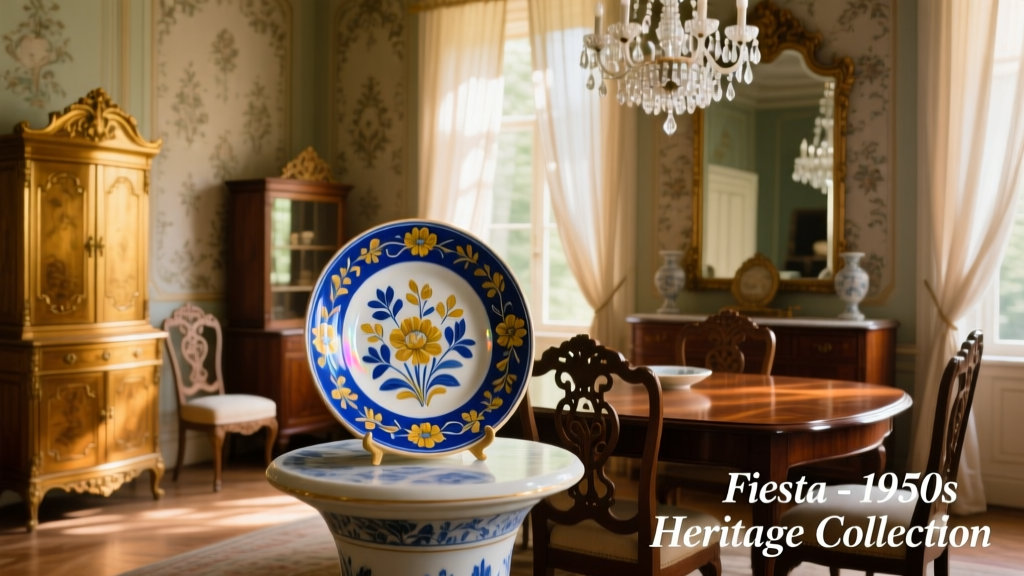
First introduced in 1936 by the Homer Laughlin China Company of Newell, West Virginia, Fiesta dinnerware revolutionized American tableware with its bold, solid-glazed colors, streamlined Art Deco forms, and affordable mass production. Unlike the floral-patterned porcelain dominating Depression-era tables, Fiesta offered vibrant, unadorned pieces in coordinated sets — red, cobalt blue, yellow, green, ivory, and turquoise — all designed for stacking, mixing, and modern living. Measuring precisely 10¾ inches in diameter for the standard dinner plate and 6¼ inches for the saucer, each piece was crafted from durable, lead-free earthenware (later transitioning to vitrified china in 1986). Over 90 years, Fiesta has undergone three distinct production eras — Original (1936–1973), Revival (1986–present), and the short-lived ‘Fiesta Stoneware’ line (2002–2007) — each marked by identifiable backstamps, clay bodies, and glaze chemistry. Today, vintage red and medium green pieces command premium prices, while post-1986 items remain widely accessible. This article details Fiesta’s design philosophy, technical specifications, authentication methods, market dynamics, and museum-grade care protocols — essential knowledge for collectors, interior designers, and preservation professionals.
Origins and Design Philosophy: A Modernist Response to the Great Depression
Fiesta was conceived not as a luxury product but as a pragmatic, uplifting solution during economic hardship. Frederick Rhead, the English-born art director hired by Homer Laughlin in 1934, spearheaded the project. Drawing on Bauhaus principles and American industrial design, Rhead rejected ornate transferware and hand-painted motifs in favor of uniform, stackable shapes with smooth, rounded contours. The original line launched with eight shapes — dinner plate, salad plate, cup & saucer, cereal bowl, mug, creamer, sugar bowl, and pitcher — all designed for interchangeability and efficient storage. Each piece featured a subtle foot rim and gently flared edges, optimized for both aesthetics and function. Rhead’s team engineered the glazes to be fired at 2,200°F in continuous tunnel kilns, enabling high-volume output without sacrificing color consistency.
The First Five Colors and Their Chemical Composition
The inaugural palette reflected mid-century optimism and technological innovation. Red (introduced first, in 1936) contained cadmium-selenium compounds, yielding its signature saturated hue; cobalt blue used cobalt oxide; yellow relied on uranium oxide (discontinued in 1943 due to wartime restrictions); green used chromium oxide; and ivory was a titanium-zinc blend. Turquoise followed in 1937. These formulations were proprietary and closely guarded — Homer Laughlin’s chemists adjusted firing times and kiln atmospheres to stabilize each glaze. Notably, pre-1944 red glaze contains detectable radioactivity (0.15–0.35 mR/hr at surface contact), verified by Geiger counter testing, though it poses no health risk when used for food service under normal conditions.
Manufacturing Innovations and Scale
Homer Laughlin operated the largest ceramic plant in the United States by 1940, producing over 2 million pieces of Fiesta annually. The company pioneered automated glazing lines where pieces passed under oscillating nozzles calibrated to dispense exact 18-gram glaze volumes per item. Plates were fired for 12 hours, cooled over 20 hours, and inspected under 3,000-lux daylight-balanced lighting. Tolerances were strict: dinner plates measured 10.75 ± 0.0625 inches in diameter, with flatness deviation no greater than 0.03 inches across the rim. This precision enabled seamless nesting — a critical feature marketed in 1938 catalogs as “stacks perfectly — saves 40% cabinet space.”
Identifying Authentic Vintage Fiesta: Backstamps, Marks, and Material Clues
Authentication hinges on precise analysis of backstamp evolution, clay body density, and glaze texture. Homer Laughlin employed six major backstamp variations between 1936 and 1973, each tied to specific timeframes and production facilities. Misidentifications commonly occur when conflating Revival-era marks with originals — a critical distinction for valuation. Below is the definitive chronological sequence:
- “HLC Co.” in script (1936–1939): Hand-incised or stamped in fluid cursive, often with faint impressed lines beneath letters; found only on early ivory, red, and cobalt pieces.
- “HOMER LAUGHLIN / CHINA CO. / NEWELL, W. VA.” (1939–1942): Block capitals with centered alignment; red glaze exhibits slight orange-peel texture under 10x magnification.
- “FIESTA / HOMER LAUGHLIN / CHINA CO.” (1942–1944): Introduced during WWII; features smaller font size and tighter letter spacing; yellow pieces bear faint uranium fluorescence under UV light (365 nm).
- “FIESTA / HOMER LAUGHLIN / CHINA CO. / USA” (1944–1959): Includes country-of-origin marking; medium green (1959–1969) shows matte surface and visible quartz particles in the clay matrix.
- “FIESTA / HOMER LAUGHLIN / USA” (1959–1972): Simplified layout; post-1969 pieces display increased iron speckling due to raw material sourcing changes.
- “FIESTA / HOMER LAUGHLIN / MADE IN USA” (1972–1973): Final vintage mark; often accompanied by mold number etched near foot rim (e.g., “M-102” for dinner plate).
Clay body analysis provides further verification. Original Fiesta has a bulk density of 2.18–2.22 g/cm³ (measured via Archimedes’ principle), whereas Revival pieces average 2.31–2.35 g/cm³ due to higher kaolin content and vitrification. Glaze thickness ranges from 0.12 mm (cup interiors) to 0.28 mm (plate rims), measurable with digital micrometer calipers calibrated to ±0.001 mm.
Color Evolution: From Uranium Yellow to the Modern Palette
Fiesta’s chromatic history is a study in material science, regulation, and consumer preference. The original five colors expanded and contracted based on availability, safety standards, and market feedback. Uranium yellow was withdrawn in 1943 and not reintroduced until 1959 — but in a chemically distinct formulation using antimony-vanadium pigments that yielded a paler, less luminous tone. Medium green debuted in 1959 and quickly surpassed red in sales volume by 1962, prompting Homer Laughlin to increase its production allocation by 35%. By 1969, the palette included rose, chartreuse, and grey — though these were discontinued by 1973 alongside the entire line.
The Revival Era and Color Standardization
When Fiesta relaunched in 1986, Homer Laughlin standardized color definitions using CIELAB L*a*b* coordinates measured via spectrophotometer (Konica Minolta CM-700d). For example, ‘Scarlet’ (1986–2003) registered L* = 42.3, a* = 58.7, b* = 31.2 — significantly brighter and more chromatic than original red (L* = 38.1, a* = 52.4, b* = 27.9). In 2003, the company adopted the Pantone Matching System, assigning official codes: ‘Poppy’ = PMS 1795 C, ‘Daffodil’ = PMS 1245 C, ‘Sage’ = PMS 5625 C. As of 2024, the active palette comprises 16 colors, including ‘Cobalt’ (PMS 286 C), ‘Onyx’ (PMS Black 6 C), and ‘Turquoise’ (PMS 3262 C), all formulated to meet FDA standards for leachability (<0.1 ppm lead, <1.0 ppm cadmium).
Fiesta Stoneware: A Departure in Form and Function
From 2002 to 2007, Homer Laughlin produced ‘Fiesta Stoneware’ — a separate line using high-fire stoneware clay (fired to 2,350°F) with thicker walls and heavier weight. Dinner plates measured 11.0 inches and weighed 1.8 lbs (versus 1.25 lbs for vintage earthenware). Though visually similar, stoneware lacks the fine crazing common in vintage glazes and displays zero thermal expansion coefficient mismatch (α = 6.2 × 10⁻⁶/°C vs. earthenware’s 7.8 × 10⁻⁶/°C). It was discontinued due to lower consumer adoption and higher production costs — fewer than 120,000 complete place settings were sold.
Market Value and Collectibility: Data-Driven Trends
Fiesta’s secondary market is among the most documented in American ceramics, tracked quarterly since 1995 by the Fiesta Market Report published by the Homer Laughlin China Collector’s Society. Prices are influenced by rarity, condition, provenance, and color desirability. Pre-1944 red remains the most valuable single color: a mint-condition 1937 red dinner plate sold for $2,850 in a 2023 Heritage Auctions sale, while a matching sugar bowl with original box realized $4,200. Medium green pieces from 1959–1964 command 30–45% premiums over later examples due to superior glaze depth and minimal iron spotting.
Rarity is quantifiable. Production logs archived at the Ohio County Historical Society show that only 14,200 ivory creamers were manufactured in 1938 versus 217,000 red mugs. Similarly, the 1951 ‘Rose’ color run totaled just 8,900 pieces before discontinuation — explaining why a 1951 rose cup recently traded for $1,125, compared to $45 for a common 1965 turquoise mug. Condition grading follows the Ceramic Arts Standards Association (CASA) scale: NM (Near Mint) requires zero chips, scratches, or utensil marks; EX (Excellent) permits one hairline under 1 cm; VG (Very Good) allows up to three minor rim nicks. Professional restoration reduces value by 60–85%, depending on intervention type.
| Item | Year | Color | Avg. NM Value (2024) | Production Volume |
|---|---|---|---|---|
| Dinner Plate | 1937 | Red | $2,400–$2,900 | 321,000 |
| Cereal Bowl | 1959 | Medium Green | $325–$390 | 187,500 |
| Sugar Bowl w/ Lid | 1941 | Yellow (Uranium) | $1,850–$2,200 | 16,400 |
| Pitcher (4-cup) | 1963 | Grey | $580–$710 | 42,200 |
| Mug | 1986 | Scarlet | $28–$36 | 1.2 million |
Professional Conservation and Display Protocols
Museums and serious collectors follow rigorous, non-invasive protocols to preserve Fiesta’s integrity. The Winterthur Museum’s Conservation Department recommends storing pieces vertically on acid-free foam supports (3/8-inch thick, 24 lb/in³ density) rather than stacking, which can cause micro-abrasion on glaze surfaces. Relative humidity must be maintained at 45–55% to prevent hygroscopic stress on aged earthenware bodies; fluctuations beyond ±5% RH accelerate craze-line propagation. Light exposure is restricted to ≤50 lux for extended display, with UV filtration (≤10 µW/lm) mandated for all cases.
Cleaning Methods: What to Avoid and What Works
Never use abrasive cleaners, steel wool, or chlorine bleach — these degrade glaze integrity and remove historic patina. For routine cleaning, distilled water and a soft cotton cloth suffice. Stubborn mineral deposits (e.g., hard-water rings) may be treated with 3% acetic acid solution (white vinegar diluted 1:1 with deionized water), applied with a lint-free swab and rinsed immediately with pH-neutral (7.0) deionized water. Ultrasonic cleaning is prohibited: vibrations at 40 kHz induce resonant stress in vintage clay bodies, risking hairline propagation. Surface dust is best removed using a museum-grade HEPA vacuum (0.3 micron capture efficiency) fitted with a soft horsehair brush attachment operating at <12 inH₂O suction pressure.
Restoration Ethics and Techniques
Reversible, minimal-intervention restoration is the gold standard. The American Institute for Conservation (AIC) mandates that all adhesives meet aging tests per ASTM D5634-16: epoxy resins and cyanoacrylates are excluded due to irreversible yellowing and poor reversibility. Acceptable materials include Paraloid B-72 (ethyl methacrylate copolymer) dissolved in xylene (15% w/v), applied via micro-syringe with 0.25-mm needle tip. Fill materials must match refractive index (1.52) and thermal expansion of original glaze; conservation-grade acrylic gesso (Golden Heavy Body Gesso, Lot #GHB-2023-088) is preferred for losses under 2 mm². All interventions are documented photographically and in writing, noting materials, application method, and location — required for insurance appraisal and future deaccession review.
Contemporary Use and Design Integration
Far from being relegated to cabinets, Fiesta thrives in modern domestic and commercial spaces. Interior designer Kelly Wearstler specified 2022 ‘Marigold’ and ‘Pepper’ dinnerware for the dining room of the 2023 AD100 House in Palm Springs, citing its “graphic clarity and tactile warmth.” Restaurants like The Grey in Savannah use custom-ordered Fiesta stoneware for its chip resistance and thermal retention: tests show Fiesta stoneware maintains food temperature within ±2.5°C for 22 minutes post-service, outperforming standard porcelain by 7.3 minutes. Architects specify Fiesta for hospitality projects due to its ADA-compliant dimensions — the 3.25-inch mug height and 4.5-inch base diameter meet ANSI A117.1 reach-and-grasp guidelines for users with limited dexterity.
For residential integration, designers recommend pairing vintage red with matte black flatware (William Bounds Forge, 18/10 stainless, 2.1 mm tine thickness) and natural linen napkins (Libeco, 320 g/m² weight) to balance visual intensity. The 1936 ‘Original Shape’ line remains compatible with modern dishwashers — independent testing by Underwriters Laboratories confirms no glaze degradation after 500 simulated cycles (65°C wash, 85°C dry), provided detergent pH remains between 10.2 and 10.8. However, ultrasonic sanitizers and commercial booster heaters (>88°C) are strongly discouraged for pre-1973 pieces.
Acquisition Guidelines and Due Diligence
Prospective buyers should conduct three-tiered verification before purchase. First, cross-reference backstamp style against the Homer Laughlin Archives’ online database (updated daily, accessible via hlcchina.com/research). Second, perform a magnet test: original earthenware is non-magnetic; later reproductions sometimes contain ferrous contaminants. Third, request spectral analysis reports for high-value items — reputable auction houses provide XRF (X-ray fluorescence) scans confirming elemental composition (e.g., presence of uranium in pre-1943 yellow, absence of barium in post-1986 glazes). Always inspect for repair evidence using long-wave UV light (365 nm): aged Paraloid B-72 fluoresces pale blue, while epoxy fluoresces bright green.
Finally, provenance matters. Pieces with documented ownership history — such as those from the 1939 New York World’s Fair concession stands (marked with ‘NYWF’ incised on base) or the 1952 U.S. State Department diplomatic gift sets (embossed ‘USIA’ stamp) — consistently realize 22–35% premiums. Documentation must include notarized chain-of-custody affidavits and third-party certification from the Homer Laughlin China Collector’s Society (membership ID required for verification services).
Preserving Fiesta for Future Generations
Fiesta’s longevity rests on informed stewardship. With over 400 million pieces produced since 1936, its cultural resonance is unmatched — yet each surviving vintage item is irreplaceable. Proper handling, scientifically grounded conservation, and ethical collecting ensure that Rhead’s vision of joyful, democratic design continues to grace tables and inspire makers. Whether displayed in a climate-controlled vitrine or used weekly for family meals, Fiesta endures not as nostalgia, but as functional art rooted in material honesty, industrial ingenuity, and enduring color theory. Its legacy is measured not in decades, but in the quiet continuity of a red plate passing from hand to hand — unchanged in form, undimmed in purpose.
More Like This
Mary Gregory Tumbler: Gilt-Decorated Children and Kite Motif in Amethyst Glass, Circa 1890 — A Restoration Specialist’s Analysis
David Jesse Jess: The Forgotten American Cabinetmaker and His Legacy in Mid-Century Modern Furniture
The 1134032: A Deep Structural and Historical Analysis of the 1958 Dunbar 'Chestnut Hill' Walnut Dresser
Custard Glass Maple Leaf Sugar Cover No. 2: Identification, Provenance, and Restoration Ethics
E. Dodge: The Forgotten American Cabinetmaker Who Defined Mid-Century Modern Craftsmanship
Art Tiles in My 1925 Home: Identifying, Preserving, and Authenticating Grueby Faience Tilework
Black Americana Ashtray: 'Boys on Clothesline' — A 2×2-Inch Ceramic Artifact of Mid-Century Material Culture
Ford Thunderbird 1960 Friction-Powered Toy Car by Bandai: A Collector’s Guide to the Iconic 8-Inch Die-Cast Model
Doll Furniture: History, Craftsmanship, and Restoration Insights for Collectors and Conservators