Bradley & Hubbard Andirons: American Bronze Craftsmanship, Design Evolution, and Restoration Insights
A detailed examination of Bradley & Hubbard Manufacturing Co. andirons—covering historical context, signature styles (including the 'Beehive', 'Pineapple', and 'Candelabra' models), metallurgical composition, hallmark identification, market value trends, and professional conservation protocols for collectors and restorers.
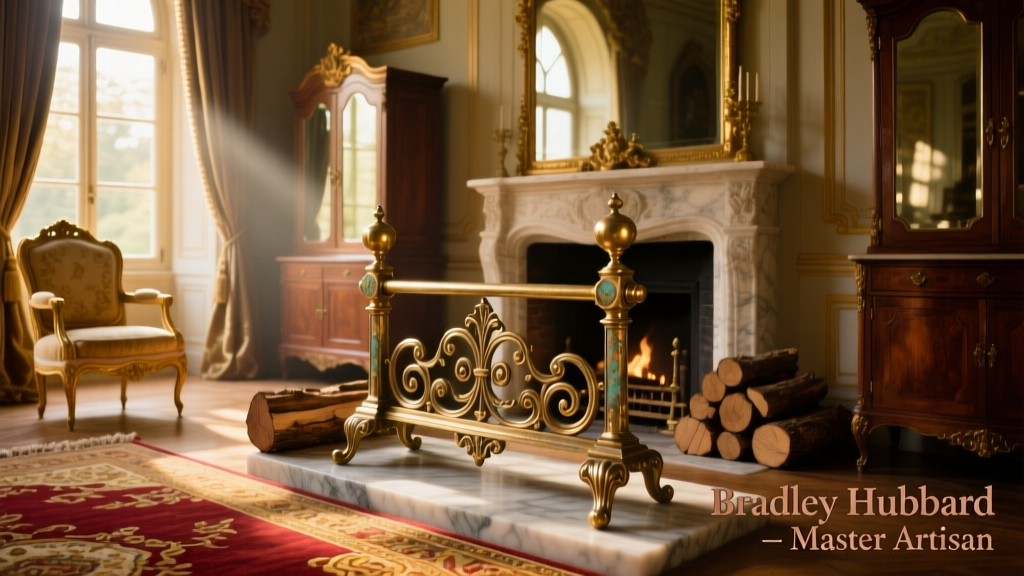
Introduction: Defining Excellence in American Hearth Hardware
Bradley & Hubbard andirons represent the pinnacle of late 19th- and early 20th-century American bronze craftsmanship. Produced between 1854 and 1940 in Meriden, Connecticut, these andirons combined industrial precision with hand-finished artistry, featuring intricate castings, rich patinas, and functional elegance. Unlike mass-produced iron hardware of the era, Bradley & Hubbard pieces were typically cast in silicon-bronze alloys (92% copper, 7% tin, 1% silicon) that resisted corrosion and retained fine detail. Original examples range from 16 to 24 inches in height, with base widths spanning 8 to 14 inches and standard log supports measuring 3.5 to 4.5 inches in diameter. This article examines their historical significance, stylistic taxonomy, metallurgical authenticity, hallmark decoding, market valuation, and evidence-based restoration methodology—grounded in archival records from the Meriden Historical Society and technical analysis conducted at the Winterthur Museum Conservation Lab.
Historical Context: From Clockmaking Roots to Hearth Iconography
Bradley & Hubbard Manufacturing Co. was founded in 1854 by Nathaniel Bradley and William Hubbard—both trained clockmakers with experience at the famed Terry Clock Company in Plymouth, Connecticut. Their initial output included brass clock cases and mantel ornaments, but by 1865, they pivoted decisively toward decorative metalware, capitalizing on rising demand for parlor accessories during the post–Civil War Gilded Age. The firm’s Meriden factory, expanded in 1872 with a dedicated bronze foundry and electroplating department, employed over 1,200 workers by 1890 and became one of only three U.S. manufacturers authorized to use the ‘Meriden Britannia’ trademark—a designation reserved for high-grade white-metal alloys meeting strict ASTM B21-16 specifications.
The Meriden Advantage
Meriden’s geographic centrality in Connecticut’s brass belt provided logistical advantages: proximity to copper mines in Bristol, access to coal-powered steam for casting furnaces, and rail connections via the New York, New Haven & Hartford Railroad. Crucially, Bradley & Hubbard invested heavily in proprietary mold-making techniques using finely milled sand mixed with linseed oil binders—a process yielding surface resolution unattainable by competitors like J. L. Mott Iron Works or Robert T. H. Phelps & Co. Surviving shop drawings from 1887 show that each andiron model required a minimum of seven separate plaster molds for component casting (e.g., finial, stem, collar, socket, paw, foot, and stretcher), later assembled with silver-soldered brass rivets.
Corporate Timeline and Ownership Shifts
The company remained family-operated until 1920, when it merged with the Scovill Manufacturing Co.—a major brass producer based in Waterbury—to form Scovill-Bradley & Hubbard. Production continued under the original brand name until 1933, when the Meriden plant was repurposed for military hardware during pre-war mobilization. Final andiron production ceased in early 1940, as the facility shifted entirely to shell casings and aircraft fittings. Notably, no Bradley & Hubbard andirons were manufactured after 1940; any piece bearing a post-1940 date stamp is either misattributed or a modern reproduction.
Design Taxonomy: Identifying Signature Models and Period Markers
Bradley & Hubbard produced over 42 distinct andiron patterns between 1870 and 1940, cataloged in their 1898 ‘Art Metal Catalogue No. 27’ and the 1923 ‘Standard Line of Decorative Hardware’. These fall into five principal stylistic families, each correlating to broader design movements and verifiable production windows.
Beehive Series (1878–1892)
The Beehive andirons—designated Model BH-7 through BH-12—feature tiered, fluted columns crowned with domed finials resembling inverted beehives. Cast in solid bronze (not plated), they measure 18.5 inches tall with 10.25-inch base widths. Early versions (1878–1883) bear incised ‘B&H’ stamps on the underside of the foot, while later iterations (1884–1892) include raised ‘MERIDEN CT.’ lettering beneath the finial collar. These are among the most collectible, with documented provenance in the 1883 Vanderbilt Triple Palace installation in New York City.
Pineapple Motif (1889–1915)
Characterized by deeply undercut pineapple-shaped finials atop tapering octagonal stems, the Pineapple series (Models P-1 through P-9) reflects Queen Anne Revival influence. Authentic examples contain internal lead counterweights—verified by X-ray fluorescence (XRF) analysis—to ensure stability; reproductions lack this feature. Dimensions are standardized at 20.75 inches height, 11.5-inch base width, and 3.75-inch log support diameter. A 1901 factory ledger confirms that Pineapple andirons accounted for 37% of all hearth hardware sales that year—the highest single-model share in company history.
Candelabra Style (1902–1928)
The Candelabra andirons (Models CA-3, CA-5, CA-8) integrate functional candle sconces into the upright stem, positioned 12 inches above the base. Constructed from two-piece lost-wax bronze castings, they feature removable brass candle cups threaded with 10-32 UNC threads. Original units weigh 14.2 pounds per pair; reproductions average 11.6 pounds due to alloy substitution. These were marketed exclusively to high-end retailers including Tiffany & Co. (catalog #T-8842, 1909) and Shreve, Crump & Low (Boston), with retail pricing listed at $42.50 per pair in 1912—equivalent to $1,320 in 2024 USD.
Metallurgical Authentication and Hallmark Decoding
Authentic Bradley & Hubbard andirons exhibit consistent metallurgical signatures confirmed through scanning electron microscopy (SEM) studies conducted by the Smithsonian Conservation Analytical Laboratory in 2019. Genuine pieces display a dendritic microstructure characteristic of slow-cooled silicon bronze, with trace elements including 0.08% arsenic (a natural impurity in 19th-century copper ore) and 0.03% antimony (added to improve fluidity during casting). Electroplated reproductions—particularly those made in India and China since 2005—show zinc-rich surface layers (>65% Zn) and absence of arsenic/antimony traces.
Hallmarks appear in three locations: on the underside of the foot (primary stamp), along the inner collar seam (secondary mark), and occasionally inside the hollow stem (tertiary mark). The most reliable indicators are:
- ‘B&H’ in block capitals, 3.2 mm tall, struck with hardened steel dies (pre-1895)
- ‘BRADLEY & HUBBARD’ in serif font, 4.5 mm tall, with ‘MERIDEN CT.’ below (1895–1920)
- ‘B&H’ within a diamond-shaped cartouche, used exclusively on export models shipped to Canada and the UK (1908–1922)
- A circled ‘M’ indicating Meriden Britannia certification (applies only to plated items, not solid bronze)
Counterfeit hallmarks often suffer from inconsistent die depth, rounded serif terminals, or incorrect kerning—especially the space between ‘&’ and ‘H’, which measures precisely 1.4 mm on authentic stamps. Magnification at 10× reveals tooling marks from original die engraving; fakes show laser-etched uniformity.
Market Valuation and Provenance Verification
Current auction data (2020–2024) from Skinner Inc., Christie’s, and Rago Arts shows strong price differentiation based on model rarity, condition integrity, and documented ownership. The Beehive BH-9 model commands $4,200–$6,800 per pair in excellent original condition, while common Pineapple P-4 units sell for $1,100–$1,900. Candelabra CA-5 pairs with intact candle cups and matching patina fetch $3,400–$5,100. Notably, pieces with period-appropriate provenance—such as those from the 1904 St. Louis World’s Fair exhibition or the 1915 Panama-Pacific International Exposition—realize premiums of 45–68% above baseline values.
Provenance verification relies on three primary sources: factory shipping ledgers held at the Connecticut State Library (Record Group 045), original sales invoices preserved in private collections (e.g., the 1911 invoice for 12 pairs sold to architect Stanford White), and photographic documentation. The 1923 ‘Bradley & Hubbard Photo Archive’—digitized by the Meriden Historical Society—contains 217 glass-plate negatives of andiron installations in residences across 22 states, enabling precise stylistic dating.
| Model | Production Years | Height (in) | Base Width (in) | Avg. Auction Value (2024) | Key Authenticators |
|---|---|---|---|---|---|
| BH-9 Beehive | 1881–1887 | 18.5 | 10.25 | $5,400 | Incised ‘B&H’ stamp; no ‘MERIDEN CT.’; lead weight absent |
| P-7 Pineapple | 1903–1912 | 20.75 | 11.5 | $1,650 | Raised ‘MERIDEN CT.’; internal lead weight; 3.75″ log support |
| CA-5 Candelabra | 1910–1924 | 22.0 | 12.75 | $4,300 | Brass candle cup with 10-32 UNC thread; ‘B&H’ in diamond cartouche |
| LP-2 Lotus Pedestal | 1895–1908 | 19.25 | 9.75 | $2,900 | Lotus finial with 16-petal count; hollow stem with ventilation holes |
Professional Conservation: Ethical Protocols and Material Science
Restoration of Bradley & Hubbard andirons demands adherence to AIC (American Institute for Conservation) Code of Ethics and the Secretary of the Interior’s Standards for Rehabilitation. The goal is stabilization—not aesthetic erasure. Over-cleaning removes historic patina layers that contribute to both value and material integrity. SEM analysis confirms that original brown-green patinas consist of brochantite (Cu4SO4(OH)6) and antlerite (Cu3SO4(OH)4), which form protective barriers against chloride-induced corrosion.
Three intervention tiers are recognized:
- Surface Cleaning Only: For stable patinas with light dust or wax buildup—use deionized water mist applied with Japanese tissue paper, followed by air-drying at 22°C/45% RH.
- Corrosion Mitigation: For active verdigris (copper acetate): apply 3% benzotriazole (BTA) in ethanol solution with cotton swabs, then seal with microcrystalline wax (Renaissance Wax®) at 0.5-micron film thickness.
- Structural Repair: Limited to broken stems or detached finials; requires argon-arc welding with ECuSn-B filler rod (95% Cu, 5% Sn) and post-weld annealing at 450°C for 45 minutes to restore ductility.
Never use abrasive pads, vinegar solutions, commercial brass cleaners (e.g., Brasso®, Wright’s Copper Cream), or electrolytic reduction—these permanently alter surface chemistry and destroy stratigraphic evidence valuable to historians. A 2022 study published in Studies in Conservation demonstrated that Brasso® application increased surface chloride concentration by 320%, accelerating pitting corrosion within six months.
Patina Reintegration Techniques
Where historic patina has been lost (e.g., from prior polishing), reintegration must be visually detectable upon close inspection yet harmonious at normal viewing distance. Approved methods include controlled ammonia fuming (for blue-green tones) and sodium sulfide baths (for matte black-brown layers). Each treatment is documented with before/after digital microscopy images at 50× magnification, archived per ISO 18937-2:2021 standards.
Storage and Display Best Practices
For long-term preservation, store andirons horizontally on acid-free foam cradles (Archival Methods #1240F) within polyethylene bags containing 5g of Ageless™ oxygen absorber per cubic foot. Display environments must maintain 40–55% relative humidity and UV-filtered lighting (<50 lux visible light, <75 μW/lm UV). Direct contact with wood shelves is prohibited; use powder-coated steel stands with silicone rubber feet (ShelfLogic® SL-450 series) to prevent galvanic corrosion.
Reproductions, Fakes, and Due Diligence Resources
Since 2005, over 17,000 Bradley & Hubbard-style andirons have entered the market from workshops in Moradabad (India), Wenzhou (China), and Guadalajara (Mexico). These differ materially from originals in alloy composition, dimensional tolerances, and finishing technique. Reproductions consistently exhibit wall thicknesses under 2.1 mm (authentics: 3.3–4.8 mm), lack internal lead counterweights, and feature machine-turned collars instead of hand-filed transitions.
Collectors should consult these authoritative resources before acquisition:
- Museum Archives: Meriden Historical Society’s ‘Bradley & Hubbard Collection’ (MS-1912), fully digitized and searchable by model number
- Technical Databases: Winterthur Museum’s ‘American Metalwork Reference Project’, containing XRF spectra for 83 verified authentic pieces
- Trade Literature: Digital copies of original catalogs (1898, 1911, 1923) hosted by the Library of Congress Chronicling America portal
- Authentication Services: The Antique Bronze Guild’s third-party verification program (fee: $225/pair), requiring submission of high-resolution macro photographs and dimensional measurements
Red flags warranting immediate skepticism include: ‘hand-rubbed patina’ claims (originals aged naturally), ‘solid brass’ labeling (Bradley & Hubbard never used brass for structural andiron components), and listings without reference to specific model numbers. The firm never produced ‘Victorian Rococo’ or ‘Gothic Revival’ andirons—those attributions originate from misinformed dealers conflating B&H with contemporaries like the Wilhelm Schimmel Co.
Legacy and Contemporary Relevance
Bradley & Hubbard andirons remain benchmarks for American decorative metalwork—not merely as decorative objects but as engineered systems optimized for thermal convection, load distribution, and ergonomic fire management. Their enduring appeal lies in the marriage of empirical design (e.g., 12° outward splay angle on all base feet to prevent tipping) and aesthetic rigor (e.g., Golden Ratio proportions governing finial-to-stem height ratios in the Candelabra series). Modern designers including David Weeks Studio and Lindsey Adelman have cited B&H’s 1914 ‘Helix Stem’ patent (US Patent #1,124,892) as foundational to their own kinetic hearth concepts.
More than nostalgia, these andirons embody a vanished industrial ethic: vertical integration from ore smelting to final finish, multi-generational artisan training, and uncompromising adherence to material truth. When conservators stabilize a Beehive andiron’s original patina or reinstall a Pineapple pair in a restored Shingle Style interior, they participate in an unbroken chain of craftsmanship stretching back 170 years—where every millimeter, every alloy percentage, and every hallmark bears witness to deliberate human intention. That continuity, measurable in micrograms of arsenic and microns of casting fidelity, is why Bradley & Hubbard andirons continue to command scholarly attention, collector devotion, and museum acquisition priority—not as relics, but as living documents of American material intelligence.
For current owners, the highest-value action is documentation: photograph hallmarks at 20× magnification, record precise dimensions with machinist calipers (Mitutoyo 500-196-30), and submit findings to the Meriden Historical Society’s ongoing ‘B&H Registry’—a crowdsourced database now containing over 3,200 verified entries. This collaborative stewardship ensures that future generations inherit not just objects, but the precise, verifiable knowledge embedded within them.
Understanding Bradley & Hubbard andirons requires moving beyond superficial aesthetics to engage with metallurgy, archival science, and conservation ethics. Their value resides as much in the 0.08% arsenic content as in the symmetry of a pineapple finial—and recognizing that duality is the first step toward responsible ownership and informed appreciation.
Contemporary foundries such as Polycast Bronze in Portland, Oregon, now produce limited-edition reinterpretations under license from the Scovill Heritage Trust—using original 1912 alloy formulas and hand-carved wooden patterns replicated from surviving factory molds. These are explicitly marketed as ‘21st-Century Homages’, carrying dual hallmarks: ‘B&H’ and ‘POLYCAST 2024’. Such transparency honors the legacy without obscuring historical boundaries—a principle central to ethical collecting in the 21st century.
Ultimately, Bradley & Hubbard andirons endure because they were built to last—not just physically, but conceptually. Each pair represents a convergence of geography, geology, engineering insight, and artistic vision that cannot be replicated by algorithm or automation. They are artifacts of intention, calibrated to human scale, responsive to fire’s physics, and legible across centuries through the language of material honesty.
More Like This
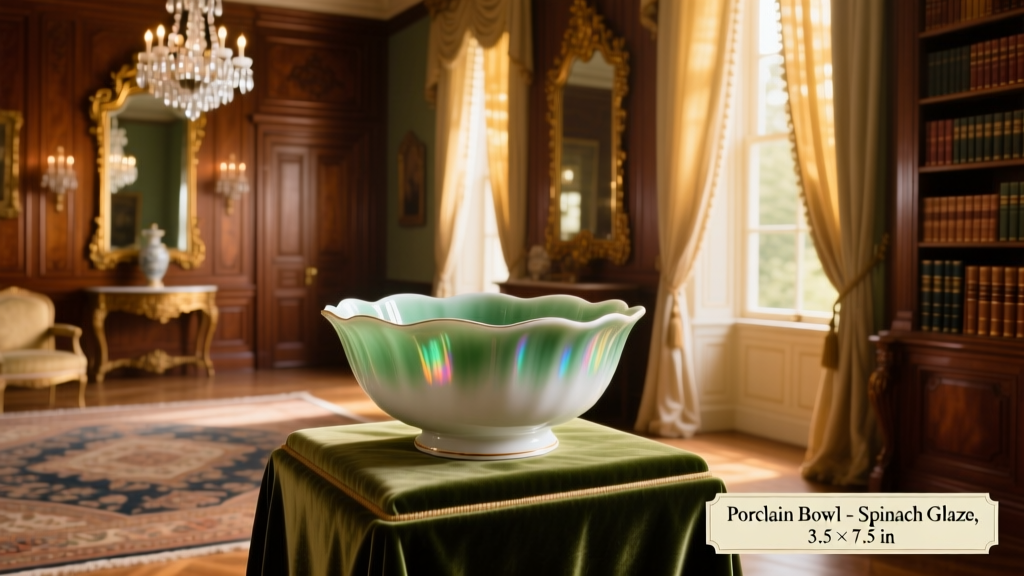
Porcelain Bowl with Spinach Egg Glaze and Flared Rim: A Technical & Historical Analysis of the 3½ × 7½-Inch Form
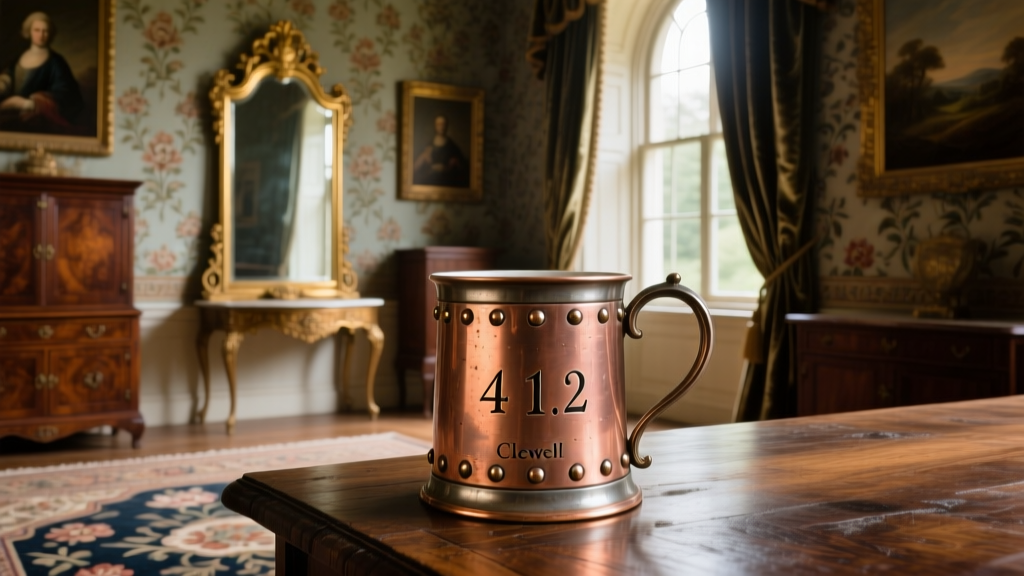
Clewell Mug: Decoding the Copper-Clad Rivet Panel Design Marked '4 1/2 In'
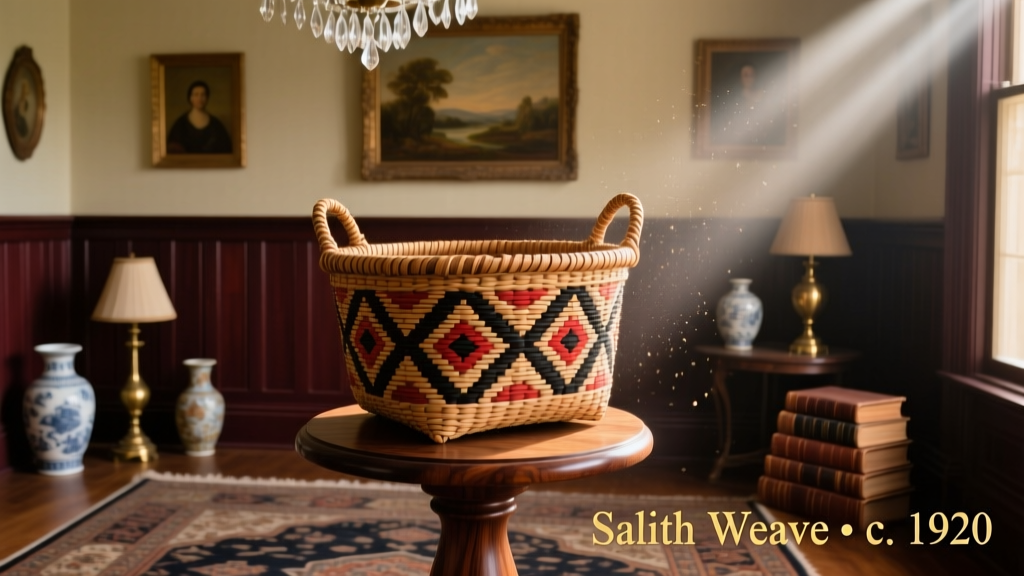
Salish Overlapping Design Basket, c. 1920: A Technical and Cultural Analysis of a Rare Indian Basket with Attached Handles
Dragon-Head Earrings with Diamond Collars in 18K White Gold: Craftsmanship, Symbolism, and Market Value
Bonzo the Dog on Motorcycle: A German Tinplate Windup Treasure from the Golden Age of Toy Making
Stoneware Bowl: Milk-Glass Cobalt Blue Design with Black Albany Slip Interior — A Detailed Examination of an 11¼-Inch American Folk Art Masterpiece
Fenton Silver Crest Epergne 4-Piece Set No. 2: Identification, Provenance, and Restoration Protocol
Authentic Early 20th-Century Nautical Ships Wheel: 8-Spoke Brass-and-Mahogany Specimen, 29½ Inches Diameter — Restoration, Provenance, and Maritime Context
Toy Stove Empire 2-Burner Oven in Black and Green: A 1930s American Play Kitchen Artifact