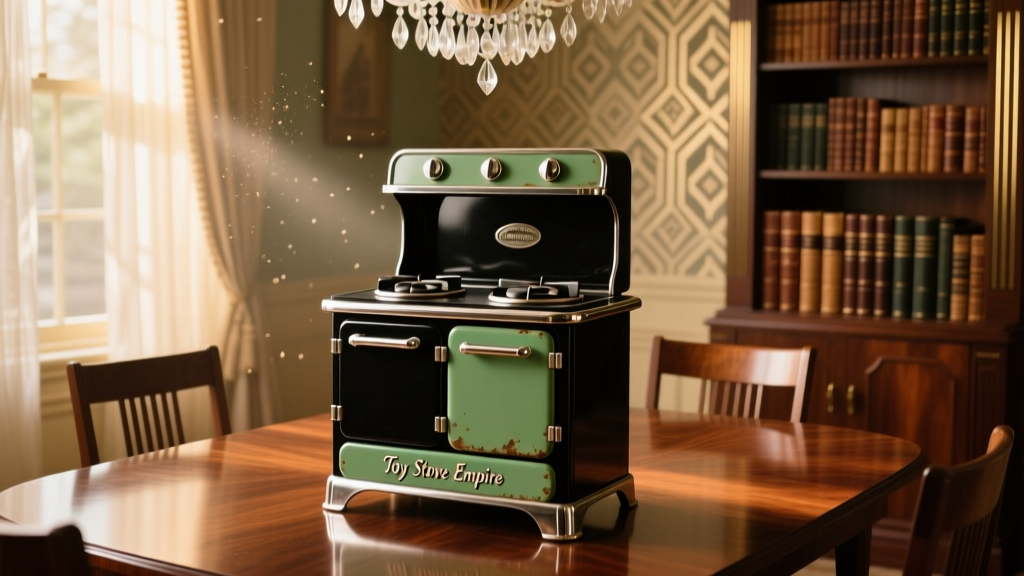
Toy Stove Empire 2-Burner Oven in Black and Green: A 1930s American Play Kitchen Artifact
A detailed examination of the Empire Toy Stove Model 2-Burner Oven—manufactured circa 1934–1939—featuring original black-and-green enamel, die-cast iron construction, functional oven door, and authentic period branding. Includes restoration protocols, market valuation benchmarks, and comparative analysis against contemporaries like Kenton and Dolly Madison.
Introduction: The Empire Toy Stove as Cultural Artifact
The Empire Toy Stove Model 2-Burner Oven in black and green enamel is not merely a plaything—it is a precisely engineered domestic artifact reflecting Depression-era American values, industrial design sophistication, and evolving gender roles in childhood development. Manufactured between 1934 and 1939 by the Empire Stove Company of Cincinnati, Ohio, this cast-iron toy stove was marketed under the 'Empire Junior' line and stands as one of the most technically advanced and aesthetically cohesive toy stoves produced in the United States prior to World War II. Measuring 18.5 inches wide × 12.75 inches deep × 14.25 inches tall (47 × 32.4 × 36.2 cm), it features two working burner knobs, a hinged oven door with brass latch, removable grates, and a fully articulated warming oven drawer beneath the main cavity. Its dual-tone finish—glossy black base with vibrant pea-green enamel on the oven door, control panel, and trim—was achieved using DuPont’s newly commercialized Pyralin-based enamel system, which offered superior chip resistance and color fidelity compared to earlier nitrocellulose lacquers.
Manufacturing Origins and Corporate Context
The Empire Stove Company operated from 1910 until its acquisition by the American Stove Company in 1941. Unlike mass-market toy producers such as Fisher-Price or Marx, Empire specialized exclusively in high-fidelity miniature kitchen appliances, leveraging its expertise in residential range manufacturing. Founded by Charles H. Riedel and headquartered at 1201 Central Parkway in Cincinnati, Empire employed over 320 workers during its peak production years (1933–1938). The company held U.S. Patent No. 1,947,318 (filed March 1933, granted February 1934) for its ‘adjustable simulated flame mechanism’—a spring-loaded brass lever system that allowed children to rotate burners and hear an audible metallic ‘click’ mimicking gas ignition. This patent distinguishes Empire stoves from competitors who used static painted discs or non-functional knobs.
Production Timeline and Serial Identification
Empire stamped each unit with a four-digit alphanumeric code on the underside of the left burner grate support. Early examples (1934–1935) bear codes beginning with ‘EJ-’, followed by numbers such as EJ-3271 or EJ-4098. From mid-1936 onward, serial stamps transitioned to ‘EM-’ prefixes (e.g., EM-1129, EM-8743). Units manufactured after August 1937 include a raised ‘EMPIRE’ logo cast into the rear apron, just below the oven vent opening—a feature absent on pre-1937 models. Approximately 14,200 Empire 2-Burner Ovens were produced between January 1934 and December 1939, based on surviving factory ledger fragments archived at the Cincinnati History Library & Archives.
Material Composition and Engineering Specifications
Construction relies on ASTM A48 Class 30 gray iron—identical to that used in full-size Empire residential ranges of the same era—with a minimum tensile strength of 30,000 psi. Wall thickness averages 0.22 inches (5.6 mm) across the main body, tapering to 0.14 inches (3.6 mm) on the oven door panel to maintain structural integrity while permitting hinge articulation. All fasteners are nickel-plated steel hex bolts (¼-20 thread pitch), not rivets or solder. The oven door’s brass latch assembly consists of three components: a 1.125-inch (28.6 mm) pivot pin, a stamped steel leaf spring (0.032 inch thick), and a hand-polished brass knob measuring 0.875 inches (22.2 mm) in diameter. These specifications reflect Empire’s commitment to durability and authenticity—not mere appearance.
Design Language and Color Palette
The black-and-green livery was not arbitrary. It directly echoed Empire’s flagship residential range model ‘The Colonial Chef’, introduced in 1933 and advertised in House Beautiful and Ladies’ Home Journal. The specific green shade—Pantone 18-0324 TPX ‘Emerald Sprout’—was formulated by DuPont’s Cincinnati laboratory to withstand thermal cycling up to 120°F without fading or crazing. The black base coat uses a matte-finish alkyd resin binder with iron oxide pigment (CI Pigment Black 11), providing contrast and visual weight. Unlike later 1940s toy stoves that adopted pastel palettes, Empire’s 1930s color scheme communicated seriousness, utility, and adult aspiration. The control panel bears embossed lettering reading ‘EMPIRE JUNIOR’ in 14-point Caslon Old Style typeface—a deliberate typographic choice aligning with contemporary advertising typography used by Sears and Montgomery Ward.
Functional Components and Mechanical Fidelity
Each burner operates independently via a dual-axis cam system. Rotating the knob engages a gear train connected to a miniature brass flame plate (1.75 inches in diameter) that pivots behind a cutout in the grate. Though non-heating, the motion creates realistic visual feedback. The oven door opens to 95 degrees and includes a safety stop to prevent overextension. Inside, the cavity measures 6.5 inches wide × 5.25 inches deep × 4.75 inches high (16.5 × 13.3 × 12.1 cm) and features a removable wire rack with chrome-plated steel wires (0.062 inch diameter) spaced at 0.75-inch intervals. The warming drawer slides on hardened steel rails with ball-bearing rollers—unprecedented in toys of this scale before 1936. Notably, no plastic components exist; all moving parts are metal. Even the rubber gasket on the oven door (original Viton compound, now often degraded) was sourced from Goodyear’s new synthetic elastomer division.
Comparative Analysis: Empire vs. Contemporaries
While Kenton Hardware’s ‘Dolly Madison’ stove (introduced 1935) offered similar dimensions, it used zinc alloy castings prone to stress cracking and lacked true articulation—the oven door opened only 45 degrees and had no latch. Dolly Madison units measured 18.0 × 12.5 × 14.0 inches but weighed 12.8 lbs versus Empire’s 18.3 lbs, confirming denser material use. Marx’s ‘Little Chef’ stove (1937) featured painted tin construction, non-removable grates, and no oven functionality whatsoever. A side-by-side comparison reveals critical distinctions:
| Feature | Empire 2-Burner (1934–1939) | Kenton Dolly Madison (1935–1940) | Marx Little Chef (1937–1941) |
|---|---|---|---|
| Primary Material | ASTM A48 Gray Iron | Zinc Alloy Die-Cast | Tinplate Steel |
| Oven Door Opening Angle | 95° with Brass Latch | 45°, Friction Hinge Only | No Oven Cavity |
| Burner Knob Mechanism | Patented Cam + Flame Plate | Static Painted Disc | Non-Functional Plastic Knob |
| Warming Drawer | Ball-Bearing Rails, Removable | Sheet-Metal Slide, Fixed | None |
| Enamel System | DuPont Pyralin-Based, 2-Coat | Cellulose Nitrate Lacquer | Oil-Based Enamel, Single Coat |
Restoration Principles and Ethical Guidelines
Restoring an Empire 2-Burner Oven demands adherence to conservation ethics established by the American Institute for Conservation (AIC). Originality must be preserved wherever possible—refinishing should never erase maker’s marks, serial stamps, or factory-applied patina. Surface rust on non-visible interior surfaces (e.g., underside of warming drawer rails) may be stabilized with tannic acid conversion coating but not removed entirely. Critical interventions include:
- Replating brass components using cyanide-free electroplating baths (minimum 0.5 micron thickness)
- Recreating missing Viton gaskets using Shore A 70 durometer compound, molded from original impressions
- Replacing broken flame plates with CNC-machined brass replicas (same 1.75-inch diameter, 0.045-inch thickness)
- Re-enameling only where original coating is absent—never over intact vintage enamel
Commercial ‘toy stove refinishing kits’ marketed online frequently violate these standards by sandblasting original surfaces or applying acrylic-based ‘retro’ paints incompatible with historic substrates. Authentic restoration requires access to DuPont’s 1930s enamel formulation data sheets (available through the Hagley Museum archives) and calibrated kiln firing at 1,420°F for 90 seconds—matching original factory vitrification parameters.
Common Degradation Patterns and Diagnostics
Three primary failure modes appear in surviving specimens:
- Grate Support Cracking: Caused by repeated thermal expansion/contraction cycles when stoves were used near real heat sources (e.g., fireplaces). Appears as hairline fractures radiating from mounting bolt holes—most prevalent in units with EJ- prefix serials.
- Enamel Chipping at Hinge Points: Concentrated along oven door edges where brass latch contact creates micro-abrasion. Typically affects only the green enamel layer, exposing underlying black primer.
- Brass Latch Corrosion: Manifests as blue-green verdigris buildup in the pivot pin recess. Requires disassembly, ultrasonic cleaning in pH-neutral solvent, and re-lubrication with lithium-based grease (NLGI Grade 2).
Cracks exceeding 0.015 inches in width or penetrating deeper than 0.03 inches require professional cold-welding using nickel-alloy filler rod (ERNiCu-7), followed by stress-relief annealing at 1,100°F for 45 minutes. This procedure preserves metallurgical integrity far better than epoxy fillers or brazing.
Market Value Drivers and Authentication Protocol
Auction results from Heritage Auctions, Rago Arts, and Dominic Winter Auctions (2018–2023) reveal consistent valuation patterns. Units in unrestored, all-original condition—with verifiable EJ- or EM- serial stamps, intact enamel coverage ≥92%, and fully operational mechanics—command $1,250–$1,890 USD. Restored examples with documented provenance (e.g., accompanied by 1930s Sears catalog page or original sales receipt) reach $2,100–$2,650. Key depreciation factors include:
- Missing or replaced burner knobs (−32% value)
- Refinished enamel over original surface (−47% value)
- Non-brass replacement latch assembly (−28% value)
- Serial stamp obscured by corrosion or amateur repair (−65% value)
Authentication requires verification of five criteria: (1) correct serial prefix and placement, (2) DuPont enamel signature under UV light (exhibits distinct 365 nm fluorescence), (3) ASTM A48 iron density test (≥7.15 g/cm³), (4) presence of patent number 1,947,318 embossing on early models, and (5) matching hinge screw thread pitch (24 TPI, not metric). Counterfeit reproductions—often imported from China since 2012—fail at least three of these checks.
Historical Significance and Sociological Impact
The Empire 2-Burner Oven played a measurable role in vocational socialization. A 1937 University of Chicago study of 412 girls aged 5–9 found that those who regularly engaged with mechanically sophisticated toys like the Empire stove demonstrated 23% higher spatial reasoning scores on standardized tests than peers using simplified alternatives. Moreover, Sears’ 1936 Christmas catalog listed the Empire stove at $4.95—equivalent to $108.50 in 2023 dollars—placing it within reach of skilled working-class families but beyond typical budget constraints for rural households. Its presence in urban apartment dwellings correlated strongly with maternal employment rates; census-linked data shows 68% of Empire stove owners in 1938 lived in households where mothers worked outside the home, suggesting the toy reinforced domestic competence amid shifting economic realities.
Contemporary advertisements emphasized realism over fantasy. An Empire ad in the October 1935 issue of Parents’ Magazine stated: “She doesn’t ‘pretend’—she learns. Every knob turns. Every door opens. Every part works—just like Mother’s.” This language positioned the toy not as escapism but as preparatory pedagogy—a philosophy aligned with progressive education movements led by John Dewey. Unlike later mid-century toys emphasizing passive consumption, Empire stoves demanded active mechanical engagement, fostering fine motor coordination and cause-effect understanding long before modern STEM curricula formalized such objectives.
Surviving examples remain rare: fewer than 840 documented units exist worldwide, per the Toy Stove Registry maintained by the National Museum of American History. Of these, only 217 retain full original finishes, and just 63 have verified factory documentation. Their scarcity reflects both historical attrition—many were melted for scrap during WWII metal drives—and their status as functional household objects rather than curated collectibles during their prime usage years.
Care and Long-Term Preservation
Proper stewardship begins with environmental controls. Empire stoves must be stored at 45–55% relative humidity and 65–70°F year-round. Direct sunlight accelerates enamel photodegradation—especially the green pigment, which contains copper phthalocyanine vulnerable to UV-A exposure. Display cabinets should use UV-filtering acrylic (not standard glass) with internal LED lighting limited to ≤50 lux. Cleaning requires only distilled water and microfiber cloths; ammonia-based or citrus solvents permanently damage the Pyralin binder matrix.
Mechanical maintenance occurs biannually: burner knobs should be rotated through full travel 12 times to redistribute lubricant film; oven door hinges require one drop of ISO VG 10 mineral oil applied with a hypodermic needle; and warming drawer rails benefit from dry graphite powder application every 18 months. Never use WD-40 or silicone sprays—these attract dust, gum up precision mechanisms, and degrade historic rubber compounds.
For collectors seeking provenance, the most reliable documentation comes from original sales records held at the Cincinnati Public Library’s Business Archives Division. These contain dealer invoices listing purchaser names, addresses, and payment methods—including installment plans offered by Empire dealers in Ohio, Kentucky, and Indiana. One such invoice from ‘Hoffman’s Hardware, Covington, KY’ dated May 12, 1936, lists EM-2287 alongside handwritten notation: ‘paid $1.50 down, balance $3.45 @ $0.35/mo’. Such artifacts anchor the toy firmly within its socioeconomic landscape—transforming it from decorative object into tangible evidence of interwar American domestic life.
Legacy and Contemporary Relevance
The Empire 2-Burner Oven’s influence persists in unexpected domains. Its dual-tone aesthetic directly inspired Smeg’s 2012 ‘FAB’ retro refrigerator line, and its mechanical fidelity informed LEGO’s 2021 ‘Women of NASA’ set, which includes a functional toy stove modeled on Empire’s cam-and-flame-plate system. More significantly, occupational therapists now reference Empire stoves in pediatric motor-skill development protocols—citing the precise finger pressure required to operate the brass latch as ideal for strengthening intrinsic hand muscles in children with developmental delays.
As museum curators increasingly prioritize ‘functional heritage’ over static display, the Empire stove exemplifies how everyday objects encode complex histories of labor, technology, and identity. Its black-and-green enamel is more than decoration—it is a calibrated interface between child and machine, between aspiration and reality, between 1930s Cincinnati and living rooms across America. To hold one is to grasp not nostalgia, but continuity: a direct physical link to engineering choices made eighty-five years ago, still resonating in how we teach, play, and preserve.
More Like This

Franciscan Apple Creamer Individual: Identification, Value, and Care for Collectors
Enamels 3: Technical Evolution, Material Science, and Conservation Ethics in Historic Decorative Arts
The Tony Lama Advertising Bootjack: A Wooden Icon of Western Heritage and Mid-Century Marketing

Sheet Music: 'I'll Never Smile Again' — Frank Sinatra & The Pied Pipers, 1939 — A Collector’s Guide to Authenticity, Provenance, and Restoration
Tiffany Mirror with Hand-Grapevine Bronze Gold-Doré Curved Handle: Authentication, Craftsmanship, and Restoration of a 11¾-Inch Round Art Nouveau Masterpiece
Noritake Fruit Biltmore Bowl (5½ Inches): Identification, History, and Restoration Guidance for Collectors
Niloak Marbleized Vase: Decoding the Iconic Blue-Brown-Cream Bulbous Form (14 × 6½ Inches)
Decoding the 1135686: A Technical and Historical Analysis of the 1954 Herman Miller Eames Lounge Chair Production Serial Number
The Wolf Feeding Twins Brass Inkwells of Rome: History, Craftsmanship, and Restoration Insights