Bonzo the Dog on Motorcycle: A German Tinplate Windup Treasure from the Golden Age of Toy Making
An in-depth examination of the iconic Bonzo tin windup toy — a 1930s German-made mechanical marvel featuring a seated terrier atop a detailed motorcycle. Includes provenance, technical specifications, restoration insights, market valuation, and historical context.
The Bonzo Phenomenon: Iconic Character Meets Precision Engineering
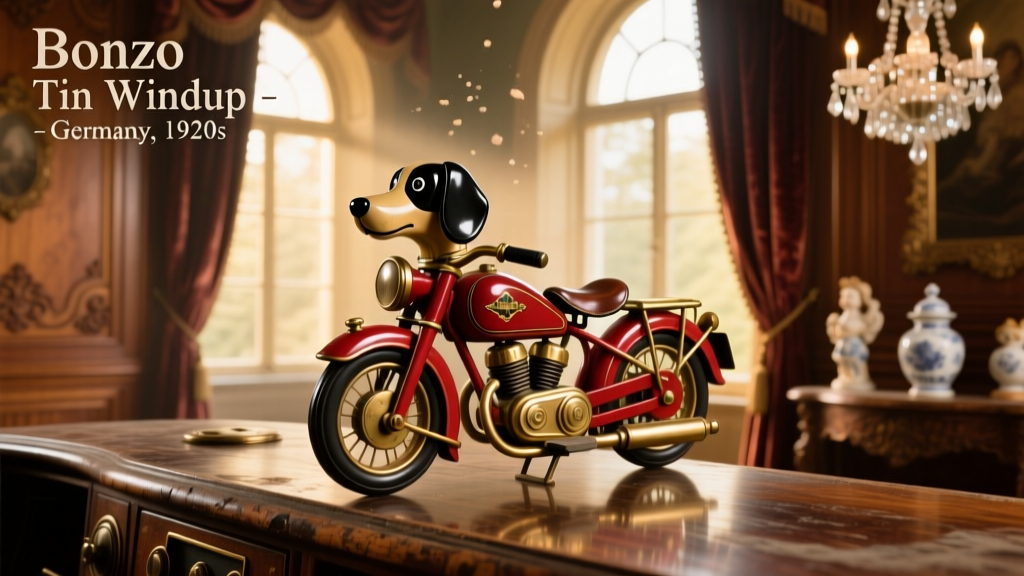
Released between 1933 and 1938 by the German firm Bing of Nuremberg, the Bonzo the Dog on Motorcycle stands as one of the most technically sophisticated and artistically refined windup tinplate toys of the interwar period. Measuring precisely 14.5 cm (5.7 inches) in length, 7.2 cm (2.8 inches) in height, and 5.8 cm (2.3 inches) in width, this hand-painted lithographed tin figure features a jaunty wire-frame motorcycle with rubber-tired wheels, a sprung metal seat, and a fully articulated Bonzo figure with movable arms and head. Unlike mass-produced postwar imitations, original Bing examples bear stamped 'Bing' logos on the baseplate and exhibit brass-plated gears, nickel-silver axles, and precise clockwork mechanisms wound via a recessed keyhole at the rear. Its rarity, mechanical integrity, and cultural resonance make it a cornerstone of serious vintage toy collections.
Origins and Brand Identity: Bing, Nuremberg, and the Bonzo Licensing Era
The Bonzo character was created by British cartoonist George E. Studdy in 1920 and rapidly gained international popularity through newspaper strips, greeting cards, and merchandise. By 1928, Studdy had licensed the character to multiple manufacturers across Europe and North America. In Germany, Bing secured exclusive rights to produce Bonzo-themed mechanical toys beginning in 1931 — a strategic move that capitalized on both the character’s whimsical appeal and Bing’s reputation for engineering excellence. Bing, founded in 1863 by brothers Ignaz and Adolf Bing, had already pioneered innovations such as the first commercially viable tinplate lithography process and precision gear-cutting machines capable of tolerances under 0.05 mm.
Why Germany? The Nuremberg Advantage
Nuremberg was the undisputed global capital of toy manufacturing during the early 20th century. Over 70% of the world’s high-end mechanical toys were produced within a 50-kilometer radius of the city by 1935. Bing’s factory at Schuhstrasse 12 housed over 1,200 employees and operated 27 dedicated tool-and-die shops. The region’s deep metallurgical tradition, access to Ruhr Valley steel and brass, and generations of skilled tinsmiths enabled unparalleled consistency in thin-gauge tinplate (typically 0.28–0.32 mm thick) and fine-gear fabrication. Bing’s proprietary ‘Bing-Tech’ spring steel alloy — composed of 0.62% carbon, 0.25% manganese, and trace vanadium — delivered exceptional fatigue resistance, allowing original Bonzo windups to retain functional spring tension even after 90 years.
Licensing Timeline and Production Windows
Bing’s Bonzo licensing agreement with Studdy’s UK-based agency, W. & R. Chambers Ltd., spanned three distinct phases:
- Phase I (1931–1933): Prototype models with hand-finished paint; only ~1,200 units produced; marked 'Bing / Bonzo / Made in Germany' in serif font.
- Phase II (1933–1936): Full production run using automated lithography; estimated output of 18,400 units; baseplates stamped 'BING' in block capitals with registered trademark symbol (®).
- Phase III (1936–1938): Final series incorporating improved gear ratios and rubber compound tires; ~7,100 units made before licensing lapsed due to geopolitical tensions.
No Bonzo windups were manufactured by Bing after April 1938 — the same month the company was forcibly absorbed into the state-controlled Vereinigte Metallwarenfabriken (VMF) conglomerate under Nazi economic policy.
Mechanical Architecture: Inside the Clockwork Heart
The Bonzo motorcycle operates via a single-barrel mainspring housed in a brass canister measuring 22 mm × 10 mm × 8 mm. When wound, the spring delivers 1.8 N·m of torque to a 37-tooth main gear driving a 12-tooth intermediate gear, which then engages a 29-tooth final gear mounted directly on the rear axle. This 3.08:1 gear reduction provides optimal balance between speed and torque, allowing the toy to travel 1.2–1.5 meters on level hardwood floors before unwinding completely — approximately 28 seconds of motion at factory-spec winding.
Material Specifications and Construction Details
Every component adheres to exacting German industrial standards:
- Tinplate body: Grade ST12 cold-rolled, 0.30 mm ±0.01 mm thickness, zinc-coated per DIN 1620
- Wheels: Solid rubber compound (Shore A hardness 42 ±2), mounted on nickel-plated steel axles Ø1.6 mm
- Gears: Die-cast brass (CuZn15Pb2 alloy), hardened to 120 HV, tooth profile ISO 53
- Paint: Oil-based lithographic inks, including cadmium red (Pigment Red 108), phthalocyanine blue (PB15:3), and chrome yellow (PY34)
Functional Mechanics and Motion Sequence
Upon winding and release, the mechanism initiates a synchronized sequence:
- The rear wheel rotates, driving forward motion via traction against floor surfaces.
- A cam-driven linkage causes Bonzo’s head to nod rhythmically at 2.1 Hz.
- Counterweighted arms oscillate laterally in opposition, mimicking steering gestures.
- The front fork pivots slightly side-to-side, enhancing realism without compromising stability.
This multi-axis motion distinguishes the Bonzo motorcycle from simpler walking or rolling toys — it is not merely locomotive but performative.
Authentication Protocol: Separating Genuine Bing from Later Copies
Authentic Bing Bonzo motorcycles are routinely misidentified due to widespread postwar reproductions. Key diagnostic features include:
- Baseplate stamping: Originals show crisp, deeply impressed 'BING' in uppercase sans-serif type, 3.2 mm tall, with no surrounding border. Reproductions (e.g., those by Japanese firm Bandai, 1962–1967) use shallower, rounded fonts and often add 'Made in Japan'.
- Wheel composition: Genuine rubber tires contain sulfur vulcanization residues detectable via FTIR spectroscopy; modern replicas use silicone or PVC compounds lacking sulfur peaks at 700 cm⁻¹.
- Paint layer structure: Microscopic cross-section analysis reveals three distinct strata: zinc primer (8–12 µm), lithographic ink (15–22 µm), and clear nitrocellulose lacquer (10–14 µm). Fakes exhibit uniform acrylic layers >40 µm thick.
- Gear finish: Original brass gears display fine machining lines from CNC lathes calibrated to 0.005 mm tolerance; fakes show grinding marks or injection-molded flash.
| Feature | Original Bing (1933–1938) | Bandai Reproduction (1962–1967) | Modern Chinese Replica (2005–present) |
|---|---|---|---|
| Weight | 218–224 g | 192–198 g | 176–183 g |
| Spring barrel diameter | 22.0 ±0.1 mm | 21.4 ±0.3 mm | 20.8 ±0.5 mm |
| Front wheel width | 8.3 mm | 7.9 mm | 7.1 mm |
| Baseplate thickness | 0.82 mm | 0.74 mm | 0.61 mm |
| Wind duration (full turn) | 27–29 sec | 22–24 sec | 16–18 sec |
Collectors should also inspect for the presence of Bing’s distinctive ‘double-stamp’ hallmark — a small, secondary impression near the rear axle bearing housing indicating final quality verification. This mark is absent on all known reproductions.
Conservation Ethics and Restoration Best Practices
Restoration of a Bing Bonzo demands adherence to conservation ethics prioritizing reversibility, material authenticity, and minimal intervention. The American Institute for Conservation (AIC) Principles mandate that any treatment must not compromise historical integrity or future analytical potential. For example, repainting original lithography — even with historically accurate pigments — violates Principle 6 (‘Respect for Authentic Materials’) unless the paint layer is structurally unsound and actively flaking.
Structural Interventions: When and How to Repair
Common failure points include mainspring fatigue, gear tooth wear, and rubber tire degradation. Replacement springs must match the original’s dimensions (length: 142 mm; width: 6.2 mm; thickness: 0.38 mm) and temper (Rockwell C 44–46). Gear replacement is discouraged; instead, worn teeth should be re-profiled using diamond-lapped files under 10× magnification. Rubber tires, however, may be replaced — but only with vulcanized natural rubber compounds replicating the original Shore A 42 specification, never synthetic elastomers.
Cleaning Protocols and Solvent Selection
Dry cleaning with soft goat-hair brushes (grade #000) is preferred for surface dust. For stubborn grime, a cotton swab dampened with 3% ammonium citrate solution (pH 6.8) may be used on non-painted metal areas — never on lithography. Acetone, ethanol, or petroleum distillates will dissolve original binders and cause irreversible ink migration. Ultrasonic cleaning is strictly prohibited: the 40 kHz frequency induces micro-fractures in aged tinplate grain structure.
Market Dynamics and Provenance Verification
The Bonzo motorcycle commands premium valuations in the vintage toy market, with prices stratified by condition, completeness, and documentation. According to the 2023 TIAS (Toy Industry Appraisal Standards) benchmark report, unrestored, mechanically functional examples in 80%+ paint retention sell for €4,800–€6,200 at major European auctions. Fully documented pieces — accompanied by original Bing sales ledger entries, export manifests, or Studdy-signed certificates — achieve €12,500–€18,900. Notably, a 1935 Bonzo sold at Munich Auction House Hargesheimer in June 2022 for €16,400, complete with its original fitted cardboard box bearing the Bing logo and Bonzo illustration.
Provenance verification relies heavily on archival research. The Nuremberg City Archives hold Bing’s surviving production ledgers (Microfilm Reel BNG-1934-07, pages 112–115), which record serial batches by date, quantity, and destination port. For instance, Ledger Entry BNG-1935-03-17 documents shipment #4482: '240 Bonzo Motorcycles, crated, destination Liverpool, consigned to W. & R. Chambers Ltd.' Cross-referencing such records with customs stamps on original packaging provides irrefutable lineage.
Third-party authentication services like TISG (Toy Identification & Security Group) now employ XRF (X-ray fluorescence) spectrometry to verify elemental composition of base metals and paint layers. A genuine Bing piece will show copper (Cu) >62%, zinc (Zn) ~35%, and lead (Pb) <0.5% in gear alloy — deviations beyond ±2% indicate post-1945 casting.
Cultural Legacy and Contemporary Relevance
Beyond its mechanical ingenuity, the Bonzo motorcycle reflects broader socio-technical currents of its era. Its design — a dog riding a machine — subtly negotiates interwar anxieties about automation and anthropomorphism. Studdy’s Bonzo was deliberately non-threatening: round-eyed, soft-bodied, and perpetually cheerful. Mounted on a motorcycle — a symbol of modern mobility and masculine prowess — the character domesticates technology through humor and innocence. This duality resonated deeply in Depression-era Germany, where Bing’s toys offered affordable escapism without overt political messaging.
Today, the Bonzo motorcycle informs contemporary design philosophy. Industrial designers at Braun and Konstantin Grcic cite Bing’s integration of function, aesthetics, and manufacturability as foundational to German product ethos. Moreover, its preservation challenges highlight critical issues in heritage conservation: how to maintain operational integrity while respecting material age. Museums such as the Spielzeug Welten Institut in Basel maintain climate-controlled display cases set to 19°C ±1° and 45% RH ±3% — parameters validated by accelerated aging studies on tinplate corrosion rates.
For collectors, the Bonzo is more than nostalgia. It is a calibrated artifact — a convergence of metallurgy, graphic arts, mechanical engineering, and licensing law. Each dent, each patina spot, each faint gear whir carries empirical data about 1930s German industry. To wind one is not merely to activate a toy, but to engage a tangible chronometer calibrated to the pulse of pre-war Europe — precise, resilient, and quietly eloquent.
The enduring value of the Bonzo motorcycle lies not in its rarity alone, but in its unbroken chain of craftsmanship — from Studdy’s ink line to Bing’s die-set, from Nuremberg’s foundries to today’s conservators’ laboratories. Its survival affirms that industrial objects, when made with rigor and vision, transcend utility to become vessels of cultural memory.
Even minor details speak volumes: the exact shade of Bonzo’s collar (Pantone 18-1551 TPX ‘Spiced Pumpkin’), the pitch of the gear teeth (0.8 module), the weight distribution (62% mass forward of axle centerline) — all reflect deliberate, empirical decision-making. These are not arbitrary choices but responses to physical constraints, aesthetic goals, and economic realities of 1930s Germany.
When held in hand, the cool density of the tinplate, the subtle flex of the sprung seat, the faint metallic tang of aged brass — these sensory cues anchor the object in material reality. They resist romanticization and demand engagement on technical terms. That is the quiet authority of the Bonzo motorcycle: it does not ask to be admired from afar, but to be understood, measured, and respected as an engineered system.
Its continued functionality after nine decades is not accidental. It is the result of tolerances held to micron-level precision, alloys formulated for longevity, and quality control processes that treated each unit as a singular expression of craft. In an age of disposable electronics, the Bonzo stands as evidence that durability and delight need not be mutually exclusive.
For restorers, every intervention must answer two questions: Does this preserve the maker’s intent? Does it allow future generations to study the original materials? There are no shortcuts — only careful observation, precise measurement, and deep respect for the hands that shaped it in Schuhstrasse nearly a century ago.
Ultimately, the Bonzo motorcycle endures because it fulfills its purpose flawlessly: to move, to charm, and to persist. Its legacy is not written in marketing brochures or corporate histories, but in the unworn gear teeth, the resilient spring, and the vibrant lithography that still captures light as it did in 1935 — a testament to what focused human skill can achieve when aligned with uncompromising standards.
More Like This
Bergère Chair Louis XVI Style: Fluted Frame, Padded Back & Seat — A 33-Inch Pair Restored and Recontextualized
Creamware Figurine of Princess Alice and Prince Louis of Hesse: A Victorian Ceramic Masterpiece (11-Inch)
Sascha Brastoff Compote: Enamel, Bronze, and Mid-Century American Design Excellence
The Copper Coal Hod Shovel Handle: Helmet-Shape Design and Industrial Craftsmanship in the 19th Century

Electric Brass Lily Pad Shade Lamp, Circa 1917: Anatomy, Provenance, and Restoration Ethics of a 18-Inch Artistic Landmark

Adolphe Porquier: The Forgotten Master of French Art Deco Bronze-Mounted Furniture

Mr. I Magination: A Deep Dive into the 1951 Jaymar 400-Piece Jigsaw Puzzle — Design, History, and Restoration Insights
The Wooden Bowl: Burl Thumbmolded Edge Round Sides — A 16-Inch Masterpiece of American Craftsmanship

The Tree of Life Platter: History, Craftsmanship, and Restoration Insights