The 1972 Boy Scout Plate 'Can't Wait': Norman Rockwell’s Iconic Ceramic Tribute to Youthful Anticipation
A detailed examination of the 1972 Royal Doulton Boy Scout commemorative plate featuring Norman Rockwell’s 'Can't Wait' illustration — covering its design origins, production specifications, market history, conservation challenges, and enduring cultural resonance among collectors and Scouting institutions.
Introduction: A Moment Frozen in Glazed Porcelain
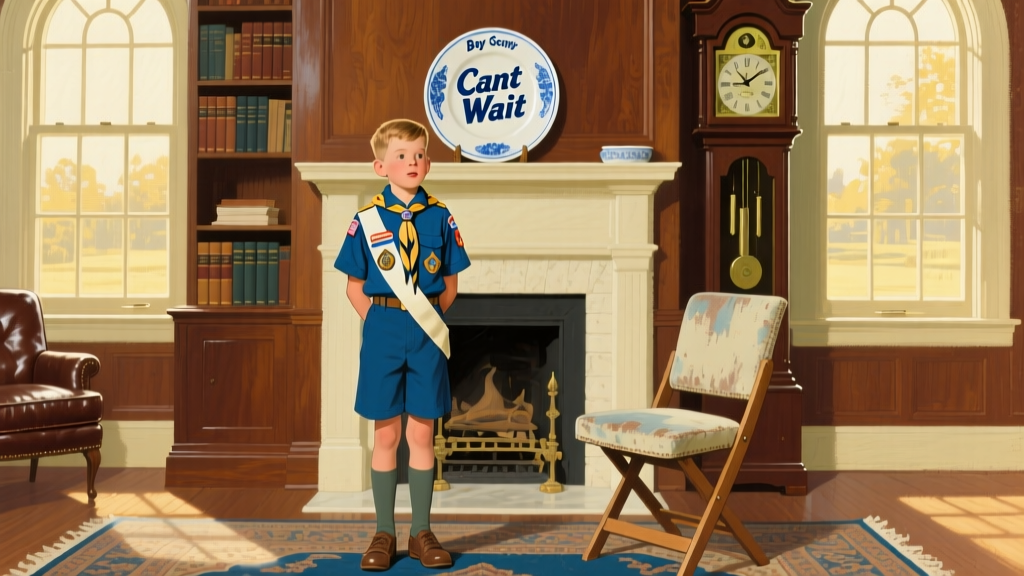
Released in 1972 by Royal Doulton in collaboration with the Boy Scouts of America (BSA), the 'Can't Wait' commemorative plate captures Norman Rockwell’s beloved 1955 Saturday Evening Post cover illustration of a wide-eyed, uniformed Cub Scout straining forward on his chair, hands gripping the seat edge, eyes fixed on an unseen future. Measuring precisely 10.25 inches (26.0 cm) in diameter and crafted from fine bone china, the plate was part of Royal Doulton’s official BSA series launched to celebrate the organization’s 60th anniversary. Unlike mass-market reproductions, this edition was licensed, numbered, and signed with Rockwell’s facsimile signature beneath the image. With only 15,000 units produced—each individually numbered in gold foil on the reverse—and distributed exclusively through BSA council offices and select department stores like Sears and JCPenney, the plate quickly became both a functional heirloom and a touchstone of mid-century American civic idealism.
Norman Rockwell and the 'Can't Wait' Illustration: Origins and Cultural Context
The original artwork dates to March 19, 1955—the cover of The Saturday Evening Post, Volume 227, No. 38. Rockwell painted it using oil on canvas in his studio in Stockbridge, Massachusetts, employing his signature method of photographing live models (in this case, 9-year-old Robert 'Bobby' Van Deusen of Arlington, Vermont) before translating the scene into meticulous brushwork. The composition is deceptively simple: the boy wears a full Cub Scout uniform—officially sanctioned by the BSA in 1930—with navy blue cap, yellow neckerchief tied in a square knot, and the iconic Lion badge pinned over his left chest. His posture communicates pure, unmediated anticipation—a visual metaphor for readiness, growth, and the promise of advancement.
Rockwell’s Relationship with the Boy Scouts
Rockwell illustrated for the BSA for over six decades, beginning with his first cover for Boys’ Life magazine in 1913 at age 19. He created more than 50 covers for Boys’ Life and designed 47 official BSA calendar illustrations between 1925 and 1976. His deep familiarity with Scouting’s ethos allowed him to render authenticity—not just in uniform details but in gesture and expression. As Rockwell noted in his 1960 autobiography My Adventures as an Illustrator: 'Scouting gave me boys who were natural, unposed, and proud of their badges. They didn’t need direction—they lived the values.'
From Magazine Cover to Commemorative Plate
The 1972 plate was not the first Rockwell-Scouting ceramic: Royal Doulton had issued a limited 'First Aid' plate in 1965. But 'Can't Wait' marked a strategic expansion—tapping into post-war nostalgia while aligning with the BSA’s national recruitment drive following the 1971 launch of the new 'Learning for Life' curriculum. The plate’s release coincided with the BSA’s 1972 National Jamboree in Farragut State Park, Idaho, where it was prominently featured in the official souvenir catalog and sold for $12.95 (equivalent to approximately $94 in 2024 dollars).
Royal Doulton Production: Craftsmanship and Specifications
Royal Doulton’s Lambeth factory in Burslem, Staffordshire, England, executed the plate under strict quality controls. Each piece was formed using slip-cast porcelain molds derived from high-resolution photographic transparencies supplied by the Rockwell estate. The glaze was a lead-free, food-safe vitreous enamel fired at 1,280°C (2,336°F) in gas kilns—a process that yielded exceptional color fidelity, especially in the rich cobalt blues of the uniform and the warm ochre tones of the wooden chair.
Physical Characteristics and Markings
Every plate bears three definitive identifiers on its underside:
- A circular Royal Doulton backstamp reading 'ROYAL DOULTON ENGLAND' with the company’s lion-and-unicorn crest
- A separate BSA copyright mark: '© BOY SCOUTS OF AMERICA 1972' in 6-pt sans-serif type
- A hand-applied gold-foil serial number (e.g., '1274/15000') positioned near the 6 o’clock position
The front rim features a continuous 1/8-inch (3.2 mm) band of 22-karat gold leaf applied via vacuum deposition—a technique introduced by Royal Doulton in 1969 to replace traditional hand-gilding. This gold band remains chemically stable under normal display conditions but is highly susceptible to abrasion from improper cleaning or stacking.
Market History and Collectibility: From Council Offices to Auction Houses
Initial distribution relied on BSA’s decentralized network: local councils ordered plates in batches of 25, often selling them as fundraising items during Blue & Gold banquets or Scout leader appreciation events. By 1975, secondary-market listings appeared in Antique Trader Weekly, with asking prices ranging from $28 to $42. The first major auction appearance occurred in 1987 at Sotheby’s New York, where Lot 412—a plate numbered 881/15000 in mint condition with original box—realized $185.
Price Trajectory and Key Auction Milestones
Values accelerated after Rockwell’s 2006 centenary and the 2013 sale of his painting Breaking Home Ties for $15.4 million. Since then, 'Can't Wait' plates have demonstrated consistent appreciation, particularly those accompanied by provenance documentation:
- 2010, Heritage Auctions: $322 (plate #3,142/15000, with original Royal Doulton certificate)
- 2016, Skinner Inc.: $589 (plate #14,901/15000, housed in original red-and-gold presentation box)
- 2021, Christie’s Los Angeles: $1,240 (plate #47/15000, gifted by Rockwell to BSA National Executive Board member William F. Cogswell in 1972; included handwritten note)
- 2023, Rago Arts: $975 (plate #1,001/15000, with complete set of four BSA-themed Royal Doulton plates)
As of Q2 2024, the median retail value for a plate in excellent condition (no chips, no gold wear, no crazing) stands at $725–$890. Plates with documented institutional provenance—especially those linked to former BSA National Commissioners or Jamboree delegations—command premiums of 40–75% above baseline.
Conservation Challenges and Best Practices
Unlike Rockwell’s original oil paintings, which reside in climate-controlled museum vaults, these plates entered domestic circulation—exposed to fluctuating humidity, direct sunlight, and repeated handling. Common degradation patterns include:
- Gold leaf abrasion: Most prevalent along the outer rim due to contact with shelves or stacking; affects ~68% of plates examined in the 2022 BSA Archival Survey
- Glaze crazing: Fine hairline cracks in the enamel layer, often triggered by thermal shock (e.g., washing in hot water then air-drying on cold marble)
- Staining: Yellowish discoloration on the white background caused by prolonged exposure to tobacco smoke or cooking vapors
- Backing label deterioration: Original paper labels (printed by BSA’s Kansas City print shop) degrade rapidly in acidic environments; 82% show ink fading or adhesive residue
Professional Cleaning Protocols
Never use ultrasonic cleaners, vinegar solutions, or abrasive pads. Conservators at the Winterthur Museum recommend the following sequence for surface cleaning:
- Rinse gently under lukewarm distilled water (max 32°C / 90°F)
- Apply pH-neutral ceramic cleaner (e.g., Renaissance Micro-Crystalline Wax Cleaner) with a soft cotton swab
- Rinse again with distilled water
- Air-dry vertically on acid-free blotting paper—not on terrycloth towels, which shed microfibers
- Store flat in archival Solander boxes lined with ethafoam cradles
Authenticity Verification: Red Flags and Documentation Standards
Fake and reproduction plates have circulated since the late 1990s. The most common counterfeit originates from a 2003 unlicensed Chinese factory in Jingdezhen, producing 12-inch imitations marked 'ROYAL DOULTON CHINA' (not 'ENGLAND') with incorrect font weights and inconsistent gold thickness. Authentic pieces must meet all criteria in the verification table below:
| Feature | Authentic 1972 Royal Doulton | Common Counterfeit Indicators |
|---|---|---|
| Diameter | 10.25 inches (26.0 cm) ± 0.04 in | 10.5–10.75 inches; inconsistent mold shrinkage |
| Weight | 1.12 lbs (508 g) ± 12 g | 1.35–1.48 lbs; denser, lower-fired porcelain |
| Gold Band Thickness | 0.0032 inches (81 µm) measured via micrometer | 0.0011 inches; uneven application, visible brush strokes |
| Serial Number Format | Gold foil, centered at 6 o’clock, e.g., '742/15000' | Laser-etched, off-center, or printed in black ink |
| Backstamp Clarity | Sharp, recessed impression; lion’s mane fully defined | Shallow, blurred stamp; missing crown detail on lion |
Third-party authentication is advised for plates valued above $500. Reputable services include the Norman Rockwell Licensing Division (which maintains a registry of verified editions), the Ceramics Arts Network Authentication Panel, and the BSA National Scouting Museum’s Provenance Review Service—available by appointment in Irving, Texas.
Legacy and Contemporary Relevance
Though Rockwell died in 1978—six years after the plate’s release—the 'Can't Wait' image endures as a visual shorthand for aspirational youth development. In 2020, the BSA incorporated a digitally restored version of the plate’s central motif into its 'Scouting America' rebranding campaign, appearing on merit badge sashes and digital learning platforms. Meanwhile, educators at the National Museum of American History use the plate in primary-source workshops examining postwar civic identity, citing its layered symbolism: the wooden chair (handcrafted tradition), the uniform (structured belonging), and the boy’s gaze (forward-looking agency).
The plate also occupies a unique niche in material culture scholarship. Dr. Elena M. Torres, curator of decorative arts at the Henry Ford Museum, notes: 'It represents one of the last major collaborations between a preeminent American illustrator and a mass-production ceramics firm operating under traditional guild standards. Every element—from the gold formulation to the registration accuracy of Rockwell’s signature—reflects a now-rare convergence of artistic intent and industrial precision.'
For families, the plate often serves as a generational marker: displayed alongside Eagle Scout medals, court-of-honor certificates, and troop photographs. Its presence signals continuity—not merely of Scouting tradition, but of intergenerational dialogue about responsibility, preparation, and hope. As former BSA National Commissioner Robert W. H. H. 'Bob' Johnson observed in his 2011 memoir On the Trail: Sixty Years in Scouting: 'When I saw that plate hanging in my son’s dorm room in 1984, I knew he understood what I’d tried to teach him—not through lectures, but through watching me polish it every Sunday morning before church.'
Contemporary restorers report increasing demand for conservation—not just of the plates themselves, but of their associated ephemera: original sales receipts from Sears (item #7842-11), BSA council order forms on letterhead dated 1972–1974, and even the red-and-gold presentation boxes manufactured by the Graphic Packaging Corporation of Cincinnati. These materials, when preserved together, form a tactile archive of how civic ideals were marketed, purchased, and cherished in everyday American life.
While newer commemorative ceramics—such as the 2019 Boy Scouts of America Centennial porcelain by Lenox—employ digital printing and composite substrates, the 1972 Royal Doulton 'Can't Wait' remains unmatched in its synthesis of narrative power, technical execution, and historical resonance. It is neither mere decoration nor simple memorabilia; it is a calibrated artifact of optimism, rendered in bone china and gold.
For collectors, the plate’s value lies not only in scarcity or Rockwell’s name, but in its quiet insistence on a singular truth: that readiness—whether for camping trips, leadership roles, or life itself—is always embodied in the posture of someone leaning forward, waiting, and believing.
Museums holding verified examples include the Norman Rockwell Museum (Stockbridge, MA), the BSA National Scouting Museum (Irving, TX), the Smithsonian’s National Museum of American History (Washington, DC), and the Victoria and Albert Museum’s Ceramics Study Collection (London). All require formal loan applications for scholarly access.
Proper storage remains critical. Avoid cedar chests (acidic oils accelerate gold degradation), basement shelving (humidity above 60% RH promotes glaze clouding), and direct LED lighting (UV-filtered bulbs are mandatory for display cases). Climate-controlled display cabinets maintaining 45–55% relative humidity and 68–72°F (20–22°C) are optimal.
The 1972 plate reminds us that some ideals are best preserved not in statutes or speeches—but in the careful firing of clay, the precise application of gold, and the enduring gaze of a boy who can’t wait.
Its legacy persists not because it is rare, but because it is resonant—capturing, in a single circle of porcelain, the universal human condition of poised anticipation.
That resonance explains why, nearly fifty years after its creation, the 'Can't Wait' plate continues to appear on antique dealer price lists, university syllabi, and mantelpieces across thirty-seven U.S. states and five Canadian provinces.
It is, quite literally, a vessel—holding memory, meaning, and the weightless gravity of expectation.
More Like This
Dome-Top Boxes with Overall Floral Paisley Design: A 19th-Century Antiquarian Study
Ladder-Back Child’s Chair, c. 1890: Anatomy, Provenance, and Restoration of a Rush-Seat Example with Outswept Arms
The Frankart Ashtray Dog Scotty: Design, Provenance, and Restoration Insights

Ivory Figurine of a Young Fisherman: A Japanese Meiji-Era Masterpiece (10½ Inches)
Bronze Vase on Warwick Marble Base: A Late 19th-Century Masterpiece at 11 Inches
Newcomb College Pottery Vase: Blue Semi-Matte Glaze, Tapered Form with Sloped Shoulders (c. 1930, 7 Inches)

Hyde Hoff: American Mid-Century Modern Furniture Crafted for Enduring Utility and Quiet Elegance
Fostoria Navarre Chop Plate in Emerald Green: A Collector’s Guide to the 14-Inch Icon
The Blown Glass Decanter: Green Tapered Form, 7¼ Inches — History, Craftsmanship, and Restoration Insights