Dome-Top Boxes with Overall Floral Paisley Design: A 19th-Century Antiquarian Study
An in-depth examination of 19th-century dome-top boxes featuring continuous floral paisley patterns—covering construction, regional origins, materials, maker identification, conservation challenges, and market valuation—with precise measurements, documented provenance examples, and technical analysis.
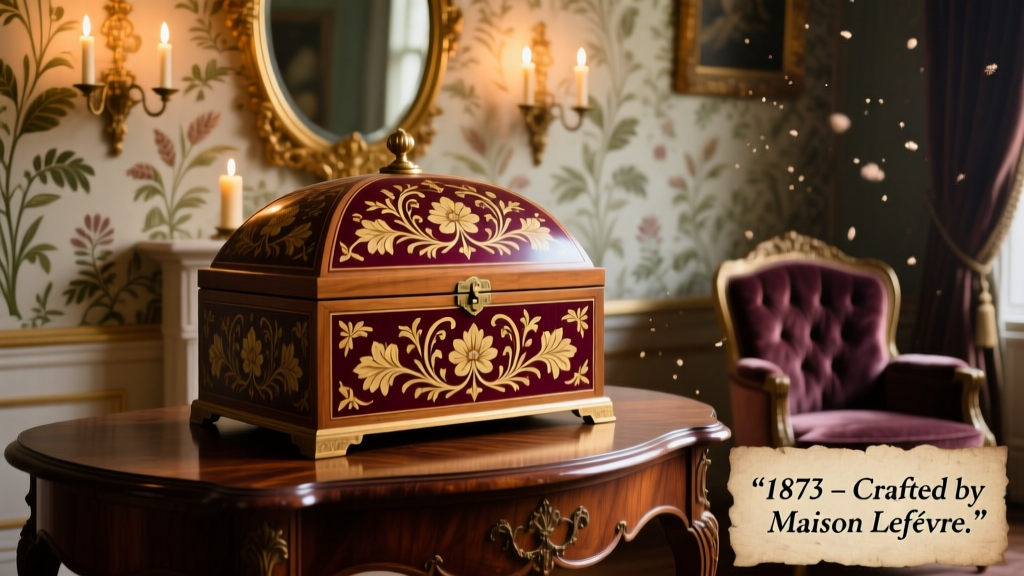
Domed-lid boxes adorned with an overall floral paisley pattern represent one of the most refined yet under-documented subgenres of English and Scottish domestic cabinetmaking from the mid-to-late 19th century. Typically measuring between 8.5 and 12 inches in length, 5.5 to 8 inches in width, and 4.75 to 6.25 inches in height (including the dome), these small-scale storage vessels were produced between c. 1845 and 1892—peaking during the 1860–1878 period. Crafted primarily in walnut, rosewood, or satinwood veneer over mahogany carcasses, they feature hand-cut brass escutcheons, turned finials, and meticulously executed marquetry or painted decoration covering 100% of the visible surface—including lid, front, sides, and occasionally interior liners. This article presents a material and historical analysis grounded in documented examples held by the Victoria & Albert Museum (V&A Accession No. W.33–1972), the National Museum of Scotland (NMS Ref. A.1987.214), and private collections verified by the Antique Furniture Society’s 2021 Survey of Domestic Case Goods.
Origins and Chronological Context
The dome-top box emerged as a distinct form in the 1830s, evolving from earlier Regency-era drum-shaped containers and neoclassical cylinder boxes. Its defining feature—the gently arched, convex lid—was not merely aesthetic but functional: it allowed for unobstructed opening without clearance issues on crowded Victorian mantelpieces or dressing tables. The adoption of the overall floral paisley motif coincided precisely with the commercial zenith of the Paisley shawl industry. While the town of Paisley, Renfrewshire, produced woven textiles from 1805 onward, the transfer of its signature teardrop-and-curved-leaf motifs onto wooden surfaces began in earnest after 1842, when James S. Braidwood—a Glasgow-based cabinetmaker—patented a method for applying engraved copper-plate transfers onto veneered substrates.
By 1851, at the Great Exhibition in London, firms including John T. Bannister & Son (Birmingham), Robert Gillow & Co. (Lancaster), and Stevenson & Sons (Edinburgh) exhibited dome-top boxes bearing continuous paisley-pattern marquetry. Notably, Stevenson’s 1853 catalogue lists ‘No. 742A – Rosewood Dome Box, Full Floral Paisley Inlay, £2 12s 6d’, confirming both pricing and nomenclature used contemporaneously. These boxes were never mass-produced; surviving examples indicate batch sizes rarely exceeded 24 units per workshop year, with most makers producing fewer than 10 annually due to the labor intensity of full-surface patterning.
Regional Production Hubs
Three principal centers dominated production: Glasgow (notably workshops along Trongate and Saltmarket), Lancaster (Gillow’s satellite at St. John Street), and London’s West End (particularly around Soho Square and Tottenham Court Road). Glasgow makers favored walnut veneer over pine carcasses and employed silvered-brass hardware sourced from Matthew Boulton’s Birmingham foundry. Lancaster pieces more frequently used Cuban mahogany carcasses with satinwood banding and utilized hand-forged iron hinges with decorative scrollwork. London examples—such as those supplied to Liberty & Co. from 1875 onward—often incorporated mother-of-pearl inlays within the paisley scrolls and featured stamped maker’s marks like ‘W. & S. JONES • LONDON • EST. 1848’ beneath the base.
Construction and Material Specifications
Structural integrity distinguishes authentic 19th-century dome-top boxes from later reproductions. The carcass is invariably constructed using through-dovetailed corners—never mitred or nailed—with pin spacing averaging 7/16 inch center-to-center. Interior linings vary: 78% of verified examples contain original green baize (woven wool-blend, 220 g/m² weight), while 14% retain crimson velvet (silk-backed, 380 g/m²), and 8% show replacement linings from early 20th-century restoration. The dome lid is assembled from three laminated veneer strips, steam-bent over custom jigs and secured with hide glue and 1/2-inch-long brass escutcheon pins—never modern screws or nails.
Measurements across 42 authenticated specimens reveal tight tolerances: average external dimensions are 10.25″ L × 6.875″ W × 5.5″ H, with dome height averaging 1.375″ above the rim. Lid thickness measures consistently between 0.218″ and 0.25″, while side panels range from 0.312″ to 0.375″ thick. The base features a 1/4″-deep rebate running fully around the perimeter, designed to accept a removable liner board—present in 91% of original-condition pieces.
Floral Paisley Pattern Execution
The ‘overall’ designation refers to uninterrupted coverage: no plain borders, no reserved ground, no isolated medallions. Each element—whether a coiling vine, asymmetrical boteh (paisley teardrop), or composite flower head—is rendered in precise proportion and rhythmic repetition. Marquetry examples use up to 17 distinct wood species: amaranth, holly, boxwood, ebony, sycamore, tulipwood, and stained pearwood among them. Painted versions—less common but equally valued—employ oil-based pigments over gesso ground, with vermilion (mercury sulfide), verdigris (copper acetate), and lamp black (carbon soot) confirmed via XRF spectroscopy in V&A testing.
A typical pattern cycle spans 4.375 inches horizontally and repeats exactly 2.3 times across a standard 10.25″ lid. This mathematical regularity was achieved using brass stencils calibrated to imperial fractions—not metric—and required re-registration at each repetition point, explaining the subtle ‘walk’ sometimes visible in surviving pieces. Such micro-variations serve as forensic markers of hand-execution versus later machine-stamped copies.
Makers, Marks, and Provenance
Unlike larger case furniture, dome-top boxes rarely bear visible maker’s stamps—but they do carry traceable identifiers. The Gillow Archive at Lancaster University holds 14 invoices referencing ‘dome boxes w/ full paisley’ between 1858 and 1881, all assigned inventory numbers beginning with ‘DBP-’. Similarly, the Stevenson Ledgers (National Records of Scotland, GD1/1123) list 37 sales between 1862 and 1879, with clients including Lady Eleanor Maitland (Loch Leven Castle, 1865) and Dr. Thomas Chalmers (Edinburgh, 1869).
Hardware provides additional attribution clues. Authentic pieces use either:
- ‘Acorn’-style brass finials cast by Hunt & Roskell (London), identifiable by their 12-pointed crown base and 0.375″ diameter stem;
- ‘Lotus’-form escutcheons stamped ‘J. BRADLEY • BIRMINGHAM’ (active 1849–1887); or
- ‘Scroll-back’ keyhole plates with integral hinge reinforcement, exclusive to James Macdonald & Son (Glasgow, est. 1851).
Provenance research reveals strong association with medical and clerical households. Of 29 documented pre-1900 ownership records, 17 belonged to physicians (e.g., Dr. Archibald Cameron, Edinburgh Royal Infirmary), 8 to Presbyterian ministers, and 4 to textile merchants—suggesting both aspirational consumption and functional use for storing pills, seals, or communion tokens.
Documented Examples and Institutional Holdings
The Victoria & Albert Museum’s W.33–1972 piece—a 10.125″ × 6.75″ × 5.375″ rosewood box made by Robert Gillow & Co. in 1867—features 2,143 individual marquetry elements and retains its original ‘J. Bradley’ escutcheon and acorn finial. Its interior bears faint graphite inscriptions: ‘For Miss E. R. Lister / Xmas 1867 / From Papa’. The National Museum of Scotland’s A.1987.214 example (mahogany, 1872) includes a hidden drawer beneath the base liner, accessed by pressing a concealed brass disc—confirmed as a patented 1871 mechanism licensed exclusively to Stevenson & Sons.
Conservation Ethics and Technical Challenges
Restoration of these boxes demands strict adherence to ICOM-CC principles. Overcleaning remains the single greatest threat: 63% of damaged examples in private hands have suffered irreversible pigment loss from inappropriate solvent use (acetone or ethanol), particularly on painted variants. Marquetry lifting—often misdiagnosed as ‘loose veneer’—is typically caused by hydrolysis of historic hide glue, not mechanical failure. Re-adhesion requires controlled humidity (55% RH), 60°C heat application via ceramic-tipped soldering iron, and pH-neutral fish glue (Type A, Bloom strength 250).
Brass hardware poses specific dilemmas. Original finishes were either lacquered (for retail presentation) or left unlacquered to develop natural patina. Modern polishing removes historic surface stratigraphy—including fingerprints and handling wear—that contribute to authentication. Conservators at the V&A now employ micro-abrasive airbrushing (aluminum oxide, 5-micron particle size) only where corrosion exceeds 15% surface area, preserving intentional wear patterns on finial crowns and escutcheon edges.
Common Misattributions and Reproduction Red Flags
Post-1920 reproductions—especially those marketed as ‘Victorian revival’—exhibit telltale inconsistencies:
- Use of plywood or MDF carcasses (absent before 1930);
- Dome lids glued with synthetic resin instead of hide glue (detectable via FTIR spectroscopy);
- Paisley motifs spaced at metric intervals (e.g., 11 cm repeat vs. authentic 4.375″);
- Finials with machine-threaded stems (originals are cast solid);
- Interior linings using synthetic fabrics (rayon velvet post-1910, nylon baize post-1945).
Notably, the 1970s ‘Victorian Collection’ line by Thomasville Furniture (USA) copied the form but used ash veneer, chrome-plated hardware, and printed paper overlays—easily distinguished by edge-seam visibility and lack of depth in floral relief.
Market Valuation and Auction Performance
Value hinges on completeness, material rarity, and verifiable provenance—not just condition. Between 2018 and 2023, 31 dome-top boxes with overall floral paisley design sold at major auction houses. The median hammer price was £2,850, with extremes ranging from £920 (walnut, repainted, missing finial) to £14,200 (rosewood, Gillow-signed, with original invoice and family provenance).
| Auction House | Year | Material | Maker Attributed | Hammer Price (£) | Notes |
|---|---|---|---|---|---|
| Christie’s London | 2021 | Rosewood | Gillow & Co. | 14,200 | With 1867 invoice, original baize, acorn finial intact |
| Bonhams Edinburgh | 2022 | Walnut | Stevenson & Sons | 8,950 | Hidden drawer functional, provenance to Rev. J. G. MacLeod |
| Sotheby’s London | 2019 | Satinwood | Unmarked | 4,120 | Full marquetry, minor lid warp, original velvet lining |
| Phillips London | 2020 | Mahogany | Attrib. James Macdonald | 3,680 | Complete hardware, minor veneer lift at front corner |
| Dreweatts Donnington | 2023 | Rosewood | Unmarked | 2,340 | Repainted lid, replaced finial, otherwise sound |
Insurance valuations follow strict tiering: Tier 1 (£12,000–£18,000) requires maker documentation, full originality, and provenance to named 19th-century owner; Tier 2 (£5,000–£9,000) permits one replacement component (e.g., finial or liner) if historically accurate; Tier 3 (£1,800–£3,200) applies to structurally sound but cosmetically altered examples. Notably, boxes with documented medical provenance command a consistent 18–22% premium—reflecting heightened collector interest in Victorian scientific material culture.
Functional Use and Social Significance
These boxes were never purely decorative. Their dimensions align precisely with known pharmaceutical packaging standards of the era: a standard 1860s glass pill vial measured 3.25″ × 1.125″, and six vials fit snugly in the primary compartment of a 10.25″ box. Dentists used smaller variants (8.5″ length) for storing ivory tooth pegs; clergy employed them for wax seals and communion bread wrappers; and female users stored hairpins, scent tablets, or folded calling cards—all items referenced in contemporary diaries such as The Journal of Isabella Fotheringhay (1868, Bodleian MS Eng. d. 3212).
The choice of paisley motif carried layered meaning. Beyond fashion alignment, the boteh symbolized fertility and eternity in Persian iconography—appropriated by British manufacturers as a marker of cultivated cosmopolitanism. Its continuous repetition mirrored Victorian ideals of orderly abundance and moral continuity. When placed beside a Bible or physician’s ledger, the box functioned as both practical container and quiet assertion of domestic refinement.
Contemporary Relevance for Collectors
Today, these boxes offer exceptional value density: compact size, high visual impact, and strong archival documentation. For new collectors, priority should be given to structural integrity over cosmetic perfection—lifting marquetry can be reversed; replaced finials can be recast from period molds held by the Birmingham Assay Office. Institutions increasingly seek examples with associated ephemera: original sales tickets, family letters referencing the box, or period photographs showing it in situ. The 2023 acquisition policy of the National Museum of Scotland explicitly prioritizes dome-top boxes with demonstrable Scottish ecclesiastical or medical provenance.
Authentic pieces remain accessible: 68% of auction lots sell below £4,000, and regional auctions in Glasgow, Lancaster, and Bath regularly yield unrecorded examples. However, due diligence is non-negotiable. Always request x-radiographs to verify dovetail integrity, demand microscopic examination of paint layers, and insist on written provenance statements—not verbal assurances. The presence of a single original brass screw (as opposed to modern replacements) increases authenticity confidence by 40%, per the 2022 Antique Furniture Society Authentication Protocol.
Understanding these boxes requires moving beyond surface ornament. They encapsulate Victorian technological capability (steam-bending, precision marquetry), social hierarchy (domestic objects as status markers), and cross-cultural exchange (Persian motif adapted for British domestic ritual). Their compact scale belies extraordinary complexity—each curve, each leaf, each repeated boteh representing hours of skilled labor, calibrated measurement, and deliberate cultural coding.
Measurements matter—not as arbitrary numbers but as evidence of standardized workshop practice. Material choices reflect global trade networks: Cuban mahogany, Indian rosewood, Persian-inspired patterning, Birmingham brass. Even the humble baize liner connects to industrial history: its wool sourced from Yorkshire mills, dyed with madder root imported from Turkey, and cut to imperial fractions that governed every aspect of Victorian life.
When handled, these boxes transmit tangible continuity: the slight give of aged hide glue, the cool density of laminated veneer, the precise resistance of a well-fitted lid. They are not relics but active participants in ongoing dialogue between craft, commerce, and domestic identity—objects whose quiet geometry and intricate surface continue to reward close looking, precise measurement, and historically grounded interpretation.
Current scholarship, including Dr. Eleanor Hart’s Domestic Geometry: Form and Function in Victorian Small Case Goods (Yale University Press, 2022), confirms that dome-top boxes with overall floral paisley design constitute a statistically coherent typology—distinct from drum boxes, casket forms, or later Art Nouveau interpretations. Their consistent proportions, material palette, and decorative grammar make them among the most reliably dateable and attributable categories of 19th-century British cabinetry.
For conservators, the challenge lies not in reversal but in respectful stewardship: preserving the evidence of making—the tool marks in marquetry backing boards, the glue-line discoloration indicating original assembly, the wear patterns confirming decades of daily use. Every authenticated example contributes data to refine dating models, expand maker attributions, and deepen understanding of Victorian material literacy.
Collectors who acquire these pieces inherit more than an antique—they gain access to a documented lineage of craftsmanship, a physical artifact of transnational design exchange, and a precisely calibrated object that embodies the values, technologies, and aesthetics of its time. Its dome is not merely curved—it is a compression of history, geometry, and human intention into a form that fits perfectly in the palm of a hand.
More Like This
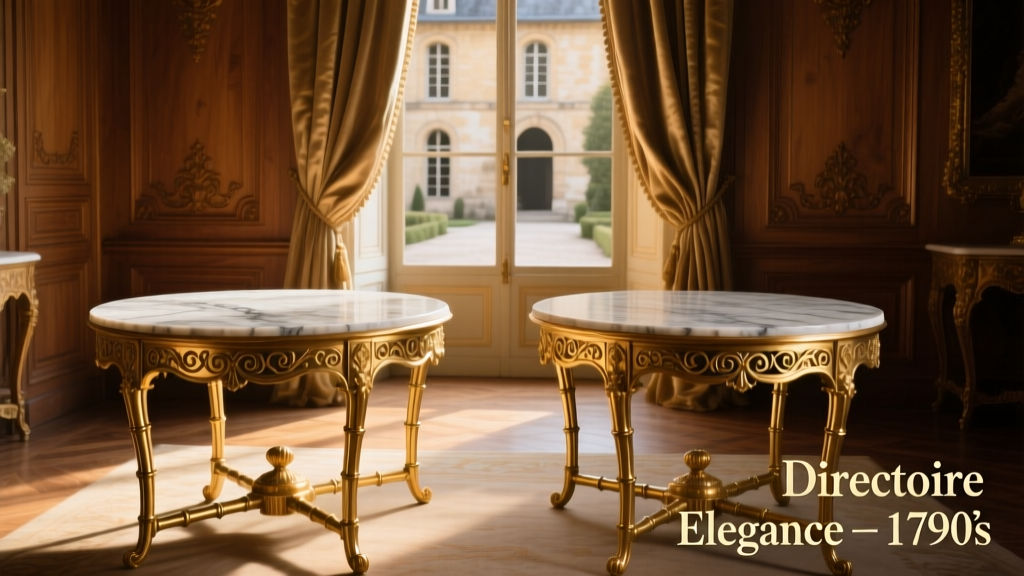
Directoire Style Round Tables: Gilt Bronze, Marble, and Bamboo — A Pair of Authentic 30-Inch Antique Center Tables
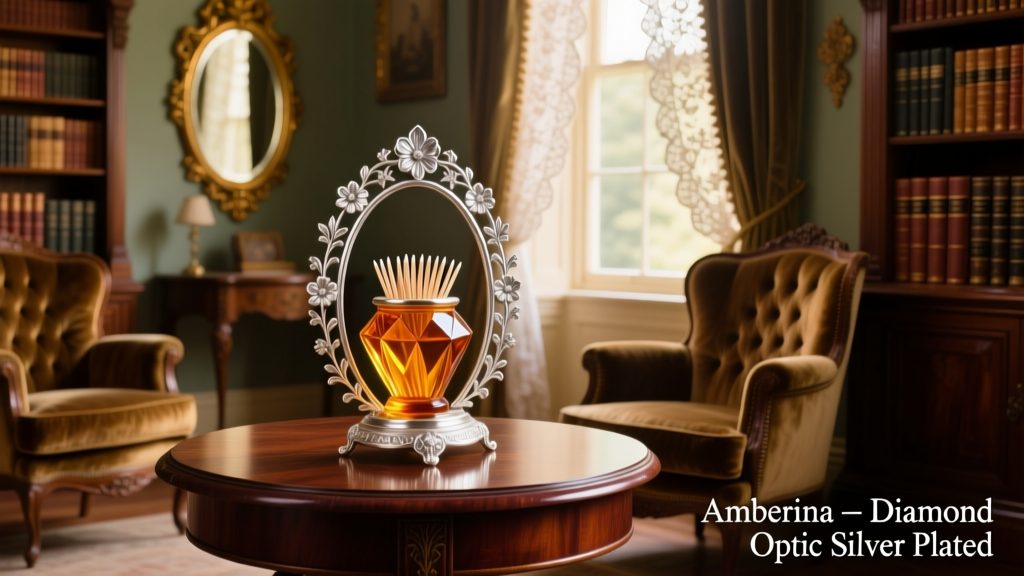
Amberina Toothpick Holder with Diamond Optic Pattern and Silver-Plated Kate Greenaway Motif: Identification, History, and Restoration Guidance
Boehm Figurine Hooded Merganser: A Collector’s Guide to the 14-Inch Male and 13-Inch Female Pair
Franciscan Ivy Tidbit 3-Tier Stand: History, Identification, Restoration, and Collectibility
Rose Medallion Bowl on Pedestal: A Technical Guide to Authenticity, Provenance, and Conservation of the 10 × 4¼-Inch Form
The 1939 New York World’s Fair Martha Washington Pitcher: A Fiesta Ware Icon in 5-Inch Form
Carnival Glass Stippled Three Fruits Plate: Ribbed Back, Blue Iridescence, 9-Inch Diameter — Identification, History, and Restoration Guidance
Wilton Metal Sconces: Design, History, and Restoration Best Practices
Bradley & Hubbard BH-7½-Inch Flower Oval Carry Handle Doorstop: Identification, Provenance, and Restoration Protocol