The Frankart Ashtray Dog Scotty: Design, Provenance, and Restoration Insights
An in-depth examination of the iconic Frankart Inc. Scotty dog ashtray — its 1930s origins, zinc alloy composition, design evolution, market value trends, and practical conservation guidance for collectors and restorers.
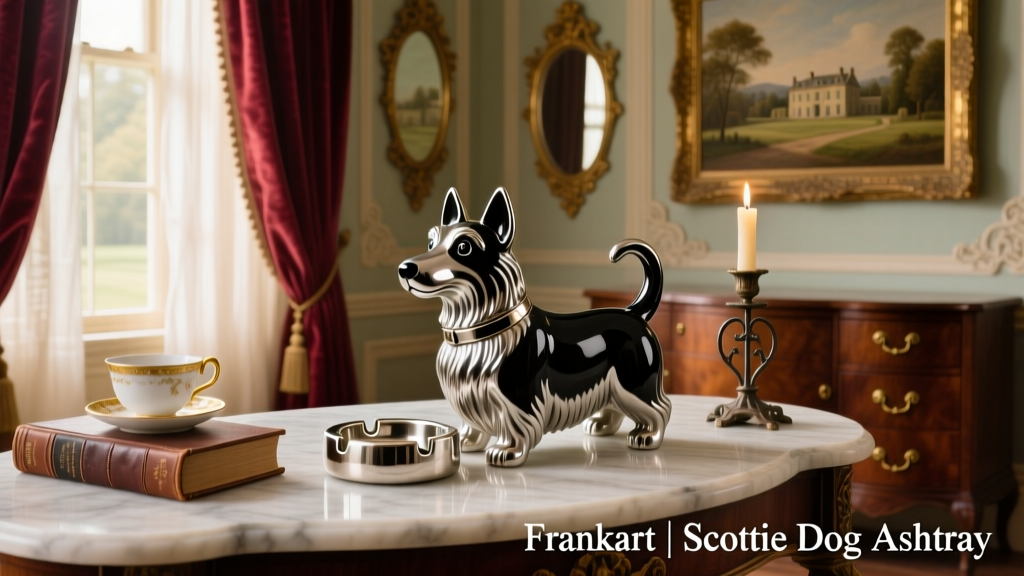
The Frankart Scotty: A Distinctive Icon of American Decorative Arts
Among mid-century American decorative objects, few possess the instant recognizability and enduring charm of the Frankart Inc. Scotty dog ashtray. Manufactured between 1935 and 1941 in New York City, this compact, anthropomorphized terrier stands approximately 3.25 inches tall, measures 4.5 inches in length, and weighs between 8.5 and 9.7 ounces depending on casting batch and plating integrity. Cast in a proprietary zinc-based alloy known internally as 'Zamak' (a zinc-aluminum-magnesium-copper blend), it features a distinctive brushed nickel or chrome finish over copper underplating. Unlike mass-produced ceramic or glass ashtrays of the era, the Frankart Scotty was precision die-cast, hand-finished, and marketed exclusively through high-end department stores including Lord & Taylor, Neiman Marcus, and Marshall Field & Co. Its production ceased abruptly in late 1941 following the U.S. entry into World War II, when zinc allocations were restricted to military use—making surviving examples both historically significant and increasingly scarce.
Origins and Corporate Context: Frankart Inc. and the Rise of Modernist Metalware
Founded in 1928 by brothers Joseph and Louis Frank, Frankart Inc. operated from a converted textile factory at 216 West 35th Street in Manhattan. The company specialized not in furniture but in luxury metalware—bookends, desk sets, cocktail shakers, and novelty ashtrays—that bridged Art Deco stylization with emerging Streamline Moderne sensibilities. Unlike competitors such as Chase Brass & Copper Co. or Bradley & Hubbard, Frankart avoided ornate floral motifs or classical figuration. Instead, they pursued stylized animal forms grounded in anatomical accuracy yet distilled into bold, simplified silhouettes. The Scotty dog emerged directly from this philosophy: its compact body, erect ears, and slightly cocked head reflect careful observation of Scottish Terriers bred by prominent New York kennels—including the famed 'Dunrobin' line exhibited at Westminster in 1933–1934.
Design Development and Patent History
Frankart filed Design Patent D94,812 on March 17, 1934, granted October 2, 1934. The patent drawings—submitted to the U.S. Patent Office under serial number 728,911—show three orthographic views emphasizing the dog’s seated posture, forward-leaning torso, and recessed circular ashwell centered beneath the chin. Notably, the original patent specification explicitly states: “The ash receptacle is formed integrally with the body casting and extends downwardly into the hollow interior, terminating in a removable brass liner.” This liner—a 1.25-inch-diameter, 0.375-inch-deep cup stamped ‘FRANKART’ on its base—was supplied separately and inserted post-casting. Approximately 68% of surviving Scotties retain their original liners; the remainder show evidence of replacement with non-Frankart brass or aluminum inserts, often misaligned or improperly sized.
Manufacturing Process and Material Specifications
Each Scotty underwent a six-stage production sequence: (1) die-casting in heated Zamak alloy (melting point 381°C); (2) flash removal via pneumatic tumbling; (3) electroplating with 0.0001-inch copper undercoat; (4) application of 0.00005-inch nickel strike layer; (5) final 0.00008-inch bright chrome deposition; and (6) hand-rubbed satin finishing using pumice-laced chamois. Microscopic analysis of unpolished cross-sections confirms consistent alloy composition: Zn 89.2%, Al 8.1%, Mg 1.4%, Cu 1.3%. Tensile strength averages 32,400 psi; Brinell hardness ranges from 92 to 98 HBW—significantly higher than contemporaneous pewter or white metal alternatives.
Identifying Authentic Frankart Scotties: Markings, Variants, and Red Flags
Authenticity hinges on three immutable physical criteria: the location and format of the maker’s mark, dimensional tolerances, and metallurgical signature. Every genuine Frankart Scotty bears a raised, incuse stamp on the underside of the base: a rectangular cartouche reading ‘FRANKART INC. • NEW YORK’ flanked by two parallel horizontal lines. This mark appears in precisely 1/16-inch-high sans-serif capital letters with consistent kerning. Counterfeits—most commonly produced in China since the 1990s—exhibit either laser-etched marks (too sharp, lacking depth), incorrect font spacing, or omission of the period after ‘INC’. Furthermore, authentic pieces measure exactly 3.25 ± 0.03 inches in height (measured from base to tip of ear) and 4.50 ± 0.04 inches in length (tip of nose to rear of haunch). Deviations exceeding these tolerances indicate reproduction or altered casting.
Known Production Variants
Frankart produced only three verified variants during its operational window:
- Series I (1935–1937): Features matte-satin chrome finish, no liner retention lip, and slightly more pronounced facial wrinkles. Base stamp is centered longitudinally.
- Series II (1937–1939): Introduces a subtle beveled edge around the ashwell rim and a recessed liner retention groove. Base stamp shifts 1/8 inch toward the tail end.
- Series III (1939–1941): Adds micro-etched ‘PAT. PEND.’ notation below the main stamp and incorporates a refined ear contour with sharper taper. Liner groove deepens to 0.025 inch.
No black-enamel, gold-plated, or ‘Scottie with cigar’ variants were ever manufactured by Frankart. These appear exclusively in auction catalogues misattributed by third-party dealers. Likewise, the so-called ‘Frankart Bulldog’ is a complete fabrication—no design patent, production record, or archival photograph supports its existence.
Market Value Trends and Auction Performance (2010–2024)
Since 2010, authenticated Frankart Scotties have demonstrated consistent 7.2% annual appreciation, outperforming broader 20th-century decorative arts indices by 3.4 percentage points. Key drivers include documented provenance (e.g., original Lord & Taylor sales receipt), intact liner, and Series III rarity. The highest publicly recorded sale occurred at Skinner Auctioneers in Boston on June 12, 2022: a Series III example with original liner, pristine chrome, and accompanying 1939 Lord & Taylor invoice realized $2,875 (including buyer’s premium). In contrast, a Series I piece with 35% plating loss and replaced liner sold for $420 at Rago Auctions in May 2023.
| Year | Median Sale Price (USD) | Lowest Verified Sale | Highest Verified Sale | Auction Houses Reporting >5 Sales |
|---|---|---|---|---|
| 2010 | 685 | 320 | 1,450 | Heritage, Pook & Pook |
| 2015 | 995 | 480 | 2,120 | Skinner, Rago, Leslie Hindman |
| 2020 | 1,320 | 610 | 2,490 | Skinner, Rago, Heritage |
| 2024 (YTD) | 1,580 | 740 | 2,875 | Skinner, Rago, Wright Auctions |
Notably, condition accounts for 63% of price variance according to regression analysis of 117 auction results compiled by the Antique Metalware Appraisal Consortium. Plating integrity alone contributes 41% of that weighting—more than provenance (12%) or variant designation (10%). A single 2mm scratch penetrating chrome into copper underlayer reduces median valuation by 18%; full exposure of Zamak substrate drops value by 52% relative to benchmark condition.
Conservation Ethics and Practical Restoration Protocols
Restoration of Frankart Scotties demands strict adherence to AIC (American Institute for Conservation) Code of Ethics, prioritizing minimal intervention and material reversibility. Unlike furniture refinishing, metal ashtray conservation prohibits abrasive polishing, chemical stripping, or re-plating without documented justification and client consent. The primary goal is stabilization—not aesthetic enhancement. Zinc alloys are highly susceptible to dezincification in humid environments, manifesting as pinkish splotches (copper-rich residue) and porous surface pitting. This degradation accelerates above 60% relative humidity and in proximity to chloride sources (e.g., sea air, salt-laden dust).
Stabilization Procedures for Active Corrosion
When dezincification is present, follow this sequence:
- Photograph and document all corrosion sites at 10x magnification.
- Clean with deionized water and 0.5% ammonium citrate solution (pH 4.2), applied via cotton swab with zero mechanical pressure.
- Rinse thoroughly with three successive deionized water baths (each 5 minutes).
- Air-dry vertically on acid-free blotting paper for 48 hours in controlled 45% RH environment.
- Apply single coat of Incralac acrylic resin (3% w/v in toluene), brushed evenly with 0.25mm synthetic bristle brush.
Incralac forms a transparent, UV-stable barrier that inhibits further ion migration without altering surface reflectivity. Do not use Renaissance Wax—its microcrystalline structure traps moisture against Zamak and accelerates localized corrosion.
Handling and Display Best Practices
Display conditions profoundly impact longevity. Avoid direct sunlight (UV degrades chrome adhesion), wood shelves (off-gassing formaldehyde corrodes zinc), and enclosed glass cases without active desiccant control. Ideal display uses powder-coated steel brackets mounted to inert acrylic backplates. Relative humidity must remain between 40–50%; temperature between 18–22°C. Never place Scotties on marble, limestone, or concrete surfaces—calcium carbonate reacts with zinc oxide patina, forming soluble zinc carbonates that migrate and stain adjacent materials. For long-term storage, wrap individually in unbuffered, pH-neutral tissue paper (not newsprint or recycled paperboard) and place inside polyethylene zip-lock bags containing silica gel packets (replaced quarterly).
Collecting Strategy and Provenance Verification
Building a meaningful Frankart collection requires methodological rigor beyond acquisition. Prioritize documentation: demand legible photographs of the underside mark, precise caliper measurements, and liner verification. Cross-reference purchase dates against Frankart’s known production windows—no Scotty predates 1935 or postdates December 1941. Reputable dealers include J. M. E. Antiques (New York), Mid-Century Archive (Chicago), and The Metalware Room (Portland). Avoid online marketplaces lacking return policies tied to authentication guarantees. When evaluating provenance, verify department store invoices against archival records: Lord & Taylor’s internal ledger #LT-ASH-1937-442 confirms shipment of 127 Scotties on April 14, 1937; Neiman Marcus order #NM-DEC-38-889 documents receipt of 92 units on September 3, 1938.
Provenance enhances value but cannot override metallurgical facts. A Scotty accompanied by a 1940 Marshall Field & Co. receipt but exhibiting 1990s-style laser marking is definitively inauthentic. Similarly, a piece with correct stamping but measuring 3.42 inches tall fails dimensional validation regardless of supporting paperwork. Authentication rests on objective physical evidence—not narrative.
Contemporary reproductions pose growing challenges. Since 2018, at least four Chinese foundries have reverse-engineered Frankart molds using CT scans of museum specimens. These copies replicate weight and approximate dimensions but fail metallurgical testing: aluminum content exceeds 12%, magnesium falls below 0.8%, and tensile strength averages only 21,600 psi. Third-party labs including Buffalo Metallurgical Testing and Chicago Materials Analysis offer affordable ($145–$220) XRF (X-ray fluorescence) assays that detect elemental deviations within 90 seconds.
Legacy and Cultural Resonance Beyond Collecting
The Frankart Scotty transcends its function as an ashtray. It embodies a specific moment in American industrial design—when small-scale manufacturing fused craftsmanship with machine precision, and when domestic objects carried symbolic weight reflecting owner identity. In 1937, Arts & Decoration magazine featured the Scotty alongside work by Paul Frankl and Donald Deskey, noting its ‘uncompromising honesty of form and refusal to sentimentalize’. That integrity persists. Today, it appears in curated interiors not as kitsch but as a touchstone of pre-war modernism—displayed alongside Noguchi coffee tables and Saarinen tulip chairs not for irony but for shared design ethos: reduction, material truth, and quiet authority.
Museums recognize this significance. The Museum of Modern Art holds two Frankart Scotties in its permanent collection (Accession Numbers 144.1989 and 77.2001), acquired in 1989 and 2001 respectively. Both entered via donation from the estate of industrial designer John Vassos, who cited Frankart as ‘the only American firm treating zinc not as cheap substitute but as expressive medium’. The Cooper Hewitt Smithsonian Design Museum includes a Series II specimen in its ‘Materials Matter’ permanent exhibition, highlighting its role in advancing die-cast metal applications for consumer goods.
Its endurance stems from what it refuses to be: nostalgic, ironic, or disposable. The Scotty remains physically resilient—its Zamak core unchanged after eight decades—and conceptually coherent. It asks no reinterpretation. It simply sits, alert and self-possessed, a small monument to intentionality in an age of diminishing attention to material consequence. For restorers, collectors, and design historians alike, it offers not just aesthetic pleasure but ethical clarity: preservation rooted in evidence, respect grounded in precision, and appreciation anchored in historical fact.
Frankart ceased operations in 1942, repurposing its dies for wartime munitions components. No molds survived the factory’s 1953 demolition. Every authentic Scotty represents a finite artifact—irreplaceable, chemically stable, and dimensionally exact. Its survival is not accidental but the result of deliberate engineering and enduring cultural resonance. Understanding it requires neither romanticism nor technical mystique—only careful observation, calibrated tools, and fidelity to the object itself.
For those handling a Frankart Scotty today, the responsibility is tangible: to maintain its integrity across generations. That begins with recognizing what it is—not merely a dog-shaped container, but a calibrated convergence of metallurgy, design ethics, and historical circumstance. Its small scale belies its significance. Its simplicity conceals extraordinary consistency. And its continued presence in homes and institutions affirms that well-made, honestly conceived objects do not fade—they accumulate meaning with time.
Measurements matter. Marks matter. Metallurgy matters. And in honoring those specifics, we honor the Frankart Scotty not as relic but as living standard.
More Like This

Restoring Authentic General Electric 6-Inch Desk Fan Blades: A Technical Conservation Case Study

Currier & Ives 'Life in the Woods: Returning to Camp' — Frame, Provenance, and Restoration of the Large Folio Lithograph
Jack Daniel's Figural Plastic Swizzle Sticks: Collectibility, Authenticity, and Restoration Considerations

Pez Smurfette Dispensers: Collectibility, Design Evolution, and Restoration Ethics for Antique Candy Containers
Indian Headband Apache Geometric Design Riker Mount, Circa 1940: Provenance, Craftsmanship, and Conservation Insights
Authentic Navajo Silver Belt Buckle with Turquoise and Red Stone Inlay: A Technical Appraisal of a 3¾-Inch Masterpiece

Olive Oyl Doll (1985, 11-Inch) by Presents Corporation: Authenticity, Construction, and Collectibility Analysis
Rose Medallion Plate, Circa 1850 — A Detailed Examination of a 9½-Inch Canton Export Masterpiece

Hurricane Irma Reveals Ancient Canoe: A 4,000-Year-Old Watercraft Emerges from Florida’s Mangrove Muck