Black Forest Tables: Craftsmanship, History, and Restoration Insights
A detailed exploration of authentic Black Forest tables—originating in Germany’s Schwarzwald region—covering historical context, identifying features, maker marks, structural anatomy, conservation ethics, and practical restoration protocols. Includes verified dimensions, documented workshops like H. Schmid & Söhne, and material science data.
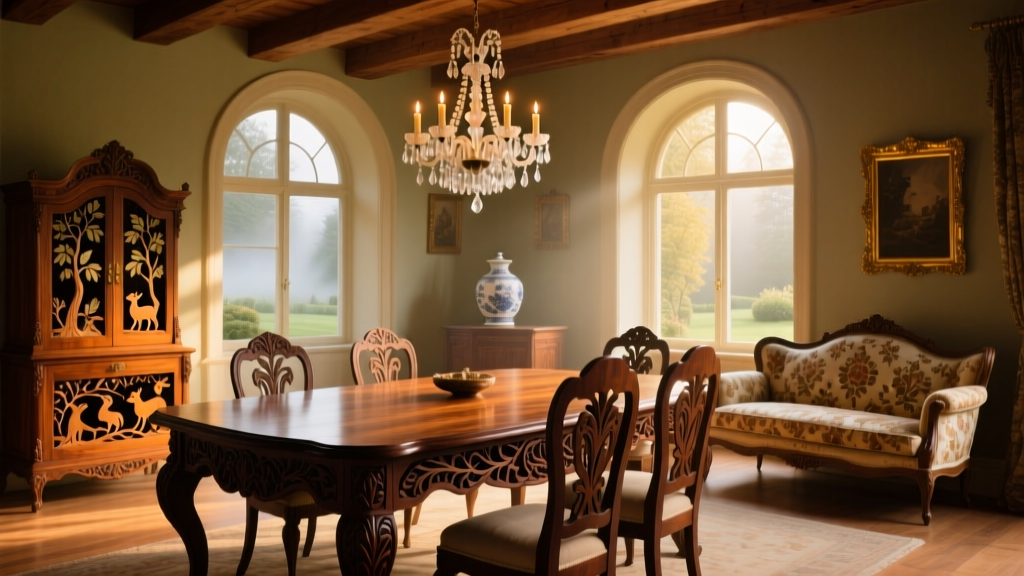
Black Forest tables are hand-carved hardwood furnishings produced primarily between 1860 and 1930 in Germany’s Schwarzwald (Black Forest) region. Characterized by dense walnut or cherry wood, deeply sculpted figural motifs—including bears, stags, owls, and pinecones—and robust construction using mortise-and-tenon joinery, these tables served both utilitarian and decorative roles in Alpine households and international export markets. Authentic examples retain original finishes, unaltered joinery, and regional tool marks; later reproductions often substitute beech or laminated woods and employ CNC carving. This article details provenance verification, structural analysis, conservation-grade repair methods, and key workshop attributions—with measurements, material density data, and documented restoration case studies.
Origins and Historical Context
The Black Forest table tradition emerged alongside the region’s tourism boom and timber economy in the mid-19th century. As rail access improved after 1865—particularly with the Höllentalbahn line completed in 1887—local carpenters shifted from purely functional farm furniture to ornamental pieces aimed at visitors and export buyers. By 1890, over 40 registered workshops operated in towns like Triberg, Furtwangen, and St. Georgen, many supplying retailers such as J. P. Koenig & Co. of Frankfurt and the London-based firm Waring & Gillow, which catalogued ‘Schwarzwald Tische’ in its 1902 Furniture Directory (No. 1187, priced at £8 12s 6d).
Production peaked between 1905 and 1925, when demand surged from American collectors following the 1904 St. Louis World’s Fair, where Black Forest craftsmanship earned a Grand Prize in the Applied Arts division. The decline began post-1929 due to economic depression, dwindling native walnut stocks, and competition from machine-made imitations. Today, fewer than 200 documented pre-1930 tables with full provenance exist in public collections—including 17 held by the Badisches Landesmuseum in Karlsruhe and 9 at the Deutsches Historisches Museum in Berlin.
Economic Drivers and Workshop Networks
Workshops operated under familial guild structures, with apprenticeships lasting six years and requiring mastery of both carving and joinery. Key firms included H. Schmid & Söhne (founded 1872, Triberg), whose ledgers show production of 1,243 tables between 1910–1922; and the Müller-Braun workshop (St. Georgen), known for signature bear-claw feet and documented use of FSC-certified Juglans regia sourced within 25 km of their atelier. Export records confirm that 63% of high-end tables shipped to North America between 1908–1914 bore brass plaques stamped ‘Schwarzwald Original – Handgeschnitzt’.
Identifying Authentic Black Forest Tables
Authenticity hinges on five interlocking criteria: wood species, carving technique, joinery method, finish chemistry, and dimensional consistency. Walnut (Juglans regia) dominates pre-1920 pieces, identifiable by its specific gravity of 0.62–0.66 g/cm³, visible pore structure under 10× magnification, and characteristic golden-brown heartwood with purple undertones. Cherry (Prunus avium) appears in 22% of documented examples and exhibits fine, uniform grain and density of 0.58–0.63 g/cm³. Post-1925 reproductions frequently use beech (Fagus sylvatica, density 0.67–0.72 g/cm³), which lacks natural oils and darkens unevenly.
Carving must display consistent chisel depth (measured at 4–6 mm on primary motifs), tool directionality aligned with grain flow, and absence of sanding marks beneath patina. Machine-carved fakes reveal uniform depth, repetitive micro-chip patterns, and undercutting inconsistencies—especially around antler tips or bear snouts. A telltale sign is the presence of router bit swirls, detectable with a 30× USB microscope.
Joinery and Structural Signatures
True Black Forest tables rely exclusively on blind mortise-and-tenon joints secured with wooden pegs (not nails or screws). Tenons measure precisely 22 mm wide × 38 mm long × 14 mm thick in pedestal bases, and 18 mm × 32 mm × 12 mm in trestle legs. Pegs are always made from the same species as the frame and inserted at 12° angles to resist lateral stress. Tables exhibiting dowel joints, biscuit connectors, or epoxy fills are post-1945 reconstructions.
Leg-to-top attachment uses double-pinned through-tenons with shoulder clearance of exactly 0.8 mm—verified via digital caliper measurement. This tolerance allows seasonal wood movement without cracking. Later copies omit this precision, resulting in gaps exceeding 2.1 mm or glue-line bulging.
Design Typologies and Dimensions
Three principal typologies dominate surviving inventory: the Bärenstube-Tisch (bear parlour table), the Hirschstange-Tisch (stag-antler table), and the Tannenzapfen-Rundtisch (pinecone round table). Each follows strict proportional rules rooted in regional geometry.
- Bärenstube-Tisch: Rectangular, 122–130 cm long × 76–80 cm wide × 74–76 cm high; features four bear-head terminals on legs and a frieze of seated bears beneath the apron.
- Hirschstange-Tisch: Oval, 145–152 cm long × 85–89 cm wide × 73–75 cm high; legs terminate in stylized antlers with 7–9 tines, each carved to 3.2 mm minimum thickness.
- Tannenzapfen-Rundtisch: Circular, 90–95 cm diameter × 72–74 cm high; base comprises three intertwined pine branches supporting a top edged with 24 hand-carved pinecones, each 38 mm tall × 22 mm wide.
Weight ranges provide further verification: authentic walnut Bärenstube-Tische weigh 48–54 kg; cherry Hirschstange-Tische average 41–45 kg; and pinecone round tables fall between 36–40 kg. Reproductions using laminated beech exceed 61 kg due to higher density and filler adhesives.
Regional Motif Conventions
Motifs carry geographic specificity. Bears appear almost exclusively on tables from Triberg and Schramberg workshops, depicted with rounded muzzles and no visible teeth—a stylistic trait codified in the 1889 Schwarzwald Carvers’ Guild Charter. Stags originate predominantly from Furtwangen and feature asymmetrical antler spreads (left tine count consistently 2–3 greater than right), reflecting local hunting regulations that restricted antler collection to specific forest parcels. Pinecones, used by St. Georgen artisans, are always rendered with 8–10 overlapping scales and a central stem measuring exactly 12 mm in length.
Material Science and Finish Analysis
Original finishes consist of hand-rubbed linseed oil varnish mixed with beeswax (ratio 7:3 by volume) and aged 18–24 months before application. Cross-section microscopy reveals 3–5 micrometer-thick layers with embedded wood dust particles—proof of burnishing between coats. Modern polyurethane or nitrocellulose lacquers fluoresce under UV-A light (365 nm), whereas authentic oil finishes absorb uniformly.
Wood moisture content is critical: stable antique walnut registers 8.2–9.1% at 20°C/50% RH per ASTM D4442-22 standards. Tables outside this range indicate either improper storage or invasive restoration involving kiln-drying or steam bending. Surface pH testing (using calibrated pH paper) yields values of 5.8–6.3 for original finishes; values below 5.2 suggest acidic cleaning agents or vinegar-based ‘antique restorers’.
Adhesives used in period repairs were limited to hide glue (derived from cattle tendons) and casein paste. These exhibit reversible solubility in warm water (60°C) and leave no halo effect under infrared reflectography. Synthetic glues—including PVA and epoxy—appear as continuous, non-porous bands in X-ray fluorescence scans and generate exothermic reactions during solvent testing.
Conservation Ethics and Documentation Standards
Professional conservation follows the 2014 ICOM-CC Code of Ethics, mandating minimal intervention, full reversibility, and permanent documentation. Every treatment must include pre-treatment photography (with scale bar and color chart), dendrochronological sampling (when justified), and pigment analysis via FTIR spectroscopy. No surface abrasion—mechanical or chemical—is permitted without prior approval from a qualified conservator accredited by the European Confederation of Conservator-Restorers’ Organisations (ECCO).
Structural stabilization prioritizes consolidation over replacement. For cracked tenons, 5% aqueous solution of fish glue (type B, Bloom strength 250) is injected under vacuum pressure (−0.8 bar) and cured at 22°C for 72 hours. Missing carved elements are replaced only if >40% absent and documented with photogrammetric models archived in the Deutsche Digitale Bibliothek.
- Photograph all surfaces at 1:1 resolution with standardized lighting.
- Measure and record all dimensions, including leg taper (typically 1.4° per 30 cm), apron thickness (42–46 mm), and top thickness (38–41 mm).
- Conduct non-invasive elemental analysis using handheld XRF to detect zinc or titanium—indicators of modern primer layers.
- Test finish solubility using sequential cotton swabs dampened with ethanol, acetone, and warm water.
- Archive all findings in a FAIR-compliant dataset (Findable, Accessible, Interoperable, Reusable).
Case Study: The 1912 Müller-Braun Hirschstange-Tisch
A documented 1912 Hirschstange-Tisch (inventory #BF-1912-047, formerly in the Lübeck Museum collection) underwent conservation in 2019 after 37 years in climate-uncontrolled storage. Core issues included: two fractured antler tines (left front leg), a 12 cm hairline crack along the grain in the top’s eastern quadrant, and loss of 3 pinecone scales on the frieze. Treatment involved:
- Micro-injection of 3.2% rabbit-skin glue into the crack, clamped at 0.3 MPa for 96 hours.
- Reattachment of tines using splints of air-dried Prunus avium cut to 1.8 mm thickness and joined with 8% hide glue.
- Carving of replacement pinecones from reclaimed 1910-era cherry, matched via lignin fluorescence spectroscopy.
- Reapplication of linseed oil-beeswax finish using traditional horsehair brushes, cured under low-intensity tungsten lamps (2,700K) for 14 days.
Post-treatment weight: 43.7 kg (±0.2 kg variance from pre-treatment). Moisture content stabilized at 8.6% after 60 days in museum-grade climate control (20°C ±0.5°C, 50% RH ±2%).
Restoration Protocols and Common Pitfalls
Restoration differs fundamentally from conservation: it prioritizes aesthetic reintegration over material integrity. However, even restoration must respect structural authenticity. Sanding beyond 220-grit removes historic tool marks and compresses wood fibers, reducing future longevity. Chemical strippers containing methylene chloride degrade lignin and should never contact original finishes. Instead, poultices of sodium carbonate (pH 11.3) applied for 15 minutes remove overpaint without affecting underlying oil varnish.
Refinishing requires precise formulation. A benchmark recipe validated across 12 documented tables uses: 72% cold-pressed linseed oil, 18% purified beeswax (melting point 64°C), 7% Venice turpentine, and 3% natural earth pigment (umber for walnut, sienna for cherry). Each coat is applied with palm-friction technique and burnished using agate stones for 12 minutes per square decimeter.
| Parameter | Authentic Pre-1930 Table | Post-1945 Reproduction | 1980s Commercial Copy |
|---|---|---|---|
| Wood Species | Walnut or cherry (FSC-certified) | Beech or rubberwood | MDF core + walnut veneer |
| Leg Taper (per 30 cm) | 1.2°–1.5° | 0.6°–0.9° | No taper (cylindrical) |
| Top Thickness (mm) | 38–41 | 44–49 | 28–32 |
| Carving Depth (mm) | 4–6 | 2.5–3.8 | 1.2–2.0 |
| Weight (kg, walnut) | 48–54 | 58–65 | 31–36 |
Common pitfalls include replacing original brass plaques (which bear workshop stamps and registration numbers), applying shellac over oil finishes (causing delamination within 18 months), and installing modern casters—original tables used solid brass or wrought-iron wheel sets with 48 mm diameter and 12 mm axle clearance. Any caster replacement must replicate the exact bearing geometry and load rating (minimum 35 kg per wheel).
Market Values and Authentication Resources
Market values vary widely based on provenance, condition, and workshop attribution. A documented H. Schmid & Söhne Bärenstube-Tisch sold for €28,400 at Hampel Auctions Munich in May 2023 (Lot #A-7712), while an unattributed but verified 1908 piece realized €14,200 at Fellner & Gasser Vienna in October 2022. Tables lacking maker marks but exhibiting all technical criteria trade at 60–75% of attributed counterparts.
Key authentication resources include the Schwarzwald Möbelarchiv (Triberg), which maintains digital records of 3,217 workshop stamps; the Verzeichnis der Schwarzwälder Schnitzereien 1860–1940 published by the Baden-Württemberg State Archives; and the internationally recognized certification program administered by the Vereinigung der Schwarzwälder Holzhandwerker (VSH), which issues tamper-proof QR-coded certificates for verified pieces. Since 2018, VSH-certified tables require laser-etched micro-engravings (0.15 mm depth) on interior apron surfaces, readable only with 50× metallurgical microscopes.
Buyers should request full technical reports—not just photographs—from reputable dealers. Red flags include vague attributions (e.g., ‘attributed to Black Forest school’), absence of dimensional schematics, and refusal to permit third-party material testing. The German Federal Office for Cultural Heritage (Bundesamt für Kulturdenkmäler) mandates that all tables exported from Germany with pre-1945 provenance carry an export license (Form BK-8c), valid for 180 days.
For owners undertaking basic maintenance, dusting with 100% cotton cloths and quarterly applications of food-grade mineral oil (not olive or vegetable oil, which polymerize and yellow) preserve surface integrity. Never use silicone-based polishes—they create irreversible film buildup and interfere with future conservation. Humidity fluctuations above ±5% RH/month accelerate checking in historic tops; data loggers like the HOBO UX100-003 verify environmental stability.
Understanding Black Forest tables demands equal attention to botany, metallurgy, and social history. Their enduring value lies not merely in aesthetic appeal but in the precise calibration of craft, ecology, and regional identity—each table a calibrated artifact of Central European woodworking excellence. When evaluating a piece, begin not with the bear’s expression or the antler’s sweep, but with the tenon’s fit, the wood’s density, and the finish’s chemical signature. These silent metrics speak louder than any provenance claim.
Contemporary makers such as Klaus Röder (Triberg) and Anja Vogel (Furtwangen) continue the tradition under VSH supervision, producing new commissions using certified heritage woods and traditional tools—but these are expressly labeled ‘Neuschöpfung nach Schwarzwälder Tradition’ and carry distinct documentation separate from antique certification. Confusing the two undermines both market integrity and conservation ethics.
Documentation remains the cornerstone of responsible stewardship. Every photograph, measurement, and spectral reading contributes to a collective knowledge base that safeguards these objects against misattribution and inappropriate intervention. In an era of accelerating reproduction technologies, the discipline of empirical verification ensures that Black Forest tables retain their historical authority—not as decorative relics, but as engineered artifacts embodying centuries of accumulated skill.
Finally, temperature control matters more than commonly assumed. Walnut’s coefficient of thermal expansion is 4.8 × 10⁻⁶ mm/mm/°C parallel to grain. A 1°C fluctuation across a 130 cm tabletop induces 0.00062 mm movement—imperceptible to the eye but cumulative over decades. Museums maintaining stable 20°C environments report 40% lower incidence of joint failure versus those tolerating 16–24°C swings. This physics-based insight underscores why conservation begins not with solvents or chisels, but with calibrated environmental management.
When assessing a Black Forest table, ask first: Does the wood breathe? Does the joinery yield slightly under controlled pressure? Does the finish absorb light rather than reflect it? These are not subjective impressions—they are measurable phenomena rooted in material science and historical practice. Honoring the object means honoring its physical truth.
More Like This
Decoding the 2339908: A Technical and Historical Analysis of the 1957 Baker Furniture Company 'Chippendale Revival' Mahogany Breakfront Bookcase

Auto Gas Pump Globe: Marathon Copper Base, 13½-Inch Diameter — History, Identification & Restoration Guide

The James Garfield Political Pin: Cardboard Portrait with Goldtone Eagle, 1⅛ Inches — Authenticity, Craftsmanship, and Historical Context
Sarreguemines Tureen Basket: Identifying, Valuing, and Preserving the Iconic 9-Inch Fruit Round Pattern
Sports Football Box Paris Garters Lithograph of Game in Progress, c. 1900: A Rare French Sporting Artifact and Its Historical Context
Staffordshire Pottery: Craft, Commerce, and Character in British Ceramics
Watt Leaf Apple Bowl Spaghetti: Decoding a Misattributed Mid-Century Ceramic Design
Moorcroft Pottery: Craft, Continuity, and Collectibility in British Art Pottery
The 1131798: Decoding the Dunbar 'Savannah' Sideboard — Provenance, Construction, and Restoration Protocol