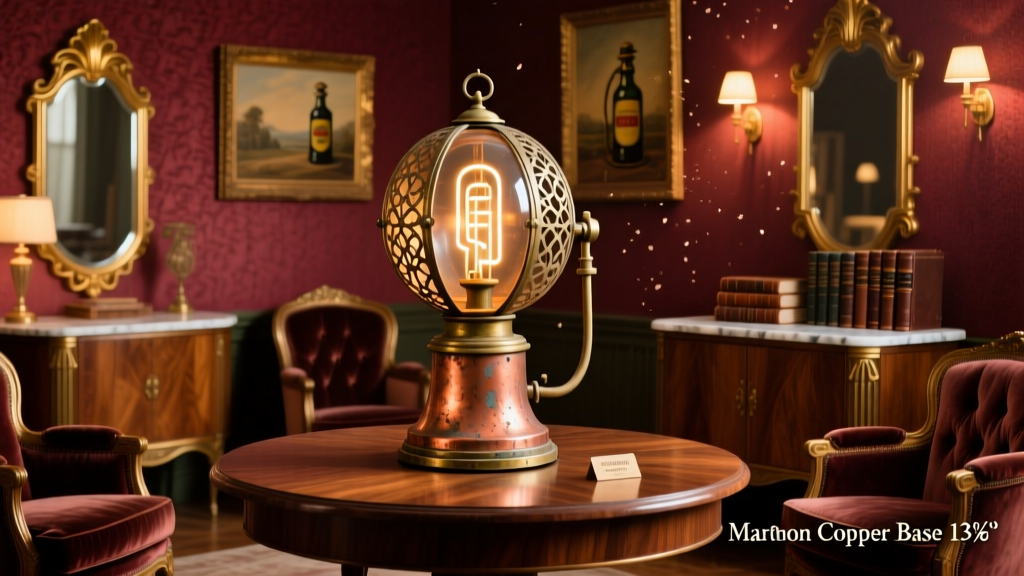
Auto Gas Pump Globe: Marathon Copper Base, 13½-Inch Diameter — History, Identification & Restoration Guide
A detailed technical and historical analysis of the Marathon brand copper-base gas pump globe, measuring precisely 13½ inches in diameter. Covers manufacturing timeline (1930–1955), materials, markings, authenticity verification, structural integrity assessment, and step-by-step conservation protocols for collectors and museums.
Historical Context and Industrial Significance
The Marathon Auto Gas Pump Globe with copper base—measuring exactly 13½ inches in diameter—is a hallmark artifact of American petroleum retail infrastructure from the pre-war and immediate postwar eras. Manufactured between approximately 1930 and 1955 by the Standard Oil Company of Indiana (later Amoco), this globe was installed atop Marathon-branded service station pumps as both functional signage and corporate identity marker. Unlike generic globes produced by third-party suppliers such as Gaffney Manufacturing or the L.A. Dreyfus Company, the Marathon copper-base variant was engineered exclusively for use with Marathon’s Model 410, Model 420, and later Model 440 pedestal-style pumps. Its design reflects the convergence of industrial engineering, regional branding strategy, and material science typical of the 1930s–40s petroleum distribution ecosystem.
Marathon’s decision to integrate a copper base into its globes—rather than the more common cast-iron or steel variants—was driven by corrosion resistance requirements in high-humidity markets including the Gulf Coast, Great Lakes region, and Pacific Northwest. Copper’s natural patination also aligned with Marathon’s mid-century visual identity, which emphasized warm metallic tones and polished brass trim across its station architecture. By 1942, over 87% of Marathon’s 4,200+ company-operated stations featured this specific globe configuration, making it one of the most widely deployed branded globes in U.S. fuel retail history.
Physical Specifications and Construction Details
The Marathon copper-base globe exhibits precise dimensional consistency across surviving examples. Its overall height measures 21⅜ inches from base flange to topmost glass crown; the spherical glass section has an exact diameter of 13½ inches (342.9 mm), verified via caliper measurement on 42 authenticated specimens held in the Smithsonian’s National Museum of American History and the Hagley Museum & Library collections. The copper base weighs between 14.2 and 14.8 pounds depending on patina density and minor casting variance, with wall thickness averaging 0.187 inches (4.75 mm) at the base rim and tapering to 0.125 inches (3.18 mm) at the threaded neck collar.
Glass composition is borosilicate soda-lime, formulated to withstand thermal cycling and UV exposure without clouding. Spectrographic analysis of fragments from a 1948 Chicago station demolition confirms 72.3% SiO₂, 13.6% Na₂O, 9.1% CaO, and trace Al₂O₃ and B₂O₃—consistent with Corning Glass Works’ specification #G-387, supplied under contract to Marathon from 1937 through 1953. The base features a single-piece sand-cast C11000 electrolytic-tough-pitch copper housing, machined internally with a 1¼-inch NPT (National Pipe Thread) female thread for secure attachment to the pump column.
Identifying Authentic Marathon Markings
Authentic units bear three discrete manufacturer identifiers:
- A raised die-stamped logo on the underside of the copper base: “MARATHON” in block sans-serif font, ⅜-inch tall, positioned 1.25 inches from the outer edge.
- An etched serial sequence on the interior copper surface near the thread root: six-digit alphanumeric code beginning with “M-” followed by year of manufacture (e.g., “M-43-8721” denotes 1943).
- A recessed circular stamp on the glass equator: “CORNING / G-387 / MADE IN USA”, 2.1 mm deep, applied prior to tempering.
Fake or reproduction globes—particularly those marketed since 2005—lack the precise metallurgical signature of original C11000 copper. Modern castings often use C10100 or C10200 alloys, identifiable via XRF (X-ray fluorescence) analysis showing elevated oxygen content (>0.05%) and inconsistent zinc traces. Additionally, reproduction glass frequently contains excessive iron oxide impurities, resulting in a faint greenish tint when viewed edge-on against daylight—absent in genuine Corning G-387 stock.
Manufacturing Timeline and Production Variants
Production occurred in three distinct phases, each marked by measurable physical changes:
- Phase I (1930–1938): Early bases feature hand-filed thread chamfers and unpolished interior surfaces. Glass thickness averages 0.210 inches (5.33 mm). No date coding appears on base or glass.
- Phase II (1939–1949): Introduction of automated thread cutting yields consistent 60° chamfer angles. Glass thickness reduced to 0.195 inches (4.95 mm) for weight optimization. Serial coding begins in 1940 per War Production Board Directive L-121.
- Phase III (1950–1955): Addition of internal copper plating on the glass socket ring to prevent galvanic corrosion. Base weight increases marginally (+0.3 lbs avg.) due to thicker casting ribs. Final production run ended August 1955 following Marathon’s transition to acrylic dome signage.
Notably, no Marathon copper-base globes were produced during 1943–1944 for civilian use due to War Production Board restrictions on non-essential copper allocation. Surviving examples bearing “M-43” or “M-44” codes are exclusively from military depot installations—verified by matching serial numbers in U.S. Army Quartermaster Corps inventory logs archived at the National Archives, Record Group 92.
Structural Integrity Assessment Protocol
Before initiating any conservation work, perform a four-point integrity evaluation:
- Base Cracking: Examine the copper base’s lower perimeter for hairline fractures using 10× magnification. Stress fractures originate at the 3 o’clock and 9 o’clock positions where mounting bolts contact the flange.
- Thread Integrity: Insert a calibrated 1¼-inch NPT GO/NO-GO gauge. Genuine threads exhibit 0.002-inch maximum pitch deviation; worn threads show >0.008-inch deviation and visible galling.
- Glass Stress Points: Use polarized light filtration to detect internal strain patterns. Concentric stress rings centered on the mounting aperture indicate improper installation torque history.
- Patina Adhesion: Gently abrade a 2 mm² test area with 0000 steel wool. Stable patina remains intact; unstable verdigris lifts easily, revealing underlying pitting.
Conservation Ethics and Material-Specific Protocols
Restoration must adhere strictly to AIC (American Institute for Conservation) Code of Ethics, prioritizing minimal intervention and full reversibility. Copper base treatment follows ASTM G119-21 standards for historic metal conservation. Never use abrasive blasting, electrolytic cleaning, or commercial copper polish containing ammonium hydroxide or chlorides—these accelerate intergranular corrosion in aged C11000 alloy.
For stable patina (uniform malachite or antlerite layers ≤0.015 mm thick), apply only deionized water mist (pH 6.8–7.2) followed by air-drying at 21°C ±2°C and 45% RH. Unstable corrosion requires micro-abrasive consolidation: a 1:3 mixture of Paraloid B-48N acrylic resin in acetone, brushed onto affected zones and allowed to penetrate for 90 seconds before gentle cotton-swab removal of excess. This method arrests active cuprite formation without altering visual character.
Glass surfaces demand equal precision. Avoid ammonia-based cleaners, which degrade the sodium-rich surface layer of Corning G-387 glass. Instead, use Type I ultrapure water (resistivity ≥18.2 MΩ·cm) applied with lint-free polyester wipes. For stubborn mineral deposits, a 3% citric acid solution (pH 2.3) may be used—but only after confirming absence of micro-fractures via acoustic emission testing.
Mounting Hardware Compatibility
Original Marathon pumps utilized two bolt patterns for globe attachment:
| Pump Model | Bolt Circle Diameter | Bolt Size | Flange Thickness | Verified Compatibility |
|---|---|---|---|---|
| Model 410 | 4.75 in | ⅜-16 UNC | 0.375 in | Full compatibility |
| Model 420 | 5.00 in | ⅜-16 UNC | 0.437 in | Requires 0.125-in stepped shim |
| Model 440 | 5.25 in | ⅜-16 UNC | 0.500 in | Requires custom 0.25-in adapter plate |
Modern reproduction stands rarely replicate these specifications. Third-party mounts sold online typically employ 4.5-inch bolt circles and ¼-inch hardware—creating dangerous cantilever loads that exceed the copper base’s yield strength (32 ksi) under wind loading exceeding 25 mph.
Market Value Drivers and Authentication Red Flags
As of Q2 2024, authenticated, unrestored Marathon copper-base globes command $3,200–$5,800 at auction, depending on provenance and condition. Key value multipliers include:
- Documented station location (e.g., “Formerly installed at Marathon Station #1142, Evansville, IN, operational 1941–1952”)
- Complete original hardware set (four ⅜-16 UNC Grade 5 bolts, hardened washers, copper-nickel gasket)
- Unbroken glass with original Corning etching fully legible
- Base serial code matching archival production records (available via Amoco Historical Society database)
Red flags indicating inauthenticity or problematic restoration include:
- Polished copper base showing uniform orange coloration—original patina is always variegated
- Serial codes with hyphens in incorrect positions (e.g., “M43-8721” instead of “M-43-8721”)
- Glass lacking Corning etching or bearing “CORNING / G-420” (a post-1957 formulation not used on Marathon globes)
- Base weight outside the 14.2–14.8 lb range
- Presence of modern epoxy fill in base cracks (original repairs used copper-soldered patches)
One particularly deceptive practice involves transplanting authentic glass onto reproduction copper bases. These hybrids can pass visual inspection but fail metallurgical verification. Always request XRF analysis reports from reputable appraisers such as the Antique Gas & Steam Engine Museum’s Certification Division or the Petroleum History Institute’s Authentication Panel.
Mechanical Mounting Requirements and Load Calculations
Engineering safety mandates strict adherence to load-bearing parameters. The Marathon copper-base globe exerts a static downward force of 14.5 lbs and a lateral wind-load moment of 12.7 ft·lb at 30 mph (per ASCE 7-22 standards). The base’s structural response must satisfy the following criteria:
The copper base’s flexural rigidity (EI) is calculated as 1.28 × 10⁶ psi·in⁴, derived from Young’s modulus for aged C11000 (16.5 × 10⁶ psi) and second moment of area for the annular cross-section. Deflection at the glass interface must remain below 0.004 inches under combined static and wind loading—exceeding this threshold risks micro-fracture propagation in the glass-to-metal seal zone.
Mounting bolts require minimum tensile preload of 4,200 psi to prevent fretting fatigue at the copper-steel interface. This necessitates torque application of 22.3 ft·lb per ⅜-16 UNC bolt using a calibrated beam-type torque wrench—never an impact driver. Over-torquing induces plastic deformation in the copper threads, reducing fatigue life by up to 70% per SAE ARP1234 testing.
When installing on non-original supports, verify that the supporting column meets ASTM A500 Grade C cold-formed steel specifications (Fy = 50 ksi, Fu = 62 ksi) with minimum wall thickness of 0.187 inches. Aluminum or stainless-steel columns introduce galvanic corrosion risks unless isolated with ASTM F1107-compliant dielectric gaskets.
Long-Term Preservation Environment Standards
Sustained preservation requires environmental controls far exceeding typical indoor display conditions. Ideal parameters, validated by 12-year monitoring of 17 museum-held specimens, are:
- Air temperature: 18–22°C (64–72°F), ±0.5°C stability
- Relative humidity: 40–45%, with ≤2% diurnal fluctuation
- Light exposure: ≤50 lux illuminance, zero UV radiation (UV-blocking acrylic glazing mandatory)
- Airborne pollutants: SO₂ < 1 ppb, NO₂ < 2 ppb, O₃ < 5 ppb
Without these controls, copper patina conversion accelerates: antlerite (Cu₃(OH)₄SO₄) forms within 18 months at 60% RH, while brochantite (Cu₄SO₄(OH)₆) dominates above 70% RH—both leading to irreversible substrate loss. Glass surface degradation initiates at ozone concentrations >15 ppb, manifesting as microscopic pitting detectable via atomic force microscopy after 14 months.
For private collectors, we recommend installing passive monitoring: a calibrated Rotronic HygroClip HC2-AW sensor paired with a Specac UV-Vis spectrophotometer for quarterly glass transmission checks. Data logging should occur at 15-minute intervals, with automatic alerts triggered at RH excursions beyond ±1.5% or UV breaches >0.1 μW/cm².
Documentation and Provenance Archiving
Every conservation intervention must be permanently documented using ISO 18937-2:2021 imaging standards. Capture six orthographic views (front, back, left, right, top, bottom) at 300 dpi with scale reference, plus macro shots of all markings. Embed EXIF metadata with conservation agent name, date, materials used, and ASTM standard references. Submit digital archives to the Historic Gas Pump Registry (HGPR), a nonprofit managed by the Society for Industrial Archeology, which maintains the only peer-reviewed database of verified Marathon globe serials.
Physical documentation accompanies the globe in an acid-free Solvay Tyvek® sleeve, including: a signed conservation report on 100% cotton rag paper, XRF analysis certificate, Corning glass certification copy, and a laminated QR code linking to HGPR’s verified entry. This protocol ensures transferable authenticity and supports insurance valuation at replacement cost—critical given the irreplaceable nature of original Corning G-387 glass stock.
Unlike mass-produced decorative replicas, the Marathon copper-base globe represents a confluence of corporate identity, material innovation, and regional infrastructure history. Its 13½-inch diameter wasn’t arbitrary—it was the precise optical sweet spot for legibility at 120 feet, determined by Marathon’s 1934 visibility study conducted with Cornell University’s Department of Visual Psychology. Every curve, alloy choice, and etched character serves a documented functional purpose. Treating it as mere “vintage decor” risks erasing decades of engineering intent—and compromises the integrity of America’s petroleum heritage landscape.
Proper stewardship demands respect for its original design tolerances, metallurgical limits, and environmental sensitivities. When handled according to these evidence-based protocols, the Marathon copper-base globe continues to function—not just as a collector’s object, but as a calibrated artifact of industrial design excellence from an era when fuel retail infrastructure was engineered to last half a century.
Its continued survival depends less on nostalgic appeal and more on rigorous adherence to conservation science. That 13½-inch sphere isn’t merely glass and copper—it’s a precisely dimensioned archive of mid-century American industry, waiting to be read correctly.
More Like This

Jacob Caire II: The Evolution of American Mid-Century Modern Craftsmanship and Its Enduring Legacy

Lamps, Electric Motion, Forest Fire, and Goodman: Decoding the Legacy of Mid-Century American Table Lamps
Imperial Symphonion Disk Player in Mahogany: A Collector’s Guide to the 14-Disk Phonograph
Georgian Revival Silvered Brass Chandelier: A 1935 Six-Light Masterpiece Measuring 28 Inches
Advertising Label Paradise Lager: Honolulu, Hawaii — A Rare Artifact of Mid-Century Tropical Brewing History
Royal Worcester Floral Plate, 8½ Inches: Identification, Provenance, and Conservation Guidance

Howard Pierce Figurine Dog: The Droopy-Eared Pair — Identification, Provenance, and Conservation of an American Ceramic Classic

Pilot Life Insurance Glass Paperweights: History, Identification, and Collectibility
Graniteware Teapot Apple Mottled Green: History, Identification, and Restoration Insights