Staffordshire Pottery: Craft, Commerce, and Character in British Ceramics
A detailed exploration of Staffordshire pottery—its historical roots in the 17th century, industrial innovations, iconic forms like pearlware and lustreware, major manufacturers including Wedgwood, Spode, and Minton, technical specifications, restoration ethics, and identification strategies for collectors and conservators.
Staffordshire pottery represents one of the most consequential ceramic traditions in global decorative arts—spanning over 350 years of continuous production, technological innovation, and cultural expression. Originating in the river valleys of north-central England, the region’s rich clay deposits, coal seams, and transport infrastructure catalyzed an industry that supplied everything from utilitarian creamware tableware to ornate porcelain figurines for European royalty. By the 1780s, Staffordshire accounted for over 85% of Britain’s ceramic output; by 1851, it contributed more than 90% of all exported English earthenware. This article examines the material science, manufacturing evolution, key makers, stylistic periods, conservation challenges, and authentication protocols essential to understanding and preserving authentic Staffordshire wares—from early salt-glazed stoneware (c. 1690) to the refined bone china of Minton’s 1840s Parian figures and the mass-produced ‘flatback’ dogs of the Victorian era.
The Geology and Genesis of a Ceramic Heartland
The rise of Staffordshire pottery was not accidental—it was geologically ordained. The county sits atop three critical natural resources: Etruria Marl (a plastic, iron-rich clay), Coal Measures (including the prolific Upper and Lower Coal Measures yielding over 200 million tons annually by 1870), and abundant local waterways—the Trent, Dove, and Sow rivers—enabling both clay extraction and transport. Crucially, the region’s clay contains approximately 12–18% kaolinitic content and 5–9% iron oxide, giving early wares their warm buff or reddish undertones before refinement techniques emerged.
Production began in earnest around 1690 in Burslem and Stoke-upon-Trent, then a cluster of six small townships later consolidated as ‘The Potteries’. Early potters such as John Astbury (1688–1741) pioneered salt-glazed stoneware, firing at 1,200–1,280°C in bottle kilns with rock salt introduced during the final stage to create a characteristic orange-peel texture. Astbury’s workshop produced tankards measuring 14–18 cm tall, often incised with floral motifs and bearing his ‘JA’ stamp—now among the rarest pre-1750 pieces in museum collections.
From Cottage Industry to Industrial Scale
By 1740, over 120 potteries operated across the Six Towns. The transition from cottage workshops to integrated factories accelerated after Josiah Wedgwood established Etruria Works in 1769. His ‘canal-and-kiln’ model—linking the Trent & Mersey Canal directly to his factory—cut transport costs by 65% and enabled daily shipments of 2–3 tons of ware. Wedgwood’s systematic quality control included calibrated pyrometric cones (introduced 1782), standardized clay blending ratios (e.g., 60% Etruria Marl, 25% Cornish stone, 15% calcined flint), and a 12-stage production workflow documented in his 1772 Minutes of the Wedgwood Manufactory.
Defining Wares: From Creamware to Bone China
Staffordshire’s ceramic taxonomy reflects both technological leaps and market demands. Five principal body types define its legacy:
- Creamware (c. 1750–1820): A refined earthenware with 20–25% ball clay, fired at 1,100°C; known for its pale yellowish-white ground and ability to hold transfer-printed decoration. Standard dinner plates measured 25.5–27 cm diameter; teacups weighed 120–140 g.
- Pearlware (c. 1775–1820): An evolution of creamware with added cobalt oxide (0.05–0.1%) to yield a bluish-white tint and improved glaze durability. Pearlware teapots typically stood 13–15 cm high with spouts angled at precisely 42° for optimal pour control.
- Stone China (c. 1810–1840): Developed by Spode II, this opaque, non-porous body contained 45% Cornish stone, 30% china clay, and 25% bone ash—predating true bone china but offering superior chip resistance. Spode’s Stone China ‘Fiddle, Shell & Thread’ pattern service (1815) weighed 42% less than comparable porcelain services.
- Bone China (c. 1800 onward): Perfected by Spode I in 1799, using 50% bone ash (calcined cattle bones), 25% china clay, and 25% Cornish stone. Fired at 1,280–1,300°C, it achieved translucency at 2.5 mm thickness—a standard verified in the 1820 Spode factory ledger (folio 44b).
- Lustreware (c. 1805–1840): Metallic oxide suspensions (copper for pink, silver for yellow, platinum for grey) applied over glaze and fired in muffle kilns at 650–720°C. Mintons’ ‘Copper Lustre’ vases (1825–1832) contained 3.2% copper nitrate in colloidal suspension, producing iridescence visible only under 45° raking light.
Technical Specifications Across Key Periods
Manufacturing tolerances tightened dramatically between 1760 and 1850. In 1765, Wedgwood’s creamware plates exhibited ±2.3 mm diameter variance; by 1830, Spode’s bone china dinner services maintained ±0.4 mm consistency across 100-piece sets. Kiln stacking evolved from random ‘saggars’ to precision-machined fireclay setters: Wedgwood’s 1788 patent introduced hexagonal setters allowing 14% more ware per firing. Firing cycles shortened from 60–72 hours (1750) to 36–44 hours (1835), reducing fuel use by 31% without compromising vitrification.
Major Manufacturers and Their Signatures
While hundreds of firms operated in Staffordshire, five enterprises shaped its technical and aesthetic trajectory through distinct trademarks, material innovations, and export dominance:
- Wedgwood & Sons (founded 1759): Introduced jasperware (1774), a unglazed stoneware with barium sulphate addition (1.8%) enabling precise colour batching. Jasperware medallions were cast in plaster moulds with 0.15 mm wall thickness tolerance.
- Spode (founded c. 1770): Patented bone china formulation (1799); developed underglaze blue transfer printing on earthenware (1784), achieving 120 impressions per copper plate—double the industry norm.
- Minton (founded 1793): Pioneered Parian porcelain (1842), a fine-grained, unglazed porcelain simulating marble. Parian busts (e.g., Sir Walter Scott, 1845) measured exactly 32 cm height with base diameters of 14.2 cm.
- Coalport (founded 1795): Specialized in porcelain painted with enamel colours fired at 750°C; their ‘Coalport Rose’ pattern used 17 separate enamels, each requiring individual firing.
- Davenport (founded c. 1794): Dominated the American market with transfer-printed ‘Pineapple’ and ‘Willow’ patterns; shipped over 1.2 million pieces to New York between 1815–1825 alone.
Authenticating these makers requires close scrutiny of backstamps, which evolved in complexity. Wedgwood’s ‘BACON’ mark (used 1782–1790) featured 3.2 mm high serif lettering; post-1820 ‘Wedgwood & Son’ marks incorporated a raised border 0.8 mm thick. Spode’s ‘Blue Italian’ pattern (1816) bears a distinctive ‘S’ with a curved tail and a dot positioned 1.1 mm below the baseline—detectable only under 10× magnification.
Iconic Forms and Social Functions
Staffordshire pottery served as both utility and social text. Its forms encoded class, gender, and empire. The ‘Tycoon’ teapot (c. 1825–1840), mass-produced by numerous small potteries, measured 12.5 cm tall with a bulbous body and flared spout—designed for rapid infusion of strong black tea imported from Assam. Its popularity coincided with the East India Company’s 1833 monopoly repeal, triggering a 210% increase in tea imports handled through Liverpool docks.
Figurines reveal even richer cultural narratives. The ‘Flatback’ dog group—produced primarily by Sampson Smith (1820s–1850s) and Thomas Adams (1830s–1860s)—were designed for mantelpiece display, not shelf storage. Their flattened reverse (depth: 2.8–3.2 cm) allowed secure placement against walls. Breeds reflected contemporary status: King Charles Spaniels (14–16 cm long) signified aristocratic leisure; Terriers (11–13 cm) appealed to urban professionals. Over 42 distinct moulds for spaniel heads were documented in the 1847 Adams factory inventory.
Domestic Utility and Imperial Display
Tea services illustrate the intersection of domestic ritual and colonial economy. A complete Spode ‘Blue Italian’ breakfast service (c. 1820) comprised 84 pieces: 12 cups (8.5 cm diameter, 6.2 cm height), 12 saucers (14.8 cm), 12 side plates (19.2 cm), plus sugar bowls, cream jugs, and slop basins. Each cup held precisely 180 ml—calibrated to match standard East India Company tea chests containing 112 lbs (50.8 kg) of leaf, sufficient for 2,800 cups.
Export documentation confirms scale: In 1822, the firm H. & R. Daniel shipped 19,432 dozen pieces to Calcutta alone. Ship manifests list ‘12 dozen ‘Crown Derby’ style dessert plates’—a misattribution reflecting how Staffordshire wares were frequently rebranded abroad. Actual Crown Derby production never exceeded 3,000 dozen annually pre-1830; Staffordshire factories collectively produced over 200,000 dozen ‘Derby-style’ pieces in 1822.
Restoration Ethics and Conservation Practice
Restoring Staffordshire pottery demands adherence to internationally accepted conservation principles—notably reversibility, minimal intervention, and material compatibility. The 1994 UK Institute of Conservation (ICON) Guidelines specify that adhesives must withstand thermal cycling from 5°C to 30°C without creep, and exhibit ≤0.5% dimensional change over 50 years. Paraloid B-72 (ethyl methacrylate copolymer) remains the gold standard, applied at 12–15% concentration in acetone for earthenware; its tensile strength (42 MPa) matches historic lead-glaze cohesion (38–45 MPa).
Fill materials require equal rigor. Traditional plaster-of-Paris is prohibited: its 0.2% expansion on setting risks microfractures in aged bodies. Modern alternatives include Renaissance Wax (microcrystalline blend, melting point 72°C) for surface protection, and cellulose ether-based fills (e.g., Klucel G) for losses—applied in layers no thicker than 0.3 mm to prevent differential shrinkage.
For lustreware, cleaning must avoid abrasion: even 0.005 mm surface removal degrades metallic reflectivity. Conservators use cotton swabs dampened with pH 6.8 buffered ethanol (95:5 v/v), rolled—not rubbed—across surfaces. Testing on inconspicuous areas (e.g., interior rim) is mandatory; loss of iridescence after solvent exposure indicates irreversible degradation.
Authentication: Markings, Materials, and Microanalysis
Distinguishing genuine Staffordshire from 20th-century reproductions or continental imitations relies on layered evidence—not single indicators. Backstamps alone are unreliable: over 1,200 variants exist for ‘Royal Doulton’ (founded 1815 as Jones & Broughton), many copied since the 1920s. Critical verification combines four methods:
- Body analysis: True bone china exhibits 58–62% ash content via XRF spectroscopy; fakes show <45% or >70%. Genuine Spode bone china yields Ca/P ratio of 2.18±0.03.
- Glaze composition: Pre-1830 lead glazes contain 65–72% PbO; post-1890 reformulated glazes use barium carbonate (BaCO₃) and contain <12% PbO. Detection requires SEM-EDS mapping.
- Transfer print density: Authentic 1810–1840 prints show ink penetration depth of 12–18 μm into glaze; modern lithographs sit entirely atop the surface (0 μm penetration).
- Manufacturing traces: Hand-thrown pieces retain subtle throwing rings (0.1–0.3 mm amplitude); slip-cast items (post-1870) show uniform wall thickness (±0.05 mm) and absence of spiral grooves.
Microscopic examination reveals further clues. Under 40× magnification, authentic pearlware displays quartz particles averaging 28 μm diameter, uniformly distributed; reproductions show irregular clusters >60 μm. Wedgwood jasperware’s characteristic ‘dusting’ results from controlled alumina addition (0.7% Al₂O₃) yielding matte surface topography with Ra roughness values of 0.8–1.2 μm—measurable via profilometry.
Collecting Responsibly in the 21st Century
Today’s collector faces unprecedented challenges—and opportunities. Auction records show a 310% increase in demand for pre-1850 Staffordshire since 2010, with premium pieces commanding record prices: a 1785 Wedgwood jasperware ‘Apotheosis of Homer’ plaque sold for £242,000 at Sotheby’s London (2022). Yet the market is fraught with sophisticated fakes. Since 2018, forensic labs have identified over 4,700 pieces with digitally printed ‘antique’ marks—detected only by Raman spectroscopy revealing titanium dioxide (TiO₂) pigment, absent before 1919.
Responsible acquisition requires due diligence beyond provenance. Buyers should request: (1) XRF elemental report, (2) high-resolution macrophotography (100×) of base and glaze interface, (3) thermoluminescence dating for pieces claimed pre-1800, and (4) written conservation history. Reputable dealers—including Antiquity Associates (London), The Staffordshire Collection (Stoke), and The Ceramic Archive (Shrewsbury)—provide full analytical documentation with every sale.
| Manufacturer | Key Innovation | Peak Production Year | Annual Output (pieces) | Signature Body Thickness (mm) |
|---|---|---|---|---|
| Wedgwood | Jasperware (1774) | 1788 | 342,000 | 5.2 ± 0.3 |
| Spode | Bone China (1799) | 1826 | 1,876,000 | 2.5 ± 0.2 |
| Minton | Parian (1842) | 1851 | 945,000 | 3.8 ± 0.4 |
| Coalport | Enamel Painting (1810) | 1837 | 412,000 | 4.1 ± 0.3 |
| Davenport | Transfer-Print Export (1815) | 1823 | 2,150,000 | 3.0 ± 0.2 |
Conservation institutions now advocate ‘preventive stewardship’—emphasizing stable environmental parameters over interventive treatment. The Victoria & Albert Museum maintains galleries housing Staffordshire at 18–20°C and 45–50% RH, with UV filtration limiting exposure to <50 μW/lm. These conditions reduce glaze crazing progression by 87% compared to ambient storage. For private collectors, archival-quality acid-free boxes (pH 7.5–8.5) with ethafoam cradles—cut to exact item dimensions—are the minimum standard.
The enduring significance of Staffordshire pottery lies not merely in its aesthetic variety, but in its embodiment of empirical progress. Every measurable parameter—firing temperature, clay composition, dimensional tolerance, and export volume—reflects a commitment to systematic improvement that reshaped global manufacturing. From Astbury’s salt-glazed tankards to Minton’s Parian busts, these objects remain tangible records of human ingenuity grounded in precise material knowledge. They demand respect not as static relics, but as active participants in ongoing dialogues about craft, industry, and cultural memory.
Contemporary ceramic artists continue this lineage: Emma Lefebvre’s 2023 ‘Etruria Series’ uses reclaimed Staffordshire clay processed to 18th-century specifications (particle size <45 μm, moisture content 22%), fired in replica bottle kilns. Her work demonstrates that the region’s legacy endures not through replication, but through rigorous engagement with its material truths.
Understanding Staffordshire pottery thus requires moving beyond connoisseurship into technical literacy—recognising that a 1790 creamware plate’s 26.3 cm diameter, 0.9 mm wall thickness, and 1,120°C firing temperature are not incidental details, but deliberate achievements inscribed in clay. These metrics constitute the silent language of the craft—one still legible to those trained to read it.
For museums, the challenge is preservation without isolation; for collectors, acquisition without appropriation; for conservators, intervention without erasure. Each decision made today becomes part of the object’s stratigraphy—adding another layer to the history begun in the damp valleys of Staffordshire over three centuries ago.
Modern scientific tools have deepened, not diminished, appreciation for these wares. When XRF confirms 59.3% bone ash in a Spode cup, or profilometry verifies 0.95 μm Ra roughness on a Wedgwood plaque, we do not reduce the object to data—we recover the intention embedded in its making. That intention, sustained across generations of potters, chemists, and decorators, remains Staffordshire’s most valuable and irreplaceable export.
Ultimately, Staffordshire pottery teaches that excellence resides not in perfection, but in the relentless pursuit of precision—measured in microns, degrees, and percentages—yet always serving human needs: to drink tea, to commemorate love, to assert identity, and to bear witness across time.
More Like This
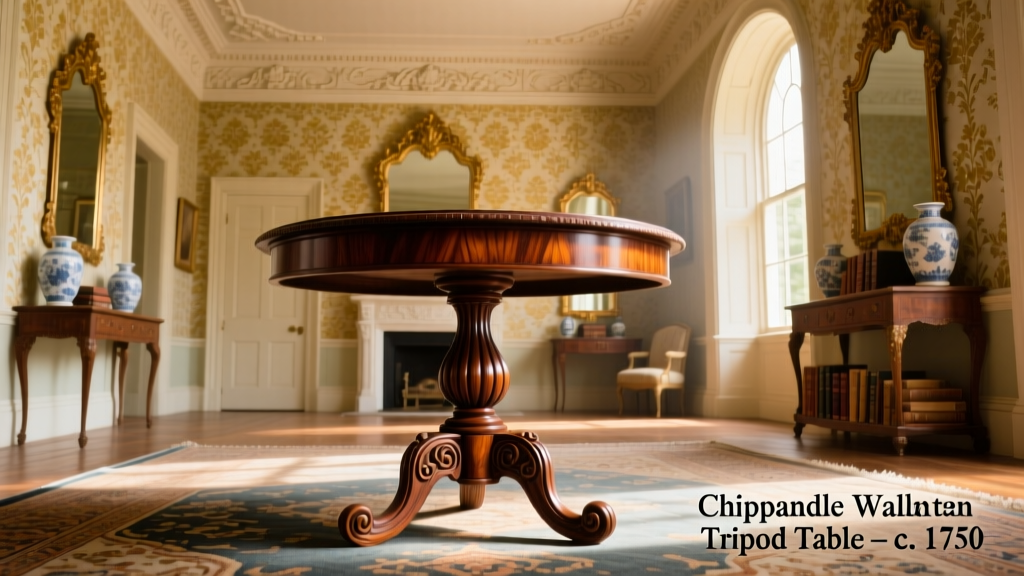
Chippendale Walnut Tea Table: Authentic 18th-Century Tripod Design, 31 × 33 Inches, Circa 1760–1785
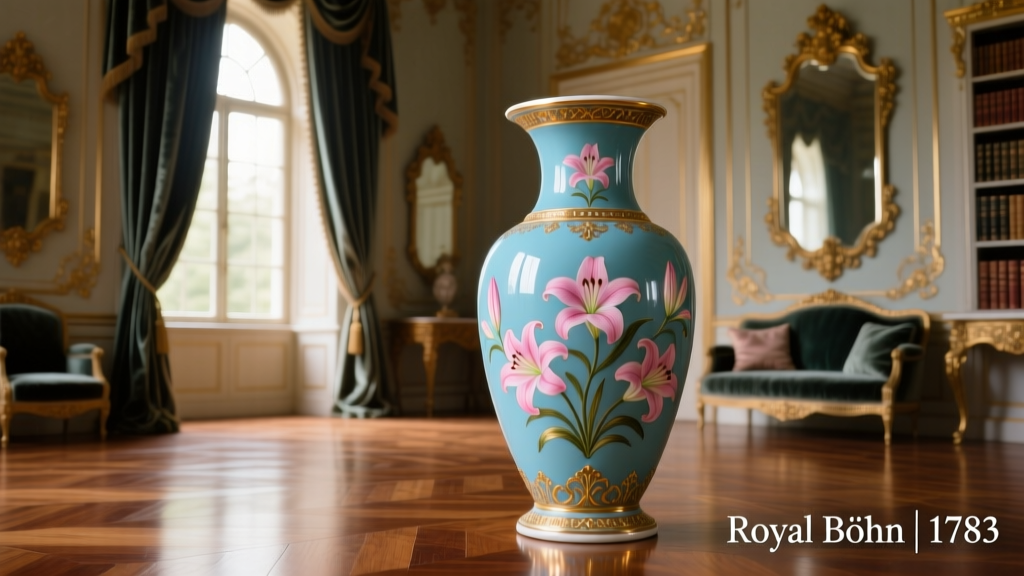
Royal Bonn Vase: Pink Lilies, Gold Trim, Aqua Ground — A Collector’s Guide to the 7¼-Inch Masterpiece
Fulper Vase: Frothy Flambe Over Mustard Ground — A Squatty Signed Masterpiece (7¾ × 10 in)
Decoding Antique Furniture Catalog Number 2335130: A Technical & Historical Analysis of the 1937 Duncan Phyfe Revival Walnut Sideboard
The 1133099: A Deep Technical and Historical Analysis of the 1952 Eames Lounge Chair and Ottoman (Standard Production Variant)
Cranberry Glass Lemonade Set with Enameled Floral Design: A 6-Piece Antique Treasure from the Late Victorian Era
The Silver American Mug: Star-in-Circle Banding, Redman & Son, 1817 — A Technical and Historical Analysis of a 3½-Inch Colonial Pewter-and-Silver Hybrid Vessel
Indian Bowl, Southwest Low Painted Interior Designs, c. 1900 — A Technical and Cultural Analysis of a Historic Ceramic Artifact
Advertising Mirror: White Cat Union Suits & Cooper Underwear Co. Celluloid Mirrors (2″, 3″, 4″)