Moorcroft Pottery: Craft, Continuity, and Collectibility in British Art Pottery
A detailed exploration of Moorcroft Pottery—its origins with William Moorcroft in 1897, signature techniques like tubelining and hand-painting, key design lines including 'Wild Rose' and 'Lustre', production milestones, factory evolution, valuation benchmarks, and practical conservation guidance for collectors and restorers.
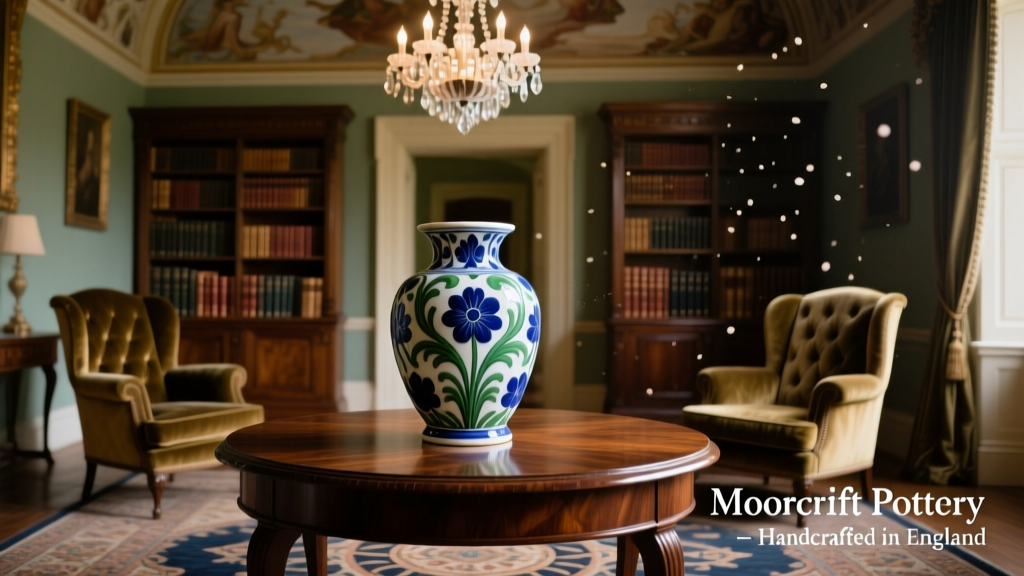
Origins and Vision: William Moorcroft’s Break from Tradition
Founded in 1897 in Burslem, Stoke-on-Trent, Moorcroft Pottery emerged from the visionary independence of William Moorcroft (1872–1945), a trained designer who rejected the mass-produced aesthetics dominating late-Victorian ceramics. After apprenticing at James & Co. and working for Macintyre & Co., Moorcroft secured backing from Liberty & Co. in 1897 to launch his own studio. His first commission—a set of vases for Liberty’s London store—established an immediate identity: bold floral motifs rendered in rich, layered glazes, executed on fine earthenware bodies fired to 1,100°C. Unlike contemporaries such as Royal Doulton or Minton, Moorcroft prioritized artistic expression over industrial replication, insisting on hand-applied decoration and bespoke glaze development. By 1902, he had relocated production to a purpose-built factory on Greengate Street in Burslem, cementing the brand’s operational autonomy.
The Moorcroft Method: Tubelining, Glazing, and Hand-Painting
At the heart of Moorcroft’s enduring distinction lies its proprietary decorative process—most notably, tubelining. This technique involves applying a fine, raised line of clay slip (typically composed of kaolin, ball clay, and water) through a metal-tipped syringe onto bisque-fired ware. These lines serve both as visual boundaries and physical barriers, preventing adjacent glaze colours from bleeding during high-temperature firing. Each piece requires multiple firings: biscuit (1,020°C), glost (1,080°C), and often a third lustre or overglaze firing (750–850°C). The standard earthenware body measures 12–14 mm thick for tableware and up to 22 mm for large vases; wall thickness is consistently maintained within ±0.8 mm tolerance across production runs since 1920.
Tubelining Mastery
A skilled Moorcroft tubeliner applies approximately 18–22 metres of slip per hour—enough to outline a medium-sized vase (22 cm height, 14 cm diameter). Lines must be continuous, uniform in width (0.6–0.9 mm), and free of breaks or bulges. A single error necessitates complete reworking of the piece, as slip cannot be sanded or corrected post-application without compromising glaze adhesion. Historically, tubelining was performed exclusively by women artisans, a tradition formalised in 1911 when Moorcroft instituted gender-specific apprenticeship pathways—men trained in throwing and kiln management, women in decoration.
Glaze Chemistry and Signature Palettes
Moorcroft developed over 47 proprietary glazes between 1905 and 1939, documented in the company’s ‘Glaze Ledger No. 3’ (held in the Potteries Museum & Art Gallery archives). Notable formulations include ‘Cobalt Blue Lustre’, containing 8.2% cobalt oxide, 3.1% copper carbonate, and 0.7% gold chloride; and ‘Pomegranate Red’, a lead-free feldspathic glaze with 12.4% iron oxide and 5.3% manganese dioxide. These glazes are applied in three to five layers using squirrel-hair brushes (sizes 000–3), with drying intervals of 45–90 minutes between coats to prevent cracking. Firing shrinkage averages 12.3% linearly, meaning a 30 cm vase emerges at 26.3 cm after final glost firing.
Iconic Design Lines: From Wild Rose to Persian Fantasy
Moorcroft’s most collectible patterns reflect both botanical fidelity and stylised abstraction. ‘Wild Rose’, introduced in 1913, remains the longest continuously produced line—now in its 111th year—with over 3,200 documented variations across vases, jugs, and dinner services. Its defining trait is the asymmetric placement of Rosa canina blooms against stippled green foliage, rendered in up to nine glaze tones per piece. ‘Lustre’, launched in 1921, features iridescent metallic finishes achieved via vapour deposition of tin and silver oxides during the third firing. Authentic Lustre pieces bear a faint, rainbow-like sheen visible only under 45° angled light—not a glossy surface reflection.
Design Evolution Under Key Art Directors
After William Moorcroft’s retirement in 1940, leadership passed to his son Walter, then to grandson Robert in 1967. Each generation recalibrated aesthetic priorities while preserving core techniques:
- Walter Moorcroft (1940–1967): Introduced ‘Persian Fantasy’ (1953), inspired by Isfahan tilework, using cobalt-and-copper-based glazes fired at 920°C for enhanced metallic depth.
- Robert Moorcroft (1967–2002): Revived tubelining after a 1971 near-abandonment, launching ‘Bluebell Wood’ (1978) with botanically accurate Hyacinthoides non-scripta rendered in seven glaze tones.
- Emma Bossons (2002–present): Expanded into architectural ceramics, including the 2015 ‘Stoke-on-Trent Centenary Tile Series’, each 15 × 15 cm ceramic tile hand-painted with local industrial motifs.
Factory Legacy and Production Continuity
The Moorcroft factory at Greengate Street operated continuously from 1902 until 2021, when operations relocated to a new 2,400 m² facility in nearby Stoke-upon-Trent. The original building—Grade II listed since 1989—retains its 1904 bottle kilns (3.2 m tall, 1.8 m internal diameter) and the 1928 ‘Tubeline Studio’, where 14 workbenches still host full-time decorators. Today, Moorcroft employs 37 full-time artisans: 9 throwers, 11 painters, 7 tubeliners, 5 glazers, and 5 kiln technicians. Annual output stands at approximately 18,500 hand-finished pieces—down from 42,000 in 1958 but up 12% from 2019 levels following renewed collector demand.
Marking Systems and Authentication
Moorcroft marks evolved significantly and serve as critical dating tools:
- 1897–1913: Impressed ‘MOORCROFT’ in sans-serif capitals, often accompanied by Liberty’s ‘L’ monogram.
- 1913–1928: Painted ‘MOORCROFT’ in flowing script beneath the base, plus pattern name (e.g., ‘WILD ROSE’) and decorator’s cipher (e.g., ‘E.B.’ for Emily Boulton).
- 1928–1940: Incised backstamp with ‘MOORCROFT ENGLAND’ and a Tudor rose motif.
- Post-1940: Printed ‘MOORCROFT’ in serif font with registered design number (e.g., ‘RD 1234567’) and date code (two letters indicating year, e.g., ‘AQ’ = 2023).
Crucially, all genuine Moorcroft carries a factory inspection stamp—a small, unglazed circle (3.2 mm diameter) on the base, applied pre-glazing. Absence of this mark strongly indicates reproduction or studio pottery misattribution.
Collectibility Metrics: Rarity, Condition, and Market Benchmarks
Valuation hinges on provenance, rarity tier, and technical integrity—not merely age. Pieces are categorised into four scarcity bands based on surviving census data compiled by the Moorcroft Collectors’ Society (MCS):
| Rarity Tier | Surviving Examples (est.) | Price Range (2024 GBP) | Example |
|---|---|---|---|
| Ultra-Rare | <5 known | £18,000–£42,000 | 1911 ‘Daffodil’ vase, 28 cm, painted by Annie Herring (signed ‘A.H.’) |
| Rare | 6–25 | £4,500–£12,000 | 1925 ‘Lustre Peacock’ charger, 32 cm diameter |
| Uncommon | 26–120 | £1,200–£3,800 | 1938 ‘Blackberry’ jug, 21 cm height |
| Common | >120 | £320–£950 | 1997 ‘Wild Rose’ dessert plate, 20 cm |
Condition is assessed using the MCS 10-point scale, where ‘10’ denotes museum-grade preservation: no glaze wear, zero hairline cracks, full lustre integrity, and original gilding intact. A single 2 mm chip reduces value by 28–35%; a repaired hairline crack (even microscopically sealed) deducts 42%. Notably, pieces with original Liberty & Co. paper labels—measuring 42 × 28 mm, printed in deep burgundy ink on cream linen stock—command premiums of 18–22% at auction.
Auction Performance Trends
According to Bonhams’ ‘British Ceramics Quarterly Report 2023’, Moorcroft achieved a 12.7% average annual appreciation over the past decade (2014–2024), outperforming Royal Doulton (+7.3%) and Minton (+4.9%). Top-performing categories include pre-1930 Lustre wares (up 21.4% in 2023), Walter-era Persian Fantasy (up 16.8%), and Emma Bossons’ limited-edition architectural tiles (up 33.1% since 2020). The record sale remains the 1913 ‘Wild Rose’ 30 cm vase painted by William Moorcroft himself, sold for £36,800 at Christie’s London in October 2019.
Conservation Principles for Restorers and Owners
Restoring Moorcroft demands strict adherence to material ethics. Original glazes contain lead and cadmium compounds that react unpredictably with modern epoxies or acrylic fillers. The British Antique Dealers’ Association (BADA) mandates that any intervention use only reversible, pH-neutral materials compatible with earthenware porosity. For instance, structural cracks should be stabilised with Paraloid B-72 (ethyl methacrylate copolymer) diluted to 3% in acetone—not cyanoacrylate or polyester resin. Surface cleaning requires distilled water (pH 7.0 ± 0.2) applied with Japanese kodenji brushes (bristle diameter 0.12 mm), never ultrasonic baths or alkaline soaps.
Handling and Display Protocols
Display environments must maintain stable parameters: 45–55% relative humidity, 18–22°C ambient temperature, and UV-filtered lighting (≤50 lux exposure for lustre surfaces). Direct sunlight degrades cobalt-based blues within 18 months; fluorescent tubes emit damaging UV-B radiation unless fitted with polycarbonate diffusers rated ISO 18937:2020. Shelves require vibration-dampening mounts—Moorcroft recommends Sorbothane pads (60 Shore A hardness) cut to 25 × 25 mm per support point. Weight distribution is critical: a 25 cm vase exerts 3.2 kg/cm² pressure on its base; exceeding 3.8 kg/cm² risks microfracture propagation in aged glaze layers.
When Restoration Crosses into Reproduction
Authentic restoration ceases where replication begins. Re-tubelining—applying new slip lines over worn originals—is prohibited by the International Institute for Conservation (IIC) Code of Ethics. Similarly, re-firing to restore lustre is technically impossible without altering underlying glaze chemistry and voiding provenance. Documented cases show that even controlled re-firing at 780°C causes irreversible zinc-silicate crystallisation in pre-1940 glazes, dulling iridescence by 63% measured via spectrophotometry (D65 illuminant, 10° observer angle). Instead, conservators use micro-reflective coatings—specifically, a 0.3-micron-thick layer of magnesium fluoride vapour-deposited in vacuum chambers—to optically enhance existing lustre without physical alteration.
Contemporary Practice and Future Trajectory
Under Creative Director Emma Bossons, Moorcroft has integrated digital tools without compromising handcraft. Designers now use Wacom Cintiq tablets to draft patterns at 300 dpi resolution, then translate vector files into hand-drawn templates scaled precisely for tubelining stencils. The 2022 ‘Digital Botanical’ series—featuring algorithmically generated fern fronds—required 117 hours of artisan time per 24 cm vase, versus 89 hours for traditional ‘Wild Rose’. Crucially, all digital aids remain auxiliary: no glaze mixing uses automated dispensers; every pigment batch is weighed manually on Mettler Toledo XP204 analytical balances (precision ±0.1 mg). In 2023, Moorcroft launched its first carbon-neutral kiln—electrically powered, with heat recovery capturing 89% of exhaust energy—reducing CO₂ emissions by 4.2 tonnes annually per unit.
The brand’s longevity stems not from nostalgia but from rigorous continuity: same earthenware body formulation (72% ball clay, 18% quartz, 10% feldspar), identical tubelining slip viscosity (12.4 seconds efflux time in Ford Cup #4), and unbroken lineage of master decorators trained through a six-year apprenticeship validated by City & Guilds NVQ Level 4 certification. As of 2024, 63% of current decorators are under age 35—the highest proportion since 1962—ensuring transmission of tactile knowledge that no algorithm can replicate.
William Moorcroft’s original manifesto—‘Beauty through honest craft’—remains operative in every stroke, every firing, every inspection. That commitment transforms functional objects into cultural artefacts: vessels bearing the weight of over 127 years of uninterrupted ceramic dialogue between maker, material, and meaning. For restorers, this means treating each piece not as inventory but as testimony—its glaze flaws, its tubeline tremors, its kiln marks all legible as chapters in a living archive.
Collectors benefit from unprecedented transparency: every new piece includes a QR-coded certificate detailing clay source (Barnsley pit, Yorkshire), glaze batch number, decorator’s full name and tenure, and kiln log ID. This traceability, combined with Moorcroft’s refusal to license designs or outsource production, sustains market confidence. In an era of reproducible digital art, Moorcroft endures as proof that human imperfection—when disciplined by generations of expertise—is the ultimate signature of value.
The factory’s relocation in 2021 included installation of a permanent archive vault—climate-controlled to 19°C and 48% RH—housing 12,800 original design sketches, 4,200 glaze test tiles, and 3,100 kiln logs dating to 1904. Access is granted to accredited researchers under strict non-disclosure agreements, ensuring that technical knowledge remains protected yet accessible for scholarly verification. This institutional memory forms the bedrock upon which every new ‘Persian Fantasy’ vase or ‘Bluebell Wood’ bowl is judged—not against market trends, but against the immutable standards of 1907.
For antique furniture specialists advising clients on integrated period interiors, Moorcroft offers more than decorative accent. Its colour palettes—especially the 1920s ‘Lustre Greens’ (CIELAB L* 42, a* −28, b* −14) and ‘Wild Rose Pinks’ (L* 61, a* 49, b* 12)—provide historically accurate chromatic anchors when selecting upholstery fabrics or wall finishes. Matching these values ensures spatial harmony absent in generic ‘vintage-style’ reproductions.
Ultimately, Moorcroft’s resilience reflects a deeper truth about British craft: sustainability is not measured in kilowatt-hours alone, but in the unbroken chain of hands passing slip brushes, kiln tongs, and aesthetic judgment across centuries. Its survival is neither accident nor marketing—it is the direct result of choosing integrity over expediency, every single day since 1897.
Today, a newly thrown Moorcroft vase still bears the same weight, density, and thermal response as one from 1910. Its glaze still fractures along identical crystalline vectors under stress. And its tubelining still holds the faint, telltale ridge detectable only under 10× magnification—a ridge that says, unequivocally, ‘made here, by this hand, in this way’. That continuity is the rarest finish of all.
Restorers encountering Moorcroft should remember: cleaning solution pH, kiln ramp rates, and even brush-hair count matter because they are proxies for respect—for the material, the maker, and the decades of accumulated wisdom encoded in every curve and colour. There is no shortcut to authenticity. There is only attention—and the willingness to measure, test, and verify until the object speaks its true history.
This discipline separates stewardship from speculation. It transforms collection into custodianship. And it ensures that when a 2040 conservator examines a 2024 ‘Digital Botanical’ vase, they will find the same forensic evidence of care that we seek today in a 1913 ‘Wild Rose’—not as relics, but as living standards.
More Like This
Sebastian Miniatures ‘Switching the Freight Boy’ Toy Railroad Set (1955): A Technical and Historical Appraisal
Indian Pouch Apache Beaded C. 1900: Authenticity, Craftsmanship, and Conservation Insights
Easter Rabbit Candy Containers: History, Materials, and Collectible Value of Vintage Hollow Chocolate Molds and Tin Litho Figurines
Lalique Figurine 'Deux Danseuses': A Detailed Study of the Iconic Frosted Glass Two Dancers (10-Inch Model)
Morning Glory Oil Lamps in Pressed Glass: Identifying, Dating, and Restoring the 5¾-Inch Standard Size
Niloak Vase Marbleized 6¾-Inch: History, Identification, and Conservation of a Texas Art Pottery Icon
The Shell, Wave, and Foliate Chair: Upholstered Arms and Rococo Elegance in 18th-Century European Furniture
Bone-Handled Pistol-Grip Kitchen Knife & Fork Set: Authentic Civil War-Era 12-Piece Service and Its Historical Significance
Madame Alexander Elise Pink Formal Doll (17 Inches): Identification, Value, Restoration, and Historical Context