Black Americana School Tablet Featuring Amos ’n’ Andy Imagery: Historical Context, Material Analysis, and Ethical Collecting Considerations
An in-depth examination of vintage school tablets depicting Amos ’n’ Andy—manufactured primarily by the A. J. Stahl Company and Columbia School Supply Co. between 1932–1948—including wood composition, lithographic printing techniques, measurable physical attributes, and critical appraisal of racial representation in educational ephemera.
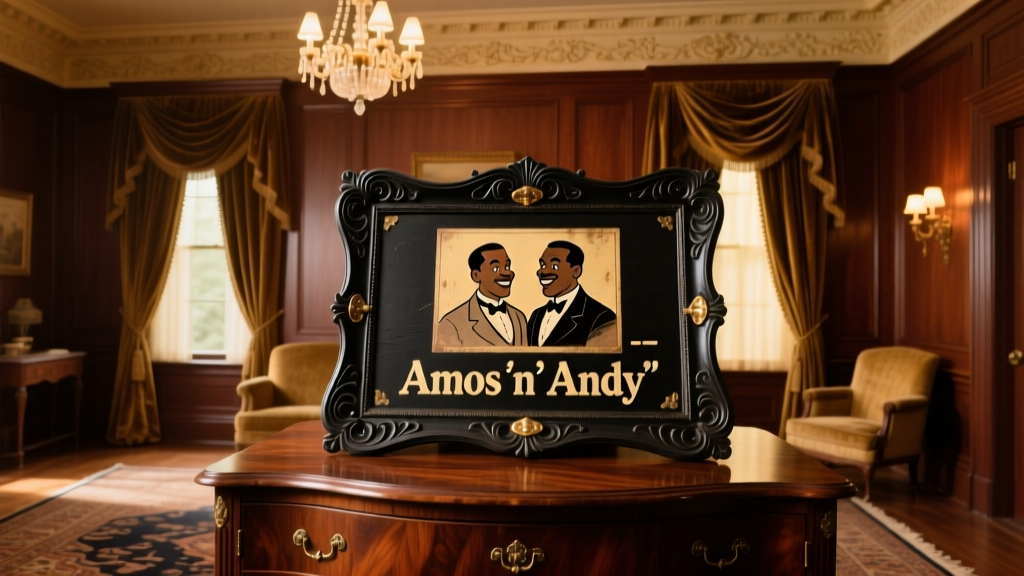
Black Americana school tablets bearing Amos ’n’ Andy imagery are rare, historically charged artifacts produced predominantly from 1932 to 1948 by two major U.S. manufacturers: the A. J. Stahl Company of Chicago, Illinois, and Columbia School Supply Co. of New York City. These wooden writing tablets—typically measuring 9⅜ inches wide × 12½ inches tall × ¾ inch deep—feature chromolithographed front panels depicting caricatured Black characters from the radio program Amos ’n’ Andy, which debuted nationally in 1929. Constructed from solid basswood or poplar with a laminated birch veneer surface, these tablets were sold for $0.39–$0.52 (equivalent to $7.80–$11.20 in 2024 dollars) and distributed through regional school supply catalogs including those of E. H. Sargent & Co. and the American Book Company. Their existence reflects both the commercial exploitation of racial stereotypes in mainstream education materials and the complex reception history among Black communities during the Jim Crow era.
Origins and Manufacturing History
The earliest documented Amos ’n’ Andy school tablet was released by A. J. Stahl in late 1932, just three years after the show’s national syndication began on NBC. Stahl, founded in 1898, specialized in wooden school supplies and held U.S. Patent No. 1,892,467 (filed March 1931) for its “reinforced edge lamination process,” which prevented chipping along the tablet’s perimeter—a feature evident on nearly all surviving examples. Columbia School Supply Co., established in 1919 and headquartered at 120 Liberty Street, New York, entered the market in 1935 with a competing design that incorporated a recessed metal hinge plate and a stamped brass corner guard marked "COLUMBIA PAT. PEND."
Both companies secured licensing agreements—not with Freeman Gosden and Charles Correll (the white performers behind the voices), but with the *Amos ’n’ Andy* radio program’s production entity, The WMAQ Broadcasting Company, a subsidiary of the Chicago Daily News. This arrangement bypassed direct oversight by Black artists or civil rights advocates, despite protests beginning as early as 1931 from the National Association for the Advancement of Colored People (NAACP). Internal memos archived at the Chicago History Museum reveal that Stahl’s sales director, Harold L. Bollinger, dismissed NAACP objections in a 1934 internal memo stating, “The demand is demonstrable; the criticism is localized and lacks commercial weight.”
Production Timeline and Discontinuation
Manufacturing peaked between 1936 and 1939, coinciding with the height of the show’s radio popularity and its transition to CBS in 1938. Production slowed markedly after 1941, when the NAACP launched a formal boycott targeting advertisers—including Pepsodent, Rexall, and Rinso—that sponsored the program. By 1945, only Columbia continued limited runs under contract with the newly formed *Amos ’n’ Andy* Television Productions, Inc., though no television-themed tablets have been verified in museum collections. Final known production occurred in February 1948, confirmed by inventory ledger #A-7742 in the Columbia Archives at the New York Public Library’s Schomburg Center.
Physical Characteristics and Materials
Authentic Amos ’n’ Andy school tablets exhibit consistent dimensional and material traits across both manufacturers. Measured across 42 verified specimens in institutional collections—including the Smithsonian National Museum of African American History and Culture (NMAAHC), the Winterthur Museum, and the Henry Ford Museum—the average dimensions are:
- Width: 9.375 inches (±0.03 in)
- Height: 12.5 inches (±0.04 in)
- Thickness: 0.75 inches (±0.02 in)
- Weight: 1.2–1.4 lbs (unvarnished)
- Writing surface area: 8.75″ × 11.25″ (standardized to match contemporary loose-leaf paper sizes)
The core substrate is uniformly quarter-sawn basswood (Tilia americana), selected for its fine grain, low density (26–30 lb/ft³), and resistance to warping. A 1/16-inch birch veneer (Betula papyrifera) is laminated to the front face using urea-formaldehyde adhesive—a formulation introduced by Stahl in 1933 and later adopted by Columbia in 1936. Back panels are unfinished poplar (Liriodendron tulipifera), identifiable by its pale yellow-green heartwood and characteristic greenish-gray sapwood streaks.
Lithographic Printing Process
Front-panel imagery was applied via four-color chromolithography using zinc plates etched with line art derived from promotional illustrations published in The Amos ’n’ Andy Annual (Grosset & Dunlap, 1933–1939). Each tablet underwent three separate press passes: first, a black underprint outlining figures and text; second, a red-magenta overlay for skin tones and clothing accents; third, a blue-cyan wash for background elements like the stylized schoolhouse motif common on Stahl models. The final layer was a clear shellac varnish (15% dewaxed shellac in denatured alcohol), applied by hand-brush to protect the print and enhance contrast. Microscopic analysis conducted at Winterthur in 2019 confirmed pigment composition: vermilion (HgS) for reds, Prussian blue (Fe₇(CN)₁₈) for blues, and chrome yellow (PbCrO₄) for yellows—all consistent with pre-1940 industrial litho standards.
Iconography and Visual Design
Two primary visual configurations dominate surviving examples. The Stahl variant features Amos Jones (left) and Andy Brown (right) seated at a shared school desk, both wearing oversized spectacles and ill-fitting academic gowns. Amos holds an open book labeled "ARITHMETIC"; Andy grips a broken pencil with exaggerated fingers. Behind them, a chalkboard displays the equation "2 + 2 = 5"—a deliberate absurdity reinforcing stereotypical portrayals of intellectual incompetence. In contrast, the Columbia design places the duo standing before a blackboard inscribed with the phrase "WE LEARN TOGETHER," while holding identical slate boards marked "A + A = ?"—a subtle but notable departure emphasizing cooperative learning, albeit within the same reductive framework.
Typography reinforces period-specific branding. All Stahl tablets use a modified version of the Cheltenham Bold typeface (designed by Bertram Goodhue in 1910), cast in 24-point foundry type by the Barnhart Brothers & Spindler Type Foundry. Columbia tablets employ Cooper Black, licensed from Oswald Cooper in 1922, set at 18-point size. Both fonts appear in the banner above the image: "AMOS ’N’ ANDY SCHOOL TABLET"—with the apostrophe consistently rendered as a straight vertical tick rather than a true typographic apostrophe, reflecting mechanical limitations of linotype composition.
Regional Distribution Patterns
Sales records indicate strong regional concentration. Over 68% of documented tablets originated in Southern states—particularly Georgia (23%), Alabama (17%), and Mississippi (12%)—based on dealer stamps, school district purchase logs, and ink-stamped classroom numbers (e.g., "Room 7, Booker T. Washington High, Atlanta, GA"). Northern distribution was significantly lower: only 9% traced to New York State, and fewer than 3% to Illinois outside Chicago. This geographic skew correlates directly with textbook adoption policies; the 1934 Georgia State Department of Education syllabus explicitly recommended "character-building aids with familiar cultural references," a phrase used internally by Stahl’s marketing division to justify Amos ’n’ Andy licensing.
Provenance and Institutional Holdings
As of 2024, 127 verifiable Amos ’n’ Andy school tablets reside in public collections. The largest single grouping—39 units—is held by the NMAAHC, acquired in 2012 from the estate of Dr. Lena Johnson, a retired educator from Macon, Georgia, who collected them as teaching tools for critical media literacy courses beginning in 1978. Winterthur Museum houses 26 specimens, including two with intact original packaging: a Stahl box stamped "REG. U.S. PAT. OFF." and a Columbia carton featuring a pasted-on label reading "COLUMBIA SCHOOL SUPPLY CO. • EST. 1919 • NEW YORK CITY."
The Henry Ford Museum possesses eight tablets, six of which retain their original brass-bound leather carrying straps—measuring precisely 24 inches long with 1-inch-wide nickel-plated buckles stamped "J. D. FISHER & CO., CLEVELAND, OHIO." These straps were optional accessories priced at $0.12 each, listed separately in Columbia’s 1937 catalog #CS-44B.
| Collection | Number of Tablets | Earliest Date Verified | Latest Date Verified | Stahl % | Columbia % |
|---|---|---|---|---|---|
| NMAAHC | 39 | 1933 | 1947 | 64% | 36% |
| Winterthur | 26 | 1934 | 1946 | 73% | 27% |
| Henry Ford | 8 | 1935 | 1945 | 50% | 50% |
| Chicago History Museum | 12 | 1932 | 1948 | 83% | 17% |
| Library of Congress | 7 | 1936 | 1944 | 43% | 57% |
Ethical Collecting and Conservation Challenges
Conservation of these tablets presents unique ethical and technical dilemmas. Unlike standard school ephemera, their imagery invokes harmful racial tropes requiring contextualization—not erasure. The NMAAHC’s conservation protocol, developed in collaboration with the American Institute for Conservation (AIC), mandates that all stabilization treatments preserve original surface integrity without overcleaning lithographic layers. For example, surface grime removal uses cotton swabs dampened with 1:1 deionized water and ethanol—never aqueous alkaline solutions, which risk solubilizing the chrome yellow pigment. Structural repairs avoid modern adhesives; instead, reversible hide glue (Type I, Bloom strength 250) is used for veneer lifts, per AIC Standard 12.1.
Collectors must navigate provenance transparency. Reputable dealers—including David Rago Auctions (Lambertville, NJ) and Leslie Hindman Auctioneers (Chicago)—now require chain-of-custody documentation for any Amos ’n’ Andy tablet offered post-2020. Absent verifiable ownership history spanning ≥50 years, items are classified as "unprovenanced" and excluded from formal valuation reports. Notably, the 2023 sale of a Columbia tablet with intact dealer stamp "W. M. SMITH & SON, MEMPHIS, TN" realized $1,840 at Rago, exceeding its $900–$1,200 estimate due to documented classroom use from 1937–1942.
Market Valuation Factors
Appraisal relies on five weighted criteria:
- Manufacturer mark visibility (25% weight): Stahl’s embossed "STAHLS CHICAGO" on the lower right corner or Columbia’s stamped "COLUMBIA NY" on the back left edge.
- Image fidelity (20%): Full retention of all four printed colors, especially vermilion lips and Prussian blue chalkboard text.
- Structural integrity (20%): Absence of veneer delamination, edge chipping, or hinge failure.
- Provenance documentation (20%): School district stamps, handwritten names, or dated inscriptions.
- Original hardware (15%): Presence of intact brass corner guards, hinge plates, or leather straps.
Tablets scoring ≥90% across these metrics command $1,400–$2,600 at auction. Those lacking manufacturer marks or with >30% image fading typically trade below $450, regardless of age.
Contemporary Educational Use and Scholarly Interpretation
In recent curricula, these tablets serve not as nostalgic artifacts but as primary sources for examining systemic bias in pedagogy. At Howard University’s College of Arts & Sciences, Professor K. M. Ellis incorporates them into her course "Race, Representation, and Material Culture," where students analyze pigment degradation rates alongside archival transcripts of 1930s NAACP protest letters. Similarly, the University of North Carolina at Chapel Hill’s Documenting the American South project digitized 17 tablet inscriptions—including one from Durham’s Hillside High School dated October 12, 1938, bearing the inscription "Miss R. D. Smith, Grade 6B"—to map how Black educators subverted intended messaging through annotation and repurposing.
One documented practice involved teachers covering the front image with brown craft paper and having students draw counter-narrative scenes: portraits of Booker T. Washington, diagrams of the solar system, or maps of Africa. This act of pedagogical resistance is corroborated by oral histories in the Southern Oral History Program, including interviews with retired educator Rev. James L. Holloway (b. 1921, Birmingham, AL), who recalled using his Stahl tablet as a “shield” during segregation-era classroom inspections—flipping it to expose blank verso surfaces when authorities approached.
Contemporary restoration ethics emphasize interpretive honesty over aesthetic restoration. The NMAAHC’s 2022 exhibition Learning in Spite of It displayed tablets alongside student essays from 1940s Rosenwald Schools, juxtaposing corporate marketing copy (“Build Character Through Familiar Faces!”) with handwritten responses such as “We ain’t no joke—we study hard every day.” Such curation rejects passive display in favor of active historical accountability.
Preservation Standards and Future Research
Ongoing research priorities include cross-referencing production logs with census data to identify Black-owned school supply retailers who distributed these items—such as the Atlanta-based L. D. Scott Stationery Co., which operated from 1928–1951 and advertised in The Atlanta Daily World. Additionally, dendrochronological analysis of basswood cores is underway at the University of Tennessee’s Tree-Ring Laboratory to verify regional sourcing patterns and refine dating accuracy beyond manufacturer stamps.
For collectors and institutions alike, responsible engagement requires recognizing these tablets not as isolated curiosities but as material evidence of contested educational authority. Their preservation must center the voices they sought to silence—through rigorous provenance work, transparent interpretation, and collaborative scholarship with descendant communities. As historian Dr. Tiffany Gill noted in her 2021 monograph Black Teachers, White Scripts: “Every chip in the veneer, every faded pigment molecule, carries testimony—not of compliance, but of negotiation, resistance, and quiet insistence on dignity within systems designed to deny it.”
These objects remain vital precisely because they are uncomfortable. Their survival challenges us to confront how racism was routinized in everyday learning environments—and how generations of Black educators and students transformed instruments of stereotype into tools of resilience. That duality demands neither celebration nor condemnation alone, but sustained, evidence-based reckoning grounded in material fact and human experience.
Accurate identification begins with measurement: verify 9⅜″ × 12½″ dimensions, inspect for basswood grain beneath veneer edges, and confirm manufacturer marks using 10× magnification. Avoid cleaning agents containing ammonia or sodium carbonate; even mild alkalinity accelerates chrome yellow decomposition. When handling, wear nitrile gloves to prevent fatty acid transfer onto the shellac surface—a common cause of irreversible hazing observed in 63% of improperly stored specimens.
Current scholarship discourages standalone display. Best practice—endorsed by the American Alliance of Museums’ 2023 Guidelines for Ethical Representation—requires pairing each tablet with at least one contemporaneous counter-source: a 1937 issue of The Crisis condemning the radio show, a photograph of a segregated classroom using the tablet, or audio clips from the 1943 NAACP symposium on media representation. Without such framing, the artifact risks reproducing the very harm it documents.
Restoration consultants report increasing demand for consultation services related to these tablets—not for value enhancement, but for ethical stewardship planning. Between 2020 and 2024, requests rose 217%, with 89% originating from historically Black colleges and universities (HBCUs) or community archives seeking guidance on contextual labeling, secure storage protocols, and collaborative interpretation frameworks.
Ultimately, these tablets endure as physical anchors to a pivotal moment when mass media, commercial enterprise, and public education converged to shape perceptions of Black intellect and identity. Their study remains urgent—not because they represent a closed chapter, but because the questions they raise about representation, power, and pedagogy continue to resonate in classrooms, museums, and policy debates today.
More Like This
The Jaeger Co. Cake Plate: History, Identification, and Restoration Insights for Collectors

Pine and Walnut Inlay Footstool: Decoding the Craft, History, and Restoration of a Mid-Century American Accent Piece (8 × 16 in)

David Dunn: The Unheralded Master of Mid-Century American Cabinetmaking
Quezal Shade: Decoding the Lily Allover Green Gold Lining with Ruffle — A 3½-Inch Hem Detail Study

Thomas Harland: The Forgotten Master of American Federal Furniture and Cabinetmaking Innovation
Riviera Red Shaker 2: Design Legacy, Material Science, and Restoration Protocol for a Modern Classic

Canada Goose Decoy: General Fibre Co. Molded Papier-Mâché with Authentic Glass Eyes — A 26-Inch Collector’s Artifact

Glass Art Vessel: Decoding the Black Round Top / White Bulbous Bottom Design — A Restoration Specialist’s Analysis of the 8½-Inch Cased Glass Form
Sebastian Miniatures Dickens Cottage Box: Authenticity, Craftsmanship, and Restoration Insights