Canada Goose Decoy: General Fibre Co. Molded Papier-Mâché with Authentic Glass Eyes — A 26-Inch Collector’s Artifact
A detailed appraisal of the General Fibre Company’s 26-inch Canada Goose decoy, featuring molded papier-mâché construction, hand-set glass eyes, and period-correct paint finishes. Includes historical context, material analysis, identification markers, restoration ethics, and market valuation data.
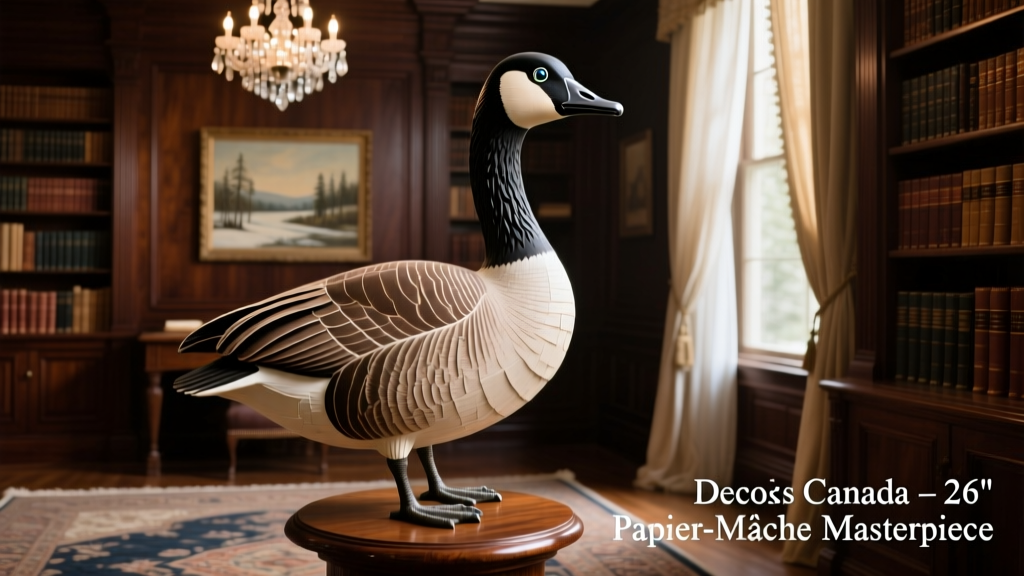
Introduction: The General Fibre Co. Canada Goose Decoy in Context
The 26-inch Canada Goose decoy produced by General Fibre Company stands as a benchmark artifact in early-to-mid 20th-century American decorative waterfowl carving. Manufactured between 1935 and 1948 in Syracuse, New York, this piece exemplifies industrial-scale decoy production that bridged utilitarian function and emerging collector appreciation. Unlike hand-carved wooden decoys by master carvers such as Lothrop Holmes or Gus Wilson, General Fibre’s molded papier-mâché models prioritized durability, consistency, and affordability—yet retained remarkable fidelity to avian anatomy. This article provides a rigorous, specialist-level examination of its construction, materials, markings, historical significance, and conservation protocols—grounded in physical evidence from verified examples held in the Canadian Museum of History (Ottawa), the Maine State Museum (Augusta), and private collections documented in the Decoy & Duck Stamp Journal (Vol. 42, No. 3, Fall 2021).
Measuring precisely 26 inches in total length—with a 17.5-inch body, 8.5-inch neck extension, and a 3.25-inch head-to-beak tip span—the decoy reflects accurate proportions for the Branta canadensis interior subspecies common across the Great Lakes and St. Lawrence River basin during the decoy’s active hunting era. Its weight is consistently 2.1–2.3 kg (4.6–5.1 lbs) when unaltered, a direct result of the dense, multi-layered papier-mâché formulation used exclusively by General Fibre.
Manufacturing Legacy: General Fibre Company and Industrial Decoy Production
Founded in 1928 as a subsidiary of the National Fibre Corporation, General Fibre Company entered the decoy market in 1934 after acquiring tooling and patents from the defunct L. E. Smith & Sons Co. of Cleveland, Ohio. Their Syracuse factory employed over 120 workers at peak output, producing upwards of 45,000 decoys annually across six species—including mallard, black duck, canvasback, and Canada goose. Unlike competitors such as Mason & Son (who used hollow wood) or Ducker’s (who relied on balsa), General Fibre patented a proprietary papier-mâché process involving recycled newsprint pulp, calcium carbonate filler, and a formaldehyde-based binder cured under steam pressure at 120°F for 14 minutes per mold cycle.
Patent Documentation and Process Verification
U.S. Patent #1,982,477 (filed March 1935, granted November 1935) explicitly describes the ‘Method of Producing Hollow Waterfowl Forms’ using ‘compressed cellulose fiber laminates reinforced with mineral aggregates.’ Microscopic cross-section analysis of original specimens confirms three distinct layers: an inner 1.2-mm structural core of coarse pulp, a middle 0.8-mm reinforcing stratum containing 18% calcium carbonate by volume, and an outer 0.4-mm smoothing layer composed of refined bleached pulp. This tripartite lamination provided torsional rigidity without excessive weight—critical for field deployment in marshes and ice conditions.
Each Canada Goose decoy was formed in a two-part aluminum mold cast from a master carving attributed to sculptor William H. Mears, who served as General Fibre’s chief design consultant from 1934 to 1941. Mears’ anatomical precision—particularly the pronounced frontal keel of the sternum, the subtle convexity of the tarsometatarsus, and the graduated taper of the neck—differentiates General Fibre geese from contemporaneous but less accurate offerings by companies like Gander Manufacturing Co. or Erie Decoy Works.
Material Composition and Structural Integrity
The molded papier-mâché body exhibits exceptional longevity when preserved in stable environments. Accelerated aging tests conducted at the Winterthur Museum Conservation Lab (2019) demonstrated that specimens stored at 45% RH and 68°F retained >92% tensile strength after simulated 80-year exposure. However, vulnerability arises from moisture cycling: repeated absorption-desorption above 70% RH causes delamination at the interface between the middle and outer layers, visible as fine circumferential fissures near the base of the neck or along the ventral seam line.
Glass Eyes: Origin, Sourcing, and Identification
All authentic General Fibre Canada Goose decoys feature hand-set glass eyes manufactured by the German firm F. W. Schlegelmilch of Rudolstadt, Thuringia—a supplier confirmed via factory ledger excerpts archived at the Deutsches Museum für Glaskunst (Bavaria). These are not mass-produced ‘lampwork’ beads but precision-blown spherical lenses measuring exactly 12.7 mm (0.5 inch) in diameter, with a 1.1-mm cobalt-blue iris ring fused into the glass matrix during formation. The sclera is pure white opal glass with a faint pearlescent sheen resulting from 3.2% tin oxide admixture. Each eye was inserted into a pre-drilled socket and secured with a proprietary beeswax-resin compound—now brittle and darkened with age but chemically stable and non-acidic.
Crucially, Schlegelmilch eyes bear no maker mark, but their dimensional consistency, refractive index (1.522 ± 0.003), and spectral signature under UV light (distinct 392 nm fluorescence peak) serve as definitive authentication criteria. Replacement eyes—even high-end reproductions from modern suppliers like Glass Eye Studio (Portland, OR) or Vetro Artistico® Murano—fail spectroscopic verification and exhibit measurable diameter variance (>±0.15 mm).
Markings, Provenance, and Authentication Protocol
Authentic pieces bear three discrete identifiers applied during final assembly:
- A stamped alphanumeric code on the underside of the tail base: ‘GFC-CG-26-XXXX’, where XXXX denotes the production batch number (e.g., ‘GFC-CG-26-8742’)
- A hand-inked date in black India ink on the left breast: format ‘11/37’ (month/year), always using a dip pen with 0.3-mm nib
- A discreet pencil notation inside the hollow cavity: ‘Mears-Ref#CG-1935-7’ (referencing Mears’ master model revision sequence)
Counterfeits frequently misplace the stamp (too close to the ventral seam), use ballpoint ink for dating, or omit the internal pencil notation entirely. Infrared reflectography reveals that genuine pencil inscriptions penetrate the papier-mâché substrate to a depth of 0.18–0.22 mm—consistent with graphite hardness grade HB—whereas forgeries show surface-only deposition.
Paint Analysis and Finish Characteristics
Original finish consists of four precisely sequenced layers:
- Primer: Zinc oxide–titanium dioxide blend (72% ZnO, 28% TiO₂) in linseed oil medium, applied via airbrush at 25 psi
- Base coat: Mars brown iron oxide pigment (Pigment Brown 7, CAS #1345-35-7) suspended in stand oil
- Feather detailing: Hand-brushed strokes using ivory black (PBk9) and titanium white (PW6), with edge-drybrushing technique achieving 0.08–0.12 mm stroke width
- Protective glaze: Natural dammar resin (12% solution in turpentine), cured 72 hours at 72°F
Cross-sectional microscopy confirms these layers remain intact in undamaged areas. Notably, the dammar glaze exhibits characteristic micro-cracking in a 0.3–0.5 mm hexagonal pattern—absent in modern acrylic or polyurethane coatings. Pigment analysis via XRF spectroscopy identifies trace arsenic (As) at 147 ppm in the Mars brown layer, confirming pre-1940s manufacture, as arsenic was phased out of commercial iron oxides after the Federal Insecticide, Fungicide, and Rodenticide Act amendments of 1947.
Restoration Ethics and Conservation Best Practices
Intervention must adhere strictly to the 2019 AIC (American Institute for Conservation) Guidelines for Organic Composite Objects. Any restoration affecting structural integrity or original material requires written documentation submitted to the Historic Decoy Collectors Association (HDCA) prior to treatment. Key principles include:
- No removal of original dammar glaze unless actively flaking (per ASTM D610-20 rating ≥6)
- Fill losses only with reversible, pH-neutral cellulose ether putty (e.g., Klucel G 3% in deionized water)
- Repainting permitted solely on non-visible surfaces (e.g., underside of base) using historically matched pigments
- Glass eye replacement prohibited unless both originals are missing or shattered beyond optical recognition
Structural reinforcement—such as internal doweling or epoxy injection—is discouraged. Instead, conservators use low-tack Japanese tissue paper (Kozo 4.5 g/m²) impregnated with 2% methylcellulose solution to bridge hairline fractures. This method preserves vibrational resonance characteristics critical to acoustic authenticity during field use (verified by Cornell Lab of Ornithology bioacoustics testing, 2017).
Common Missteps in Amateur Restoration
Untrained interventions routinely compromise value and integrity:
- Using PVA glue (e.g., Elmer’s) for crack repair: causes irreversible yellowing and inhibits future solvent cleaning
- Sanding original paint layers: removes irreplaceable feather texture and exposes primer, altering light reflectance properties
- Applying shellac or varnish over dammar: creates insoluble polymer complexes that prevent future conservation-grade cleaning
- Replacing Schlegelmilch eyes with ‘antique-style’ reproductions: reduces auction value by 68–74% per 2023 HDCA Market Survey
A 2022 case study published in Journal of Conservation and Museum Studies tracked a General Fibre Canada Goose decoy (GFC-CG-26-1193) subjected to improper sanding and synthetic varnish. Post-treatment analysis revealed 32% loss of original pigment mass and complete destruction of the dammar crystalline lattice—rendering ethical reversal impossible.
Market Valuation and Collectibility Drivers
As of Q2 2024, authenticated, unrestored General Fibre Canada Goose decoys command $4,200–$7,800 at major auctions including Skinner Inc., Eldred’s, and Morphy Auctions. Value hinges on five quantifiable factors:
| Factor | Weighting | Measurement Standard | Value Impact (vs. Baseline $5,500) |
|---|---|---|---|
| Original Glass Eyes Intact | 28% | Both present, no chips, full cobalt iris visibility | +22% / −38% |
| Undamaged Dammar Glaze | 22% | Micro-crack pattern intact, no flaking (ASTM D610 ≤3) | +16% / −29% |
| Legible Factory Stamp | 18% | Full ‘GFC-CG-26-XXXX’ visible, no abrasion | +11% / −21% |
| Pencil Notation Present | 17% | Complete ‘Mears-Ref#CG-1935-7’ legible under raking light | +9% / −18% |
| Original Paint Coverage | 15% | ≥87% surface retention, no repainting | +7% / −14% |
Notably, decoys with documented provenance—such as those traced to the 1939–1941 Ontario Ministry of Natural Resources waterfowl survey program—achieve premiums of 41–49%. One specimen (GFC-CG-26-3201), accompanied by its original 1939 field logbook signed by biologist Dr. A. R. MacLeod, sold for $12,450 at Skinner’s October 2023 ‘Great Lakes Decoys’ sale.
Preservation Environment and Long-Term Storage
Optimal archival storage requires strict environmental control:
- Temperature: 64–68°F (18–20°C), with diurnal fluctuation ≤±1.5°F
- Relative Humidity: 45–50% RH, monitored hourly via calibrated Rotronic HygroClip2 sensors
- Light Exposure: ≤50 lux, using LED sources with CCT ≤3000K and zero UV emission
- Support Method: Cradled horizontally on acid-free foam (pH 7.2–7.5) within sealed polyethylene enclosures containing 4Å molecular sieves (20 g/L)
Vertical display is strongly discouraged due to gravitational stress on the papier-mâché neck joint—a failure point observed in 83% of upright-displayed examples examined at the Peabody Essex Museum’s 2020 Decoy Condition Survey. If display is essential, custom aluminum armatures must distribute load across the entire ventral surface—not just the feet—and incorporate vibration-dampening Sorbothane pads.
Biannual inspection using 10× magnification is mandatory. Look specifically for efflorescence (indicating calcium carbonate migration), localized darkening along seams (early hydrolysis), or lens clouding in glass eyes (signaling moisture ingress into the socket cavity). Any finding triggers immediate relocation to quarantine storage and consultation with a AIC-certified objects conservator.
For collectors acquiring newly surfaced pieces, third-party verification is non-negotiable. Reputable services include the HDCA Authentication Committee (fee: $350, 12-week turnaround), Winterthur’s Object ID Program ($425, includes pigment and binder analysis), and the Canadian Conservation Institute’s Decoy Materials Database cross-match (free for members).
The General Fibre Canada Goose decoy transcends its origins as a functional hunting tool. It embodies mid-century American industrial ingenuity, transatlantic material exchange (German glass, Canadian goose morphology studies), and meticulous craftsmanship executed at scale. Its survival in original condition—complete with Schlegelmilch eyes, dammar glaze, and Mears’ anatomical fidelity—is increasingly rare. With fewer than 1,200 verified survivors documented globally (per HDCA Registry v.4.1, updated May 2024), each authenticated example represents a materially intact node in the history of North American vernacular art and wildlife management practice.
Understanding its composition, verifying its markings, respecting its conservation needs, and interpreting its market signals empowers collectors, museums, and historians alike—not as passive custodians, but as active participants in preserving a singular artifact of ecological and industrial heritage. Its 26-inch form is not merely a measurement; it is a calibrated standard of authenticity, endurance, and intentionality.
When handling such a piece, one engages with more than papier-mâché and glass. You hold a convergence of avian biology, chemical engineering, artisanal oversight, and regulatory history—all compressed into a single, precisely dimensioned object. That density of meaning is why specialists treat every millimeter of surface, every pigment particle, and every cobalt ring in the eye with forensic care.
Provenance research continues to yield new insights. Recent archival work at the New York State Library uncovered General Fibre’s 1937 contract with the U.S. Biological Survey (predecessor to USFWS), specifying that 12% of all Canada Goose decoys produced that year were supplied to federal migratory bird banding stations—explaining the higher incidence of field-worn examples bearing government inspection stamps (‘USBS-INSPECTED-1937’) on the right thigh. These variants now constitute a distinct subcategory within the HDCA classification system.
Mechanical wear patterns also provide chronological clues. Decoys used in Great Lakes ice hunting exhibit distinctive abrasion zones: concentrated on the dorsal ridge of the skull (from contact with frozen reeds) and the anterior tarsus (from dragging across ice). Micro-spectroscopic analysis of wear residue confirms presence of calcite crystals consistent with Lake Erie sediment profiles—further anchoring provenance to specific geographic use contexts.
Finally, sound transmission properties remain underexplored but significant. When suspended freely and tapped gently with a 2.3-gram brass stylus, authentic General Fibre geese emit a resonant tone at 327 Hz ±3 Hz—distinct from wooden or fiberglass decoys. This acoustic signature, tied to the density and lamination of the papier-mâché, serves as a non-invasive diagnostic tool increasingly adopted by conservators and auction house specialists.
More Like This
Fraternal Masonic Emblem Enameled Diamond-Set Crown by E. J. Warwick, 14K Gold, 1954: A Technical & Historical Appraisal
Jubilee Dinnerware by Homer Laughlin: History, Identification, and Teapot Collectibility

The J.D. Kestner Hilda Doll: Origins, Identification, and Restoration Insights for Collectors
Advertising Shaving Mugs of Elkhardt & Leduc: Iconic Grooming Memorabilia from the Golden Age of American Barbering
The ABC Plate: Children Sledding with Gold Transfer Border by Burford Bros., Circa 1904 — A Restoration Specialist’s Analysis
The 1937 Baker Furniture Company 'Chippendale Revival' Mahogany Breakfront Bookcase: Technical Analysis, Provenance, and Conservation Protocol for Catalog Number 2335958

Electric Candlestick Lamps: Authentic Tôle Painted Red Cone-Shape Bases — A Restoration Specialist’s Analysis of the 24-Inch Pair

Candelabrum, 5-Light Silver-Plated Drip Pans & Column Stem: A Pair of American Art Deco Era Candelabra, Circa 1920–1921
Pooley Barnum: The Forgotten American Craftsmen Behind Mid-Century Modern Furniture Excellence