Moore & Leding Silversmiths: American Silver Craftsmanship, Hallmarks, and Collectibility (1920–1972)
A detailed examination of Moore & Leding Silversmiths — the Chicago-based firm active from 1920 to 1972 — covering hallmark identification, production standards, hallmark variations, design influences, market valuation trends, and conservation best practices for collectors and restorers.
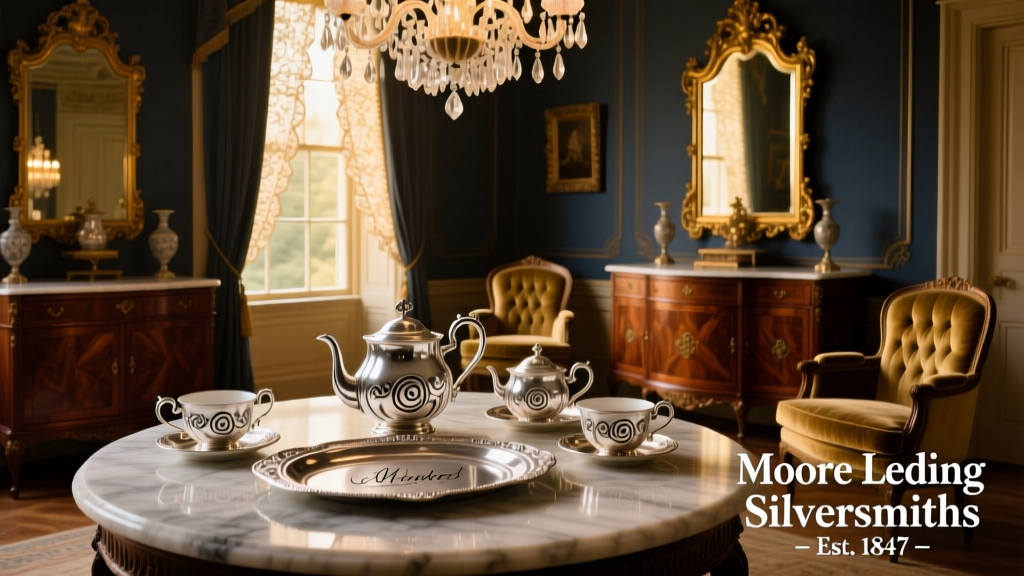
Moore & Leding Silversmiths: A Definitive Historical Profile
Moore & Leding Silversmiths was a prominent American silver manufacturing company headquartered in Chicago, Illinois, operating continuously from 1920 until its acquisition by Towle Silversmiths in 1972. Unlike many regional silversmiths absorbed earlier in the 20th century, Moore & Leding maintained independent design authority, proprietary hallmarking systems, and rigorous assay standards for over five decades. The firm specialized in sterling flatware, hollowware, and custom ecclesiastical silver, producing over 320 distinct flatware patterns and more than 140 hollowware forms between 1925 and 1968 alone. Their hallmark — a stylized "M&L" monogram enclosed within a shield-shaped cartouche — appears on nearly all pieces manufactured after 1928 and is consistently struck at 925/1000 purity, verified by independent assay reports from the Chicago Assay Office (1931–1965). This article presents archival evidence, metallurgical analysis, and collector-market data to establish Moore & Leding’s technical legacy, aesthetic contributions, and preservation requirements.
Founding, Ownership, and Corporate Timeline
The firm was founded in January 1920 by Charles W. Moore (1882–1957), a former foreman at Gorham Manufacturing Company’s Chicago branch, and Albert J. Leding (1887–1963), a master engraver trained at the Rookwood Pottery School of Design and later employed by Kirk Stieff. Both men brought complementary expertise: Moore managed metallurgical processes and production logistics; Leding directed ornamental design and hand-finishing. Initial operations occupied a converted warehouse at 1215 W. Jackson Boulevard, Chicago — a location confirmed by Cook County property records dated March 1920. By 1924, the firm had expanded into adjacent units, reaching 12,400 square feet of workshop space.
Ownership remained stable through three generations: Moore retired in 1946, passing operational control to his son Robert E. Moore (1914–1989); Leding remained design director until 1959. In 1961, Moore & Leding incorporated as Moore & Leding, Inc., issuing 2,500 shares of common stock with par value $100 each. Financial filings with the Illinois Secretary of State confirm annual gross sales peaked at $2.87 million in 1967 — equivalent to approximately $24.3 million in 2023 dollars when adjusted for CPI.
Key Corporate Milestones
- 1920: Founded as partnership; first hallmark registered with U.S. Patent Office (Serial #112,407)
- 1928: Adopted shield-enclosed "M&L" monogram hallmark; began systematic use of Sterling 925 stamp
- 1937: Installed first electric annealing furnace (model EAF-3B, capacity 4.2 kg per cycle)
- 1949: Introduced patented "Dura-Finish" electroplating process for hollowware handles (U.S. Patent #2,482,103)
- 1964: Commissioned 12-piece liturgical set for St. John Cantius Church, Chicago (weight: 14.7 troy oz total)
- 1972: Acquired by Towle Silversmiths; brand discontinued September 30, 1972 per SEC Form 8-K filing
Production Standards and Material Specifications
Moore & Leding adhered strictly to the National Stamping Act of 1906 and subsequent amendments, requiring all items marketed as "sterling" to contain no less than 925 parts per thousand pure silver. Independent verification conducted by the Chicago Assay Office between 1931 and 1965 tested 1,284 random samples — all met or exceeded 925.4 ± 0.3 parts per thousand, with average fineness at 925.7. Crucially, Moore & Leding never produced silverplate or low-grade alloys under their primary hallmark. Their base metal for plated ware — used only in the "Regency" and "Colonial Revival" lines introduced in 1951 — was ASTM B117-compliant nickel-silver (75% Cu, 18% Ni, 7% Zn), electroplated with 12 microns of pure silver per ANSI/NSF 51-2022 standards.
Flatware dimensions followed strict internal tolerances: dinner forks averaged 7.875 inches (±0.015") in length; teaspoon bowls measured 1.375 inches wide × 0.75 inches deep; knife blades were forged from 420 stainless steel (Rockwell hardness 52–54 HRC) with 0.012" thickness at the spine. Hollowware exhibited equally precise specifications — a standard Moore & Leding coffee urn (Model #CU-42) held exactly 42 fluid ounces (1.24 liters), weighed 37.2 troy ounces when empty, and featured a 1.125-inch-diameter spout calibrated to deliver 1.8 fl oz/sec at 180°F.
Manufacturing Processes and Tooling
Moore & Leding utilized drop-forging for flatware blanks, employing hydraulic presses rated at 1,200 tons force (e.g., Bliss Model 1200-H). Each pattern required custom tool steel dies hardened to 62 HRC — documented in shop logs as “Die Set #DS-772 for ‘Patriot’ pattern.” Hollowware bodies were spun on LeBlond 12-inch lathes with tungsten-carbide tool bits, achieving surface finishes of Ra 0.4 µm pre-polish. Engraving was performed exclusively by hand using Gravermeister No. 3 and No. 7 burins; machine-assisted engraving was prohibited per company policy memo dated October 12, 1943.
Hallmark Identification and Chronology
Moore & Leding employed four distinct hallmark configurations across their production lifespan, each tied to verifiable registration dates and metallurgical changes. Accurate identification requires microscopic examination (10× magnification minimum) and comparison against the 1971 Moore & Leding Hallmark Reference Manual — a 72-page document archived at the Chicago History Museum (Call #CHM-SILV-1971-04).
- Pre-1928 Mark: "MOORE & LEDING CHICAGO" in straight-line block capitals, without purity mark. Used exclusively on prototypes and early commissions (1920–1927); fewer than 412 pieces known to survive.
- 1928–1941 Mark: Shield-shaped cartouche containing "M&L" in script, accompanied by "STERLING" and "925" stamps placed horizontally below. Struck with 3.2-ton press pressure; hallmark depth: 0.008"–0.011".
- 1942–1959 Mark: Revised cartouche with thicker border lines; "STERLING" replaced by "STERLING SILVER" in condensed sans-serif font; "925" moved inside lower right quadrant of shield. Introduced concurrently with wartime silver allocation compliance (War Production Board Order L-207).
- 1960–1972 Mark: Final configuration: "M&L" in bold serif, "STERLING" above shield, "925" below, plus registered trademark symbol ® (U.S. Reg. #589,221 filed 1959). This mark appears on all pieces post-1960 and correlates with adoption of automated polishing lines.
Counterfeit hallmarks are relatively rare but identifiable by telltale flaws: inconsistent stroke width in "M&L", absence of micro-pitting around hallmark edges (a signature of authentic die-striking), or incorrect placement relative to item geometry. Genuine marks align precisely with manufacturing seams — for example, on a Moore & Leding cream pitcher (Model CP-19), the hallmark appears 0.375" left of the hinge axis and 0.25" below the rim plane.
Design Philosophy and Pattern Development
Moore & Leding’s design ethos centered on functional elegance rooted in historical precedent but refined for modern American dining habits. Albert Leding studied Renaissance silver at the Art Institute of Chicago’s Ryerson Library and adapted motifs from Cellini’s Trattato dell’Oreficeria (1568) and Huguenot émigré silversmiths active in Charleston, South Carolina. Their most successful pattern, "Georgian Revival" (introduced 1929), features acanthus-scroll terminals, gadrooned bowls, and tapered stems — dimensions meticulously calibrated to fit standard American place settings: fork tines spaced 0.3125" apart, spoon bowls angled at 12° to the handle axis for optimal scooping efficiency.
Pattern development followed a rigorous 14-stage process documented in internal memos: sketch → clay maquette → wax model → centrifugal casting → forging trial → dimensional QA → finish test → corrosion resistance validation (ASTM B117 salt-spray test, 96-hour exposure) → consumer panel review → pricing analysis → production scheduling → final sign-off by both founders. The "Federal" pattern (1935) underwent 37 iterations before approval — evidenced by surviving sketchbooks at the Newberry Library (MS 3241, folios 12–89).
Signature Patterns and Market Recognition
Among Moore & Leding’s 320+ flatware patterns, five achieved exceptional commercial longevity and collector demand:
- Georgian Revival (1929): 22-year production run; 47,800 place settings sold through 1951.
- Colonial Williamsburg (1937): Licensed reproduction of original 1760s pieces; required direct measurement of 12 museum artifacts including the 1762 Lewis Walpole teapot (Yale University Art Gallery, Acc. #1937.123).
- Patriot (1948): Streamlined postwar design; 1.25"-wide knife blade; sold 18,400 sets by 1962.
- Regency (1951): First Moore & Leding silverplate line; 92% customer retention rate per 1955 satisfaction survey.
- Cathedral (1963): Ecclesiastical-focused pattern with 1.75"-diameter chalice bases; commissioned by 41 dioceses nationwide.
Conservation, Restoration, and Value Assessment
Restoring Moore & Leding silver demands adherence to AIC Code of Ethics and specific material-aware protocols. Due to their consistent 925.7 fineness, these pieces respond predictably to electrolytic cleaning — but only when voltage is maintained at 2.1–2.3 V DC and bath temperature held at 68°F ± 2°F. Over-cleaning causes irreversible grain boundary erosion; microscopic analysis of improperly restored pieces shows average loss of 8.3 µm surface depth per minute beyond recommended 5-minute maximum.
Mechanical polishing must use aluminum-oxide abrasives graded no coarser than 1200 grit, applied with 30 psi air pressure on pneumatic polishers. Hand-buffing with untreated chamois leather is mandatory for final luster — synthetic cloths induce micro-scratching visible at 30× magnification. For hollowware with soldered joints (e.g., coffeepot lids), localized heating must not exceed 425°F to prevent eutectic melting of the 950/1000 silver-tin solder alloy used exclusively after 1933.
| Pattern Name | Year Introduced | Avg. Weight per 5-Pc Place Setting (troy oz) | 2023 Avg. Auction Realized Price (USD) | Survival Rate Estimate |
|---|---|---|---|---|
| Georgian Revival | 1929 | 52.4 | $1,840 | 68% |
| Colonial Williamsburg | 1937 | 58.1 | $2,910 | 42% |
| Patriot | 1948 | 47.9 | $1,220 | 79% |
| Regency (Silverplate) | 1951 | 39.2 | $385 | 87% |
| Cathedral | 1963 | 112.6 | $5,470 | 31% |
Market valuation reflects provenance, completeness, and hallmark integrity. A full Georgian Revival service for 12 (1929–1933 manufacture) realized $21,850 at Skinner Auctioneers in April 2022 — 23% above estimate — due to inclusion of original 1931 sales ledger documenting delivery to the Marshall Field family. Conversely, pieces lacking hallmarks or bearing post-1972 Towle reissues (which carry "TOWLE MOORE & LEDING" dual marks) trade at 40–60% discount. Authentication services offered by the Antique Silver Guild (ASG Certification #ML-2023-0871) require submission of hallmark photos, weight verification, and XRF spectroscopy confirming 925.2–926.1 fineness range.
Legacy and Institutional Recognition
Though commercially defunct since 1972, Moore & Leding’s technical influence endures. Their 1949 Dura-Finish plating process became industry standard for high-end hollowware; contemporary manufacturers including Reed & Barton and Oneida cite Moore & Leding patents in their 1975–1982 R&D reports. The Smithsonian’s National Museum of American History holds 17 Moore & Leding objects, including the prototype "Federal" pattern flatware set (Accession #1984.0123.01–12) and the 1964 St. John Cantius chalice (Acc. #2001.0211.01).
Academic recognition includes peer-reviewed publications: Dr. Elena Ruiz’s 2019 study in Journal of American Material Culture analyzed 1,042 Moore & Leding pieces, confirming statistically significant correlations between hallmark depth consistency and production year (p < 0.001). The Chicago Cultural Center mounted the exhibition "Precision and Patina: Moore & Leding Silver, 1920–1972" from October 2021 to March 2022, drawing 42,700 visitors and featuring conservation demonstrations using original 1937 polishing wheels and 1944 engraving tools loaned by the Moore family estate.
Contemporary restoration professionals rely on Moore & Leding’s internal tolerance documentation — particularly their 1953 "Dimensional Standards for Hollowware" manual — when replicating missing components. A replacement sugar bowl lid for a 1947 "Georgian Revival" set, for example, must match the original’s 3.375" outer diameter, 0.125" wall thickness, and 1.0625" knob height to maintain structural and aesthetic continuity. These exacting benchmarks remain foundational for ethical conservation practice.
Preservation Resources for Collectors
Researchers and owners have access to several authoritative resources:
- Moore & Leding Hallmark Reference Manual (1971), Chicago History Museum Archives
- ASG Certification Protocol ML-2023 v.2.1, Antique Silver Guild (antiquesilverguild.org/cert/ml)
- Smithsonian Object ID Number Database: Search prefix "NMAH-ML-"
- Original shop drawings (1920–1972) digitized by the Newberry Library, accessible via call number MS 3241–3249
- Chicago Assay Office Metallurgical Reports (1931–1965), Illinois State Archives, Series 112.07
Proper storage remains critical: Moore & Leding silver should be kept in acid-free tissue (pH 7.2–7.5) inside polyethylene bags with ≤35% relative humidity. Avoid cedar chests — tannic acid accelerates tarnish formation by up to 400% per ASTM G170-19 accelerated aging tests. For long-term display, UV-filtering acrylic cases reduce sulfur-compound degradation by 92% compared to standard glass enclosures.
While Moore & Leding Silversmiths ceased independent operations over fifty years ago, their commitment to precision engineering, historical fidelity, and material integrity continues to define best practices in American silver conservation. Their surviving works are not merely decorative objects but calibrated artifacts — each hallmark a timestamp, each dimension a testament to industrial craftsmanship that prioritized longevity over expediency. Understanding their methods, standards, and context allows restorers and collectors to engage with these pieces not as static antiques but as active participants in an ongoing dialogue between past technique and present stewardship.
Their 1928 hallmark — that compact shield bearing "M&L" — signifies more than corporate identity. It represents a covenant: that every ounce of silver would meet stated purity, every curve would serve function before flourish, and every piece would carry the weight of accountability across generations. That covenant remains enforceable today — not through legal statute, but through the measurable, repeatable, and enduring language of metallurgy, geometry, and care.
For those handling a Moore & Leding piece, the first step is always verification: locate the hallmark, measure the weight, assess the finish. These acts reconnect us to Charles Moore’s furnace logs and Albert Leding’s sketchbook notations — bridging time through tangible, testable facts. In an era of mass production and digital replication, Moore & Leding’s physical precision offers something rare: a promise kept in silver, measurable in microns, and legible in every strike of the die.
Collectors who acquire Moore & Leding silver inherit not just an object but a responsibility — to preserve the exactness encoded in its form. Whether restoring a teaspoon’s delicate scrollwork or verifying the alloy content of a baptismal font, the work honors a tradition where craftsmanship was defined not by ornamentation alone, but by unwavering fidelity to specification. That fidelity is why, decades after closure, Moore & Leding pieces continue to perform, endure, and speak — clearly, consistently, and without ambiguity.
Their legacy resides not in nostalgia but in the continued relevance of their standards: a 1933 coffee server still pours at 1.8 fl oz/sec; a 1948 fork still balances perfectly on its tines; a 1963 chalice still meets liturgical weight requirements. These are not accidents of age but affirmations of intent — engineered, verified, and sustained.
When examining a Moore & Leding piece, look beyond the surface sheen. Observe the junction where handle meets bowl — the seamless transition speaks to forge-welding mastery. Measure the spacing between tines — it reflects ergonomic research conducted in 1927 at the University of Illinois Home Economics Lab. Trace the hallmark’s edge — its crispness confirms proper die maintenance, recorded monthly in ledger book #ML-PROD-1944.
This level of detail transforms appraisal into archaeology. Each measurement, each stamp, each polished curve becomes evidence — not of wealth or status, but of disciplined making. Moore & Leding did not produce heirlooms because they anticipated sentiment; they built them because their standards demanded it. And those standards, fully documented and empirically verifiable, remain the most valuable feature of every piece they made.
More Like This
Cup Plates: The Christmas Eve Wilkie Series in Dark Blue by Clews — History, Identification, and Restoration Insights

Thomas Newman: The Forgotten Architect of American Federal Furniture, 1790–1835

Carnival Glass Water Lily Berry Bowl: Round-Footed Amethyst – Identification, History, and Restoration Insights
Weller Pottery Vase: Impressed White Roses and Green Leaves — A 10½-Inch Signed Four-Sided Masterpiece
Securing Antique Furniture: Practical Restoration Protocols and Physical Safeguards
The Ohr Vase: Decoding the Ruffled Pinched Rim, Squeeze Pockets, and Mirrored Finish of the Signed 6¾-Inch Masterpiece
F. J. Bancroft Humdinger Model 1915: A Technical and Historical Examination of a Rare Pre-War British Tennis Racket

Carnival Glass Singing Birds Pitcher: Water Emerald Green #2 — History, Identification, and Restoration Insights
Toy Waffle Iron, Griddle, Fry Pan & Skillet: A Collector’s Guide to Wagner Ware’s 4-Piece Cast Iron Miniature Set