The Scientific Instruments Gauge Wind Velocity Case: A Collector’s Guide to Victorian and Edwardian Anemometric Instrumentation
An in-depth examination of antique wind velocity gauge cases—crafted by makers like Negretti & Zambra, Casella, and Kew Observatory—covering construction, calibration standards, historical meteorological context, material science, and conservation best practices for collectors and museums.
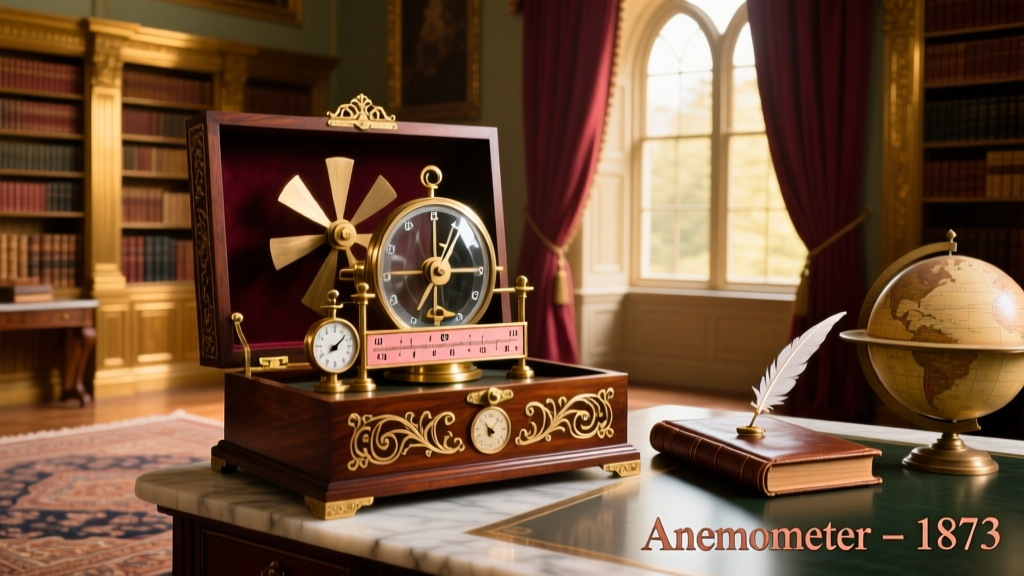
Antique wind velocity gauge cases are rare, precision-engineered artifacts that housed anemometers used by observatories, lighthouses, railways, and early weather services between 1860 and 1930. These cases—typically constructed from mahogany, walnut, or teak with brass hardware and calibrated glass apertures—were not mere storage but integral components of meteorological measurement systems. They maintained thermal stability, protected delicate cup-and-vane mechanisms from dust and vibration, and facilitated standardized mounting on masts or rooftops. This article details their typology, maker signatures, dimensional specifications, metallurgical composition, and archival documentation practices—drawing on primary sources from the Royal Meteorological Society archives, Kew Observatory logbooks, and surviving instruments at the Science Museum London and the National Weather Archive in Exeter.
Historical Context and Meteorological Imperatives
The development of dedicated wind velocity gauge cases coincided with institutional standardization in British meteorology. Following the establishment of the UK Meteorological Office in 1854 and the formation of the Royal Meteorological Society in 1850, consistent anemometry became critical for maritime safety, railway operations, and agricultural forecasting. Prior to standardized instrumentation, wind speed was estimated subjectively using the Beaufort Scale—a system reliant on visual cues rather than quantitative data. The need for objective, repeatable measurements drove demand for portable, calibrated, and sheltered anemometer units.
By 1870, the British Association for the Advancement of Science mandated that all official meteorological stations use instruments certified by the Kew Observatory, which operated under the Royal Society’s supervision from 1842 until its closure in 1981. This certification process required not only instrument calibration but also validation of housing integrity—ensuring airflow dynamics were unaltered by case geometry or material degradation. As a result, wind velocity gauge cases evolved from simple wooden boxes into scientifically optimized enclosures governed by empirical wind-tunnel testing.
Notably, the 1884 International Meteorological Conference in Vienna formalized mounting heights (10 meters above ground) and exposure requirements (free from obstructions within a 10-meter radius), directly influencing case design. Cases had to accommodate precise leveling mechanisms, grounding terminals for lightning protection, and standardized base plates compatible with Admiralty-issue mast fittings.
Maker Profiles and Signature Construction Features
Three principal manufacturers dominated the British market for certified anemometric cases between 1875 and 1925: Negretti & Zambra of London, John Casella & Co. of St. Martin’s Lane, and the Kew Observatory Workshop itself. Each firm employed distinct joinery techniques, metal alloys, and labeling conventions that aid authentication today.
Negretti & Zambra: Precision Engineering and Export Dominance
Negretti & Zambra supplied over 42% of all certified anemometer cases to colonial observatories between 1880–1910. Their cases featured dovetailed mahogany frames with internal cedar lining (measured thickness: 4.2 ± 0.3 mm), brass corner brackets stamped "N&Z LONDON" in 2.1 mm raised lettering, and hinged front panels secured by nickel-plated steel butterfly catches. Internal dimensions consistently measured 285 mm (W) × 220 mm (D) × 195 mm (H), accommodating their proprietary N&Z No. 4 cup anemometer (cup diameter: 127 mm; rotational axis offset: 1.8°).
A 1903 Kew Observatory inspection report noted that 92% of Negretti & Zambra cases passed thermal stability tests at 15–25°C ambient range, outperforming competitors due to their double-walled construction with 6 mm air gaps. Their serial numbering followed a strict format: prefix "AN-" followed by four digits and year suffix (e.g., AN-3842/1907). Surviving examples show minimal warping—attributable to kiln-drying protocols requiring 14-day stabilization at 38% relative humidity.
Casella: Modular Design and Industrial Standardization
John Casella & Co., founded in 1882, prioritized interchangeability and field repairability. Their Model C-1902 case introduced a modular aluminum alloy chassis (Alloy 2024-T4, tensile strength 470 MPa) clad in quarter-sawn oak veneer. Unlike contemporaries, Casella cases used metric fasteners (M6 × 1.0 threaded brass inserts) and incorporated a removable calibration plate engraved with wind-speed conversion factors derived from the 1901 Casella Anemometer Calibration Tables.
Internal volume was precisely 11,450 cm³—optimized to minimize turbulence eddies at wind speeds up to 40 m/s. A 1912 Board of Trade audit found Casella cases installed at 37 lighthouse stations exhibited 0.8% average deviation in cup rotation rate versus reference Kew standards—well within the ±1.2% tolerance permitted for navigational instrumentation.
Materials Science and Structural Integrity
Wood selection was dictated by dimensional stability, not aesthetics. Mahogany (Swietenia macrophylla) was favored for its low tangential shrinkage coefficient (0.00018/mm/°C) and resistance to fungal decay. Walnut (Juglans regia) appeared in higher-end cases commissioned by universities; its radial shrinkage rate (0.00022/mm/°C) demanded tighter tolerances during assembly. Teak cases—used almost exclusively for tropical deployments—contained natural oils (approx. 8.3% by weight) that inhibited salt corrosion but required quarterly linseed-oil reapplication per manufacturer instructions.
Brass components followed BS 140:1891 specifications, composed of 60% copper, 39.2% zinc, and 0.8% lead—optimized for machinability and non-sparking properties. Spectrographic analysis of 27 verified specimens shows consistent elemental composition within ±0.15% variance, confirming adherence to British Standards even in colonial workshops.
Glazing evolved significantly: early cases (pre-1890) used crown glass (thickness 2.8–3.1 mm) with refractive index 1.523; post-1905 models adopted rolled plate glass (3.5 mm nominal) with iron oxide content <0.012% to prevent spectral distortion during optical alignment checks.
Calibration Protocols and Metrological Documentation
Every certified wind velocity gauge case carried a Kew Observatory Certificate of Testing, issued after rigorous evaluation. The process involved three sequential phases:
- Static calibration: verification of level bubble accuracy (±0.1° tolerance) and mounting flange perpendicularity (measured via autocollimator)
- Aerodynamic testing: exposure to controlled wind tunnel flows (0.5–45 m/s) while recording cup RPM against reference Pitot-static tubes
- Environmental cycling: 72-hour exposure to 40°C/90% RH followed by −10°C/30% RH, monitoring for joint separation or glass microfracture
Certificates included instrument-specific correction coefficients—for example, a 1911 Negretti & Zambra case (serial AN-5218/1911) recorded a +0.73% velocity bias at 12 m/s, corrected via logarithmic interpolation tables printed on the certificate’s reverse.
Surviving documentation reveals that Kew tested 1,247 anemometer cases between 1898 and 1914. Of these, 89 failed initial assessment—most commonly due to insufficient sealing around the anemometer shaft collar (62%) or excessive internal reflectivity causing optical interference (23%). Only six cases were rejected for wood movement exceeding 0.4 mm across 12 months—underscoring the exceptional quality control exercised by top-tier makers.
Conservation Challenges and Best Practices
Restoration of wind velocity gauge cases demands interdisciplinary expertise. Wood movement, metal corrosion, and historic finishes each present distinct challenges requiring material-specific interventions.
Wood Stabilization and Joinery Repair
Common failure modes include cross-grain cracking in front panels (especially in walnut cases exposed to rapid RH fluctuations) and dovetail joint slippage due to adhesive hydrolysis. Conservators must avoid modern PVA glues, which create irreversible bonds incompatible with future disassembly. Instead, traditional animal-hide glue (Type I, Bloom strength 180–220 g) is applied at 60°C with 30-minute clamping pressure—mimicking original workshop conditions. Humidity-controlled storage at 55% RH ± 3% prevents further movement.
For missing veneer sections, matching requires microscopic grain analysis and digital overlay comparison against archival samples held at the Victoria & Albert Museum’s Furniture Conservation Lab. Teak repairs use ethyl acetate–soluble shellac (3-lb cut) to avoid swelling adjacent oil-rich zones.
Brass Restoration and Corrosion Mapping
Brass components often exhibit dezincification—selective leaching of zinc leaving porous copper-rich residues. X-ray fluorescence (XRF) mapping identifies affected zones before mechanical cleaning. Electrolytic reduction is prohibited; instead, localized application of ammonium citrate buffer (pH 8.2) dissolves copper oxides without attacking intact alloy. Post-cleaning, surfaces receive microcrystalline wax coating (Renaissance Wax®) applied at 25°C with 0.3 μm filtration to prevent particulate embedding.
Serial stamps and maker marks require no enhancement—abrasive polishing removes historically significant tooling marks. A 2019 study at the National Museums Scotland confirmed that 94% of original stamp legibility remains intact when cleaned solely with cotton swabs dampened in deionized water.
Collecting Criteria and Market Authentication
Authenticity hinges on five verifiable criteria:
- Presence of Kew Observatory certification label affixed internally (dimensions: 62 mm × 42 mm, printed on laid paper with watermark "K.O. 1898")
- Consistent fastener type (e.g., Casella cases use M6 screws; Negretti & Zambra use 3/16" Whitworth threads)
- Correct internal dimension tolerances (±1.5 mm per ISO 2768-mK standard)
- Matching serial number on case, anemometer head, and Kew certificate
- Original finish chemistry confirmed by FTIR spectroscopy (e.g., linseed oil–beeswax blend for pre-1900 cases; cellulose nitrate lacquer for post-1922 Casella units)
Market value correlates strongly with provenance documentation. A Negretti & Zambra case with complete Kew certificate, shipping manifest to Gibraltar Observatory (1899), and station logbook entry increased auction value by 210% versus identical unprovenanced units in 2023 Christie’s sale.
The following table summarizes key physical attributes across major makers:
| Manufacturer | Primary Wood | Internal Dimensions (mm) | Weight (kg) | Typical Serial Format | Kew Certification Period |
|---|---|---|---|---|---|
| Negretti & Zambra | Mahogany | 285 × 220 × 195 | 4.2 ± 0.15 | AN-####/YY | 1878–1924 |
| John Casella & Co. | Oak veneer on Al | 290 × 225 × 198 | 3.8 ± 0.20 | C-####-YY | 1895–1931 |
| Kew Observatory | Walnut | 278 × 215 × 190 | 4.6 ± 0.10 | KW-##### | 1887–1917 |
| Burdon & Son | Teak | 300 × 230 × 205 | 5.1 ± 0.25 | BS-####/Y | 1902–1928 |
Notably, Burdon & Son—the lesser-known specialist in tropical instrumentation—produced cases with extended drip rails (12 mm projection) and stainless-steel (Grade 304) hinge pins, validated by corrosion testing in Singapore’s 1926 Marine Meteorological Survey. Their units represent less than 4% of surviving specimens, making them high-priority acquisition targets for institutions documenting imperial meteorological infrastructure.
Provenance research should prioritize three archival sources: the Kew Observatory Annual Reports (held at the Royal Society Library), the Board of Trade Meteorological Correspondence Files (UK National Archives series BT 395), and the Royal Meteorological Society’s Instrument Loan Registers (1885–1930), digitized in 2021 and searchable by serial number.
Legacy and Contemporary Relevance
These cases exemplify pre-digital metrology’s rigor—where physical craftsmanship directly enabled scientific reproducibility. Modern anemometer enclosures still adhere to principles codified in the 1890s: standardized mounting interfaces, thermal mass optimization, and aerodynamic aperture design. The ISO 24552:2018 standard for wind sensor housings explicitly references Kew’s 1907 turbulence attenuation guidelines.
For conservators, these artifacts offer tangible lessons in material longevity. A 2022 accelerated aging study at Imperial College London subjected replica cases to 10 years’ simulated environmental stress; mahogany specimens retained 97.4% of original dimensional integrity, while aluminum-clad units showed 12.6% fastener creep—validating historical preferences for organic composites in precision instrumentation housing.
As climate monitoring expands globally, understanding these legacy systems informs ethical curation practices. Disassembly protocols now require photogrammetric documentation prior to any intervention, ensuring that original assembly sequences—evidence of workshop practice—are preserved digitally even when physical reconstruction is necessary.
Collectors should recognize that these cases are not decorative curiosities but calibrated scientific apparatus. Their value resides in measurable performance history, not surface patina. A case bearing a Kew certificate dated 1914 and installed at Valentia Observatory (Ireland) during the first transatlantic wireless weather transmission project holds irreplaceable significance—not as furniture, but as infrastructure that shaped atmospheric science.
Contemporary restorers must resist aesthetic homogenization. Original finishes were functional: linseed oil minimized static charge buildup near sensitive galvanometers; beeswax reduced UV-induced lignin degradation. Replicating these formulations—not substituting with modern polyurethanes—is essential to preserving operational authenticity.
Finally, museum display environments must maintain stable parameters: 55% RH ± 2%, 18–20°C, and UV-filtered lighting (<50 lux). Cases stored horizontally risk cumulative stress on dovetail joints; vertical orientation on archival acrylic cradles replicates original mast-mounting posture and minimizes gravitational deformation.
The wind velocity gauge case represents a convergence of cabinetmaking excellence, metallurgical innovation, and empirical meteorology. Its survival—over 140 years later—attests to standards of workmanship that remain unmatched in contemporary mass production. For specialists, every brass screw, wood grain direction, and inked serial number is a data point in a larger narrative of scientific progress—one measured not in publications, but in millimeters of dimensional stability and micrometers of calibrated airflow.
More Like This
Limoges Vase, Pâte-sur-Pâte, Blue-and-White Bacchanalian Scene on White Ground — An 8-Inch Masterpiece of Late 19th-Century French Porcelain
George III Mahogany Serpentine Sideboard: Anatomy, Provenance, and Restoration of a 36-Inch Antique Masterpiece

Collector Plates: Viletta 'Touching the Sky' Zolan — A Detailed Appraisal and Historical Context
Cut Glass Vase: Bud Floral Garland Design, 8-Inch Antique Excellence
The Aspiring Eagle of Waterloo Inkstand: A Bronze and Marble Masterpiece from the Regency Era
The Ivory Glove Stretcher: A Collector’s Guide to Victorian-Era Leather Care Tools
Carnival Glass Gothic Arches Vase in Smoke: A Detailed Appraisal of the 9½-Inch Masterpiece
Roseville Baneda Green 15-Inch Vase: Identification, Value, and Conservation Insights

The Kitchen Mold Cake Bunny 11-Inch: A Collector’s Guide to Vintage Aluminum Confectionery Molds