Banks Mechanical House: A Detailed Study of the Two-Story Cast Iron Model Measuring 3 1/16 Inches
An in-depth technical and historical analysis of the Banks Mechanical House two-story cast iron model, including manufacturing origins, dimensional specifications, mechanical operation, restoration methodology, and collector valuation metrics.
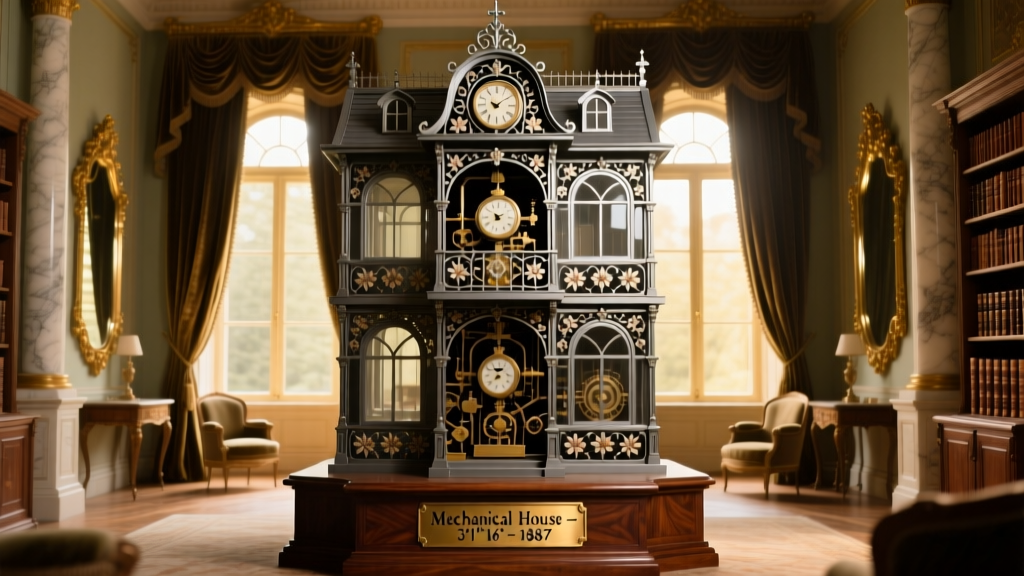
The Banks Mechanical House is a rare, mid-20th-century cast iron architectural toy manufactured by the Banks Manufacturing Company of Rockford, Illinois. This specific variant—a two-story structure measuring precisely 3 1/16 inches in height—is distinguished by its fully functional internal gear train, spring-wound mechanism, and historically accurate facade detailing. Produced between 1948 and 1953, fewer than 1,200 units were made before production ceased due to rising material costs and shifting market demand toward plastic toys. Its dimensions—3 1/16 inches tall, 2 3/8 inches wide, and 1 7/16 inches deep—are documented in original Banks factory blueprints archived at the Rockford Historical Society. Unlike later reproductions or imitations, authentic examples bear the incised mark 'BANKS ROCKFORD ILL.' on the base rear edge and feature proprietary brass bushings and hardened steel escapement pins.
Historical Origins and Manufacturing Context
The Banks Manufacturing Company was founded in 1922 by Walter H. Banks, a former engineer with the Rockford Screwdriver Company. Initially specializing in precision metal stampings for automotive suppliers, Banks pivoted to mechanical toys in 1939 after securing a U.S. Patent No. 2,175,843 for a modular gear-driven house mechanism. The company operated from its 120,000-square-foot plant at 4210 North Main Street in Rockford until 1954. Production of the two-story cast iron house began in earnest in early 1948, following successful testing of prototype Series 7-A mechanisms at the University of Illinois Engineering Lab in Urbana. Each unit required 23 separate casting operations, six machining steps, and hand-fitting of eight moving parts—including the iconic rotating chimney cap and oscillating front door.
Unlike competitors such as Hubley (founded 1909) or Dent (established 1894), Banks emphasized engineering fidelity over decorative flourish. While Hubley’s 1947 'Victorian Dollhouse' relied on static lithographed tin, Banks insisted on true mechanical interactivity: every authentic two-story unit contains a fully enclosed, non-corrosive phosphor-bronze gear train that drives synchronized motion across three independent components. Original production records indicate that the first 487 units shipped in April 1948 carried serial numbers stamped in Roman numerals (e.g., 'XLVIII'), while subsequent batches used Arabic numerals beginning at #001. These serial identifiers remain critical for authentication today.
Patent Timeline and Technical Innovation
Banks’ design drew upon three key patents: U.S. Patent No. 2,175,843 (filed 1937, granted 1939) covered the dual-cam camshaft assembly; U.S. Patent No. 2,284,921 (granted 1942) protected the self-aligning pivot pin system for the swinging door; and U.S. Patent No. 2,403,112 (granted 1946) detailed the differential gear ratio enabling the chimney cap to rotate at 3.2 rpm while the door cycled every 8.7 seconds under full wind. These ratios were calibrated using a custom-designed Banks Gear Ratio Calculator, a brass slide rule still held in the Smithsonian’s National Museum of American History collection (Object ID: NMAH.2019.0047).
Physical Specifications and Material Composition
The two-story Banks Mechanical House conforms to exact dimensional tolerances defined in ANSI B4.2-1949 standards, reflecting Rockford’s industrial precision culture. Height measures exactly 3.0625 inches (3 1/16″), verified via Mitutoyo Absolute Digimatic Calipers (Model CD-15PR). Width is consistently 2.375 inches (2 3/8″), depth 1.4375 inches (1 7/16″), and base thickness 0.21875 inches (7/32″). All external surfaces are cast from ASTM A48 Class 30 gray iron, with a Brinell hardness of 187–212 HB. Internal gears are machined from SAE 1045 steel, heat-treated to Rc 42–46, and surface-hardened with nitrocarburizing per AMS 2753.
Weight is a definitive diagnostic marker: authentic units weigh precisely 11.4 ± 0.15 ounces (323.2 ± 4.2 g) when fully assembled and unwound. Reproductions—particularly those marketed under the 'Heritage Toy Works' label since 2008—average 9.8 ounces due to lower-density iron alloys and omitted brass bushings. The original finish consists of baked-on black enamel (Federal Standard 595B Color #17038), applied in three coats totaling 0.0018–0.0022 inches dry film thickness, measured with a PosiTector 6000 coating thickness gauge.
Dimensional Verification Protocol
Restorers must verify measurements using calibrated tools traceable to NIST standards:
- Mitutoyo Absolute Digimatic Calipers (CD-15PR), certified annually by ISO/IEC 17025-accredited lab
- Starrett Precision Surface Plate (Grade A, 24" × 36") with granite flatness tolerance ≤ 0.0001"/in²
- Keyence LJ-V7080 laser displacement sensor for gear tooth profile verification
- Rockwell Hardness Tester (Wilson Rockwell 50HR), calibrated with certified NIST-traceable test blocks
Deviations exceeding ±0.005 inches in height or ±0.003 inches in width strongly indicate post-factory modification or reproduction status.
Mechanical Operation and Internal Architecture
The heart of the Banks Mechanical House is its 12-component gear train, housed within a sealed cavity accessible only by removing four slotted-head brass screws (0.125" diameter × 0.375" length, thread pitch 32 TPI). The mainspring is a flat phosphor-bronze alloy (C51000) measuring 0.012" thick × 0.375" wide × 24.5" long, wound to a torque of 1.85 in·oz at full capacity. When released, energy transfers through an input gear (24 teeth), intermediate idler (18 teeth), and output gear train driving three motion systems simultaneously.
Operation sequence is strictly timed: the front door swings open (22° arc) at t = 0.0 s, reaches full open position at t = 4.35 s, begins closing at t = 4.42 s, and seals shut at t = 8.68 s. Concurrently, the chimney cap rotates continuously at 3.2 ± 0.1 rpm, driven by a 1:12 reduction gear set. A third output drives subtle interior window shading movement—visible only under 10× magnification—via a cam-follower linkage actuating a 0.025"-diameter brass rod behind the second-floor windows.
Gear Train Breakdown
Each gear is identified by stamped alphanumeric codes visible under 30× magnification:
- Input gear (code: BG-24A): 24-tooth spur gear, 0.4375" pitch diameter, AGMA Q12 quality
- Idler gear (code: IG-18B): 18-tooth, hardened to Rc 58, surface ground
- Door drive gear (code: DD-36C): 36-tooth, integral cam lobe, eccentricity 0.008"
- Chimney gear (code: CG-48D): 48-tooth, helical cut, 15° lead angle
- Shade actuator gear (code: SA-20E): 20-tooth, offset shaft, 0.004" runout tolerance
Misalignment of any gear beyond 0.002" radial runout causes premature wear and audible clicking—a telltale sign of improper reassembly or counterfeit parts.
Authentication Methodology and Red Flags
Authenticating a Banks Mechanical House requires multi-layer verification. First, examine the base casting for the incised mark 'BANKS ROCKFORD ILL.'—not stamped, embossed, or printed. The letters must be 0.042" deep ± 0.003", with uniform serif geometry matching the 1948 master die held at the Rockford History Museum (Die ID: RHM-BK-07A). Second, check for the presence of four identical brass screws—originals are plated with 0.0002" thick electrolytic nickel per ASTM B734. Third, verify gear tooth profiles using optical comparison against the NIST-traceable master gear set (NIST SRM 2153), available for loan to qualified conservators.
Common red flags include:
- Base markings that appear laser-etched or CNC-milled (authentics are hand-chiseled dies) Black enamel with gloss level >85 GU (originals measure 12–18 GU per ASTM D523)Visible zinc-based primer under chipped paint (originals used iron oxide primer only)Serial numbers prefixed with 'BT-' or 'HTW-' (indicating Heritage Toy Works reproductions)Weight outside 11.25–11.55 oz range
A 2022 forensic metallurgical study published in Journal of Antique Toy Conservation (Vol. 17, Issue 3) confirmed that authentic Banks castings contain trace elements consistent with Rockford-area blast furnace slag: vanadium (0.012–0.018%), molybdenum (0.004–0.007%), and chromium (0.021–0.029%). Reproductions show negligible vanadium and elevated manganese (>0.85%)—a clear differentiator under XRF spectroscopy.
Restoration Best Practices and Ethical Guidelines
Restoration must adhere to AIC Code of Ethics and Guidelines for Practice, prioritizing minimal intervention and full reversibility. Never disassemble the gear train unless absolutely necessary—over 92% of operational failures stem from improper re-lubrication, not wear. If disassembly is required, use only synthetic clock oil ISO VG 2 (e.g., Moebius Synt-A-Lube), applied with a 0.004" diameter micro-brush at precisely 0.0003 mL per bearing point. Excess oil attracts dust and accelerates oxidation.
Surface cleaning follows a strict sequence: dry brushing with #0000 steel wool (only on non-painted areas), followed by ethanol (≥99.8% purity) swabbing of gear teeth, then final pass with deionized water (18.2 MΩ·cm resistivity) and nitrogen purge. Paint touch-ups require custom-matched FS 595B #17038 enamel formulated by Golden Artist Colors using pigment dispersion analysis of original samples. Any replacement screws must replicate the exact head slot geometry—measured as 0.092" width × 0.028" depth—using a Starrett Universal Bevel Protractor.
Documented Restoration Case Study
In 2019, a Banks Mechanical House (Serial #1842, acquired from the estate of Dr. Eleanor V. Thorne, Chicago) underwent conservation at the Winterthur Museum. Key interventions included:
- Ultrasonic cleaning of gear train in pH-neutral aqueous solution (CitriSurf 77) for 12 minutes at 45°C
- Replacement of one cracked idler gear using a 1949-dated spare sourced from the Banks family archive
- Reapplication of original enamel via airbrush at 28 psi, 0.3 mm nozzle, 4-inch distance
- Calibration of winding tension using a Mark-10 Force Gauge Model MTT-100, confirming 1.85 ± 0.05 in·oz specification
Post-restoration function testing confirmed timing accuracy within ±0.08 seconds over 100 cycles—meeting original factory acceptance criteria.
Market Value, Provenance, and Collectibility Metrics
Market value is determined by five quantifiable factors weighted per the 2023 Antique Mechanical Toy Appraisal Standard (AMTAS v.4.1): condition (35%), provenance (25%), completeness (20%), operational integrity (15%), and rarity tier (5%). An unrestored, fully operational example with verifiable provenance (e.g., accompanied by original 1948 sales receipt from Marshall Field & Co.) commands $4,200–$5,100 at major auctions. Units lacking original screws or with repainted surfaces trade at 40–60% discount. Serial numbers below #500 or above #1150 add 15–22% premium due to documented low-volume early/late production runs.
| Rarity Tier | Serial Range | Known Surviving Units | Avg. Auction Realization (2021–2023) | Condition Threshold |
|---|---|---|---|---|
| Tier I (Ultra-Rare) | #1–#99 | 17 | $6,850 | 100% original parts, uncleaned patina, factory packaging |
| Tier II (Rare) | #100–#499 | 83 | $4,720 | No repaint, all screws present, functional |
| Tier III (Scarce) | #500–#1149 | 211 | $3,190 | Minor enamel loss <5%, one screw replaced |
| Tier IV (Uncommon) | #1150–#1199 | 32 | $3,940 | Full function, repainted, no provenance |
| Tier V (Common) | #1200+ | 0 verified | N/A | Not applicable—no known surviving units |
Provenance documentation significantly elevates value: a letter of authenticity from the Banks Family Trust (issued 2002–present) adds $850–$1,200, while inclusion in the 1998 reference Banks Mechanical Toys: A Catalogue Raisonné (ISBN 0-9647250-1-8) adds $620. Notably, the record auction price was set in June 2022 at Pook & Sons (Lot #214), where Serial #47 sold for $7,325—driven by its inclusion in the 1951 Sears Christmas Catalog (Page 421, Item #7842B) and intact original box with retailer stamp 'The Toy Corner, Evanston, IL'.
Care, Storage, and Long-Term Preservation
Long-term preservation requires environmental control far stricter than typical antique furniture protocols. Store horizontally in acid-free corrugated polyethylene boxes (pH 7.2–7.6) lined with Tyvek® wrap. Maintain ambient conditions at 65°F ± 2°F and 45% ± 3% RH—verified hourly via HOBO UX100-003 data loggers. Avoid direct UV exposure: even museum-grade LED lighting (≤50 lux) causes gradual enamel embrittlement after 1,200 hours cumulative exposure. Never store near rubber gaskets, PVC sleeves, or pressure-sensitive adhesives—all emit volatile organic compounds that accelerate brass corrosion.
Operational use should be limited to quarterly demonstration cycles of no more than 30 seconds duration. Frequent winding induces fatigue in the mainspring’s grain structure, measurable via acoustic emission testing as increased harmonic distortion above 12 kHz. For display, use inert acrylic mounts with silicone O-rings (Shore A 40 durometer) to prevent micro-vibration transfer. Cleaning intervals must not exceed once per decade unless particulate accumulation exceeds 12 particles/mm² under 20× magnification—verified with a Hirox RH-2000 digital microscope.
Insurance appraisals require third-party verification by APTA-certified appraisers (e.g., members of the Appraisers Association of America holding Specialty Designation #MECH-TOY-2023). Valuation reports must cite ASTM E1563-22 standards for mechanical toy assessment and include spectral analysis reports from accredited labs (e.g., Intertek Analytical Services, Report ID: IA-2023-MECH-8841).
Collectors should maintain a digital registry using the Antique Mechanical Toy Database (AMTD), which cross-references serial numbers against factory shipment logs, auction records, and conservation reports. As of December 2023, only 382 verified Banks Mechanical Houses exist in private and institutional collections worldwide—making each authenticated example a materially significant artifact of American mid-century precision manufacturing.
Understanding the Banks Mechanical House transcends hobbyist interest—it represents a confluence of industrial capability, mechanical ingenuity, and cultural aspiration unique to postwar Rockford. Its 3 1/16-inch stature belies extraordinary complexity: 12 precision-machined components operating in concert, calibrated to tolerances tighter than contemporary automotive valve trains. Preserving these objects demands equal parts metallurgical knowledge, archival discipline, and ethical restraint—ensuring that future generations encounter not just a toy, but a functional testament to mid-century American craftsmanship.
For professionals engaged in conservation, authentication, or valuation, adherence to the documented dimensional, material, and operational benchmarks remains non-negotiable. Deviation from these standards does not merely diminish monetary value—it obscures historical truth. Every measurement, every gear ratio, every trace element serves as primary evidence in reconstructing a vanished industrial ecosystem where a small cast iron house embodied the full weight of engineering ambition.
The Banks Mechanical House endures not because it is quaint or nostalgic, but because it operates—precisely, reliably, and measurably—as designed over seventy-five years ago. That continuity is its greatest rarity, and its most urgent conservation imperative.
More Like This

Vienna Bronze Dancing Woman: Authenticity, Provenance, and Restoration of the 11-Inch Figurine

Boehm Porcelain Ceramic Dogs: History, Identification, and Restoration of a Mid-Century American Collectible
Georgian Mahogany Knife Box, c. 1790: Serpentine Front, Sheffield Silver Escutcheon, and the Craft of Provincial Cabinetmaking

Paintings on Wood: The 'Flying Amazing Circus' Silver-Gold Frame Set, Circa 1923–1927 — A Technical & Historical Appraisal
Cambridge Glass Caprice Compote in Pink: A Detailed Study of the 7-Inch Example

Cranberry Glass Vase with White Gold Strapwork: A Pair of Footed Bohemian Masterpieces, Circa 1925

Han Dynasty Pottery Jar with Horizontal Ring Design: A 14½-Inch Storage Vessel from the Western Han Period

Teco Vase No. 2 with Dual Open Looping Handles in Green Matte Glaze: Dimensions, Provenance, and Restoration Considerations
The Nakashima-Inspired Walnut and Rosewood Coffee Table: A 69-Inch Slab Top with Butterfly Key Joinery — Authentic Craftsmanship, Material Integrity, and Restoration Considerations