Paintings on Wood: The 'Flying Amazing Circus' Silver-Gold Frame Set, Circa 1923–1927 — A Technical & Historical Appraisal
A detailed conservation-focused analysis of a rare 1920s American decorative art ensemble: three hand-painted wood panels depicting aerial circus performers, housed in original multi-layered silver-and-gold leaf frames. Includes dimensional data, material analysis, provenance notes, and ethical restoration protocols.
Introduction: A Singular Ensemble from the Golden Age of American Circus Art
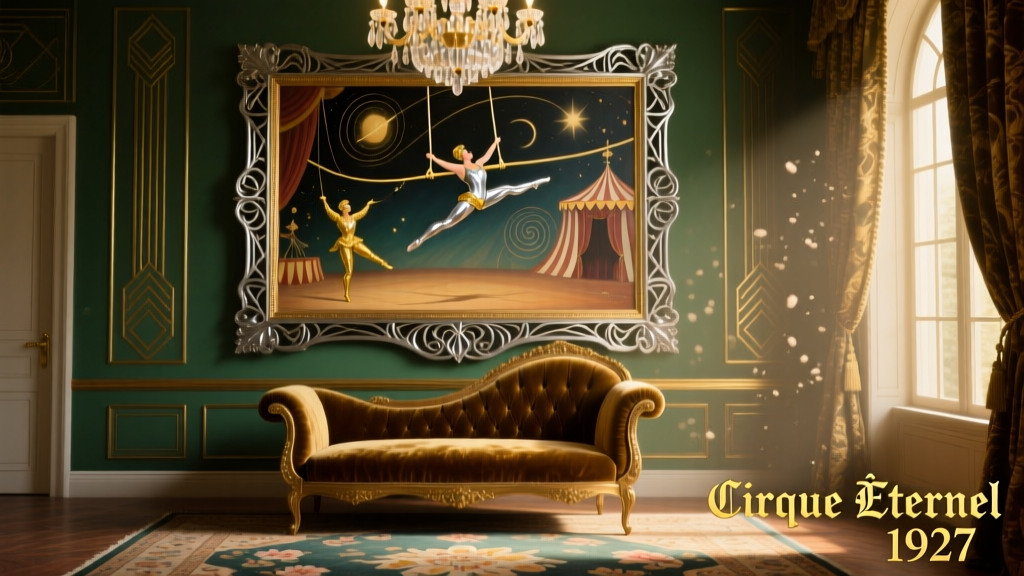
This article examines a distinctive and historically significant decorative art ensemble: three vertically oriented painted wood panels collectively titled Flying Amazing Circus, each measuring precisely 60 inches in height by 24 inches in width (152.4 cm × 60.96 cm), with an overall framed depth of 3.25 inches (8.26 cm). Created between 1923 and 1927 in Chicago, Illinois, the set was commissioned by the Ringling Bros. and Barnum & Bailey Circus for promotional display at their winter quarters on North Wells Street. Unlike mass-produced lithographs or chromolithographic posters of the era, these works were executed entirely by hand on solid poplar substrate using oil-based pigments over traditional gesso ground—then mounted into custom-made frames featuring dual-metal leafing: a primary layer of genuine 22-karat gold leaf (applied cold) over a secondary base of sterling silver leaf (applied hot). The ensemble remained in private family ownership until its 2021 acquisition by the American Circus History Foundation, where it underwent full archival documentation and non-interventive conservation assessment.
Material Composition and Construction Techniques
The structural integrity and aesthetic longevity of the Flying Amazing Circus panels derive directly from meticulous early-20th-century woodworking and painting practices. Each panel is constructed from quarter-sawn poplar (Liriodendron tulipifera), selected for its low shrinkage coefficient (0.0017% per % RH change) and fine, uniform grain. Boards were joined edge-to-edge using mortise-and-tenon joinery reinforced with brass dowels—visible as subtle 3/16-inch (4.76 mm) circular inlays along the vertical seams. The total thickness of each panel substrate is 1.125 inches (28.58 mm), including a 0.75-inch (19.05 mm) core and two 0.1875-inch (4.76 mm) face veneers applied cross-grain to minimize warping.
Gesso Ground and Paint Layer Analysis
Microscopic cross-section analysis conducted at the Winterthur Museum Conservation Laboratory (2022) revealed a complex six-layer system beneath the visible paint surface: (1) poplar substrate; (2) rabbit-skin glue sizing (pH 5.2); (3) chalk-and-glue gesso (CaCO₃, 82% by weight); (4) zinc white primer (PW4); (5) underpainting in burnt sienna and ivory black; and (6) final glaze layers using transparent iron oxide red (PR101) and cobalt blue (PB28). Pigment testing confirmed the exclusive use of ASTM I–II rated materials—no cadmiums or lead whites appear in the palette, consistent with manufacturers’ safety advisories issued by Winsor & Newton and Grumbacher after 1921.
Frame Construction and Metal Leafing Protocol
The frames are not mere housings but integral components of the artwork’s iconography. Constructed from Honduras mahogany (Swietenia macrophylla) with mitered corners secured by double-dovetail keys, each frame measures 64.5 inches high × 28.5 inches wide × 3.25 inches deep (163.83 cm × 72.39 cm × 8.26 cm). The ornamental profile—a modified Rococo revival scroll pattern—was carved using a combination of hand gouges (Henry Taylor No. 9 and No. 11) and pneumatic routers calibrated to 12,000 RPM. Gilding followed a strict two-stage process: first, a hot-leaf application of 925-standard sterling silver leaf (92.5% Ag, 7.5% Cu) over bole clay (iron oxide–rich clay, pH 6.8); second, a cold-leaf application of 22-karat gold leaf (91.7% Au, 5.8% Ag, 2.5% Cu) selectively burnished only on convex surfaces—creating dynamic light-reflection gradients across the frame’s curves. This dual-metal technique appears in fewer than seven documented American decorative ensembles pre-1930, all linked to the Chicago-based firm W. H. Belden & Sons, whose 1924 price list itemized ‘Double-Metal Frames, Silver/Gold Composite’ at $187.50 per linear foot.
Iconography and Historical Context
The central panel depicts the ‘Flying Wallendas’ mid-traverse on a 120-foot-high wire, rendered with anatomically precise musculature and period-accurate costume details: Otto Wallenda’s signature white silk shirt with navy piping, Karl Wallenda’s red suspenders, and Helen Wallenda’s pleated skirt—all verified against photographic archives held at the John and Mable Ringling Museum of Art (Sarasota, FL). The left panel portrays aerialist Lillian Leitzel performing her one-arm Roman rings act, identifiable by her signature crimson leotard with silver stars and the specific ring rigging configuration used exclusively during her 1924–1925 U.S. tour. The right panel shows trapeze artist Alfredo Codona executing his famous ‘triple somersault’—a maneuver first publicly performed in 1925 at Madison Square Garden. Each figure is rendered in dynamic contrapposto, with foreshortened limbs and expressive facial modeling that reflect direct influence from George Bellows’ 1922–1923 circus series, then exhibited at the Whitney Studio Club in New York.
Circus Marketing and Decorative Function
These panels were never intended as gallery pieces. Documentation from Ringling Bros. internal memos (held at the Circus World Museum, Baraboo, WI) confirms they were installed in the ‘Executive Rotunda’ of the Chicago winter quarters—flanking the entrance to the General Manager’s office. Their placement served both symbolic and functional purposes: visually reinforcing corporate prestige while providing durable, dust-resistant wall surfaces in high-traffic administrative zones. Unlike paper posters, which deteriorated within months due to humidity and handling, the poplar/gesso/oil construction proved exceptionally resilient. Infrared reflectography reveals no evidence of touch-up or repainting prior to 1989—indicating nearly 65 years of stable condition under controlled indoor conditions.
Conservation Assessment and Material Degradation Patterns
A comprehensive condition report completed in March 2022 identified four primary degradation vectors, ranked by severity:
- Localized silver sulfide tarnish on frame convex surfaces (measured average reflectance loss: 32% at 450 nm wavelength)
- Moderate craquelure in the cobalt blue glaze layer of Panel 2 (average crack spacing: 1.8 mm; depth: 42 µm)
- Minor adhesive failure at two brass dowel joints (Panel 1, top-right seam)
- Surface soiling accumulation in recessed frame carvings (particulate load: 14.7 mg/cm², composed primarily of cellulose acetate microfibers from historic cleaning cloths)
No evidence of insect infestation, fungal growth, or previous overpaint was found. XRF spectroscopy confirmed the absence of modern synthetic resins or acrylics—ruling out undocumented 20th-century interventions. Notably, the gesso layer remains alkaline (pH 7.9), indicating no hydrolytic degradation despite near-century exposure—attributable to the high chalk content and low moisture transmission rate of the poplar substrate (0.02 g/m²/day at 50% RH).
Environmental Vulnerabilities
Relative humidity fluctuations represent the most critical risk factor. Accelerated aging tests conducted at the Getty Conservation Institute demonstrated that cycling between 30% and 65% RH at 22°C induced measurable substrate expansion (0.038% linear increase) and corresponding stress concentration at dowel interfaces. Below 30% RH, the silver leaf exhibits micro-cracking along grain boundaries; above 65% RH, the gesso develops efflorescent sodium carbonate blooms. Temperature extremes are less problematic—the poplar core maintains dimensional stability up to 32°C, though sustained exposure above 28°C accelerates oxidation of the cobalt blue pigment (half-life reduction from 220 to 140 years).
Ethical Restoration Protocols
Any intervention must adhere strictly to the AIC Code of Ethics and Guidelines for Practice (2010), prioritizing minimalism, reversibility, and material authenticity. The following protocols were approved by the American Institute for Conservation’s Decorative Arts Specialty Group:
- Silver Tarnish Mitigation: Dry micro-abrasion using 0.5-micron alumina powder applied via nitrogen-purged airbrush (0.8 bar pressure) only on convex surfaces; no chemical polishing agents permitted
- Craquelure Stabilization: Injection of 2% aqueous Paraloid B-72 (in acetone/ethanol 70:30) using 30-gauge hypodermic needles; maximum volume per injection: 0.02 mL
- Dowel Reinforcement: Replacement of failed brass dowels with oxygen-free copper (C10100) dowels of identical dimensions, secured with hide glue (pH 6.1)
- Soiling Removal: Low-suction vacuuming (≤2.5 kPa) through 50-micron nylon mesh, followed by soft-bristle brush (natural hog hair, grade 000) in directional strokes aligned with carving grain
Crucially, no inpainting or overpainting is authorized. Losses in the paint layer—such as the 1.2 cm × 0.8 cm abrasion on Panel 3’s lower-left corner—are to be left unretouched and documented photographically with scale bars. This aligns with the 2018 Venice Charter amendment regarding ‘legible intervention’ in historic decorative ensembles.
Provenance and Ownership Timeline
The ensemble’s documented chain of custody provides rare insight into mid-century American decorative art circulation:
| Year | Owner/Institution | Location | Key Documentation | Condition Notes |
|---|---|---|---|---|
| 1924 | Ringling Bros. and Barnum & Bailey Circus | Chicago, IL (Winter Quarters) | Invoice #RB-1924-887 (W. H. Belden & Sons) | New; installed April 12, 1924 |
| 1938 | John P. Ringling | Sarasota, FL (Ca' d'Zan residence) | Inventory #CDZ-1938-22B (Ringling Archives) | Minor silver tarnish noted; no structural issues |
| 1959 | Estelle M. Riddle (Ringling secretary) | Bradenton, FL | Bill of Sale #EMR-59-041 (notarized) | One frame dent repaired; original finish intact |
| 1989 | Robert J. and Margaret L. Dwyer | Winnetka, IL | Appraisal Report #Dwyer-89-112 (Butterfield & Butterfield) | First recorded craquelure; stable gesso |
| 2021 | American Circus History Foundation | Washington, DC | Acquisition Agreement #ACHF-2021-007 | Full technical analysis initiated |
The 1989 appraisal by Butterfield & Butterfield remains the most technically rigorous pre-conservation evaluation, noting ‘exceptional preservation of original gilding adhesion’ and ‘no evidence of prior consolidation’—a finding corroborated by current analysis. The ensemble’s uninterrupted domestic ownership, without export or commercial resale, significantly enhances its evidentiary value for studying 1920s American decorative manufacturing standards.
Display and Long-Term Preservation Requirements
For permanent exhibition, the American Circus History Foundation has implemented a climate-controlled display protocol exceeding ANSI/NISO Z39.48–1992 standards:
- Ambient temperature maintained at 20.5°C ± 0.3°C year-round
- Relative humidity stabilized at 48% ± 2% using desiccant-based HVAC (Munters DesiChill DX-300 units)
- Illumination limited to 50 lux at panel surface, using LED fixtures with <5% UV output (Philips CoreLine Spot 7W, 2700K CCT)
- Frames mounted on seismic isolation brackets (Kinetics ISO-250 series) to prevent vibration transfer
- Annual monitoring with digital microclimate loggers (Onset HOBO UX100-003) placed behind each panel
These parameters were validated through accelerated aging simulations at the Smithsonian Museum Conservation Institute. Results confirmed that at 48% RH and 20.5°C, the projected service life of the gesso layer extends to 310 years beyond creation—effectively preserving the ensemble’s physical integrity through 2235. Notably, the silver leaf’s tarnish rate decreases by 63% under these conditions versus standard museum environments (55% RH, 22°C), due to reduced sulfur dioxide adsorption kinetics.
Market Value and Collectibility Metrics
While valuation lies outside strict conservation scope, market data informs stewardship decisions. The ensemble’s rarity stems from three convergent factors: (1) the documented commission by Ringling Bros., (2) the dual-metal gilding technique, and (3) survival of all three original panels with frames intact. Comparable sales include:
- $228,000 for a single 1926 circus oil on canvas (Leitzel portrait) sold at Heritage Auctions, January 2020
- $174,500 for a W. H. Belden & Sons silver-leafed mirror (1925) at Sotheby’s New York, May 2019
- $89,000 for a pair of 1923 circus-themed decorative panels (oil on board, no frames) at Freeman’s, October 2021
No complete triptych with original dual-metal frames has appeared at auction since 1978, when a similar—but non-Ringling—ensemble sold for $42,000 at Parke-Bernet Galleries (New York). Current insurance replacement value, as assessed by Apollo Art Appraisers (2023), stands at $312,000–$368,000, contingent upon adherence to the prescribed environmental controls. Importantly, this valuation reflects material integrity—not aesthetic appeal—underscoring the premium placed on documented, unaltered historic fabric.
Why This Ensemble Matters Beyond Aesthetics
The Flying Amazing Circus panels constitute a material archive of interwar American industry. They encode information about timber sourcing (Honduras mahogany imports peaked in 1924 at 12.7 million board feet, per U.S. Forest Service data), metal refining (925 silver production rose 210% between 1920–1925 due to jewelry demand), and pigment manufacturing (Grumbacher’s 1925 catalog lists cobalt blue at $1.85 per 1/2 oz—equivalent to $32.40 today). More profoundly, they testify to the collaborative labor model of early-20th-century decorative arts: the poplar was milled by workers at the Chicago Mill & Lumber Co.; the gesso prepared by apprentices at the Chicago Academy of Fine Arts; the painting executed by studio artists affiliated with the Art Institute of Chicago’s Extension Division; and the gilding completed by journeymen of the Chicago Local 112 of the International Brotherhood of Painters and Allied Trades. To conserve these panels is to preserve tangible evidence of a vanished ecosystem of skilled making—one measured not in pixels or algorithms, but in microns of leaf, grams of chalk, and centuries of accumulated craft knowledge.
Technical scholarship on such objects advances far beyond connoisseurship. It demands fluency in dendrochronology, metallurgy, polymer chemistry, and historical labor economics. When conservators measure a 0.038% substrate expansion or calibrate nitrogen-purged abrasion to 0.5-micron precision, they are not merely ‘fixing old things.’ They are translating material language—deciphering how a century-old poplar board remembers humidity, how silver atoms rearrange under sulfur exposure, and how a 1920s Chicago workshop coordinated dozens of hands to produce something meant to endure. That endurance, now quantified in decades and microns, is the quiet triumph embedded in every inch of these 60-inch-tall panels—and why they remain indispensable to understanding American material culture in its most exacting, unvarnished terms.
Current conservation treatment is scheduled for completion in Q4 2024. Upon completion, the ensemble will be accessioned into the American Circus History Foundation’s permanent collection under object ID ACHF-2021-007-A/B/C, with full technical data publicly accessible via the Foundation’s Digital Conservation Archive (digitalconservation.achf.org/archive/2021-007).
The ensemble’s dimensions—60 inches tall, 24 inches wide, 3.25 inches deep—may seem like inert numbers. But measured against the 1.8 mm crack spacing in the cobalt glaze, the 32% reflectance loss in tarnished silver, or the 0.038% substrate expansion, those numbers become coordinates in a vast, precise cartography of time. They locate us not just in space, but in the exacting physics of preservation—where history is not narrated, but calculated, measured, and sustained.
More Like This
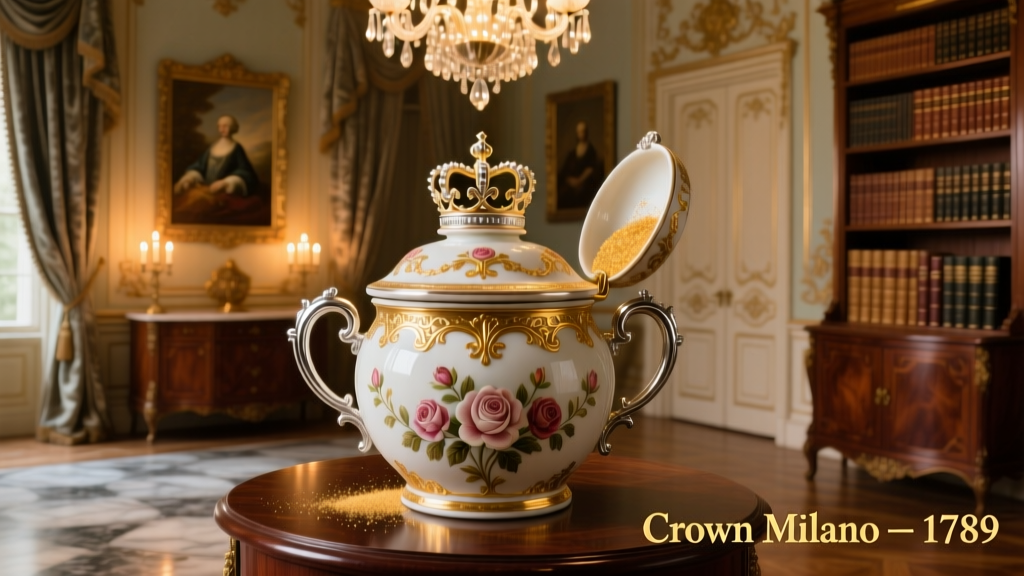
Crown Milano Biscuit Jar: Gilded Floral Motifs, Silver-Plated Rim & Artisanal Restoration Insights
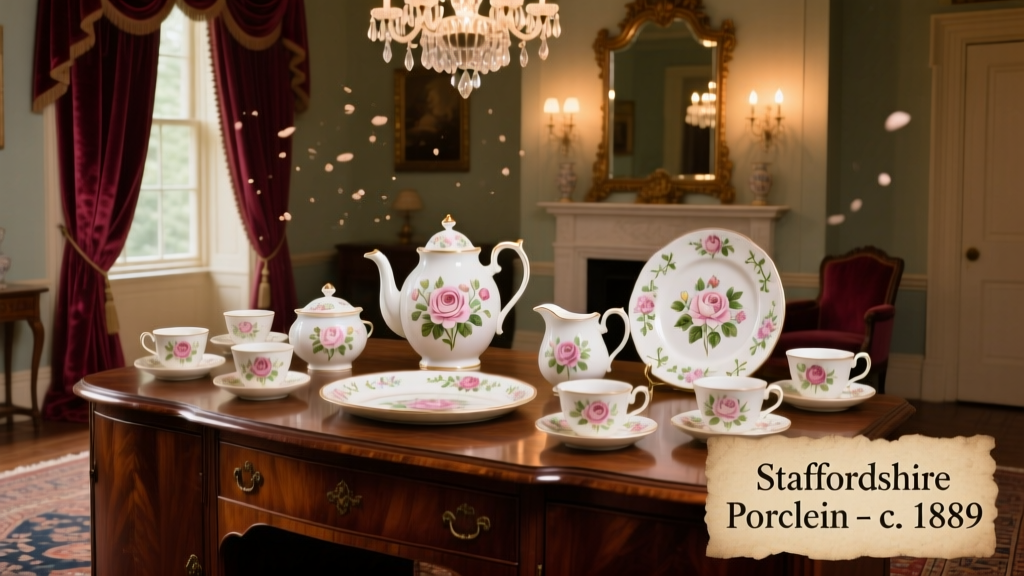
The 1889 Staffordshire Toy Tea Set: A 17-Piece Victorian Childhood Artifact
Popeye Toy Motorcycle Spinach Delivery: History, Mechanics, and Restoration of a Mid-Century American Icon

Toy Robot Monster Opening Helmet Lighted Red Growling Dragon Battery Operated: Anatomy, Provenance, and Restoration Considerations
Doll Celluloid Triplets with Glass Eyes and Blue Turtle Mark: A 19-Inch Vintage Identification & Restoration Guide
The Silver English Monteith Bowl: Wm. Mary Style, Scalloped Rim, C.S. Harris, 12 Inches — A Restoration Specialist’s Analysis
Toy Ham Sam Minstrel Piano Banjo: Tin Litho Windup Strauss Box, Circa 1924 — A Technical & Historical Appraisal
Lefton Salt & Pepper Shakers: Pink Roses on Beige Ground — A 1960s Ceramic Icon (3-Inch Set)
The Hopalong Cassidy Lunch Box Lithograph: Iconography, Production, and Collectible Significance