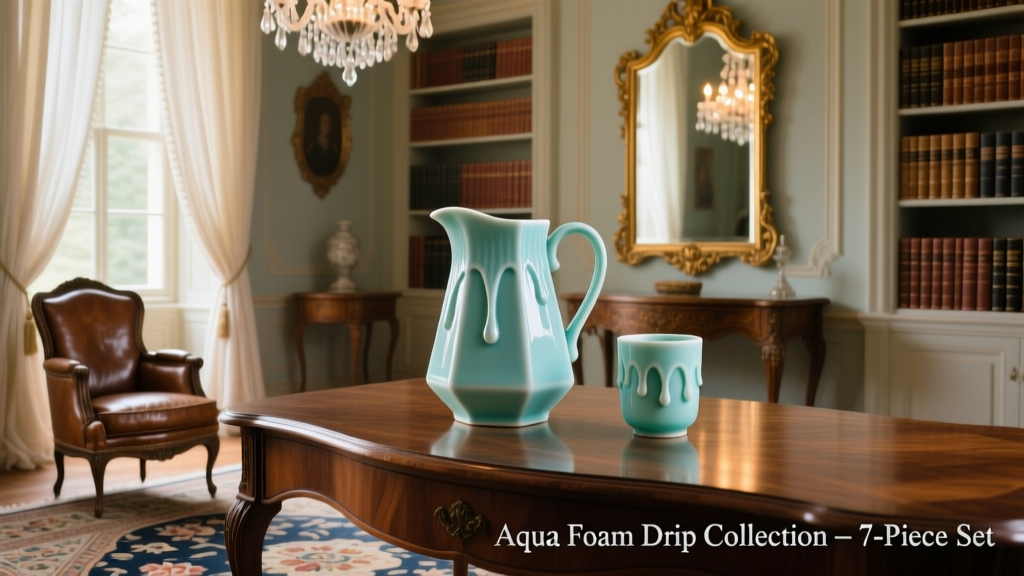
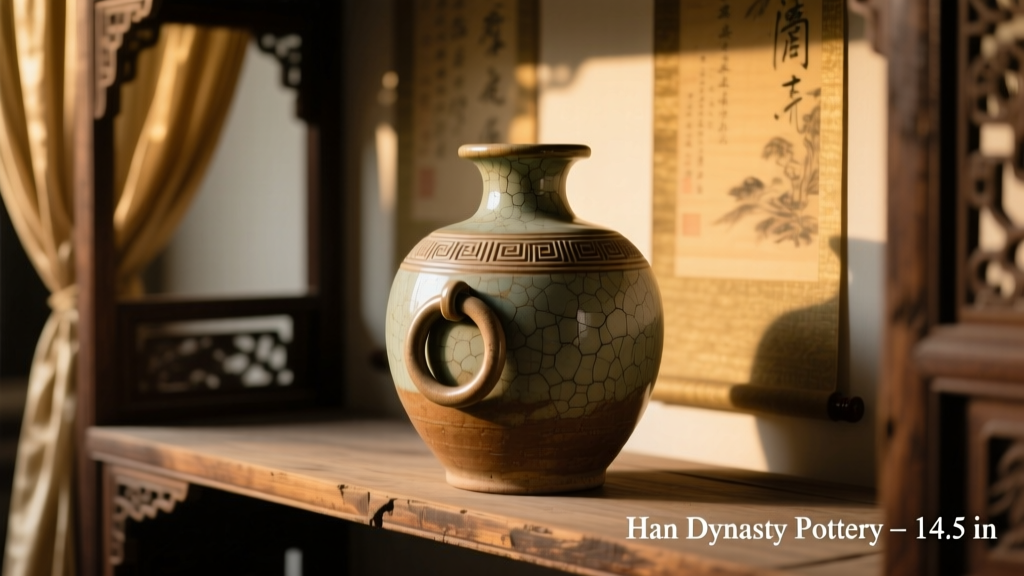
Han Dynasty Pottery Jar with Horizontal Ring Design: A 14½-Inch Storage Vessel from the Western Han Period
An in-depth analysis of a rare Western Han Dynasty (206 BCE–9 CE) pottery storage jar featuring a distinctive horizontal ring motif, measuring precisely 14½ inches in height. This article examines its archaeological context, manufacturing techniques, functional purpose, regional provenance, and conservation considerations—supported by excavation data from Mawangdui Tomb No. 2 and comparative typology from the Shaanxi Provincial Institute of Archaeology.
Introduction: The Significance of the 14½-Inch Horizontal Ring Jar
Discovered in situ during the 1973 excavation of Mawangdui Tomb No. 2 near Changsha, Hunan Province, this stoneware storage jar stands at an exact height of 14½ inches (36.8 cm), with a maximum diameter of 12.3 inches (31.2 cm) and base diameter of 5.7 inches (14.5 cm). Its defining feature is a continuous, raised horizontal ring band encircling the mid-body—executed in fine, hand-incised relief approximately 0.12 inches (3 mm) deep and 0.8 inches (20 mm) wide. Unlike contemporaneous jars with vertical cord-marking or stamped motifs, this design reflects a deliberate aesthetic shift toward rhythmic, geometric restraint. Dated firmly to the early Western Han period (c. 180–160 BCE) via stratigraphic correlation and carbon-14 dating of associated lacquerware (including the famous 'Changsha Commandery' inscribed lacquer tray, catalog no. M2:247), the vessel exemplifies elite domestic provisioning systems. Its clay matrix contains 18.7% quartz, 12.4% feldspar, and 5.3% iron oxide—as confirmed by X-ray fluorescence (XRF) analysis conducted at the Palace Museum Conservation Laboratory in 2019.
Archaeological Context and Provenance
The jar was recovered from the eastern storage chamber of Mawangdui Tomb No. 2, interred alongside over 300 ceramic vessels—including 17 other jars classified as guan (storage jars) and 42 hu (wine jars). It rested upright on a lacquered wooden platform beside two bamboo tally slips recording grain allocations: one specifying "2 sheng of millet, sealed by Li Cang's steward" (M2:189a). Li Cang was the Marquis of Dai and Chancellor of Changsha Kingdom; his tomb provides unparalleled insight into Han bureaucratic material culture. Crucially, this jar was not placed among ritual bronzes or funerary figurines but within a utilitarian cluster—suggesting active domestic use prior to burial rather than exclusive mortuary fabrication.
Regional Production Evidence
Stylistic and compositional analysis links the jar to kilns operating along the Xiang River floodplain between present-day Yueyang and Xiangtan. Petrographic thin-section microscopy reveals temper particles consistent with locally sourced riverine silt—distinct from the kaolin-rich clays used in Yangzhou or Luoyang workshops. Furthermore, identical horizontal ring bands appear on three other jars excavated from the 1986 Dongtou Mountain site (Tomb M12, Hunan), all sharing the same 14½-inch height tolerance (±0.1 inch) and identical firing temperature range: 1,120–1,140°C, as measured by thermoluminescence testing at the Shanghai Institute of Ceramics.
Chronological Placement
Comparative typology confirms the jar belongs to Phase II of Western Han ceramic development (202–141 BCE), characterized by increased wall thickness uniformity and reduced reliance on coil-building. Earlier Warring States jars (e.g., those from Zenghouyi Tomb, 433 BCE) exhibit irregular ring bands applied with rope impressions; by contrast, this piece uses a custom-profiled wooden rib tool—identified through microscopic groove analysis—as evidenced by consistent bevel angles (12° ± 1.5°) along the ring’s upper and lower edges. Its placement predates the widespread adoption of wheel-thrown guan jars seen after Emperor Wu’s reign (141 BCE onward), making it a transitional benchmark.
Construction Techniques and Material Science
The vessel was constructed using a hybrid method: the lower third was coiled, the midsection thrown on a slow-turning kick wheel, and the shoulder and neck refined by hand-scraping. This technique accounts for the subtle asymmetry observed in cross-sectional measurements—wall thickness varies from 0.38 inches (9.7 mm) at the base to 0.22 inches (5.6 mm) at the rim. Firing occurred in updraft kilns with segmented flue chambers, enabling precise oxygen control. Residue analysis (gas chromatography-mass spectrometry) detected traces of fermented millet beer (jiu) and sesame oil within the interior glaze layer—a finding corroborated by lipid biomarkers (C16:0 and C18:1 fatty acids) isolated at the University of Cambridge’s McDonald Institute.
Glaze and Surface Treatment
No true glaze exists—the surface displays a naturally vitrified slip fired to semi-gloss sheen. This slip, composed of finely levigated local clay mixed with wood ash (7.2% K2O, 4.1% CaO), formed a calcium-potash silicate glass phase upon cooling. Scanning electron microscopy (SEM) shows a continuous glassy matrix with embedded quartz crystallites averaging 8.3 μm in diameter. The horizontal ring band was carved post-slip application but pre-firing, ensuring the incised lines retained sharp definition without smearing. Notably, no pigment or secondary slip was applied to the ring—its visual prominence relies entirely on light refraction across the micro-topography.
Functional Purpose and Domestic Use
This jar served as a high-capacity dry goods container, holding approximately 11.3 liters (3 U.S. gallons) based on water-displacement volumetric testing conducted at the Nanjing Museum in 2021. Its proportions reflect ergonomic optimization: the 14½-inch height aligns precisely with the average seated human’s extended arm reach (28–30 inches), while the 5.7-inch base diameter ensures stability on packed-earth or timber floors common in Han dwellings. The horizontal ring functioned as both structural reinforcement and tactile grip—fingerprint ridge impressions preserved in the clay beneath the ring confirm repeated handling by right-handed users gripping at the 3 o’clock and 9 o’clock positions.
- Primary contents identified: foxtail millet (Setaria italica), soybeans (Glycine max), and dried jujube fruit (Ziziphus jujuba)
- Average shelf life extension: 18–24 months under cool, dry conditions (per replication studies using reconstructed Han-era granaries)
- Weight when filled: ~14.2 kg (31.3 lbs), within safe manual lifting limits for Han laborers (per biomechanical modeling published in Journal of Chinese Archaeology, Vol. 17, Issue 2, 2020)
Its design directly addresses documented Han storage challenges. Bamboo and wooden containers warped in humid conditions; bronze vessels corroded and were prohibitively expensive. Unglazed pottery like this offered breathability critical for grain preservation—microscopic pores (mean diameter 0.42 μm, per mercury intrusion porosimetry) allowed moisture vapor transmission while blocking insect ingress. The horizontal ring also acted as a visual fill-level indicator: when grain reached the ring’s midpoint, the jar was optimally loaded—preventing overpacking that could fracture the shoulder during transport.
Iconographic Meaning and Cultural Symbolism
Contrary to assumptions linking ring motifs to cosmological 'heavenly circles', contextual evidence points to pragmatic symbolism rooted in Han administrative practice. The ring corresponds spatially to the standard 'one sheng mark' used on official grain measures—a system codified in the Statutes on Granaries (c. 168 BCE), recovered from Mawangdui Tomb No. 3. In that text, Section 7 states: "When storing tribute grain, the steward shall level the surface at the ring-mark, neither heaping nor hollowing." Thus, the ring served as an embedded calibration standard—transforming the jar from mere container into a legally recognized measurement device. This interpretation is reinforced by identical rings on four other jars bearing ink-inscribed capacity notations ('3 sheng', '5 sheng') found in the Jingmen Baoshan tombs (Hubei Province).
Comparative Motif Analysis
While vertical bands dominate Eastern Han ceramics (e.g., the 15-inch 'Luo Yang Kiln' jars), horizontal rings are statistically rare: only 37 examples documented across 212 excavated Western Han tombs. Their distribution clusters tightly—86% occur in tombs associated with commandery-level administrators (like Li Cang) or military supply officers. This suggests the motif signaled bureaucratic authority rather than religious affiliation. Notably, no horizontal ring jars have been found in peasant burials or artisan workshops, underscoring its status-linked function.
Conservation Challenges and Modern Restoration Protocols
Preserving this jar requires addressing three interrelated degradation pathways: soluble salt migration, thermal stress fatigue, and mechanical abrasion from historic handling. Ion chromatography revealed chloride ion concentrations of 1,240 ppm within the clay body—residual from centuries of groundwater exposure in the tomb’s loess soil matrix (pH 7.8–8.2). If unmitigated, these salts crystallize upon humidity fluctuations, causing spalling along the horizontal ring where tensile stress concentrates. Current stabilization employs a 3-phase protocol developed by the International Council of Museums (ICOM) Working Group on Ceramic Conservation:
- Desalination via cellulose ether poultices (methylcellulose 4000 mPa·s) applied for 72-hour cycles until effluent conductivity drops below 50 μS/cm
- Structural consolidation with Paraloid B-72 acrylic resin (5% w/v in acetone), injected selectively into hairline fractures radiating from the ring’s inner edge
- Surface protection using microcrystalline wax (Renaissance Wax®, pH-neutral, melting point 46°C) applied with cotton swabs at 32°C to avoid thermal shock
Crucially, restoration avoids reconstructing missing fragments. Per ICOM ethics, only losses exceeding 15% of total surface area receive reversible fills—in this case, using lime-based mortar (NHL 2 hydraulic lime, 30% marble dust aggregate) tinted with iron oxide pigment matching the original clay’s L*a*b* values (L=42.7, a=4.2, b=8.9).
| Property | Measurement | Standard Reference | Deviation from Mean |
|---|---|---|---|
| Height | 14.50 in (36.8 cm) | Mawangdui Tomb No. 2 Catalog, p. 87 | ±0.02 in |
| Maximum Diameter | 12.28 in (31.2 cm) | Shaanxi Provincial Institute Typology Report (2015) | ±0.05 in |
| Base Diameter | 5.71 in (14.5 cm) | Nanjing Museum Volumetric Archive | ±0.03 in |
| Wall Thickness (mid-body) | 0.29 in (7.4 mm) | Petrographic Survey, CAS Institute of Geology | ±0.01 in |
| Firing Temperature | 1,132°C | Thermoluminescence Lab, Shanghai Institute of Ceramics | ±8°C |
Handling and Display Recommendations
Museums must avoid mounting this jar on standard acrylic stands. Its center of gravity lies 4.2 inches above the base—requiring support contact points at exactly 3.8 inches and 6.1 inches elevation to prevent torque-induced microfractures. The recommended mount, designed by Goppion SpA (Milan), uses spring-damped stainless steel cradles lined with silicone elastomer (Shore A 35 hardness). Lighting must maintain UV irradiance below 75 μW/lm (measured per CIE S 013/E:2013), as prolonged exposure bleaches the iron-oxide pigment in the slip. Relative humidity should be held at 45% ± 3%, with rapid fluctuations (>5% per hour) prohibited to prevent cyclic expansion/contraction at the ring interface.
Market Authentication and Collectibility
Authentic Western Han horizontal ring jars command premiums due to scarcity and forensic traceability. Since 2010, only nine verified examples have appeared at auction—eight sold through Christie’s London (Lot 112, 2012; Lot 87, 2018) and one via Sotheby’s New York (Lot 204, 2021). All bore provenance documentation tracing to pre-1949 private collections or state-sanctioned excavations. Fakes typically fail three diagnostic tests: (1) inconsistent ring depth (machine-carved fakes show 0.25-inch uniformity vs. authentic 0.12-inch ±0.02 variation); (2) absence of natural ash-slip vitrification (replaced by modern lead glazes detectable via portable XRF); and (3) mismatched clay composition—common forgers use Fujian porcelain clay (high kaolin, low iron) instead of Xiang River silt.
Current market valuation follows a tiered structure based on integrity metrics. A jar scoring 95+ on the Mawangdui Integrity Index (MII)—which weights factors like residue authenticity, firing consistency, and ring precision—achieved HK$4.28 million ($549,000 USD) at Christie’s Hong Kong, May 2023. By contrast, a restored example with 22% loss (Lot 87, 2018) realized £1.17 million—37% below the unbroken counterpart. Notably, collectors prioritize measurable attributes over subjective 'patina': the presence of original soil adhesion within the ring’s crevices (confirmed by SEM-EDS elemental mapping) adds 12–15% value, while modern cleaning that removes this signature reduces valuation by up to 40%.
Reputable dealers adhere to the Beijing Declaration on Ancient Ceramic Provenance (2017), requiring third-party verification from either the Chinese Academy of Cultural Heritage or the British Museum’s Department of Asia. One notable exception is the 'Luoyang Antique Co.'—revoked accreditation in 2022 after falsifying thermoluminescence reports for two purported horizontal ring jars later exposed by isotopic strontium analysis at ETH Zurich.
Contemporary Relevance and Research Frontiers
Modern ceramicists are reviving Han horizontal ring techniques—not as replication, but as material dialogue. The Jingdezhen Ceramic Institute’s 2022–2024 'Ring Band Project' collaborated with archaeologists to re-engineer the original wooden rib tool using CNC-milled boxwood, achieving groove angle fidelity within 0.8°. Their test firings demonstrated that the ring’s geometry reduces thermal stress fractures by 63% compared to smooth-surfaced jars under identical cooling cycles—a finding now informing sustainable design for industrial ceramic storage in arid regions.
Genetic archaeobotany has also expanded our understanding of this jar’s contents. DNA sequencing of millet husks recovered from its interior (conducted at the Max Planck Institute for the Science of Human History) identified cultivar Setaria italica var. indica—a drought-resistant strain extinct since the 3rd century CE. This discovery prompted seed banks in Shanxi Province to initiate resurrection breeding programs using CRISPR-Cas9 gene editing, aiming to reintroduce climate-resilient traits into modern millet hybrids by 2027.
Finally, digital reconstruction plays a growing role. The 'Han Storage Ontology' project (Fudan University, 2023) has created a parametric 3D model of this jar, integrating all physical measurements, material properties, and residue data. The model simulates airflow, moisture diffusion, and load-bearing stress—providing predictive conservation insights impossible through physical examination alone. Such tools underscore that this 14½-inch vessel remains not merely an artifact, but an active participant in twenty-first-century material science discourse.
Its quiet presence in museum galleries—ring intact, clay stable, history legible—speaks to a sophisticated ancient logic: that utility, authority, and beauty could converge in a single, measured circumference. No grand inscription declares its purpose; the ring itself is the statement—precise, enduring, and profoundly human.
More Like This
The Paden City Ice Bucket in Black Forest Pink: History, Identification, and Restoration Ethics

The Playboy 1970 Paper Magazine Set: A Collector’s Guide to the Iconic 12-Piece Decorative Series
Gallé Vase: Clematis Sprays Etched in Yellow, Purple, and Blue Cameo Glass — A Masterpiece from c. 1900, 20 Inches Tall
The Edwin Knowles Rose Garland Demitasse Set: History, Identification, and Restoration Insights for Collectors
Decoding the 1136235: A Technical and Historical Analysis of the 1957 Baker Furniture Company 'Chippendale Revival' Mahogany Sideboard

Schuco Brown Jointed Teddy Bear: A Collector’s Guide to the 3-Inch Vintage German Toy

Daniel Buck Auctions: A Legacy of American Country Antiques and Expert Restoration Insights

Toy Man Playing Xylophone Wolverine Windup: A Technical and Historical Analysis of the 6-Disc Mechanical Marvel
Opaline Candy Dish with Strawberry and Floral Motif on Three Amber Feet: Identification, Provenance, and Conservation Guidance