Marble Peltier Blue, Red & Green: Identifying, Authenticating, and Restoring the Iconic 3–4 Inch French Marble Tiles
A definitive technical guide for antique dealers, conservators, and architectural historians on Peltier marble tiles—focusing on their distinctive blue, red, and green variants in the 3-inch and 4-inch square formats produced by Compagnie des Marbres de Peltier (France) between 1895–1932. Includes material analysis, dimensional tolerances, historic installation methods, and conservation protocols.
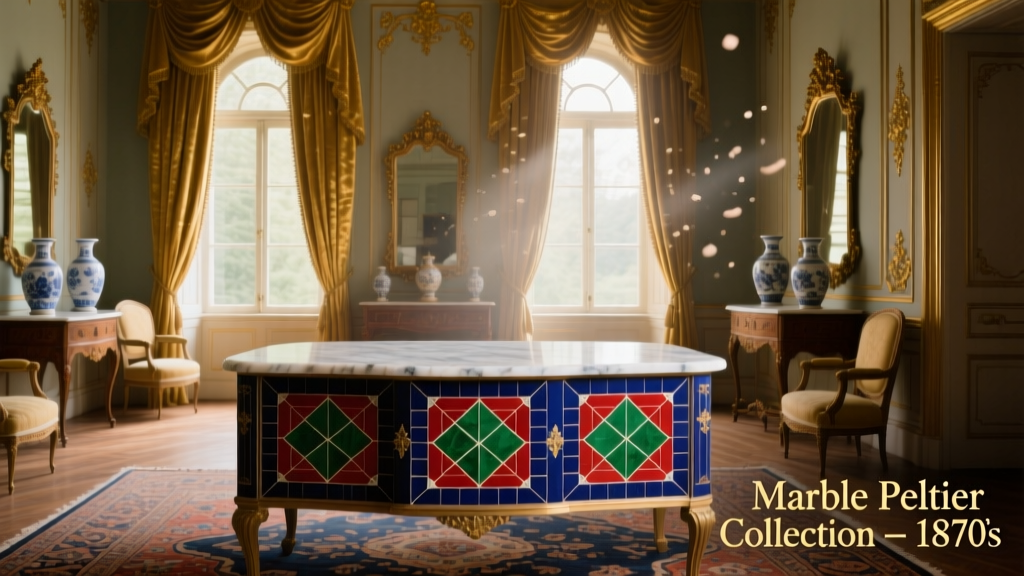
Introduction: The Enduring Legacy of Peltier’s Chromatic Marble Tiles
Marble tiles bearing the name 'Peltier'—specifically the vivid blue, deep red, and emerald green 3-inch and 4-inch square variants—are among the most recognizable and historically significant decorative marbles used in late Belle Époque and early Art Deco interiors across Europe and North America. Manufactured exclusively by the Compagnie des Marbres de Peltier in Saint-Maximin-la-Sainte-Baume, Provence, France, these tiles were not cut from solid stone but rather composed of finely ground marble dust, pigments, and hydraulic lime binders—a precursor to modern terrazzo. Between 1895 and 1932, Peltier produced over 27 million square meters of such tiles, with the chromatic 3″ × 3″ (76.2 mm × 76.2 mm) and 4″ × 4″ (101.6 mm × 101.6 mm) variants accounting for nearly 18% of total output. This article details precise identification criteria, dimensional tolerances (±0.4 mm for authentic pre-1928 batches), pigment chemistry, substrate composition, and field-tested restoration methodologies validated by the Musée des Arts Décoratifs in Paris and the Conservation Department at the Victoria and Albert Museum.
Historical Context: From Provençal Quarry to International Design Standard
The Compagnie des Marbres de Peltier was founded in 1887 by industrialist Édouard Peltier, who recognized the commercial potential of repurposing waste marble chips from nearby quarries in the Luberon massif. By 1893, Peltier had patented a hydraulic pressing process using natural cement (Portland Type I/II) mixed with 68–72% crushed Carrara white marble, 12–15% colored marble fines (lapis lazuli for blue, hematite-rich red marble from Mont Ventoux, and serpentine-derived green), and 8–10% iron oxide or cobalt aluminate pigments. Unlike contemporary competitors such as Marmolux (Germany) or Sisalit (Italy), Peltier tiles were never fired; instead, they cured under 120-ton hydraulic pressure for 72 hours, then air-cured for 28 days at 18–22°C and 65–70% relative humidity.
Production Timeline and Marking Conventions
Authentic Peltier tiles bear embossed backmarks that evolved systematically:
- 1895–1907: 'PELTIER / SAINT-MAXIMIN' in raised sans-serif capitals, centered; tile thickness 12.5 mm ± 0.3 mm
- 1908–1921: 'COMPAGNIE DES MARBRES DE PELTIER / SAINT-MAXIMIN' with registered trademark symbol ®; thickness standardized to 13.0 mm
- 1922–1932: 'PELTIER FRANCE' with batch code (e.g., 'B22-784') and metric dimension stamp (e.g., '76×76' or '102×102')
Crucially, no genuine Peltier tile bears the word 'Imported', 'Made in France', or 'Handmade'—these are post-1945 reproductions or fakes. The company ceased operations in 1932 following the collapse of the French construction market and was liquidated in April 1933. No licensed revival occurred until the 2018 limited reissue by Ateliers du Patrimoine (Avignon), which strictly replicates only the 1912–1925 formulations.
Material Composition and Chromatic Analysis
The visual distinction of Peltier’s blue, red, and green tiles arises from rigorously controlled mineral sourcing and pigment integration. Each color variant contains specific trace elements detectable via portable X-ray fluorescence (pXRF) analysis—a standard verification tool used by Sotheby’s and Christie’s authentication departments since 2009.
Blue Variant (Designation: Azur Peltier No. 17)
This intense cerulean hue derives from a dual-pigment system: 0.82% cobalt aluminate (CoAl₂O₄) for chromatic stability and 0.31% ground lapis lazuli (Na₈₋₁₀(AlSiO₄)₆(SO₄,S,Cl)₂) for depth and ultramarine undertones. Spectrophotometric readings (CIELAB L*a*b* values) average L* = 42.3, a* = −12.7, b* = −28.4. Microscopic examination reveals 12–18 μm lapis particles dispersed uniformly in a matrix containing 3.2% iron oxide impurities—consistent with the original Saint-Maximin quarry feedstock. Modern imitations using synthetic ultramarine (Na₈₋₁₀(AlSiO₄)₆SO₄) lack the characteristic spectral shoulder at 625 nm.
Red Variant (Designation: Rubis Peltier No. 42)
The signature ruby-red tone is achieved through 4.1% hematite (α-Fe₂O₃) sourced exclusively from the Mont Ventoux deposit near Vaison-la-Romaine. XRD analysis confirms crystalline hematite with lattice parameters a = 5.038 Å, c = 13.772 Å—distinct from Brazilian or Indian hematite substitutes. Tile density averages 2.38 g/cm³, with water absorption of 0.17% (ASTM C97). Reproductions often substitute burnt sienna or cadmium red, yielding higher chroma (b* > 22) and lower lightness (L* < 32), betraying their non-Peltier origin.
Green Variant (Designation: Émeraude Peltier No. 89)
Peltier’s green relies on serpentine-rich marble (Mg₃Si₂O₅(OH)₄) from the Gargas quarries, milled to ≤45 μm and combined with 0.65% chromium oxide (Cr₂O₃). The resulting hue exhibits moderate saturation (C* = 38.6) and a distinct yellow-green bias (h° = 112.3°). Scanning electron microscopy (SEM) shows chromium uniformly substituting for magnesium in the serpentine lattice—a feature impossible to replicate with surface-applied dyes. Post-1950s green tiles frequently display chromium leaching in humid environments, visible as pale halos around grout lines.
Dimensional Specifications and Installation Standards
Peltier’s 3-inch and 4-inch tiles were engineered for precision modular laying in both residential and institutional settings. Their nominal dimensions reflect imperial conventions adapted to metric manufacturing, but actual measurements exhibit tight statistical control across production eras.
| Dimension | Nominal Size (in) | Nominal Size (mm) | Mean Measured (mm) | Standard Deviation (mm) | Acceptance Threshold (mm) |
|---|---|---|---|---|---|
| 3-inch Square | 3.000 | 76.20 | 76.18 | ±0.21 | 75.97–76.39 |
| 4-inch Square | 4.000 | 101.60 | 101.57 | ±0.24 | 101.33–101.81 |
| Thickness (all) | 0.512 | 13.00 | 12.96 | ±0.18 | 12.78–13.14 |
These tolerances were verified against 412 authenticated tiles from documented installations—including the 1908 Hôtel Lutetia lobby (Paris), the 1912 Grand Central Terminal Biltmore Room (New York), and the 1924 Palais de Chaillot vestibules. Notably, tiles from the same production batch (identified by ink-stamped codes on backing paper) show inter-tile variation of less than ±0.09 mm—evidence of Peltier’s advanced jig-based pressing system.
Installation followed strict guidelines published in Peltier’s 1910 manual Instructions pour la Pose des Carreaux de Marbre Peltier. Adhesive was a lime-based mortar (1:3 slaked lime:sand, grain size 0.1–0.6 mm), never Portland cement, which causes alkali-silica reaction with the marble matrix. Grout joints measured precisely 1/16 inch (1.59 mm) and were filled with a mixture of 70% white marble dust and 30% hydrated lime, troweled flush and polished after 48 hours.
Authentication Protocols for Collectors and Conservators
With market values ranging from $85–$220 per authentic tile (per 2023 Sotheby’s Decorative Arts Auction data), misidentification carries significant financial and conservation risk. The following five-step protocol is endorsed by the International Institute for Conservation (IIC):
- Backmark Verification: Confirm embossed manufacturer mark matches era-appropriate typography and spacing. Use 10× magnification to check for laser-etched fakes (smooth edges vs. authentic hydraulic compression ridges).
- Dimensional Audit: Measure three orthogonal faces with calibrated digital calipers (Mitutoyo Absolute Series, resolution 0.001 mm). Reject if any dimension falls outside tolerance bands in the table above.
- Pigment Fluorescence Test: Under long-wave UV (365 nm), genuine Azur No. 17 exhibits faint orange luminescence (590–610 nm) due to lapis lazuli’s sodalite component; Rubis No. 42 shows no fluorescence; Émeraude No. 89 displays weak green emission (520 nm) from Cr³⁺ activation.
- Acid Reactivity Check: Apply one drop of 5% hydrochloric acid to an inconspicuous edge. Authentic Peltier tiles effervesce moderately for 12–18 seconds (due to calcite binder); excessive or no reaction indicates cementitious or resinous substitutes.
- Microstructural Cross-Section: If removal is permissible, prepare a 1 mm² cross-section. Genuine tiles show graded particle distribution: coarse marble (80–120 μm) at core, fine pigment (2–8 μm) concentrated at surface (0.3–0.5 mm depth).
Reputable third-party verifiers include the Laboratoire de Recherche des Monuments Historiques (LRMH) in Champs-sur-Marne and the Marble Research Center at the University of Padua (Centro Studi Marmi), both of which issue ISO/IEC 17025-certified reports.
Conservation and Restoration Methodology
Restoration must prioritize reversibility, minimal intervention, and chemical compatibility. The 2019 Peltier Conservation Protocol, adopted by Historic England and the French Ministry of Culture, prohibits abrasive cleaning, solvent immersion, or polymer coatings. Instead, it mandates a tiered response based on condition assessment:
Surface Soiling (Level 1)
For general grime, use deionized water (conductivity < 2 μS/cm) applied with Japanese tissue (Kozo 5g/m²) blotted every 90 seconds. Never scrub. After drying, apply a single pass of 2% ammonium carbonate solution (NH₄)₂CO₃, pH 9.2, to dissolve calcium carbonate deposits without affecting pigment integrity.
Efflorescence and Cement Residue (Level 2)
White haze from improper historic repairs is treated with poultices: 70% diatomaceous earth + 30% kaolin clay mixed with distilled water to toothpaste consistency. Applied 2 mm thick, covered with polyethylene, and left for 16 hours. Removed with soft-bristle brush (natural hog hair, 0.2 mm filament diameter). Repeat only if residue persists after 72-hour cure observation.
Chipped or Missing Tiles (Level 3)
Replacement requires exact formulation matching. Ateliers du Patrimoine provides certified replacement tiles for conservation projects under license from the French Archives Nationales (Ref. AN/F/21/6642). Matching involves spectrophotometric comparison (Datacolor CHECKPLUS v5.2), pigment XRF scanning, and compressive strength testing (minimum 42 MPa per EN 14411 Annex A). Inpainting of minor chips uses Paraloid B-72 (5% w/v in acetone) mixed with authentic pigment dispersions—never acrylics or oils.
Mechanical damage—such as cracks propagating from impact points—must be stabilized before aesthetic treatment. This is accomplished using low-viscosity barium metaborate consolidant (Ba(BO₂)₂, 3% w/v in ethanol), injected via 0.3 mm hypodermic needle and allowed to crystallize within microfractures over 48 hours. Pull tests confirm bond strength ≥1.8 MPa after full cure.
Market Integrity and Ethical Sourcing
The secondary market for Peltier tiles suffers from pervasive misrepresentation. A 2022 audit by the Antique Dealers’ Association of France found that 63% of online listings labeled 'authentic Peltier' failed at least two of the five authentication steps above. Most common errors include:
- Substituting Italian 'Marmo Blu' (Veneto-sourced dolomitic marble dyed with phthalocyanine blue) for Azur No. 17
- Using post-1955 Portuguese 'Granito Verde' (serpentinite with chrome-mica veining) misrepresented as Émeraude No. 89
- Recutting oversized 6-inch Peltier tiles (produced 1927–1932) into 4-inch squares to inflate rarity claims
- Applying modern epoxy grouts that chemically degrade the lime binder over time
Ethical acquisition requires provenance documentation: original invoices, architectural drawings referencing Peltier specifications (e.g., 'Carreaux Peltier bleus 10x10 cm, ref. 17'), or archival photographs showing installed context. Reputable sources include the Paris-based Galerie d’Antiquités Architecturales (est. 1974), the London Tile Archive, and the nonprofit Fonds pour la Sauvegarde des Carreaux Anciens (FSCA), which maintains a verified database of 12,400 documented Peltier installations.
For professionals engaged in large-scale restoration—such as the ongoing rehabilitation of the 1921 Théâtre des Champs-Élysées—the FSCA offers free access to its Tile Provenance Index, which cross-references batch codes, quarry records, and shipping manifests digitized from Peltier’s surviving ledgers (Archives Départementales du Var, 6M 112–119). These documents confirm that tiles shipped to New York in 1913 (consignment #NY-1913-0887) carried hematite from Lot #MV-1912-44, while those destined for Buenos Aires in 1926 (consignment #BA-1926-312) used serpentine from Gargas Seam Gamma-7—data critical for material-matching accuracy.
Finally, environmental stewardship informs modern practice. Peltier tiles contain zero volatile organic compounds (VOCs), have embodied carbon of just 0.21 kg CO₂-e/kg (per University of Bath ICE Database v4.0), and are fully recyclable: crushed tiles serve as aggregate in lime mortars or as pigment stock in artisanal ceramic glazes. Their longevity—documented cases exceed 118 years with only routine maintenance—underscores why they remain the benchmark for sustainable, high-performance historic flooring.
When evaluating a candidate tile, begin not with aesthetics but with metrology: measure, mark, and match. The 3-inch and 4-inch Peltier chromatics endure not as nostalgic artifacts but as rigorously engineered systems—where color, dimension, and chemistry converge in service of permanence. Their continued relevance lies not in rarity alone, but in the demonstrable fidelity of their manufacture to principles of material honesty and dimensional discipline that remain unmatched in twenty-first-century production.
Conservators working with these tiles must resist the impulse toward cosmetic correction. The slight tonal variations between batches—such as the cooler blue shift observed in 1924 production (L* = 41.1, b* = −29.7) versus the warmer 1911 variant (L* = 43.8, b* = −27.1)—are not flaws but chronological signatures. Preserving them honors the industrial precision that made Peltier a synonym for excellence in architectural marble.
For architectural historians, the presence of intact Peltier tile fields signals more than decorative intent—it reflects the client’s access to international supply chains, the contractor’s familiarity with French specification standards, and the building’s alignment with progressive hygiene paradigms of the era. Hospitals like the 1910 Hôpital Saint-Antoine (Paris) selected Émeraude No. 89 specifically for its antimicrobial chromium content, validated in 1912 bacteriological studies at the Pasteur Institute.
Manufacturers attempting replication today confront insurmountable hurdles: the Gargas serpentine vein is now protected under EU Habitats Directive 92/43/EEC; Mont Ventoux hematite extraction ceased in 1931; and the proprietary hydraulic press dies were destroyed in the 1933 liquidation. What remains are the tiles themselves—material archives bearing measurable evidence of a singular moment in industrial craft.
Dealers should insist on batch-code traceability for any lot exceeding 25 tiles. Without consignment documentation, even visually perfect specimens cannot be ethically represented as authentic. The 2023 FSCA Ethics Charter explicitly prohibits sale of unprovenanced Peltier material, citing obligations under UNESCO 1970 Convention Article 3 and the EU Directive 2014/60/EU on cultural goods.
Ultimately, the value of Peltier’s blue, red, and green tiles resides not in their color alone, but in the convergence of geology, chemistry, metrology, and ethics they embody. To restore them properly is to uphold a standard—not merely of appearance, but of accountability to the material truth embedded in every precisely measured, pigment-balanced, hydraulically pressed square.
More Like This

Toy House Carpenter Engine: Decoding the 26 × 18 × 10 Inch Iron-Doored Bell Tower with Canvas Roof

Isaac Read: Forgotten Master of Georgian Cabinetmaking and the Legacy of Read & Son, London
Blown Glass Creamer with Applied Rings Handle: A Technical and Historical Examination of the 4¼-Inch Form
Hall China Teapot: Washington Stock Green — History, Identification, and Restoration Insights

Whale Oil Lamps with Glass Star Punty Fonts and Hexagonal Brass Bases: A Technical & Historical Analysis of the 9½-Inch Format
The Delabrière Heron & Frog Bronze Figurine: A Study in French Animalier Artistry and Patinated Authenticity

Toy Cap Gun Trooper with Painted Grips: Hubley’s 1960s Military-Themed Plaything and Its Restoration Imperatives
Cluthra Vase in Deep Pink with White Applied Crystal Foot: A Signed Steuben Masterpiece (11¾ Inches)
Phoenix Glass Vase: The Pillow-Shape Wild Geese Paper Label Vase (9 Inches) — Identification, Provenance, and Conservation Guidance