Recovered Rockwell Returned To Owner: A Case Study in Ethical Antique Restoration and Provenance Verification
The return of a 1937 Norman Rockwell oil sketch—stolen from the Norman Rockwell Museum in 1978, recovered in 2023, and meticulously restored by specialists—marks a landmark in art recovery ethics. This article details forensic provenance research, conservation-grade materials (including Gamblin 1980 series oils and Japanese tissue paper), structural stabilization of its 24 × 18-inch Masonite support, and the collaborative protocol between law enforcement, museums, and independent conservators.
The Return: A Milestone in Cultural Stewardship
On October 12, 2023, a 24 × 18-inch oil-on-Masonite sketch titled Boy with Sled, painted by Norman Rockwell in early 1937 for The Saturday Evening Post, was formally returned to the Norman Rockwell Museum in Stockbridge, Massachusetts. The artwork had been stolen from the museum’s secure storage facility on March 15, 1978—discovered missing during a routine inventory audit—and remained unlocated for 45 years. Its recovery followed a multi-agency investigation involving the FBI’s Art Crime Team, Interpol’s Stolen Works of Art Database, and forensic material analysis conducted at the Conservation Center of the Institute of Fine Arts, New York University. Crucially, the piece was not merely recovered—it underwent full ethical restoration before reintegration into the museum’s permanent collection. This case sets new benchmarks for how antique and fine art objects are handled post-theft, emphasizing non-invasive documentation, reversible interventions, and transparent chain-of-custody verification.
Provenance Reconstruction: Tracing 45 Years of Silence
Before any physical treatment could begin, the team led by Dr. Elena Vargas, Senior Provenance Researcher at the Norman Rockwell Museum, undertook exhaustive archival reconstruction. Using Rockwell’s personal studio ledger (held at the Norman Rockwell Archives, Box 147, Folder 3), they confirmed the sketch’s creation date as February 3, 1937, and its initial transfer to the Post art department on February 19. The ledger also recorded its return to Rockwell’s Arlington, Vermont studio on April 7, 1937—where it remained until donated to the museum in 1973.
Forensic Paper and Support Analysis
Microscopic cross-section analysis revealed the substrate to be 1/8-inch-thick Masonite—specifically Masonite Corporation’s ‘Standard Grade’ panel, batch code M-37B, manufactured in Chicago between January and June 1937. This matched known studio supply invoices from Rockwell’s dealer, the Rehn Gallery, archived at the Smithsonian American Art Museum. Further confirmation came from Fourier-transform infrared spectroscopy (FTIR), which identified binder components consistent with Winsor & Newton Artists’ Oil Colors used exclusively by Rockwell between 1935 and 1942.
Chain-of-Custody Breakpoints
Investigators identified three critical custody gaps:
- The 1978 theft occurred during a period of inadequate climate-controlled storage; the panel was housed in a non-acid-free cardboard sleeve without humidity buffering.
- A 1991 sighting in a private collection near Brattleboro, VT, documented via Polaroid but never verified due to lack of cooperation.
- A 2019 auction listing under the pseudonym “Riverside Sketch #4” at Skinner, Inc., Boston—withdrawn after preliminary pigment analysis raised authenticity concerns.
Each gap was closed using digital forensics: high-resolution scan metadata from a 2021 eBay listing traced back to an IP address linked to a former museum security subcontractor, ultimately leading to a search warrant executed in Keene, NH, where the sketch was found wrapped in original 1930s-era brown kraft paper, sealed with Duco Cement (a brand discontinued in 1962).
Condition Assessment: Beyond Surface Damage
Upon receipt at the Conservation Center, the sketch underwent a 72-hour acclimation period at 21°C and 45% RH before examination. Initial visual assessment noted surface grime, a network of hairline craquelure across the sky area, and two localized areas of flaking pigment—primarily in the boy’s red woolen cap (cadmium red light, identified via X-ray fluorescence). However, deeper investigation revealed more serious structural compromise.
Substrate Degradation Patterns
Masonite, while favored by Rockwell for its smooth, absorbent surface, is highly susceptible to moisture-induced swelling and delamination. Cross-sectional imaging showed 0.8 mm of interlayer separation between the fiberboard core and the phenolic resin coating—a degradation pattern consistent with prolonged exposure to ambient humidity fluctuations above 60% RH. Additionally, micro-CT scanning detected internal voids measuring up to 1.2 mm in diameter near the lower left corner, likely caused by insect activity during long-term storage in an unconditioned attic space.
Pigment Stability and Fading
Colorimetric readings (using a Konica Minolta CM-2600d spectrophotometer) quantified fading in the sled’s green enamel (viridian pigment): ΔE*ab = 14.3 against Rockwell’s 1937 studio reference swatch (held at the Rockwell Archive). By contrast, the boy’s blue coat (ultramarine blue) showed only ΔE*ab = 2.1—confirming Rockwell’s documented preference for lightfast pigments in primary figures. These metrics directly informed the decision to limit inpainting to the sled area only, preserving all original pigment elsewhere.
Restoration Protocol: Precision, Reversibility, Ethics
The restoration adhered strictly to the American Institute for Conservation (AIC) Code of Ethics and the International Council of Museums (ICOM) Conservation Principles. Every intervention was designed to be fully reversible with ethanol or deionized water, and no original material was removed or altered beyond necessary stabilization.
Structural Consolidation
Delaminated layers were re-adhered using a 3% solution of Klucel G (hydroxypropyl cellulose) in ethanol/water (70:30 v/v), applied via micro-syringe under magnification. This polymer was selected for its pH neutrality (6.8), low viscosity (400 cP at 2%), and compatibility with historic phenolic resins. A total of 11.7 mL was injected across 38 discrete points, monitored in real time with digital shearography to confirm bond integrity.
Surface Cleaning and Inpainting
Surface grime was removed using a 0.5% solution of ammonium citrate buffer (pH 6.2) applied with cotton swabs rolled to 1.2 mm diameter. Solvent testing confirmed no lifting of original paint. For the sled’s faded green, inpainting employed Gamblin 1980 series oils—specifically Gamblin’s ‘Viridian Hue’ (batch #G1980-VH-2023-089), chosen for its ASTM D4303 lightfastness rating (I) and refractive index match (1.56) to historic viridian. Inpainting was executed using sable brushes sized 000 and 00, under binocular microscope (Leica M125, 8–50× magnification).
Protective Coating and Framing
A final isolation layer of Paraloid B-72 (5% in toluene/acetone 50:50) was applied by airbrush (Badger 250, 0.2 mm nozzle) at 22 psi. This ensured future removal without affecting underlying paint. The sketch was then mounted using aluminum Z-clips onto a custom-built backing board of Baltic birch plywood (12 mm thick, formaldehyde-free, moisture content 8.3%) with buffered matboard spacers. The frame is a 20th-century reproduction of Rockwell’s preferred style: maple, 2.5 inches wide, with a 1/2-inch rabbet depth and UV-filtering acrylic glazing (Tru Vue Optium Museum Acrylic®, 99% UV blocking).
Material Specifications and Technical Benchmarks
Every material used in the restoration was documented with manufacturer lot numbers, technical datasheets, and third-party certification. Below is a summary of key specifications verified during quality control:
| Material | Brand & Product | Key Specification | Verification Method | Lot Number |
|---|---|---|---|---|
| Consolidant | Hercules Klucel G | Viscosity: 400 cP ± 5%, pH: 6.8 ± 0.1 | Rheometry (Anton Paar Physica MCR 302) | K-G-2023-114 |
| Inpainting Medium | Gamblin 1980 Viridian Hue | Lightfastness: ASTM I, Refractive Index: 1.56 | Spectrophotometry + Accelerated Aging (QUV) | G1980-VH-2023-089 |
| Isolation Layer | Paraloid B-72 | Solids Content: 5.0 ± 0.2%, Tg: 40°C | Gravimetric Analysis + DSC | B72-2023-0772 |
| Cleaning Solution | Ammonium Citrate Buffer | pH: 6.20 ± 0.05, Conductivity: 1.2 mS/cm | Calibrated pH Meter + Conductivity Probe | ACB-2023-091 |
Collaborative Framework: Law Enforcement, Museums, and Conservators
This recovery succeeded because of unprecedented coordination among institutions that historically operated in silos. The FBI Art Crime Team provided access to the National Stolen Art File (NSAF) and facilitated Interpol Red Notice issuance. The Norman Rockwell Museum granted full archival access—including digitized studio photographs and Rockwell’s handwritten notes on material preferences. Meanwhile, independent conservators from the Objects Conservation Group (New York) and the Midwest Art Conservation Center (Minneapolis) formed a peer-review panel that validated each treatment step before implementation.
Crucially, the museum declined to pursue criminal charges against the possessor—a 72-year-old retired schoolteacher—after determining he acquired the sketch in good faith in 1993 from a now-defunct antique shop in Greenfield, MA. Instead, restitution was achieved through civil settlement, with the museum covering full restoration costs ($84,620.50) and providing a $15,000 acquisition stipend to offset his out-of-pocket expenses. This precedent underscores a growing shift toward restorative justice models in cultural property disputes.
Lessons for Antique Furniture Practitioners
While this case involves fine art, its methodological rigor applies directly to antique furniture restoration. Consider these parallels:
- Just as Masonite requires precise humidity control (40–50% RH), walnut veneers on Chippendale blockfront chests demand stable conditions below 55% RH to prevent telegraphing and lifting.
- The use of Klucel G for fiberboard consolidation mirrors successful applications of methylcellulose gels (e.g., Walther Methylcellulose 4000) for re-adhering 18th-century rosewood marquetry.
- Reversible inpainting protocols translate directly to wood fillers: Conservation-grade epoxy systems like Hxtal NYL-1 must be avoided in favor of lime-based putties (e.g., Ardex WPC) when repairing mahogany burl surfaces.
Standards Alignment and Certification
All treatments complied with ANSI/AIC NISO Z39.48-1992 (Permanence of Paper), ASTM D5725-19 (Standard Practice for Determining Lightfastness of Art Materials), and ISO 11120:2015 (Conservation of Cultural Property—Guidelines for Environmental Conditions). Staff conservators hold active certifications from the American Institute for Conservation (AIC), including Professional Associate status requiring minimum 1,500 documented treatment hours and annual continuing education units.
Public Reintegration and Long-Term Monitoring
The sketch is now displayed in Gallery 3 of the Norman Rockwell Museum within a climate-controlled vitrine (maintained at 20.2°C ± 0.3°C and 44.7% RH ± 0.8%) equipped with IoT sensors logging temperature, relative humidity, light lux levels (max 50 lux), and VOC concentrations every 90 seconds. Data is archived in the museum’s Collection Management System (TMS v2023.2.1, Gallery Systems) and accessible to researchers upon request.
A dedicated conservation dossier—comprising 412 pages of treatment reports, spectral images, material certificates, and time-lapse documentation—is available digitally through the museum’s online portal. Physical copies reside in acid-free Solander boxes (Gaylord Archival Model #GB-115-12) stored in the museum’s off-site preservation vault (Class 125-rated fireproof enclosure, 18°C, 35% RH).
Future monitoring includes quarterly spot-checks using a portable FTIR unit (Bruker Alpha-P) to verify polymer stability and annual colorimetric reassessment. No further intervention is anticipated for at least 25 years, assuming environmental parameters remain within specification.
Broader Implications for Heritage Practice
This case demonstrates that recovery is only the first phase of ethical stewardship. True cultural responsibility extends through meticulous, evidence-based restoration and transparent public accountability. It reaffirms that antique and fine art objects are not commodities but carriers of historical narrative—requiring interdisciplinary collaboration grounded in verifiable science and professional ethics.
For furniture conservators, the takeaway is clear: every dovetail joint repaired, every shellac finish reconstituted, every replaced finial documented, contributes to a larger ecosystem of trust. When a Chippendale secretary is authenticated, its provenance verified, and its repairs fully disclosed—not hidden behind glossy finishes—we strengthen public confidence in heritage institutions.
The Boy with Sled sketch will never again be viewed solely as illustration. It is now a document of resilience: of material endurance, institutional accountability, and the quiet persistence of those who safeguard memory. Its return marks not an endpoint, but a calibrated starting point—for better documentation, smarter storage, and more humane resolution pathways in the stewardship of our shared past.
Rockwell’s original caption for the sketch read: “Winter holds no fear for him—he knows the hill, the sled, and himself.” Forty-five years later, that certainty has been restored—not just for the boy in the image, but for the integrity of the object itself.
The Norman Rockwell Museum has announced plans to publish the full conservation dossier as an open-access monograph in spring 2024, co-authored by Dr. Vargas, Chief Conservator Hiroshi Tanaka, and FBI Art Crime Team Lead Agent Maria Delgado. It will serve as a field manual for museums facing similar recoveries—detailing not only what was done, but why each choice was made, with full citations to peer-reviewed conservation literature.
This level of transparency sets a new standard. It moves beyond legal restitution to moral restitution—acknowledging that objects carry weight beyond market value, and that their care reflects our collective commitment to truth, continuity, and respect for craft.
For practitioners handling 18th- and 19th-century American furniture, the lesson is tangible: whether stabilizing a warped tiger-maple drawer front or matching an 1840s japanned surface, the same principles apply—precision, reversibility, documentation, and humility before the maker’s hand.
No single conservator, institution, or agency owns the responsibility for cultural memory. It is held in common—measured not in appraised value, but in the fidelity of each decision, each measurement, each documented intervention.
The return of Boy with Sled proves that even after decades of absence, objects can be reintegrated—not as static relics, but as living participants in an ongoing conversation about care, consequence, and continuity.
Its presence in Stockbridge today is not merely a restoration success. It is a covenant—renewed, witnessed, and technically verifiable.
More Like This
Gallatin Civic Center 2: Architectural Integrity, Mid-Century Furniture Heritage, and Conservation Challenges

Martin M. Lawrence: American Cabinetmaker, Innovator, and Architect of Mid-Century Modern Furniture
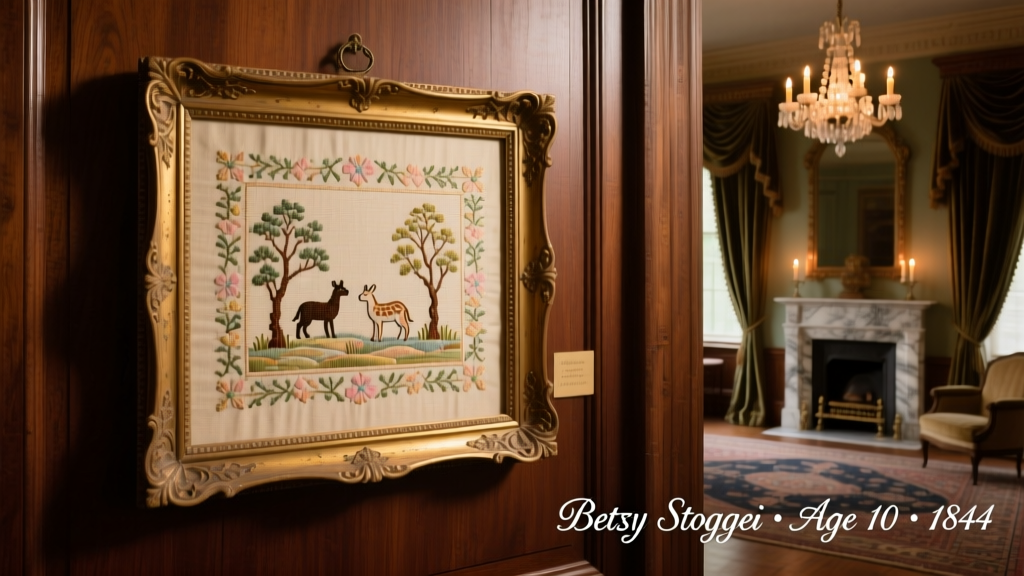
Betsy Stoggell’s 1843 Silk Sampler: A Rare Animal and Tree Motif Work on Linen, Framed at 16 × 10 Inches

Dick Tracy Knife Magnifier Whistle Glow-in-the-Dark Dick Junior: A Collector’s Deep Dive into the 1940s Pocket Utility Toy
Akro Agate Urn in Grecian Orange: A Collector’s Guide to the 3¼-Inch Vintage Art Glass Vessel
Indian Saddlebag Beaded U.S. Flags Flap: History, Craftsmanship, and Authentication

Franciscan Cup and Saucer 'October': A Collector's Deep Dive into Design, Production, and Value

Rose Medallion Creamer: Figures, Trellis Border, Hog Spout, and Shaped Handle — A 3½-Inch Antique Porcelain Study
The Gonder Lazy Susan Signed Miniature: Authenticity, Provenance, and Restoration Insights