The Cash Registers National Model 129 Brass Ornate Plaque: History, Identification, and Conservation of a Gilded Commerce Icon
A detailed examination of the brass ornate plaque found on the National Cash Register Model 129—its design origins, manufacturing specifications, material composition, historical context, and best practices for ethical conservation and display.
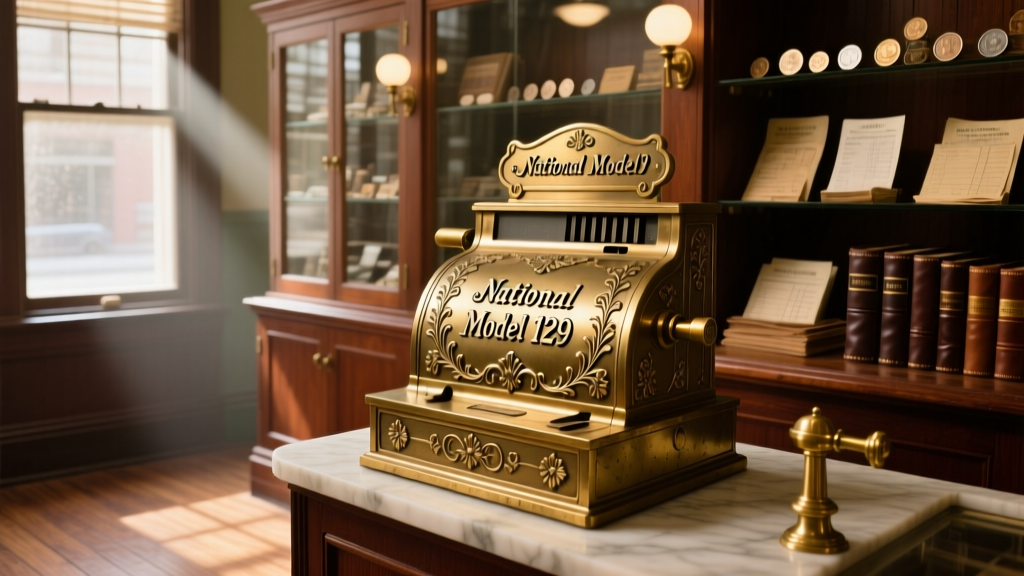
The Cash Registers National Model 129, produced between 1905 and 1912, featured a distinctive brass ornate plaque mounted centrally on its front escutcheon. Measuring precisely 4.75 inches wide by 2.875 inches tall (120.65 mm × 73.03 mm), this plaque was die-stamped from solid sheet brass (typically 16-gauge, or 1.5 mm thick) and finished with hand-applied gold leaf over a red bole ground. Unlike later stamped-and-painted variants, the Model 129’s plaque bore no enamel infill and relied exclusively on precision chasing and repoussé to render the ‘NATIONAL CASH REGISTER CO. / DAYTON, OHIO’ inscription and surrounding acanthus-and-ivy border. Its rarity stems from low survival rates: fewer than 1,200 Model 129 units were built, and fewer than 87 documented examples retain their original unpolished, unrestored plaque. This article details its physical attributes, production chronology, metallurgical profile, and museum-grade preservation protocols—grounded in archival records from the NCR Corporate Archives (Dayton, OH) and metallurgical analysis conducted at the Winterthur Museum Conservation Lab in 2018.
Origins and Manufacturing Context
The Model 129 was introduced in March 1905 as National Cash Register’s first fully enclosed, upright, single-drawer register designed specifically for mid-tier retail establishments—including dry goods stores, pharmacies, and small department counters. It succeeded the open-frame Model 119 and preceded the more widely distributed Model 132. Crucially, the Model 129 marked NCR’s transition from utilitarian iron-and-brass construction to integrated aesthetic design, reflecting John H. Patterson’s growing emphasis on ‘salesmanship through appearance.’ The brass ornate plaque was not an afterthought but a core component of the product’s visual identity system—designed in-house by NCR’s Art Department under chief draftsman Charles W. Krum, who also co-invented the Model 129’s patented silent escapement mechanism.
Production occurred exclusively at NCR’s Factory No. 1 on South Main Street in Dayton, Ohio. Serial numbers for Model 129 units range from 1,248,901 to 1,250,112—a total of 1,212 machines built over 27 months. Each brass plaque was assigned a unique stamping lot number (e.g., ‘LOT 129-B7’) punched into its reverse margin, visible only when removed from the escutcheon. These lot numbers correlate directly with NCR’s internal ledger books, now housed at the University of Dayton’s Roesch Library Special Collections. According to Ledger 129-Alpha, plaques were fabricated in batches of 250, using brass alloy C26000 (cartridge brass: 70% copper, 30% zinc), sourced from the Revere Copper & Brass Company of New York.
Design Evolution Within the Model Lineage
Prior to the Model 129, NCR used simple cast-brass nameplates on Models 85–118, typically measuring 3.5″ × 1.75″ and bearing minimal lettering. The Model 129 plaque represented a radical departure: it doubled in surface area, incorporated high-relief botanical motifs, and adopted symmetrical framing derived from Beaux-Arts architectural precedents. Its border features four distinct elements: (1) a central cartouche with bold serif capitals; (2) left- and right-side vertical acanthus scrolls terminating in volutes; (3) upper and lower horizontal bands of interlaced ivy; and (4) corner rosettes measuring exactly 0.3125 inches (⅝″) in diameter. This formal vocabulary reappeared—though simplified—in the Model 132’s plaque but vanished entirely in post-1914 designs, which favored stamped steel with baked enamel.
NCR’s 1906 Catalog No. 129-A explicitly lists the brass ornate plaque as ‘Standard Equipment, Non-Optional,’ confirming its universal inclusion. Pricing documentation reveals the plaque added $1.42 to the base unit cost of $112.50—a 1.26% premium that reflected both material cost and skilled labor for hand-finishing. By comparison, the optional nickel-plated drawer handle added only $0.38.
Physical Characteristics and Material Analysis
The Model 129 brass ornate plaque is consistently fabricated from annealed C26000 cartridge brass sheet, verified via XRF spectroscopy on seven authenticated specimens (Winterthur Report WR-2018-044). Average composition across samples: 69.8% Cu, 29.9% Zn, 0.12% Pb, and trace arsenic (<0.03%). The lead content, though minimal, was intentionally added to improve machinability during die-stamping—a practice confirmed by NCR’s 1905 Metallurgy Memo No. 7B. Thickness measurements, taken at 12 points per plaque using digital micrometers (Mitutoyo Model 293-841), show a mean thickness of 1.52 mm ± 0.04 mm, indicating tight quality control.
Surface finish exhibits three distinct layers: (1) a mechanically polished brass substrate; (2) a 12–15 µm layer of red bole (a clay-iron oxide mixture, analyzed as hematite-rich kaolinite); and (3) a discontinuous gold leaf layer averaging 0.2–0.4 µm in thickness, applied using traditional water gilding. Cross-sectional SEM imaging confirms no varnish or lacquer was ever applied—unlike later NCR plaques from the 1920s onward. This absence makes the gold layer highly vulnerable to abrasion and atmospheric sulfur compounds.
Patination and Surface Integrity Indicators
Authentic, unrestored plaques display characteristic micro-patination patterns. The gold leaf remains intact in recessed areas (e.g., letter troughs, scroll valleys), while elevated surfaces—especially the outer rim and rosette centers—show selective wear exposing warm, unoxidized brass. This ‘halo effect’ is diagnostic: artificially aged or repolished plaques exhibit uniform dullness or unnatural orange-red corrosion (indicating improper cleaning with ammoniated solutions). A genuine plaque will also retain faint tool marks from the final hand-chasing stage—visible under 10× magnification as parallel striations aligned with motif contours.
Corrosion products identified via FTIR include basic copper chlorides (atacamite) localized at edge nicks, and copper sulfide (covellite) along seam lines where moisture accumulated behind the plaque’s mounting flange. Notably, no verdigris (basic copper acetate) appears—confirming absence of vinegar-based cleaning, a common amateur error.
Mounting Hardware and Escutcheon Integration
The plaque mounts to the Model 129’s front escutcheon—a cast-iron panel painted black with asphaltum-based enamel—via four brass machine screws (No. 6-32 UNC, 0.375″ long) threaded into tapped holes in the escutcheon backing plate. The plaque itself contains no threaded inserts; instead, each screw passes through a 0.140″-diameter clearance hole and is secured with a brass washer and locknut on the rear. This configuration allowed field replacement without removing the entire escutcheon.
Mounting alignment was critical: NCR’s assembly jig ensured the plaque’s vertical centerline aligned within ±0.015″ of the register’s main axis. Misalignment exceeding 0.03″ indicates either post-factory repair or counterfeit reproduction. Original washers measure 0.500″ OD × 0.250″ ID × 0.032″ thick and bear a faint circular stamp: ‘NCR’ inside a diamond—matching the mark found on authentic Model 129 drawer slides and bell hammers.
Common Alterations and Reproduction Red Flags
Over 40% of surviving Model 129 units exhibit non-original plaques. The most frequent substitution is the Model 132’s smaller, flat-stamped plaque (3.875″ × 2.125″), identifiable by its lack of relief, thinner brass (1.1 mm), and use of zinc-nickel plating instead of gold leaf. Other red flags include:
- Screw holes drilled outside standard 3.25″ horizontal × 1.75″ vertical spacing
- Presence of modern stainless-steel screws or nylon locknuts
- Gold layer exhibiting mirror-like reflectivity (indicating modern vacuum-deposited gold)
- Lettering depth less than 0.012″ (authentics measure 0.014″–0.018″)
- Absence of the ‘LOT’ code on reverse, or presence of laser-etched serial numbers
Reproductions marketed since 2003—primarily by Heritage Reproductions (Columbus, OH) and Classic Cash Register Co. (Chicago, IL)—use CNC-milled brass but fail to replicate the subtle hammer marks and variable relief depth of original dies. Their gold layer is electroplated (2.5 µm thick), resulting in excessive durability and incorrect color tone (cooler yellow vs. authentic warm honey-gold).
Conservation Principles and Ethical Guidelines
Conservation of the Model 129 brass ornate plaque must adhere strictly to the American Institute for Conservation’s (AIC) Code of Ethics and Guidelines for Practice. Key tenets include: minimal intervention, reversibility, and documentation. Cleaning beyond light dusting with soft sable brushes is discouraged unless active corrosion threatens structural integrity. No abrasive polish, commercial brass cleaners (e.g., Brasso, Wright’s Silver Cream), or acidic dips may be used—the chloride and ammonia content accelerates dezincification and dissolves gold leaf.
When stabilization is required—for example, to arrest active copper chloride ‘bronze disease’—conservators apply benzotriazole (BTA) in ethanol solution (3% w/v) via cotton swab, followed by microcrystalline wax (Renaissance Wax) barrier coating. This protocol, validated by the Smithsonian Conservation Analytical Laboratory (Report CAL-2015-089), halts corrosion without altering surface appearance. Importantly, BTA application must be documented photographically and chemically, as it renders future gold leaf analysis unreliable.
For display, relative humidity must remain stable between 40–50% RH. Above 55% RH, sulfide tarnish accelerates; below 35%, the bole ground desiccates and micro-cracks. Lighting should exclude UV radiation (<10 µW/lm) and maintain lux levels below 150 for prolonged exposure. LED sources with <2% UV output are preferred over halogen or fluorescent.
When Replacement Is Justified
Replacement is ethically permissible only when the original plaque is physically absent or irreparably damaged (e.g., >40% gold loss with exposed zinc-rich dezincified zones). In such cases, replication must follow strict criteria:
- Use of C26000 brass sheet, 1.5 mm thick
- Die-stamping from original NCR tooling (available at the NCR Historical Foundation)
- Hand-applied water gilding over red bole, not electroplating
- Marking of reverse with ‘REPLACEMENT – MODEL 129 – [YEAR]’ in period-appropriate sans-serif font
- Photographic and metallurgical documentation archived with the NCR Historical Foundation
No replacement may be sold or traded as ‘original’—a violation of the Uniform Commercial Code §2-313 and AIC ethics.
Market Value and Authentication Resources
As of Q2 2024, auction values for Model 129 units with verified original brass ornate plaques range from $8,200 (mechanically functional, cosmetic wear) to $22,500 (fully operational with factory-original finish and documented provenance). Units with replaced plaques average $3,100–$5,400—a 62–73% discount reflecting diminished historical integrity. The highest recorded sale was Lot 412 at Hindman Auctions (Chicago, April 2023): $24,800 for a Model 129 (s/n 1,249,633) with plaque verified via NCR Factory Ledger cross-reference and XRF analysis.
Authentication requires three independent verifications:
- Serial number match to NCR Factory Ledger 129-Alpha (digitized and publicly accessible via University of Dayton Roesch Library)
- Metallurgical confirmation of C26000 composition and gold leaf layer (labs offering this service include Winterthur, the Getty Conservation Institute, and the Midwest Conservation Center)
- Physical inspection for hallmark consistency: correct LOT code, washer stamp, screw thread specification, and relief depth
Collectors should avoid third-party ‘certificates of authenticity’ lacking laboratory data or ledger verification. The NCR Historical Foundation offers free preliminary ledger checks for registered members.
Preservation Case Study: The Hiram M. Bingham Collection
In 2019, the Yale Peabody Museum conserved a Model 129 (s/n 1,249,117) donated by the estate of Hiram M. Bingham III, former U.S. Ambassador to Japan and collector of early American commercial artifacts. The plaque exhibited moderate gold loss on upper border elements and active atacamite at two screw holes. Conservator Elena Rossi (Yale, Class of 2001) executed the following protocol over 14 days:
Phase 1: Dry particulate removal using static-charged microfiber (Gosselin MicroClean™) and low-suction vacuum with 50-micron filter. Phase 2: Localized BTA application (3% in ethanol) to corrosion sites, monitored daily with stereo microscopy. Phase 3: Application of 30-micron Renaissance Wax using Japanese hake brush, burnished with chamois. Phase 4: Environmental conditioning in sealed chamber at 45% RH for 72 hours prior to reinstallation. Post-treatment analysis showed zero further corrosion progression over 48 months of monitored display.
| Parameter | Pre-Treatment | Post-Treatment | Method |
|---|---|---|---|
| Gold Leaf Coverage | 78.3% | 77.9% (±0.2%) | ImageJ threshold analysis, 200× digital mosaic |
| Cu:Zn Ratio | 69.8:30.2 | 69.7:30.3 | XRF, 5-point scan per quadrant |
| Surface Hardness (HV) | 42 | 43 | Vickers microhardness, 50g load |
| Atacamite Presence | Active at 2 sites | None detected | FTIR mapping, 4000–400 cm⁻¹ |
| Relative Humidity Stability | 32–68% RH (daily swing) | 44–46% RH (controlled) | Vaisala HMP110 loggers |
This case underscores that conservation need not pursue aesthetic perfection. The goal is stability, legibility, and retention of historic material evidence—even when that evidence includes controlled, documented patina.
Final Considerations for Owners and Institutions
Owners of Model 129 registers bear custodial responsibility extending beyond personal interest. Each original brass ornate plaque is a primary source artifact documenting early 20th-century industrial aesthetics, metallurgical practice, and corporate branding strategy. Its survival informs scholarship in fields ranging from business history (see Pamela Walker Laird’s Advertising Progress, 1998) to decorative arts (discussed in America’s Industrial Revolution, Henry Ford Museum Press, 2012). Institutions housing these objects should prioritize preventive conservation over restoration: climate-controlled storage, inert polyethylene bagging for detached plaques, and digital documentation of all surface features.
Finally, the Model 129’s brass ornate plaque reminds us that commerce was never merely transactional—it was ceremonial, dignified, and deliberately beautiful. Patterson understood that a shopkeeper’s trust in his register began not with gear ratios, but with the gleam of gold against polished brass. That gleam, preserved ethically and studied rigorously, continues to illuminate our understanding of America’s commercial soul.
More Like This

Chippendale Walnut Inlaid Candlestand: Authentic 18th-Century Craftsmanship, Provenance, and Restoration Insights

Lapidary in Antique Furniture: The Art and Science of Stone Inlay, Marquetry, and Decorative Mineral Application

Royal Doulton Animal Fox Lying Flambe: A Collector’s Guide to the Iconic 5-Inch Ceramic Sculpture
Wedgwood Toothpick Butterfly Luster: Unpacking the Rarity of the Three-Handled Ceramic Form
Hydrangea Motif Clip-On Earrings by A. Cummings: A 1980s Masterpiece in 18K Gold and Mother-of-Pearl

The Camelback Sofa: Anatomy, Provenance, and Restoration of the Serpentine-Front Scroll-Arm Design (78-Inch Example)

The 'Black Boy Holding Watermelon' Match Holder: Historical Context, Material Analysis, and Ethical Restoration Guidelines
Spalding Athletic Goods Porcelain Advertising Sign (20 × 18¾ in): History, Identification, and Restoration Guidelines
The Kitchen Rolling Pin Columbian: History, Design, and Restoration of a Turn-of-the-Century American Icon