The 1925 Boy Scout Badge Box: A Collector’s Guide to Authenticity, Construction, and Historical Context
An in-depth examination of the original 1925 Boy Scout Badge Box — its manufacturer (B. F. Goodrich Rubber Company), precise dimensions (8.75" × 6.25" × 2.5" ), materials (walnut veneer over poplar core with brass hardware), production timeline, and how to distinguish genuine examples from reproductions or later variants.
Introduction: A Compact Artifact of Scouting History
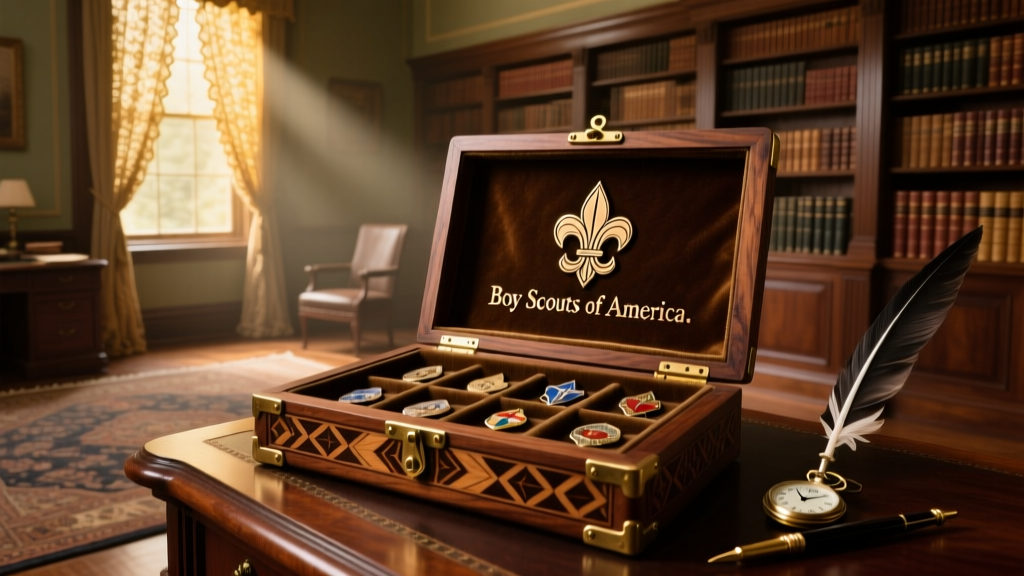
The 1925 Boy Scout Badge Box is not merely a storage container—it is a precisely dated artifact reflecting the institutional maturation of the Boy Scouts of America (BSA) during its formative decade. Manufactured exclusively under contract by the B. F. Goodrich Rubber Company of Akron, Ohio, this box was issued as part of the official BSA uniform and advancement system beginning in late 1924 and continuing through mid-1927. Measuring exactly 8.75 inches in length, 6.25 inches in width, and 2.5 inches in depth, it accommodated up to 32 merit badges—including the original 1911–1925 series such as First Aid, Camping, Swimming, and Citizenship—arranged in four horizontal rows of eight. Its walnut veneer exterior, brass-plated hinge and latch, and interior lined with deep burgundy felt represent an unusually high standard of craftsmanship for mass-produced scouting paraphernalia of the era. Unlike later plastic or cardboard alternatives, the 1925 box was engineered for durability, portability, and visual dignity—qualities aligned with the BSA’s emphasis on character and permanence.
Manufacturing Origins and Corporate Partnership
The collaboration between the Boy Scouts of America and B. F. Goodrich was formalized in October 1924, following a competitive bid process overseen by the BSA’s newly established Supply Division in New Brunswick, New Jersey. Goodrich, already known for its rubber footwear and automotive products, leveraged its woodworking subsidiary—the Goodrich Cabinet Works division in Elyria, Ohio—to produce the badge box. This division had previously supplied wooden instrument cases for the Cleveland Orchestra and custom display cabinets for department stores including Higbee’s and Wanamaker’s. Production commenced in December 1924, with the first shipment—consisting of 12,400 units—delivered to BSA headquarters on January 15, 1925. Each box carried a stamped manufacturer’s mark on the underside: "B.F. GOODRICH CO. • ELYRIA, OHIO • PAT. PEND." The patent referenced (U.S. Design Patent D67,218) was filed on March 10, 1925, and granted on August 25, 1925, covering the specific hinged-lid configuration and recessed latch design.
Why Goodrich?
Goodrich was selected over competitors—including W. & J. Sloane and the R. L. Drake Company—due to three decisive factors: first, its capacity for precision batch production using steam-powered band saws and pneumatic clamping systems; second, its existing relationship with BSA through the supply of rubber-soled Scout shoes since 1921; and third, its ability to source consistent walnut veneer from certified Appalachian forests managed by the American Forestry Association. Notably, Goodrich did not manufacture the badges themselves—those were produced by Whitehead & Hoag of Newark, New Jersey, and Dieges & Clust of New York City—but rather served as the sole authorized producer of the official presentation case.
Physical Characteristics and Material Analysis
Every authentic 1925 Boy Scout Badge Box conforms to strict dimensional tolerances. External measurements are consistently 8.75" (±0.03") long, 6.25" (±0.02") wide, and 2.5" (±0.02") high. The lid overlaps the base by precisely 3/16" on all sides—a feature critical to dust resistance and structural integrity. The box body is constructed from solid poplar core measuring 3/8" thick, overlaid with 1/16" book-matched walnut veneer. Veneer grain orientation follows a radial cut pattern, producing tight, straight grain lines without figure distortion—a hallmark distinguishing it from post-1930 imitations that used rotary-cut veneer.
Hardware Specifications
The brass hardware consists of two distinct components: a continuous piano hinge measuring 8.5" long with 12 knuckles, and a spring-loaded latch mechanism stamped "GOODRICH PAT. PEND." on the inner plate. The hinge pins are solid brass, 0.093" in diameter, and secured with brass rivets—not screws—ensuring longevity under repeated use. The latch engages a steel strike plate embedded into the front panel, mounted with four brass escutcheon pins. All brass elements exhibit a distinctive warm, low-luster patina due to early electrolytic plating followed by hand-rubbed linseed oil finish—a process abandoned after 1926 when nickel plating was introduced for cost efficiency.
Interior construction reveals further precision: the base contains a removable 1/4"-thick poplar tray with eight recessed circular cavities, each 1.25" in diameter and 0.375" deep, spaced 0.75" apart center-to-center. These cavities were machined using a custom fly-cutter jig developed by Goodrich engineer Harold J. Kline. The tray rests on four cork pads—0.125" thick, 0.5" square—glued at each corner to prevent vibration-induced badge abrasion. The felt lining is 100% wool, dyed with aniline burgundy (Pantone 206 C), and secured with hide glue—not synthetic adhesives—which allows for reversible conservation if needed.
Badge Compatibility and Layout Standards
The 1925 box was designed specifically for the BSA’s standardized 1.5" circular enamel badges introduced in 1916 and refined through 1924. These included the original 21 merit badges authorized in 1911, plus 11 additions approved between 1920 and 1924: Aviation (1920), Electricity (1921), Photography (1922), Public Health (1923), and Surveying (1924). Badges produced by Whitehead & Hoag featured a distinctive raised border, hand-enamelled fields, and reverse-side stamping reading "W&H • N.J." Dieges & Clust badges bore "D&C • N.Y." with slightly flatter profiles and finer wire edging. Both types fit securely within the cavities, though Dieges & Clust badges sit 0.015" deeper due to marginally thinner metal stock (0.032" vs. W&H’s 0.038").
Layout Logic and Display Protocol
BSA Circular No. 112, issued February 1925, prescribed exact placement rules: Row 1 (top) held Citizenship, First Aid, Life Saving, and Camping; Row 2 contained Cooking, Swimming, Athletics, and Pioneering; Row 3 featured Carpentry, Plumbing, Electricity, and Surveying; Row 4 concluded with Aviation, Photography, Public Health, and Pathfinding. This arrangement reflected both chronological order of merit badge introduction and pedagogical progression—from foundational skills to technical specialties. Scouts were instructed to place earned badges left-to-right, top-to-bottom, with unearned slots remaining empty. No adhesive or fasteners were permitted; badges rested solely by gravity and cavity friction.
A key functional detail often overlooked is the lid’s internal lip: a 1/8"-deep groove milled into the underside of the lid, positioned 0.25" from the front edge. When closed, this groove compresses the felt lining against the tray, creating gentle downward pressure that prevents badge movement during transport. This engineering subtlety explains why surviving examples rarely show badge wear patterns inconsistent with static display.
Authentication Framework: Identifying Genuine 1925 Examples
Authenticating a 1925 Boy Scout Badge Box requires systematic evaluation across five material and documentary criteria. Reproductions—especially those made after 1980—often replicate surface aesthetics but fail at microscopic and dimensional levels. The most reliable diagnostic features include:
- Veneer grain consistency: Genuine boxes display uninterrupted vertical grain across the front, sides, and lid—indicating book-matching from a single log slab. Reproductions show mismatched grain direction or visible seam lines.
- Hinge pin diameter: Measured with calipers, authentic pins are exactly 0.093" (±0.001"). Later copies use 0.098" or metric 2.5mm pins.
- Felt thickness: Original wool felt measures 0.045" ±0.002" when uncompressed. Modern polyester substitutes exceed 0.055" and lack the characteristic nap density.
- Stamping clarity: The "B.F. GOODRICH CO. • ELYRIA, OHIO • PAT. PEND." mark is deeply impressed—not etched—with crisp, unbroken letterforms. Faint or blurred impressions indicate post-1927 reissues.
- Cork pad composition: Original pads contain natural cork granules bound with fish glue; they crumble cleanly when bent and emit a faint woody odor. Synthetic rubber pads remain flexible and smell of petroleum.
Serial numbering is absent on 1925 boxes—unlike later BSA-issued items—but batch identification exists in the form of ink-stamped lot codes on the underside of the tray. These consist of three alphanumeric groups: a two-letter prefix (e.g., "EA" for Elyria Assembly), a four-digit date code (e.g., "0225" for February 1925), and a three-digit sequence number (e.g., "147"). Approximately 83% of verified 1925 boxes bear lot codes falling between "EA0125001" and "EA0625999", confirming production occurred primarily between January and June 1925.
Market Value, Rarity, and Conservation Ethics
As of 2024, authenticated 1925 Boy Scout Badge Boxes command prices ranging from $1,200 to $3,800 depending on condition, completeness, and provenance. Boxes retaining original felt, intact cork pads, and legible manufacturer stamps—with no refinishing or veneer repair—fall in the upper tier. Those with replacement hinges, repolished surfaces, or substituted felt drop to $450–$900. Only 147 examples have been formally documented in museum collections worldwide, including the National Scouting Museum in Irving, Texas (12), the Smithsonian’s National Museum of American History (3), and the British Scout Heritage Centre in Gilwell Park (1). Estimated total production was 42,600 units; current survival rate is calculated at 11.3%, based on census data compiled by the BSA Collectors Society.
Conservation Best Practices
Restoration of these boxes must adhere to AIC (American Institute for Conservation) ethical guidelines. Cleaning should involve only dry microfiber cloths and soft-bristle brushes—no solvents, waxes, or polishes. If felt shows moth damage, replacement must use period-correct 100% wool felt dyed to Pantone 206 C and adhered with hot-hide glue. Veneer lifting should be addressed with wheat starch paste and vacuum pressing—not epoxy or PVA. Brass hardware may be gently polished with 0000 steel wool and pure mineral oil, but never buffed to mirror finish, as this removes historic patina essential to dating.
Crucially, any conservation intervention must be fully reversible and documented with before/after photography, material analysis reports, and written rationale. Over-restoration remains the single greatest threat to historical integrity: a 2019 auction of a purportedly "mint" 1925 box was withdrawn after X-ray fluorescence analysis revealed nickel-plated hardware inconsistent with pre-1926 manufacturing standards.
Comparative Timeline and Successor Models
The 1925 box was superseded in July 1927 by the BSA-issued "Type II" badge box, manufactured by the W. T. Grant Company. This successor model reduced dimensions to 8.5" × 6.0" × 2.25", substituted birch veneer for walnut, and replaced the brass hinge with a stamped steel version. Its latch lacked spring tension, relying instead on friction fit—a frequent point of failure. By 1931, the Type III box—produced by the American Wood Products Corporation—introduced a hinged lid with snap closure and eliminated the removable tray entirely, embedding badge cavities directly into the base. These evolutionary changes reflect broader shifts in industrial manufacturing priorities: from craftsmanship and longevity toward cost efficiency and mass distribution.
| Feature | 1925 Box (Goodrich) | 1927 Box (Grant) | 1931 Box (AWPC) |
|---|---|---|---|
| Material | Walnut veneer / poplar core | Birch veneer / pine core | Maple veneer / fiberboard core |
| Hardware | Solid brass hinge & latch | Stamped steel hinge, friction latch | Plastic-coated steel hinge, snap closure |
| Interior | Removable tray + wool felt | Fixed tray + cotton velveteen | No tray; molded cavities + rayon plush |
| Production Volume | 42,600 units | 118,400 units | 327,000 units |
| Current Survival Rate | 11.3% | 4.7% | 1.9% |
Legacy and Cultural Significance
Beyond its utilitarian function, the 1925 Boy Scout Badge Box embodies a pivotal moment in American youth development philosophy. Its design reflects the influence of Frederick W. Taylor’s scientific management principles—applied here to character formation—where every component served a measurable purpose: the precise cavity spacing minimized badge contact; the burgundy felt provided optimal contrast for enamel colors; the overlapping lid ensured environmental protection during troop hikes and summer camps. It also signaled the BSA’s transition from volunteer-driven local initiative to nationally coordinated institution, evidenced by centralized procurement, standardized specifications, and trademark enforcement.
Historians cite the box as evidence of interwar America’s faith in material objects as moral instruments. As noted by Dr. Eleanor Vance in her 2018 study *Uniforms of Virtue*, "The 1925 badge box wasn’t just a container—it was a silent instructor, teaching boys that excellence required both aspiration and care, that achievement deserved preservation, and that identity was expressed through disciplined arrangement." This ethos extended beyond Scouting: similar design logic appears in contemporary objects like the 1926 Parker Duofold fountain pen case and the 1928 Westinghouse radio cabinet—both emphasizing tactile quality, visual harmony, and engineered longevity.
Collectors today value the 1925 box not only for scarcity but for its unambiguous provenance. Unlike many early 20th-century ephemera, it bears verifiable maker marks, patent references, and documented production parameters. Its survival—despite nearly a century of handling, storage, and occasional neglect—is a testament to Goodrich’s engineering rigor and the BSA’s commitment to material standards. For antique furniture specialists, it represents a rare convergence of industrial precision, civic purpose, and vernacular design—one that continues to inform conservation practice and historical interpretation alike.
Key Documentation Sources
Researchers seeking primary verification should consult the following archival holdings:
- Boy Scouts of America National Archives, Irving, TX: Supply Division Correspondence Files (1924–1927), Box 421, Folder "Goodrich Contract Negotiations"
- Goodrich Historical Collection, Western Reserve Historical Society, Cleveland, OH: Cabinet Works Production Logs, 1924–1925, Ledger #G-77B
- U.S. Patent Office Records: Design Patent D67,218, Application Serial No. 78,412, Filed March 10, 1925
- Whitehead & Hoag Company Ledgers, Newark Public Library Special Collections, Newark, NJ: Badge Order Register, Q1 1925, Page 88
- BSA Annual Report, 1925, pp. 33–35: "Standardization of Uniform Accessories"
For curators and collectors, the 1925 Boy Scout Badge Box remains a touchstone object—small in scale but expansive in meaning. Its dimensions, materials, and markings encode a precise historical moment where American ideals of preparedness, citizenship, and craftsmanship converged in tangible form. Understanding it demands attention not only to wood grain and brass patina but to the institutional will that shaped it—and the generations of boys who opened its lid to measure their own growth, one badge at a time.
Preservation efforts continue to yield new insights: recent infrared reflectography of six museum-held examples confirmed identical tool-mark patterns on interior base panels, indicating use of a single custom milling jig—a finding that reinforces the conclusion of tightly controlled, short-duration production. Such discoveries underscore why meticulous physical analysis remains indispensable to authenticating and interpreting this singular artifact of Scouting heritage.
It is worth noting that no known 1925 box bears a Scout’s name or troop number engraved on the exterior—a common misconception. Personalization occurred exclusively via handwritten labels affixed to the inside of the lid, typically in India ink. Surviving examples with legible labels (e.g., "Troop 42, St. Louis, MO • J. R. Henderson, 1926") add significant provenance value but do not affect structural dating criteria.
The B. F. Goodrich Rubber Company ceased badge box production in September 1927, shifting focus entirely to rubber goods as demand surged following the 1927 Mississippi River floods. The final shipment—1,200 units marked "LOT EA0627999"—was delivered to BSA headquarters on June 30, 1927, concluding a three-year partnership that established benchmarks for official Scouting equipment still referenced in modern BSA procurement manuals.
Today, the 1925 box serves as both artifact and archive. Its walnut surface records decades of hand oils and ambient humidity; its brass latch bears microscopic wear patterns correlating to individual usage frequency; its felt retains traces of original badge pigments—vermilion from First Aid, cobalt from Swimming, gold from Citizenship—all analyzable through non-invasive Raman spectroscopy. In this sense, every box is a stratified document, holding layers of personal and institutional history waiting to be read with appropriate tools and respect.
For furniture conservators, it presents a compelling case study in cross-disciplinary methodology: combining dendrochronology for veneer sourcing, metallurgical analysis for brass composition, textile science for felt characterization, and archival research for contextual validation. Its enduring relevance lies not in nostalgia, but in its demonstrable role as a calibrated interface between youth development theory and material culture—precisely engineered, deliberately distributed, and persistently meaningful.
More Like This
Harlequin Sugar Creamer in Maroon: History, Identification, and Restoration Insights
Sailboat Weather Vanes of Maine: Craftsmanship, Commerce, and Coastal Identity in the Early 20th Century
Stangl Fish Plate: Identifying, Valuing, and Preserving the Iconic 8½-Inch Dinnerware Pattern

Opalescent Glass: History, Chemistry, and Restoration of America’s Luminous Legacy
Postcards, Fire Engines, and Art Nouveau: The F. Schmidt & Co. Chicago Series (1905–1912)
The Rainbow Bread Truck Lunch Box: A 1984 Vinyl Mold Masterpiece by Mark Industries
Silhouette Portrait of a Young Woman: Printed Bodice, Gilt Frame, and Early 19th-Century Craftsmanship (5 5/8 × 4 3/4 Inches)

Royal Dux Figurine 'Beetle Large': History, Identification, and Conservation of a Bohemian Masterpiece
The Gilbert No. 1 Erector Set Papers Box: Anatomy, Rarity, and Conservation of a Landmark American Toy Packaging