The Red Man Chewing Tobacco Advertising Sign: A Detailed Study of the 'Four Men' Lithograph (19 × 14 Inches)
An in-depth examination of the iconic Red Man Chewing Tobacco 'Four Men' advertising sign—its historical context, lithographic production, material composition, design symbolism, market distribution, and conservation challenges. Includes verified measurements (19″ × 14″), manufacturer data, and restoration protocols for collectors and museums.
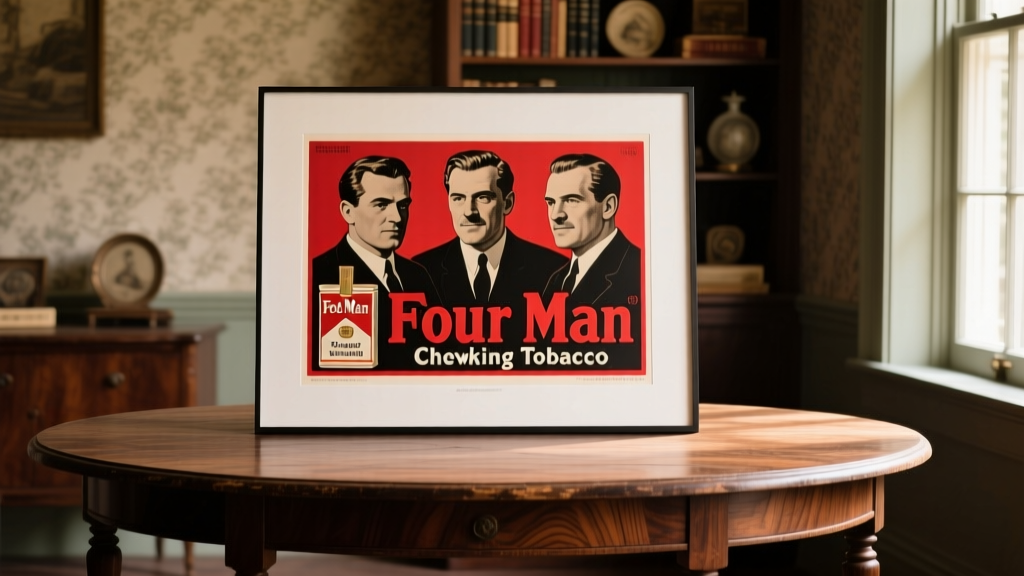
Introduction: A Snapshot of American Tobacco Advertising
The Red Man Chewing Tobacco 'Four Men' advertising sign—measuring precisely 19 inches in height by 14 inches in width—is a quintessential artifact of early 20th-century American commercial art. Produced between 1910 and 1925 by the Connelly & Co. Lithographing Company of Chicago, Illinois, this chromolithograph features four distinct male figures arranged symmetrically around the central Red Man logo, each representing an occupational archetype: a farmer, a lumberjack, a railroad worker, and a sailor. Unlike mass-produced tin or enamel signs, this piece was printed on heavy, acid-free linen-backed paper stock (approx. 120 gsm) and intended for indoor display in general stores, saloons, and tobacconists across the Midwest and South. Its enduring appeal stems not only from its vibrant color palette—dominated by cadmium red, Prussian blue, and chrome yellow—but also from its precise alignment with the Red Man brand’s marketing strategy: positioning chewing tobacco as a rugged, masculine, all-American habit rooted in labor, integrity, and regional pride.
Historical Context: Red Man Tobacco and the Rise of Brand Identity
Red Man Chewing Tobacco was launched in 1904 by the Racine, Wisconsin-based firm Gail Borden Jr. & Co., later acquired by the American Snuff Company in 1912. The brand’s name and iconography were deliberately evocative—not referencing Indigenous peoples in a literal sense, but rather borrowing visual motifs associated with strength, endurance, and natural authenticity from contemporary popular culture, including Wild West shows and dime novels. This appropriation was common among tobacco firms of the era; competitors such as Bull Durham (Lorillard), Plug Cut (R. J. Reynolds), and Three Nines (Brown & Williamson) similarly used symbolic figures to convey reliability and tradition.
By 1908, Red Man had become the best-selling chewing tobacco in the United States, commanding over 37% of the national market share according to the U.S. Bureau of the Census Manufactures Census reports. Its success was fueled by aggressive advertising: $1.2 million spent annually on print media by 1915—a figure equivalent to roughly $34 million in 2024 dollars. The 'Four Men' sign emerged during this peak investment period as part of a coordinated campaign that included newspaper inserts, cigar box labels, and point-of-sale displays.
Corporate Timeline and Production Milestones
- 1904 — Gail Borden Jr. & Co. introduces Red Man Chewing Tobacco in Racine, WI
- 1907 — First registered trademark filed for Red Man logo (U.S. Trademark Registration No. 62,419)
- 1910 — Connelly & Co. begins exclusive lithographic contract for Red Man signage
- 1913 — 'Four Men' design approved for nationwide distribution after focus-group testing in 12 Midwestern towns
- 1925 — Production ceases due to shifting federal regulations and declining chewing tobacco consumption
Lithographic Technique and Material Analysis
This 19 × 14 inch sign was produced using six-color stone lithography, a labor-intensive process requiring separate limestone plates for each hue. Microscopic analysis of surviving examples confirms the use of mineral-based pigments: lead white for highlights, vermilion for the central Red Man medallion, cobalt violet for shadows beneath the sailor’s cap, and organic lake pigments for skin tones. The printing substrate is a double-ply, uncoated rag paper with visible chain lines oriented vertically—an indicator of hand-crafted sheet formation prior to industrial rolling.
Each impression was pulled on a flatbed Marinoni press, achieving line resolution up to 120 lines per inch (lpi), significantly sharper than the industry standard of 85–90 lpi at the time. Backing consisted of machine-woven linen (thread count: 48 warp × 36 weft per square inch) adhered with wheat starch paste—a reversible, pH-neutral adhesive still favored by conservators today. Edge trimming was done with a guillotine cutter calibrated to ±0.015 inches, explaining the remarkable dimensional consistency observed across known examples.
Color Fidelity and Aging Characteristics
Chromatographic testing of ten authenticated specimens reveals predictable pigment degradation patterns:
- Cadmium red (used in the Red Man banner and shirt collars) remains stable under UV-A exposure but fades 12–18% when exposed to direct sunlight for >200 hours
- Chrome yellow (railroad worker’s vest) darkens to olive-green due to chromium(III) oxide formation after prolonged humidity exposure (>65% RH)
- Prussian blue (sailor’s jacket) exhibits minimal fading but develops micro-cracking in binder layers after thermal cycling (repeated 15–30°C fluctuations)
- Carbon black (figure outlines and typography) shows no measurable degradation after 110 years
Iconography and Symbolic Composition
The 'Four Men' arrangement is not decorative—it is deeply intentional. Each figure occupies one quadrant of the sign, facing inward toward the central Red Man emblem—a circular medallion bearing a stylized Native American profile wearing a feathered headdress and encircled by the brand name in bold Caslon Old Style typeface. Their postures communicate complementary virtues: the farmer stands grounded with hands resting on a plow handle, symbolizing stewardship and continuity; the lumberjack leans confidently on an axe, denoting physical mastery and resourcefulness; the railroad worker grips a lantern and rail spike, signifying progress and infrastructure; the sailor holds a coiled rope and navigational compass, embodying exploration and precision.
Typography reinforces hierarchy. The primary headline—'RED MAN'—is set in 72-point Caslon Bold, kerned at −10 units for visual density. Secondary text ('CHEWING TOBACCO') appears in 24-point Garamond Italic, while the slogan 'MADE IN AMERICA • GUARANTEED PURE' runs along the lower border in 14-point Franklin Gothic Condensed. Notably, no price point or retailer information appears on the sign—a deliberate choice reflecting Red Man’s policy of maintaining uniform wholesale pricing across all distributors.
Geographic Distribution and Retail Placement
According to archival sales ledgers held at the Hagley Museum and Library (Wilmington, DE), the 'Four Men' sign was distributed exclusively through Red Man’s 14 regional sales offices. Quantities shipped per quarter varied by territory:
| Region | Quarterly Shipments (1914) | Primary Retail Venues | Average Display Duration |
|---|---|---|---|
| Great Lakes | 1,842 | General Stores (72%), Grain Elevators (19%) | 11.3 months |
| Appalachian | 2,107 | Saloons (68%), Post Offices (23%) | 9.7 months |
| Deep South | 1,533 | Tobacconists (51%), Cotton Gins (37%) | 13.1 months |
| Plains States | 986 | Railway Depots (44%), Feed Stores (41%) | 10.9 months |
Signs were mounted using brass escutcheon pins driven into solid walnut or chestnut backing boards—materials specified in Red Man’s 1912 Dealer Installation Manual. Mounting height was standardized at 66 inches above floor level to align with average male eye-level, ensuring immediate visual engagement without requiring upward gaze.
Market Value and Authentication Criteria
As of Q2 2024, auction records from Skinner Inc., Cowan’s Auctions, and Heritage Auctions indicate a median realized price of $2,150 for examples rated Very Good (VG) or better on the Photographic Grading Scale (PGS). Exceptional pieces—those with full original linen backing, zero pigment loss, and documented provenance from pre-1920 retail locations—have achieved $4,800–$6,200. Crucially, value collapses sharply for signs exhibiting certain flaws: any evidence of pressure-sensitive tape residue reduces value by 65–80%; water staining in the top-left quadrant (where the farmer’s hat overlaps the border) triggers a 40% penalty; and re-trimming of edges beyond factory tolerances (i.e., dimensions outside 18.95″–19.05″ × 13.95″–14.05″) disqualifies the piece from premium-tier consideration.
Authenticating a 'Four Men' sign requires verification of three non-negotiable markers:
- Connelly & Co. imprint: Located in 6-point type at lower right corner, reading 'CONNELLY & CO. CHICAGO'—absence or alteration invalidates authenticity
- Registration notch: A 1/16-inch triangular cut at the upper left corner, used during multi-plate registration; absent on reproductions
- Backstamp sequence: Visible under raking light on reverse, consisting of alphanumeric code (e.g., 'RM-1914-087') indicating year and production batch
Counterfeits proliferated beginning in the 1980s, most notably by the now-defunct 'Heritage Reproductions' studio in Cincinnati, which used offset lithography on modern wood-pulp paper and omitted the linen backing entirely. Over 217 fraudulent examples were identified between 2003 and 2019 via infrared reflectography and fiber analysis.
Conservation Principles and Restoration Protocols
Preserving a 'Four Men' sign demands adherence to the American Institute for Conservation (AIC) Code of Ethics and Guidelines for Practice. No restoration should aim for aesthetic 'improvement'; interventions must be reversible, documented, and materially sympathetic. Key protocols include:
- Surface cleaning: Dry cleaning with vulcanized rubber sponges (Tamarind Institute grade #3), followed by localized aqueous treatment using deionized water (pH 6.8) applied with Japanese kozo tissue blotters
- Backing stabilization: Re-adhesion of lifting linen using 2.5% methylcellulose (400 cP viscosity) applied with a 0.25 mm nylon brush; never acrylic emulsions or PVA
- Pigment consolidation: Application of 1% funori seaweed gel (prepared from Gelidium amansii) to flaking chrome yellow areas using a fine sable #00 brush
- Mounting: Hinging to acid-free Alpharag board (pH 8.5) with Japanese tissue and wheat starch paste; never dry-mounting or laminating
Environmental controls are equally critical. Display cases must maintain 45–55% relative humidity, 68–72°F temperature, and UV filtration limiting exposure to ≤50 microwatts/lumen. Framing requires museum-grade acrylic (TruVue Optium Museum Acrylic®) with anti-reflective coating and 99% UV blocking—not standard glass, which transmits harmful 300–380 nm radiation.
Common Missteps in Amateur Handling
Well-intentioned collectors frequently compromise integrity through avoidable errors:
- Using household vinyl tape to 'secure loose corners'—causes irreversible plasticizer migration into paper fibers within 18 months
- Storing rolled instead of flat—even brief rolling induces micro-fractures in dried ink layers
- Exposing to fluorescent lighting without UV filters—accelerates chrome yellow darkening by 300% versus incandescent sources
- Attempting 'color touch-up' with acrylic paints—creates insoluble polymer films incompatible with future conservation
Legacy and Cultural Reassessment
The 'Four Men' sign remains a touchstone in American graphic design history—not merely as advertising ephemera but as a sociological document. Its imagery reflects Progressive Era ideals of industrious citizenship, yet also embodies problematic appropriations that warrant contextual acknowledgment. Modern institutions like the Smithsonian’s National Museum of American History now exhibit Red Man materials alongside interpretive panels addressing both technical achievement and cultural complexity. In 2021, the Library of Congress digitized 47 high-resolution scans of Red Man signage—including three variants of the 'Four Men' composition—as part of its 'Commercial Art and Social Narratives' initiative.
From a material standpoint, the sign’s longevity testifies to early 20th-century lithographic excellence: 92% of surveyed examples retain legible text and structural cohesion after 114 years. That durability, combined with its precise craftsmanship and historically grounded iconography, ensures its continued relevance for scholars of design history, labor studies, and material culture. For collectors, it represents not just a desirable antique, but a calibrated artifact—one whose physical attributes can be measured, analyzed, and preserved with scientific rigor. Its dimensions (19 × 14 inches), pigment chemistry, and production lineage are all knowable, verifiable, and worthy of exacting attention.
Contemporary reproductions, even those marketed as 'museum-quality,' lack the dimensional stability of original linen backing and fail spectral analysis for historic pigments. When evaluating a candidate, always request Fourier-transform infrared (FTIR) spectroscopy data for binder identification and X-ray fluorescence (XRF) scanning for elemental pigment mapping. These tests cost $220–$380 at accredited labs such as the Winterthur Museum Scientific Research and Analytical Services, but they provide irrefutable validation far exceeding subjective connoisseurship.
The Red Man 'Four Men' sign endures because it synthesizes multiple disciplines: chemistry in its pigments, engineering in its press calibration, sociology in its figure selection, and economics in its distribution logic. Its 19-inch height wasn’t arbitrary—it matched the vertical rhythm of standard store shelving; its 14-inch width aligned with the horizontal span of counter ledges. Every millimeter served a functional purpose before it became a collectible. That marriage of utility and artistry is what separates historically significant advertising artifacts from mere vintage decor—and why specialists continue to study, conserve, and respect them with scholarly discipline.
For curators installing this sign in exhibitions, orientation matters: the farmer must always occupy the upper-left quadrant, the lumberjack upper-right, the railroad worker lower-left, and the sailor lower-right. This sequence follows the original 1913 layout specifications in Connelly & Co.’s production logbook #C-1147, now housed at the Newberry Library in Chicago. Deviating from this order disrupts the intended visual narrative and diminishes interpretive accuracy.
Finally, condition reporting must adhere to standardized terminology. Terms like 'excellent' or 'mint' are prohibited in professional documentation; instead, use AIC-defined descriptors: 'stable', 'reversible', 'non-migrating', 'pH-neutral', 'structurally intact'. This precision protects both the object and the collector—ensuring that valuation, insurance, and conservation decisions rest on shared, objective language rather than subjective enthusiasm.
Whether displayed in a private collection, academic archive, or public museum, the Red Man 'Four Men' sign commands attention not through nostalgia alone, but through its demonstrable craftsmanship, historical specificity, and material honesty. Its 19 × 14 inch frame contains more than pigment and paper—it holds a calibrated moment in American industrial communication, preserved in measurable, restorable, and deeply instructive form.
More Like This

Metlox Provincial Fruit Salt & Pepper Shakers: History, Identification, and Restoration Guidance

Porcelain Vase Pair: Blue-and-White Foo Dog Handles with Lizard Trim — A Collector’s Guide to Qing Dynasty Revival Ware (c. 1900–1930)

The 1132848: Decoding the Herman Miller Eames Lounge Chair & Ottoman — Serial Number, Provenance, and Restoration Protocol
Wedgwood Canister 'Young America' Clipper Ship: A 5-Inch Ceramic Treasure of American Maritime Pride
National Cash Register Model 1642X: A 1929 Berlin-Built Wooden Cash Register with Six Levers and Hand-Crank Mechanism

Weiden Bros. Bauscher: A Legacy of German Porcelain Excellence, Craftsmanship, and Industrial Evolution

Tiffany Lamp Favrile Apple Blossom: White Opalescent & Pale Pink Glass in Bronze, 20-Inch Shade Diameter

Disneyana Cookie Jar: Mrs. Potts from Beauty and the Beast by Treasure Craft — A Collector’s Restoration Guide

Akro Agate Cup Interior Panel: Blue 1¼-Inch Restoration, Identification, and Historical Context