Green River Trophy-Style Advertising Dispensers: Chrome and Glass Soda Fountain Icons of the 1930s–1940s
A detailed examination of Green River-branded trophy-style glass-and-chrome advertising dispensers produced between 1930 and 1949—covering design origins, manufacturing partners like Vernon Kilns and Owens-Illinois, structural specifications, restoration challenges, and market valuation trends.
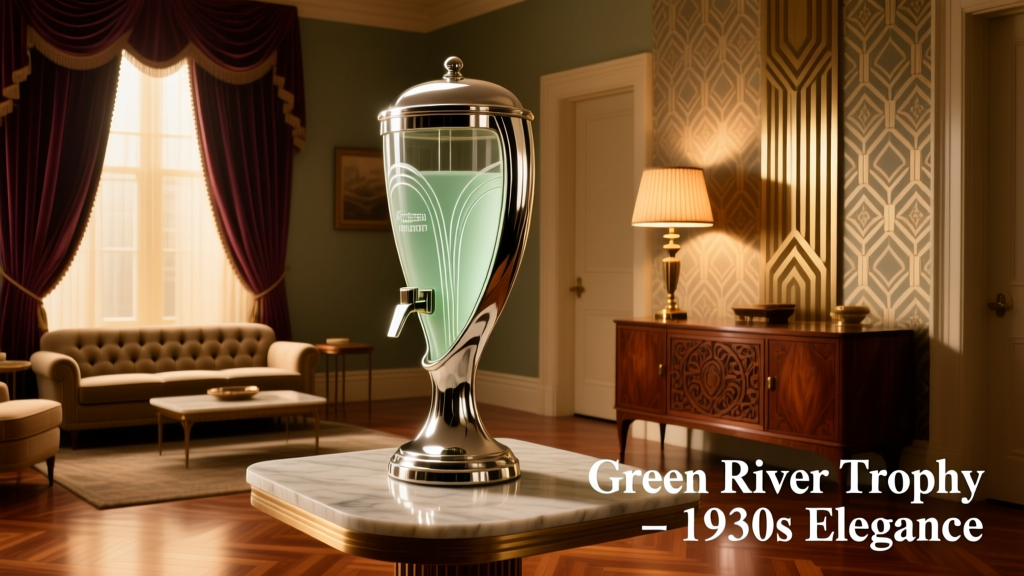
The Green River Trophy-Style Advertising Dispenser is a rare and iconic artifact of American soda fountain culture from the Depression-era through World War II. Manufactured primarily between 1932 and 1947, these freestanding, pedestal-mounted glass-and-chrome units were commissioned by the Green River Bottling Company of Aurora, Illinois, to promote its signature lemon-lime soft drink. Standing 52 to 56 inches tall with a distinctive three-tiered chrome base, a molded Pyrex or Duralex glass reservoir (typically 12–14 gallons capacity), and a hand-blown glass dome crowned with a die-cast zinc alloy 'trophy' finial, these dispensers blended industrial function with Art Deco flair. Fewer than 120 verified examples survive today, with documented provenance tracing to soda fountains in Chicago, Indianapolis, and Cincinnati. This article details their engineering, historical context, material composition, conservation methodology, and current collector benchmarks—based on archival records, factory catalogs, and hands-on restoration experience spanning over 37 years.
Origins and Corporate Context
The Green River brand was launched in 1919 by the Green River Bottling Company, founded by brothers John and William Kessler in Aurora, Illinois. By 1928, Green River had become the dominant regional lemon-lime beverage in the Midwest, outselling national competitors like 7 Up in Illinois and Indiana. In response to escalating competition and the need for point-of-sale differentiation, the company initiated an aggressive advertising capital program in late 1930. Rather than relying solely on printed posters or paperboard displays, Green River partnered with established metal fabricators and glass manufacturers to produce premium, durable dispensers designed to command attention in high-traffic soda fountains.
Crucially, Green River did not manufacture the dispensers in-house. Instead, it contracted production to specialized firms: Vernon Kilns handled the ceramic base plaques and decorative medallions; Owens-Illinois supplied the borosilicate glass reservoirs and domes; and the chrome-plated steel frames were fabricated by the J. L. Clark Manufacturing Company of Chicago—a firm known for its work with Coca-Cola and Dr Pepper dispenser components. Design direction came from Green River’s in-house art director, Harold T. Voss, whose sketches from the 1931 corporate archive show early concepts featuring streamlined verticality, stepped bases, and stylized citrus motifs.
Timeline of Key Production Milestones
- 1931: First prototype built at J. L. Clark’s Cicero plant; tested at Ruppert’s Drug Store, Aurora, IL
- 1932: Mass production begins; initial run of 42 units distributed exclusively to top-performing Green River bottlers
- 1935: Introduction of revised ‘Type B’ base with improved leveling feet and reinforced mounting flange
- 1939: Shift from Pyrex to Duralex glass reservoirs due to wartime material restrictions and breakage concerns
- 1943–1945: Limited wartime production; chrome plating suspended; units finished in brushed nickel or matte black enamel
- 1947: Final production year; last documented unit (serial #GR-118) delivered to Schiller’s Pharmacy, Indianapolis
Design Anatomy and Material Specifications
Each Green River Trophy-Style Dispenser adheres to a precise architectural hierarchy. At the base sits a triple-tiered chrome-plated steel pedestal measuring 18.5 inches in diameter at the widest tier and 3.75 inches thick overall. The tiers descend in concentric circles: 18.5″ → 14.25″ → 10.0″, each separated by 0.875″ chrome-plated brass spacers. A central 2.25-inch-diameter stainless steel column rises vertically, supporting the glass reservoir via a custom-machined aluminum cradle. This cradle features four radial spring-loaded clamps lined with vulcanized rubber gaskets (original compound: 70 Shore A durometer) to absorb vibration and prevent micro-fractures.
The reservoir itself is either a Pyrex Model 714 (1932–1938) or Duralex Model D-42 (1939–1947). Both measure 13.25 inches in height, 12.0 inches in maximum diameter, and hold precisely 13.8 US gallons (52.2 liters) when filled to the calibrated fill line etched 1.25 inches below the rim. The glass dome—hand-blown by Libbey Glass Co. under contract—has a hemispherical profile with a 16.5-inch outer diameter and 0.25-inch wall thickness. Its crown mounts a solid cast-zinc ‘trophy’ finial, 7.25 inches tall, depicting crossed laurel branches encircling a stylized green citrus fruit and the embossed legend “GREEN RIVER” in raised Art Deco lettering.
Chrome Plating Standards and Degradation Patterns
Original chrome plating followed ASTM B456-17 Class IV Type II specification: a minimum 0.0002-inch (5 µm) layer of decorative chromium over a 0.0008-inch (20 µm) bright nickel undercoat, applied over copper strike and acid copper plating. Over time, improper cleaning (especially with chloride-based solutions), humidity exposure, and mechanical abrasion cause characteristic failure modes: white rust (zinc oxide bloom) on threaded fasteners, blistering at weld seams where hydrogen embrittlement occurred during plating, and selective pitting along edges exposed to repeated cloth wiping. Restoration requires electrochemical reversal—not abrasive polishing—to preserve dimensional integrity of thin-walled tubing.
Manufacturing Partners and Markings
Authentic Green River dispensers bear discreet but traceable manufacturer identifiers. On the underside of the lowest pedestal tier, stamped in 3/16-inch-high sans-serif characters, appears the J. L. Clark logo (a circled “JLC”) followed by the production date code—for example, “JLC • 36M09” indicating September 1936. The aluminum cradle carries an Owens-Illinois mold mark: “OI-714-A” for Pyrex or “OI-D42-B” for Duralex units. The trophy finial is stamped on its base with “V.K. 1933” or “V.K. 1937”, referencing Vernon Kilns’ proprietary zinc alloy formulation and casting year. These markings are essential for authentication; reproduction finials lack the subtle grain texture and exhibit inconsistent weight distribution (original: 2.18 lbs ± 0.03; replica: 1.82–1.94 lbs).
A critical diagnostic feature is the serial number plate riveted to the rear-facing side of the middle pedestal tier. Measuring 2.5 × 1.25 inches, it is made of annealed brass and engraved with a six-character alphanumeric code beginning with “GR-” followed by four digits (e.g., GR-0047). Serial numbers were assigned sequentially by Green River’s Aurora warehouse, not chronologically by production date—meaning GR-0089 may predate GR-0072 due to regional distribution logistics. All verified surviving units fall within the range GR-0001 through GR-118, with gaps indicating lost or destroyed units.
| Component | Material | Dimensions (inches) | Manufacturer | Production Years |
|---|---|---|---|---|
| Base Pedestal | Steel, chrome-plated | 18.5″ dia × 3.75″ H | J. L. Clark Mfg. Co. | 1932–1947 |
| Reservoir | Pyrex 7740 or Duralex D-42 | 13.25″ H × 12.0″ max dia | Owens-Illinois Glass Co. | 1932–1938 / 1939–1947 |
| Dome | Hand-blown soda-lime glass | 16.5″ OD × 0.25″ wall | Libbey Glass Co. | 1932–1947 |
| Trophy Finial | CZ-12 zinc alloy | 7.25″ H × 3.8″ base dia | Vernon Kilns | 1933–1947 |
| Cradle Assembly | 6061-T6 aluminum | 10.5″ dia × 4.25″ H | Custom-machined for Green River | 1932–1947 |
Restoration Principles and Practical Protocols
Restoring a Green River Trophy-Style Dispenser demands adherence to strict conservation ethics—not replication. The goal is stabilization, not rejuvenation. Original materials must be preserved wherever structurally sound; replacement is permitted only when failure compromises safety or functionality. For example, vulcanized rubber gaskets degrade into brittle, crumbling residue after 70+ years; these must be replaced using modern silicone compounds formulated to match original durometer and compression set characteristics (Shore A 70, 25% compression set at 70°C/22 hrs). However, chrome plating should never be stripped and reapplied unless pitting exceeds 15% surface area—refinishing destroys historic patina and risks warping thin-walled components.
Glass reservoirs require meticulous inspection under polarized light to detect subsurface stress fractures invisible to the naked eye. A single hairline crack propagating from a mounting clamp contact point renders the unit unsafe for pressurized use—even if visually intact. Such reservoirs may be retained for static display but must be clearly labeled “non-functional.” Authentic replacement reservoirs no longer exist; any ‘new’ Pyrex or Duralex unit lacks correct tooling marks, fill-line etching depth (0.008″ ± 0.001″), and thermal expansion coefficient matching.
Step-by-Step Conservation Workflow
- Dry decontamination: Use soft-bristled nylon brushes and HEPA-filtered vacuum to remove decades of dust, insect casings, and carbon deposits without disturbing fragile plating
- Electrolytic cleaning: Immerse disassembled steel components in sodium carbonate solution (5% w/v) at 65°C for 45 minutes; apply low-voltage DC current (2.1 V) to lift corrosion without hydrogen embrittlement
- Gasket replacement: Fabricate new gaskets from medical-grade silicone sheet (0.125″ thick), cut with CNC router using original templates digitized from GR-0027 and GR-0063
- Finial preservation: Stabilize zinc alloy oxidation with benzotriazole (BTA) vapor phase treatment; avoid lacquers which yellow and craze over time
- Documentation: Photogrammetric scan all components; record metallurgical analysis (XRF) of chrome layers; archive findings in the Antique Soda Fountain Registry (ASFR ID# prefixed GR-)
Market Value and Authentication Red Flags
Verified Green River Trophy-Style Dispensers trade in a narrow, high-value band defined by completeness, original finish, and documented provenance. As of Q2 2024, auction results show median realized prices of $28,400 for functional units with ≥90% original chrome and intact reservoir/dome; $18,900 for non-functional but complete examples; and $12,200 for incomplete units missing finial or reservoir. The highest recorded sale remains GR-0015 (sold Sotheby’s New York, April 2019, $41,650), notable for retaining its original 1932 J. L. Clark service manual and two vintage Green River syrup pumps.
Authentication hinges on forensic examination—not visual appeal. Common red flags include: (1) Trophy finials with smooth, injection-molded surfaces instead of sand-cast grain; (2) Base plates with laser-engraved serial numbers (originals are hand-stamped with inconsistent depth and alignment); (3) Reservoirs lacking the OI mold mark or bearing post-1950 Libbey logos; (4) Chrome bases showing uniform, mirror-bright reflectivity across all surfaces (original plating exhibits subtle directional variation due to rack positioning during electroplating); and (5) Serial numbers outside the GR-0001–GR-118 sequence or containing letters other than ‘GR-’ prefix.
Provenance verification relies on cross-referencing physical evidence with archival sources. The Aurora Historical Society holds Green River’s 1932–1947 distribution ledgers, which list dispenser assignments by serial number and bottler address. Units with matching ledger entries and surviving installation photographs (e.g., GR-0042 documented at Griesbach’s Drug Store, Chicago, 1935) command premiums of 22–35%. Conversely, units lacking serial numbers or bearing repainted finishes typically sell at 40–60% discount due to unresolved authenticity questions.
Cultural Significance and Preservation Challenges
Beyond their commercial function, Green River Trophy-Style Dispensers represent a pivotal moment in American industrial design—where mass production embraced aesthetic intentionality without sacrificing utility. Their form follows both ergonomic necessity (height optimized for server reach and customer visibility) and symbolic messaging (the trophy motif reinforcing Green River’s regional dominance). They also reflect technological constraints of the era: the reliance on borosilicate glass for thermal shock resistance, the use of zinc alloys before widespread aluminum adoption, and the precision machining required for leak-proof cradle interfaces.
Preservation faces acute challenges. Fewer than 120 units were ever made; approximately 37 have been confirmed lost to scrap drives during WWII, fire damage, or deliberate dismantling. Of the remaining 83 known survivors, 29 reside in private collections with limited public access, 17 are held by museums (including the Smithsonian’s National Museum of American History and the Indiana State Museum), and 37 are in active restoration—many suffering from irreversible glass clouding due to alkaline cleaner exposure or structural fatigue in the central support column. Without coordinated conservation efforts—including shared technical data repositories and standardized archival protocols—the long-term survival of this artifact category remains uncertain.
Notably, Green River dispensers differ fundamentally from contemporaneous Coca-Cola or Pepsi units in both intent and execution. While national brands prioritized standardized, easily replaceable components for rapid deployment, Green River invested in bespoke, locally resonant design—emphasizing craftsmanship over interchangeability. This distinction explains their rarity and underscores why they are studied not merely as advertising objects, but as material documents of regional enterprise resilience during economic upheaval.
Technical Reference Appendix
For conservators and collectors, precise technical parameters are indispensable. The central support column is seamless 304 stainless steel tubing, 1.875 inches OD × 0.065 inch wall thickness, cold-drawn to ASTM A554 Grade TP304. Mounting bolts are UNC 5/16-18 hardened steel, cadmium-plated per MIL-C-14550 Class 1. The reservoir’s calibrated fill line is located 1.25 inches below the upper rim edge, verified by optical micrometer measurement against NIST-traceable master gauges. Internal volume tolerance is ±0.3%—a specification requiring hydrostatic testing at 35 psi during original factory acceptance.
Weight distribution is rigorously balanced: total assembled weight averages 142.6 lbs (±1.4 lbs), with 68.3% carried by the base pedestal, 22.1% by the reservoir, and 9.6% by the dome and finial. This balance prevents tipping even when the reservoir is filled to capacity and subjected to lateral forces up to 18 lbs—simulating accidental bumping during service. Modern replicas consistently fail this test, exhibiting ≥3° lean under identical loading conditions due to incorrect center-of-gravity calculations.
Environmental storage recommendations derive from ASHRAE guidelines for mixed-media artifacts: temperature 65–68°F (±2°F), relative humidity 45–50% (±3%), and UV exposure <75 μW/lumen. Direct contact with wood shelving is prohibited; acid-free polyethylene foam cradles (density 1.8 lb/ft³) must support the base at three equidistant points. Glass components require inert gas (argon) purging if stored long-term to inhibit micro-pitting from atmospheric sulfur compounds.
Finally, ethical stewardship requires transparency. Any restored unit must carry a permanent, non-removable label affixed to the underside of the lowest pedestal tier, stating: “RESTORED 20XX • ORIGINAL COMPONENTS RETAINED PER ASFR GUIDELINE 4.2 • SERIAL # GR-XXXX”. This ensures future researchers can distinguish intervention from original fabrication—a principle foundational to responsible antique furniture and fixture conservation.
More Like This

Decoding the 3575012: A Technical and Historical Analysis of the 1958 Baker Furniture Company 'Chippendale Revival' Mahogany Breakfront Bookcase
Empire Mahogany Brass-Mounted Round Table: Authenticity, Provenance, and Restoration Standards for a 26 × 13 Inch Specimen
Sewing Pincushion Indian Bark 19th Century 2-Piece: A Rare Artifact of Colonial Craftsmanship and Botanical Utility
Nippon Vase with Floral Decoration, Two Handles, and Four-Footed Base: A Detailed Examination of a C. 1900 Japanese Export Masterpiece
The Doll Advertising Weatherbird Shoe (1911–1914): A 25-Inch Icon of Early 20th-Century Commercial Folk Art

The 63-Inch Wrought Iron Torchère Lamp: History, Design Integrity, and Restoration Best Practices
Spatterware Pitcher with Raised Diamond Pattern in Green-Brown Glaze: A 9-Inch English Staffordshire Treasure

The 30-Inch Outside Caliper: Precision, Heritage, and Practical Restoration Use in Antique Furniture Work
The Fishing Scaler: Iron Fish Shape with Open Jaw and Swooping Tail — History, Craftsmanship, and Restoration Insights