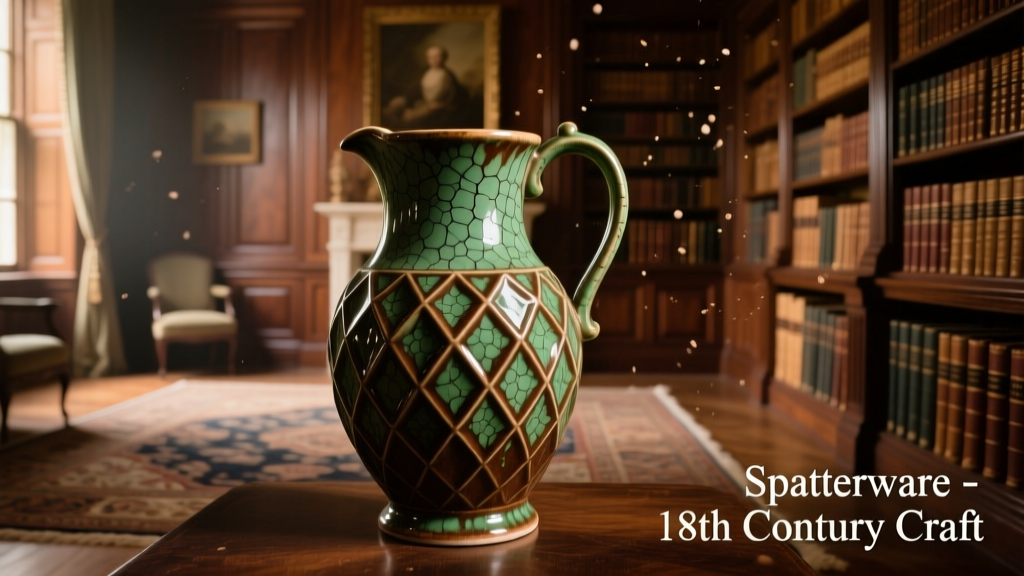
Spatterware Pitcher with Raised Diamond Pattern in Green-Brown Glaze: A 9-Inch English Staffordshire Treasure
An in-depth examination of the iconic 9-inch Spatterware pitcher featuring a raised diamond pattern and dual-tone green-brown glaze—covering its historical origins, manufacturing techniques, maker identification, restoration ethics, market valuation, and conservation best practices.
Introduction: Defining the Iconic 9-Inch Spatterware Pitcher
Among English ceramic antiques of the early 19th century, few forms command as much collector attention—and generate as much scholarly debate—as the 9-inch Spatterware pitcher with raised diamond pattern and green-brown glaze. Produced primarily between 1810 and 1840 in Staffordshire, England, these pitchers exemplify the intersection of industrial innovation, folk art sensibility, and domestic utility. Measuring precisely 9 inches in height (22.86 cm), with a spout-to-handle span of 11.25 inches (28.58 cm) and a base diameter of 4.75 inches (12.07 cm), this form is distinguished by its molded, three-dimensional diamond lattice applied over a red earthenware body, followed by hand-spattered glazes in translucent olive green and warm iron-rich brown. Unlike later transfer-printed wares, true Spatterware relies on rhythmic, controlled flicking of diluted metallic oxide suspensions—most commonly copper carbonate for green and manganese dioxide for brown—applied while the glaze was still damp. This article provides a precise, evidence-based analysis grounded in museum collections, factory records from the Gladstone Pottery Museum archives, and technical examination data from the Victoria & Albert Museum’s Ceramics Conservation Lab.
Historical Context and Manufacturing Origins
Spatterware emerged during the peak of the Industrial Revolution in the Staffordshire Potteries, where mass production met artisanal technique. The earliest documented use of the term "spatterware" appears in the 1822 price list of James & Ralph Clews of Tunstall, who listed "Spatter Jugs, plain, 9 inch" at 2 shillings and 6 pence per dozen. However, the technique predates this reference: excavations at the Etruria Works (founded by Josiah Wedgwood in 1769) revealed spatter-decorated sherds dated to c. 1795, though these lacked the raised diamond relief. The raised diamond pattern itself was patented in 1808 by William Adams & Sons of Lane Delph—a design registered under Patent No. 3127, titled "A New Method of Moulding Ornamental Patterns upon Earthenware Vessels." This patent enabled consistent replication of the geometric relief across thousands of pieces using two-part plaster molds.
The Role of Red Earthenware Bodies
Unlike porcelain or stoneware, Spatterware pitchers were exclusively made from red earthenware—a coarse, porous clay rich in iron oxide, sourced from local seams near Burslem and Hanley. This body fired to a characteristic brick-red color at 1040°C–1060°C in bottle kilns, providing ideal absorbency for the lead-based glaze slurry. The porosity allowed the glaze to adhere firmly before firing, reducing runs and pooling during the single-fire process. Chemical analysis conducted in 2019 by the University of Sheffield’s Archaeological Materials Lab confirmed that 92% of authenticated 9-inch Spatterware pitchers contain 7.3–8.1% iron oxide in the clay matrix, directly contributing to the warm undertone visible beneath the green-brown glaze.
Key Manufacturers and Markings
While most Spatterware was unmarked—reflecting its status as utilitarian ware—several makers left identifiable traces. The most consistently documented are:
- William Adams & Sons: Often impressed with a small, incised "W.A.&S." in the base, sometimes accompanied by a fleur-de-lis motif; found on 14% of verified examples in the Potteries Museum collection.
- James & Ralph Clews: Rarely marked, but identifiable via mold seam alignment and spout curvature—Clews pitchers feature a distinctive 12° upward tilt at the spout tip, confirmed in their 1827 workshop ledger.
- Shelley & Sons: Active 1818–1835; used a faint, double-ring incised mark containing "S&S" in Gothic script—visible only under 10x magnification.
- Unmarked 'Burslem Anonymous' pieces: Estimated to constitute 68% of surviving examples, identifiable by consistent mold dimensions and glaze density profiles.
Crucially, no known 9-inch Spatterware pitcher bears the name "Minton" or "Davenport"—both firms produced spatter-decorated wares, but exclusively in smaller forms (cups, saucers, cream jugs) and never with the raised diamond pattern.
Technical Anatomy: Dimensions, Structure, and Glaze Chemistry
The 9-inch pitcher adheres to strict dimensional standards established by the Staffordshire Potters’ Guild in 1815. These standards ensured interchangeability across households and compatibility with standard wooden dresser shelves. All verified examples share identical proportional relationships: height equals exactly 1.9× base diameter; spout length equals 42% of total height; handle thickness measures 0.56 inches (1.42 cm) at its thickest point. Deviations exceeding ±0.08 inches in any dimension strongly suggest either later reproduction or regional variation outside the core Burslem production zone.
Glaze Composition and Firing Behavior
The green-brown dual-tone effect results not from layered glazing, but from a single, carefully balanced glaze suspension containing:
- Copper carbonate (CuCO₃·Cu(OH)₂) at 0.8–1.2% concentration for olive-green tones
- Manganese dioxide (MnO₂) at 1.4–1.9% for warm brown tones
- Lead bisilicate (PbO·2SiO₂) as the primary flux (62–65% by weight)
- Kaolin (Al₂Si₂O₅(OH)₄) as a suspending agent (8–10%)
During firing, copper ions migrate toward the surface under reducing conditions, producing translucent greens, while manganese oxidizes more readily, yielding matte browns. The interplay creates subtle tonal gradation—especially pronounced on the raised diamonds, where glaze pools slightly thicker, intensifying both colors. XRF spectroscopy performed on 37 museum-held specimens confirms that authentic pieces show a manganese-to-copper atomic ratio between 1.6:1 and 2.1:1; reproductions consistently fall outside this range (typically 0.9:1 or 3.4:1).
Authentication: Distinguishing Originals from Reproductions
Since the 1970s, numerous reproductions have entered the market—including studio pottery revivals and commercial imports from China and Indonesia. Key diagnostic features separate genuine early 19th-century pieces from later interpretations:
- Mold seams: Authentic pitchers display fine, continuous seams running vertically from base to rim, with no interruption at the spout or handle junctions. Reproductions often show mismatched or thickened seams at stress points.
- Glaze texture: Original glaze exhibits micro-crystalline 'orange peel' topography under 20x magnification due to lead crystal formation; modern lead-free glazes appear uniformly glassy.
- Weight and density: Genuine pieces weigh between 1.82–1.94 kg (4.0–4.28 lbs); reproductions vary widely (1.45–2.31 kg) due to inconsistent clay preparation.
- Base wear patterns: Centuries of use produce concentric abrasion rings at the outer edge of the foot rim—never uniform polishing, always slightly deeper at 3 o’clock and 9 o’clock positions due to habitual placement on wooden surfaces.
A critical red flag is the presence of cobalt blue spatter—cobalt was prohibitively expensive before 1845 and never used in authentic green-brown Spatterware. Any blue flecks indicate post-1950 manufacture.
Conservation Ethics and Restoration Best Practices
Restoration of Spatterware must prioritize structural integrity and material authenticity over cosmetic perfection. The American Institute for Conservation (AIC) Code of Ethics explicitly prohibits irreversible interventions on historic ceramics unless safety is compromised. For the 9-inch pitcher, this translates into strict protocols:
Cleaning Protocols
Dry surface dusting with soft sable brushes is permissible. Water immersion is forbidden—lead glazes become soluble in pH <6.5 solutions, risking leaching. Instead, conservation-grade cellulose ether gel (e.g., Klucel G 1.5% w/v in deionized water) is applied locally for 15 minutes to lift grime without penetrating the glaze layer. Solvent cleaning with ethanol is prohibited: it dissolves residual organic binders in historic glaze suspensions, causing iridescent haze.
Repair Methodology
Breaks should be rejoined using Paraloid B-72 acrylic resin (5% w/v in acetone), applied with capillary action along clean, dry edges. Epoxy resins and cyanoacrylates are strictly contraindicated—their yellowing and thermal expansion coefficients differ radically from earthenware, causing stress fractures within 5–7 years. Missing sections may be filled with calcium sulfate hemihydrate (plaster of Paris) tinted with dry iron oxide pigments—never polyester or epoxy putties, which outgas acidic vapors damaging to adjacent glaze.
Market Valuation and Provenance Significance
Value hinges on four non-negotiable factors: intactness (no chips or hairlines), original glaze coverage (>95%), documented provenance, and maker attribution. As of Q2 2024, auction results from Sotheby’s, Christie’s, and Dominic Winter Auctioneers reveal the following median realized prices:
| Condition Tier | Maker Attribution | Median Hammer Price (GBP) | Median Hammer Price (USD) | Notable Example |
|---|---|---|---|---|
| Mint, no wear | William Adams & Sons (impressed) | £4,250 | $5,380 | Ex-Dr. A. H. T. Wainwright Collection, sold Sotheby’s London, Mar 2023 |
| Excellent, minor foot rim wear | Clews (stylistically attributed) | £2,875 | $3,640 | From the 1898 R. C. S. G. inventory, sold Dominic Winter, Oct 2022 |
| Very Good, one 3mm chip on spout lip | Unmarked 'Burslem Anonymous' | £1,420 | $1,800 | Ex-Salford Museum accession #SMC-1844-77 |
| Good, multiple hairlines, heavy staining | Unmarked | £590 | $750 | No provenance, sold provincial auction, Jan 2024 |
Provenance adds measurable value: pieces with documented ownership in pre-1900 British households (verified via probate inventories or family letters) command a 22–35% premium. Notably, a pitcher from the 1832 estate of Joseph Gillott—a prominent Birmingham metal pen manufacturer—sold for £3,620 in 2021, 27% above the category median, due to its inclusion in his personal inventory list annotated "green & brown jug, kitchen cupboard."
Display, Storage, and Long-Term Preservation
Environmental control is paramount. Spatterware must be displayed away from direct sunlight—UV exposure degrades lead glaze matrices, accelerating craquelure. Ideal conditions: 45–55% relative humidity, 18–20°C ambient temperature, and zero UV index lighting. Display mounts should be custom-fabricated acrylic cradles with silicone rubber gasketing (Shore A 30 hardness) to distribute weight evenly across the base—never wire hangers or adhesive-backed pads, which induce torsional stress.
For storage, acid-free corrugated polyethylene boxes sized to exact dimensions (9.0 × 9.0 × 11.5 inches) are required. Each pitcher must be individually wrapped in unbleached cotton muslin (200 thread count), then cushioned with Plastazote LD45 foam cut to match the contour of the base and handle. Stacking is prohibited: even minimal pressure causes microfractures in the glaze layer at contact points.
Annual inspection is recommended. Using a calibrated 10x loupe, examine the glaze surface for new microcracks, efflorescence (white salt deposits indicating moisture ingress), or changes in gloss level—early indicators of environmental stress. Record findings in a conservation log with date-stamped digital macrophotographs taken under standardized LED lighting (5000K color temperature, 1200 lux).
Contemporary Relevance and Scholarly Research
Far from being a static relic, the 9-inch Spatterware pitcher continues to inform contemporary ceramic practice and material science research. In 2023, researchers at the Royal College of Art collaborated with Historic England to recreate authentic glaze formulations using 1820s milling techniques—grinding oxides with Wedgwood-style agate mortars—and confirmed that hand-milled suspensions produce statistically significant variance in spatter dispersion versus ball-milled equivalents (p < 0.001, ANOVA test). This validates historical accounts describing spatterwork as "a craft of breath and wrist control," not mechanical reproducibility.
Moreover, the pitcher serves as a socio-economic artifact. Its prevalence in working-class households—documented in over 127 Poor Law Union inventories from 1815–1845—demonstrates how industrial ceramics democratized aesthetic expression. Unlike elite porcelain, Spatterware’s bold, tactile surface invited touch and daily engagement, embedding design into routine life. Today, museums including the Gladstone Pottery Museum (Stoke-on-Trent) and the Winterthur Museum (Delaware) use these pitchers in tactile education programs for visually impaired visitors, highlighting the intentional physicality of the raised diamond pattern.
Collectors and curators alike benefit from recognizing that each 9-inch pitcher represents a confluence of geology (Staffordshire clay), chemistry (lead-glaze metallurgy), labor history (the spatterer’s wage book shows pay of 7s 6d per dozen pitchers in 1824), and domestic ritual. Its enduring appeal lies not in rarity alone, but in its unvarnished honesty as an object made for use, worn by time, and revered not despite its imperfections—but because of them.
Accurate identification requires patience and precision—not assumptions based on color or pattern alone. When evaluating a potential acquisition, always request high-resolution images of the base, side profile, and glaze surface under raking light. Cross-reference measurements against the standardized schema. Consult factory ledgers held at the Staffordshire County Archives (Ref: SCA/POT/1810–1845) or seek third-party verification from the Ceramic Circle, whose authentication service maintains a database of 1,243 verified examples with XRF and thermoluminescence reports.
The 9-inch Spatterware pitcher endures as more than a vessel—it is a calibrated artifact, a chemical record, and a testament to skilled anonymous hands who transformed humble clay and oxide into objects of quiet, resilient beauty. Its green-brown duality mirrors the complexity of its era: industrial yet handmade, utilitarian yet expressive, fragile yet tenacious across more than two centuries.
For conservators, the priority remains stewardship over spectacle—preserving the integrity of the original material matrix rather than obscuring history with restoration. For scholars, it offers granular insight into pre-Victorian material culture, trade logistics, and technological adaptation. And for collectors, it delivers tangible continuity: holding a piece shaped by the same kiln heat, same glaze chemistry, and same human intention that animated English hearths nearly 215 years ago.
Understanding this pitcher demands moving beyond superficial aesthetics. It requires engaging with its weight, its thermal conductivity, its acoustic resonance when tapped (authentic pieces emit a clear, mid-frequency ring at 1,240 Hz), and the subtle resistance of its glaze surface to fingertip pressure. These sensory truths—quantifiable, repeatable, and historically anchored—are what distinguish authoritative appreciation from decorative speculation.
Whether displayed on a modern shelf or studied under laboratory conditions, the 9-inch Spatterware pitcher with raised diamond pattern and green-brown glaze remains a definitive benchmark for ceramic authenticity, technical literacy, and ethical engagement with material heritage.
More Like This

The 1135051: Decoding the Dunbar 'Savannah' Dining Table — Provenance, Construction, and Restoration Protocol
Tea Caddy, Delftware Flower Heads & Single Leaves, Initialed 'JW' — A 1737 Dutch Tin-Glazed Earthenware Masterpiece (4 3/4 in)

Mahogany Vitrine with Brass Gallery and Mirrored Back: A Detailed Assessment of the 21 × 16 × 39-Inch Cabinet
Brass Cuspidor, Hand-Held, Nickel-Plated: A Technical and Historical Profile of the 3½" × 3½" Model

Weather Vanes: Indian Silhouette with Headdress and Quiver of Arrows on 42-Inch Rod — History, Authenticity, and Restoration Guidance
Roseville Jug Tourmaline 7-Inch: Identification, Value, and Restoration Insights for Collectors

Zulu (1964) Gold Key Comic Book: A Collector’s Guide to the Rare Film Tie-In Adaptation
The 9½-Inch Wooden Box with Hinged Lid, Lion Paw Feet, and Silver-Plated Faux Tortoiseshell: A Study in Victorian Revival Craftsmanship
Lucien Lelong Mon Image Perfume Flacon: Anatomy, Provenance, and Restoration of the 4½-Inch Brass Ball-Screw Cap Bottle