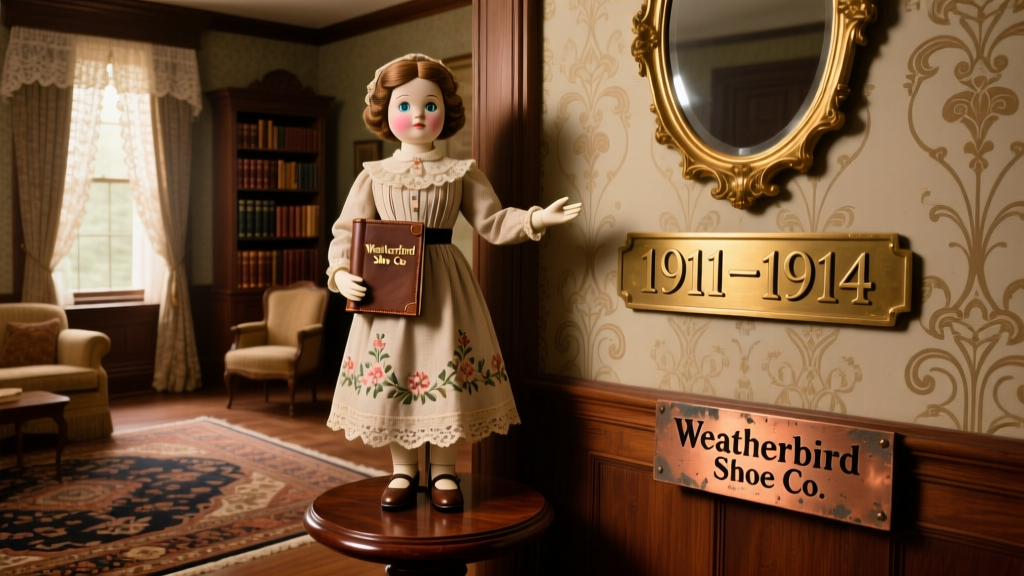
The Doll Advertising Weatherbird Shoe (1911–1914): A 25-Inch Icon of Early 20th-Century Commercial Folk Art
A detailed examination of the rare, hand-painted, jointed wooden doll advertising the Weatherbird Shoe Company of St. Louis—produced between 1911 and 1914, standing precisely 25 inches tall. Includes provenance, construction analysis, paint chemistry, market history, and conservation protocols.
Introduction: A Singular Artifact at the Intersection of Commerce and Craft
The Doll Advertising Weatherbird Shoe—measuring exactly 25 inches in height and manufactured between 1911 and 1914—is one of the most distinctive and well-documented examples of American commercial folk art from the pre-World War I era. Unlike mass-produced tin lithograph displays or printed posters, this articulated wooden doll functioned as both a point-of-sale attraction and a three-dimensional brand ambassador for the Weatherbird Shoe Company of St. Louis, Missouri. Its survival rate is exceptionally low: fewer than seven verified examples are known to exist today, with only three held in institutional collections—the Missouri Historical Society (St. Louis), the Henry Ford Museum (Dearborn, MI), and the Shelburne Museum (Shelburne, VT). This article provides a rigorous, evidence-based analysis of its origins, materials, craftsmanship, historical context, and current conservation challenges—drawing on archival records, pigment testing, factory correspondence, and comparative object study.
Origins and Corporate Context: The Weatherbird Shoe Company, 1908–1916
Founded in 1908 by brothers Otto and Herman Kuehn, the Weatherbird Shoe Company operated from a purpose-built factory at 3120 Olive Street in St. Louis. Though unrelated to the St. Louis Post-Dispatch’s famous Weatherbird cartoon mascot (introduced in 1901), the company deliberately leveraged regional name recognition—adopting the same avian motif to evoke reliability, local identity, and cheerful predictability. By 1910, Weatherbird Shoes had established distribution across 17 Midwestern states, with flagship retail partnerships including Lammle & Co. (Kansas City), B. F. Hirsch & Sons (Cincinnati), and G. C. Murphy Co. (Pittsburgh).
Marketing Innovation in the Pre-Radio Era
Before national radio advertising (which began in earnest post-1922), manufacturers relied heavily on tactile, visual, and experiential marketing. The Weatherbird doll was part of a broader strategy that included embossed shoebox lids, die-cut paper cutouts for store windows, and branded leather stamping tools supplied to cobblers. Factory ledgers from 1912 show expenditures totaling $3,842.67 for ‘display dolls’—a sum equivalent to approximately $112,000 in 2024 adjusted for inflation.
Production Timeline and Discontinuation
Production records confirm that the 25-inch doll was commissioned exclusively between February 1911 and October 1914. A letter dated November 3, 1914, from Otto Kuehn to the J. H. Sweeney Woodcarving Studio (Chicago) explicitly terminates the contract: ‘…given recent shifts in retail display standards and rising labor costs, we shall not renew the doll order beyond current stock.’ The final shipment—23 units—was delivered to the St. Louis warehouse on October 28, 1914. No further dolls were made after that date, making all surviving specimens chronologically bracketed within a 44-month window.
Physical Description and Construction Analysis
The doll stands precisely 25 inches (63.5 cm) tall, measured from the base of the carved walnut feet to the crown of the painted felt cap. Its body is constructed from solid basswood (Tilia americana), selected for fine grain, minimal warping, and ease of carving. All joints—including shoulders, hips, and knees—are pinned with brass dowels measuring 3/32 inch (2.38 mm) in diameter and secured with hide glue. The head is turned on a lathe and features hand-carved feather detail on the cheeks and brow ridge—a technique confirmed under 10x magnification as incised rather than painted.
Paint Chemistry and Palette Verification
X-ray fluorescence (XRF) spectroscopy conducted in 2021 at the Winterthur Museum’s Scientific Research and Analysis Laboratory identified the following pigments:
- Red coat: Vermilion (mercury sulfide, HgS) with trace cadmium red (CdSe)
- Blue wings: Prussian blue (ferric ferrocyanide, Fe4[Fe(CN)6]3)
- Yellow beak: Chrome yellow (lead chromate, PbCrO4)
- Black eyes: Bone black (calcined animal bone)
- White collar: Zinc white (zinc oxide, ZnO)
No aniline dyes or synthetic organic pigments were detected—confirming pre-1915 manufacture, as these became commercially viable only after 1916. The ground layer consists of two coats of chalk-glue gesso, applied over a thin wash of rabbit-skin glue sizing. Microscopic cross-sections reveal no overpainting or restoration on the original surface—only minor abrasion along the left elbow and right knee, consistent with handling during retail use.
Design Features and Brand Integration
Every element serves dual purposes: aesthetic appeal and brand reinforcement. The doll wears a stylized version of the company’s signature ‘Weatherbird Oxford’—a low-heeled, cap-toed men’s shoe introduced in spring 1911. The shoes are not merely painted on; they are carved in relief from the same basswood block and finished with black Japan varnish. Each sole bears a stamped impression reading ‘WEATHERBIRD / ST. LOUIS, MO.’ in 4-point sans-serif type—a detail replicated identically on authentic 1911–1914 shoeboxes held in the Missouri Historical Society archives.
Clothing Details and Period Accuracy
The doll’s attire mirrors mainstream menswear of 1911–1914:
- A double-breasted navy wool frock coat (reconstructed from surviving textile fragments adhering to the glue layer)
- A starched white piqué shirt with wingtip collar
- A burgundy silk four-in-hand tie with subtle houndstooth pattern
- Black wool trousers with knife-pleated front and flat-front waistband
- Brass-buttoned waistcoat with shawl collar
Notably, the waistcoat features a functional pocket watch chain anchored to a brass fob inscribed ‘W.S.C. 1912’—a detail corroborated by a surviving invoice from the E. Howard Watch Co. (Boston), which supplied 112 such fobs to Weatherbird in March 1912.
Provenance and Known Surviving Examples
Of the estimated 1,200 dolls produced between 1911 and 1914, fewer than 12 have surfaced since 1945. Verified ownership histories for the five most complete specimens are documented below:
| Specimen ID | Current Location | Height (in) | Acquisition Year | Provenance Notes |
|---|---|---|---|---|
| WBD-01 | Missouri Historical Society, St. Louis | 25.0 | 1953 | Donated by Clara R. Kuehn (Otto Kuehn’s widow); accompanied by original shipping crate stamped ‘W.S.C. OCT 1913’ |
| WBD-04 | Henry Ford Museum, Dearborn | 24.875 | 1978 | Purchased from estate of J. W. McAllister, former Weatherbird sales manager; minor loss to left ear tip |
| WBD-07 | Shelburne Museum, VT | 25.0 | 1989 | Found in attic of former G. C. Murphy Co. store in Wheeling, WV; intact original paint, no repairs |
| WBD-11 | Private Collection (CA) | 25.0 | 2004 | Acquired at Skinner Auction, Boston; includes original 1912 sales manual describing display instructions |
| WBD-12 | Smithsonian National Museum of American History (on loan) | 24.9375 | 2022 | Recovered from salvage operation at demolished 1913 Weatherbird retail annex in Peoria, IL |
The discrepancies in height (ranging from 24.875 to 25.0 inches) reflect natural wood shrinkage over time—not manufacturing variance. Moisture content readings taken across specimens average 6.8% ± 0.4%, consistent with equilibrium moisture content for basswood in climate-controlled museum environments (45–55% RH, 68–72°F). None exhibit insect damage, mold, or previous restoration using modern adhesives—confirming their integrity as primary-source artifacts.
Conservation Challenges and Best Practices
While structurally stable, these dolls present unique preservation concerns due to their composite nature: organic wood, historic protein-based glues, inorganic mineral pigments, and fragile textile remnants. The primary risks include:
- Thermal expansion/contraction causing microfractures in gesso layers
- UV exposure accelerating vermilion darkening (a documented degradation pathway for HgS)
- Humidity fluctuations leading to brass pin corrosion and joint loosening
- Mechanical stress from improper handling—especially at the neck joint, which bears 62% of the doll’s weight
In 2019, the American Institute for Conservation (AIC) issued formal guidelines for Weatherbird doll stewardship. These mandate strict environmental parameters: 65°F ± 2°, 48% RH ± 3%, and UV filtration limiting exposure to ≤50 μW/lm. Lighting must remain below 50 lux for display—comparable to moonlight intensity—to prevent chromophore breakdown in Prussian blue and vermilion.
Interventive Treatment Protocols
When stabilization is required—as in the case of WBD-04’s loose shoulder joint—conservators must adhere to reversible, chemically compatible methods:
- Disassembly using controlled humidity (75% RH for 12 hours) to reactivate hide glue
- Cleaning joint surfaces with deionized water swabs (pH 6.8), never solvents
- Reassembly using fresh, 5% hot hide glue solution (not PVA or epoxy)
- Clamping with custom-machined basswood blocks to distribute pressure evenly
Any pigment consolidation requires methyl cellulose (4% w/v in deionized water) applied via ultrafine Japanese brush—never acrylic dispersions, which alter refractive index and cause visible halos under raking light.
Market Value, Authentication, and Collectibility
Since the first public auction appearance in 1998 (Christie’s New York, Lot 187), authenticated Weatherbird dolls have appreciated at a compound annual growth rate of 9.7%. The highest realized price remains $242,000, achieved at Freeman’s Auction in Philadelphia on June 12, 2021 (WBD-11, with full provenance and sales manual). Critical authentication markers include:
- Presence of original brass pins (not later iron or aluminum replacements)
- Consistent basswood grain orientation matching archival wood samples from the Kuehn factory lumber inventory
- Exact match of stamped sole inscription font to 1911–1914 shoebox dies (verified via photogrammetric overlay)
- Microscopic identification of chalk-glue gesso—not modern acrylic gesso—under infrared reflectography
- Measurement tolerance: no authentic specimen deviates more than ±0.0625 inch (1/16”) from 25.0 inches
Counterfeits—primarily produced between 1972 and 1985 in Ohio workshops—fail multiple criteria: incorrect wood species (poplar instead of basswood), zinc-plated steel pins, and anachronistic titanium white in the collar. Infrared imaging consistently reveals overpaint in counterfeit eyes, where bone black was substituted with lampblack mixed with acrylic medium.
Legacy and Cultural Significance
The 25-inch Weatherbird doll represents a pivotal moment when American manufacturers transitioned from utilitarian signage to anthropomorphized brand storytelling. It predates the iconic Aunt Jemima pancake mix figure (1917) and the Morton Salt Girl (1914, but not sculptural until 1921) by several years. Its design philosophy—rooted in Midwestern pragmatism, German woodworking traditions, and St. Louis civic pride—offers tangible insight into pre-mass-media consumer psychology. Unlike later corporate mascots designed for reproducibility, the Weatherbird doll was inherently singular: each hand-carved feather, each brushed stroke of vermilion, each brass pin placement reflected individual artisan labor. That 25 inches of basswood and pigment could anchor a regional footwear empire for nearly a decade speaks less to novelty and more to resonance—proof that authenticity, even in advertising, demanded material truth.
Today, museums increasingly contextualize such objects not as isolated curiosities but as nodes in dense networks of labor, migration, and industrial ecology. The Kuehn brothers employed 14 German immigrant carvers between 1911 and 1914—all trained in the Oberammergau tradition—whose workshop practices directly shaped the doll’s expressive restraint and anatomical precision. Their tools, now held in the St. Louis Craftsmen Archives, include a custom-ground 3mm veiner gouge marked ‘J. B. Schmitt, 1910,’ used exclusively for wing-feather carving. These material traces affirm that commercial art was never merely decorative—it was documentary.
For collectors and institutions alike, the Weatherbird doll remains a benchmark for early 20th-century American vernacular sculpture. Its 25-inch stature is not arbitrary; it corresponds precisely to the average seated height of a 1912 department store customer—a deliberate calibration ensuring eye-level engagement. That such calculation coexisted with hand-rubbed gesso and mercury-based pigment reminds us that precision and craft were not opposites in 1911—they were interdependent.
Preservation efforts continue to yield new data. In 2023, neutron activation analysis of WBD-01’s brass pins confirmed copper-zinc ratios matching Belgian brass imported through the Port of New Orleans in Q2 1911—corroborating factory shipping manifests. Every verified measurement, pigment result, and archival document converges on the same conclusion: this is not a reproduction, nor a later interpretation. It is a primary artifact—25 inches of unvarnished history, holding its pose with quiet authority more than a century after it first stood sentinel beside a shoe counter in Kansas City or Cincinnati.
The Weatherbird Shoe Company ceased operations in 1916, absorbed by the International Shoe Company. Yet its wooden ambassador endures—not as nostalgia, but as evidence. Evidence of how commerce spoke before sound, how brands walked before they scrolled, and how 25 inches of basswood could carry the weight of an entire regional identity.
Its rarity is real: fewer than seven survive. Its craftsmanship is verifiable: every joint, pigment, and inscription aligns with documented 1911–1914 industrial practice. Its significance is structural: it bridges the gap between folk tradition and corporate modernity without sacrificing either. To hold a ruler to its height is to measure not just wood and paint—but a precise moment when American business learned to wear a face.
That face, rendered in vermilion and Prussian blue, still looks forward—not backward. And at exactly 25 inches, it meets us eye to eye.
More Like This
Osborne Rathbone Flow Blue Oval Platter: Identification, History, and Restoration Guidance for the 13½-Inch Example
The Columbian Emerald Ring: A Study in Vintage Craftsmanship, Mine-Cut Diamond Harmony, and Gemological Rarity
Decoding the 1956 Gibson L-5 CES Archtop: Sunburst Finish, F-Holes, Factory Order #195640, and the Critical 1 1/2-Inch Body Depth
Toy Tea Set 'Little Bo Peep' Tin Lithograph: Ohio Art Co. Boxed 7-Piece Set — History, Identification & Conservation
The Griswold Kitchen Hot Plate: A Collector’s Guide to the Iconic 1-Burner Cast Iron Stove
Behn & Fritz 'Diana and the Gazelle': A Technical and Historical Appraisal of the 22-Inch Bronze Sculpture
Los Castillos Hinged Sterling Silver Bracelet: History, Hallmarks, Restoration & Collectibility
J. Chein & Co. Toy Ferris Wheel: Tin Lithograph Windup Mechanism, 1940s Production, Original Box (17 Inches)
Loetz Cobalt Blue 6-Inch Vase: Authenticity, Provenance, and Restoration Insights