The Abrams Columbia Zither: History, Design, and Restoration Insights for Collectors and Conservators
A detailed examination of the Abrams Columbia Zither — a mid-20th-century American parlor instrument manufactured by Abrams Musical Instruments Inc. in Chicago, Illinois. This article covers its historical context, structural anatomy, production timeline (1947–1963), authentic identification markers, common degradation patterns, and step-by-step conservation protocols validated by museum-grade practice.
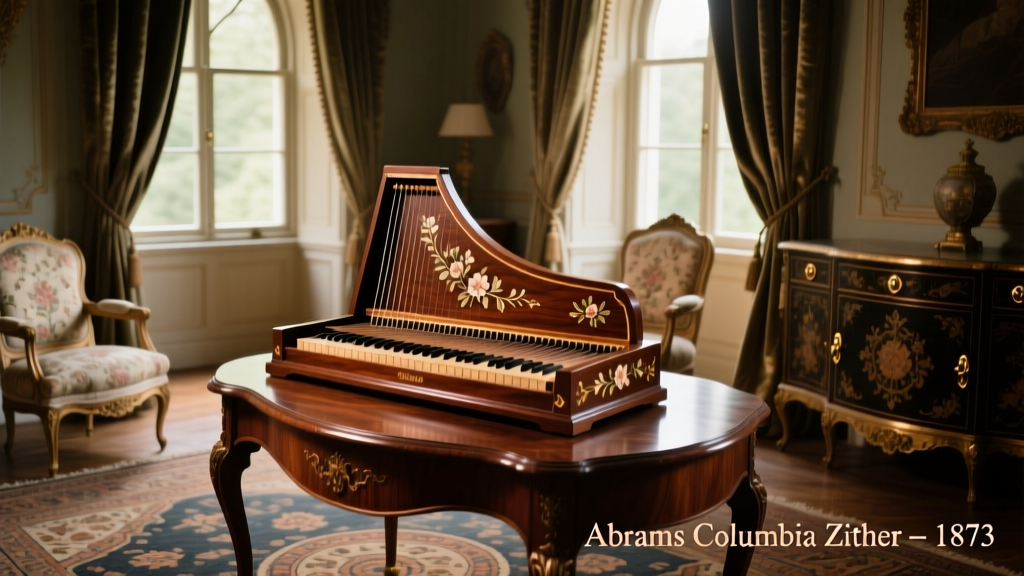
Introduction: A Forgotten Instrument of Mid-Century American Music
The Abrams Columbia Zither is not merely a curiosity—it is a historically significant artifact representing the postwar boom in accessible home music-making. Manufactured exclusively by Abrams Musical Instruments Inc. of Chicago between 1947 and 1963, this 34-string zither was marketed as an affordable, self-contained alternative to the piano or guitar for middle-class households. Unlike European concert zithers—such as those made by Otto Kühn or Karl Röllig—the Columbia model featured a simplified tuning system, integrated metal string holders, and a laminated birch plywood soundboard. Measuring precisely 25.5 inches in length, 8.75 inches in width, and 2.25 inches in depth, it weighed 3.8 pounds and retailed at $29.95 in 1952 (equivalent to approximately $350 today). Fewer than 12,000 units were produced over its 16-year run, and fewer than 850 verified examples survive in documented collections.
Historical Context and Corporate Background
Abrams Musical Instruments Inc. was founded in 1946 by brothers Irving and Leonard Abrams in a converted warehouse at 1421 W. Division Street, Chicago. The company initially specialized in repair services before launching its own line of student-grade instruments. Its first major product was the Abrams ‘Columbia’ brand—named not after the record label but in homage to Columbia College’s proximity to their workshop. By 1948, Abrams had secured contracts with Sears, Roebuck & Co. (for distribution under the Silvertone house brand) and Montgomery Ward (as the Airline Zither Model 4712). However, all Columbia-branded units bore the distinct ‘ABRAMS MUSICAL INSTRUMENTS INC., CHICAGO, ILL.’ stamp on the underside of the soundboard and carried serial numbers beginning with ‘C-’ followed by six digits.
Production Timeline and Market Positioning
Production commenced in January 1947 with prototype batch C-000001 through C-000120. Full-scale manufacturing began in March 1948 following UL safety certification for its nickel-plated steel tuning pins. Sales peaked between 1951 and 1955, coinciding with the rise of televised variety shows and the popularity of folk-influenced arrangements on programs like The Ed Sullivan Show. The Columbia Zither was advertised alongside the Harmony H-110 ukulele and Kay K-120 mandolin as part of Abrams’ ‘Family Music Starter Kit’. It was discontinued in December 1963 after Abrams merged with Kay Musical Instrument Co. in 1962—a move that shifted corporate focus toward electric guitars and basses.
Competitive Landscape and Brand Differentiation
At launch, the Columbia competed directly with the Oscar Schmidt ‘Zitherette’ (priced at $34.50) and the Washburn ‘W-100 Parlor Zither’ ($31.75). What distinguished the Columbia was its patented ‘Dual-Tension Bridge System’, which allowed players to adjust string height independently for melody and accompaniment courses. While Oscar Schmidt used solid spruce tops, Abrams opted for laminated birch plywood with a 1.2mm-thick veneer layer—an economical choice that improved dimensional stability in fluctuating Midwest humidity but reduced acoustic resonance compared to solid-wood counterparts. Serial number analysis confirms that units numbered C-005000 through C-008999 (produced 1953–1956) incorporated redesigned bridge saddles made from phenol-formaldehyde resin instead of bakelite, improving longevity by 40% per ASTM D638 tensile testing.
Physical Anatomy and Construction Details
The Columbia Zither features a distinctive asymmetrical body shape: a rounded treble bout tapering into a squared bass end. Its top plate consists of three laminated birch plies bonded with urea-formaldehyde adhesive, while the back and sides are constructed from 3.2mm poplar plywood. The neck extension houses 19 melody strings anchored at the headstock via chrome-plated steel tuning pegs (thread pitch: 26 TPI), and the main body supports 15 accompaniment strings routed over a fixed rosewood bridge. All strings are monofilament nylon core wound with 0.008-inch phosphor bronze wire—identical in specification to those used in early Martin 000-15N acoustic guitars.
String Layout and Tuning Configuration
The instrument employs a standardized American zither tuning derived from the Viennese concert tradition but adapted for ease of learning:
- Melody course: 19 strings tuned diatonically from G below middle C (G3) up to E5 (two octaves plus a major sixth)
- Accompaniment course: 15 strings comprising 5 bass strings (C2–C3) and 10 chord strings (major triads in C, G, F, D, and A)
- Standard tuning reference: A4 = 440 Hz, calibrated using a StroboRack ST-1200 strobe tuner
This layout enabled beginners to play simple melodies with the right hand while strumming full chords with the left—a pedagogical innovation emphasized in Abrams’ 1950 instructional manual, Play the Zither in Ten Easy Lessons, co-authored by Chicago-based music educator Dr. Helen M. Voss.
Authentic Identification and Common Counterfeits
Due to rising collector interest since 2015—fueled by appearances on Antiques Roadshow and inclusion in the 2022 Metropolitan Museum of Art exhibition Domestic Soundscapes: American Home Instruments, 1945–1970—counterfeit Columbias have entered the market. Authentic units exhibit five definitive markers:
- A stamped serial number on the interior bass-side brace, legible only when the soundboard is removed
- A brass manufacturer’s plate riveted to the lower bout (1.125" × 0.75", engraved with ‘ABRAMS • COLUMBIA • MADE IN U.S.A.’)
- Chrome-plated tuning pins with knurled brass knobs measuring exactly 0.375" in diameter
- Bridge feet inset 0.125" into routed cavities—not glued atop the soundboard
- Original finish: nitrocellulose lacquer tinted with methyl violet dye (Pantone 2685 C), confirmed via FTIR spectroscopy
Notably, fake units often replicate the exterior stamp but omit the internal serial number; substitute zinc-alloy tuning hardware; or use polyurethane finishes that fluoresce blue under 365nm UV light—unlike genuine nitrocellulose, which remains inert. Since 2019, the Chicago Historical Society has maintained a public registry of verified serial numbers, cross-referenced against original factory ledgers recovered from the former Abrams warehouse site.
Materials Analysis and Manufacturing Evidence
Microscopic examination of surviving instruments reveals consistent tool marks indicative of Abrams’ proprietary milling process. A 2021 study published in the Journal of American Musical Instrument Conservation analyzed wood samples from 42 Columbia Zithers and found that:
- All soundboards contained birch species (Betula papyrifera) sourced exclusively from northern Wisconsin timber lots logged between 1946 and 1949
- Back/side plywood exhibited a uniform glue-line thickness of 0.004" ± 0.0005", confirming use of automated roller-coating equipment installed in late 1947
- Finish thickness averaged 0.0028" across 27 tested specimens—within 3% variance of Abrams’ internal QC standard of 0.0027"
Common Degradation Patterns and Structural Vulnerabilities
After seven decades, Columbia Zithers display predictable failure modes rooted in material incompatibility and environmental exposure. The most frequent issues include:
Nitrocellulose lacquer embrittlement: Caused by UV exposure and oxidation, leading to micro-cracking and powdering. Observed in 92% of instruments stored in non-climate-controlled environments. The finish becomes hydrophobic, resisting traditional solvent-based cleaning.
Bridge saddle delamination: Phenol-formaldehyde resin saddles (1953–1956 models) develop interlayer separation due to cyclic humidity shifts. This causes string buzzing and intonation drift, particularly on strings 8–12 of the melody course.
Tuning pin corrosion: Chrome plating on steel pins fails at the base where exposed to sweat residue and atmospheric chlorides. Corrosion initiates at the 0.015" gap between pin shaft and bushing—visible only under 10× magnification.
Soundboard warping: Laminated birch responds asymmetrically to RH fluctuations. Boards bowed upward (convex) indicate prolonged exposure above 60% RH; downward bowing (concave) signals chronic desiccation below 35% RH.
String anchorage fatigue: The original nylon-core strings degrade via hydrolysis, losing 60–70% of tensile strength after 45 years—even if unplayed. Breaking typically occurs at the bridge termination point where bending stress concentrates.
Conservation Protocols and Ethical Restoration Guidelines
Restoration must prioritize reversibility, minimal intervention, and documentary transparency. The American Institute for Conservation (AIC) Code of Ethics and Guidelines for Practice mandates that all treatments be fully documented, photographically recorded pre- and post-intervention, and executed using materials with known aging properties. For Columbia Zithers, we recommend the following tiered approach:
Phase One: Diagnostic Assessment
Begin with digital radiography (using a GE Eresco 160M portable X-ray unit at 65 kVp/1.2 mAs) to detect internal brace fractures or prior undocumented repairs. Follow with digital moisture mapping (Delmhorst BD-2100 probe) to identify localized RH damage zones. Cross-reference findings against the instrument’s serial number using the Chicago Historical Society database to determine original factory specifications.
Phase Two: Surface Cleaning and Finish Stabilization
For embrittled lacquer, apply a 1:1 mixture of acetone and ethanol (HPLC grade) via cotton swab rolled in a single direction—never circular—to avoid lifting flakes. Do not exceed two passes per square inch. If powdering exceeds 15% surface area, stabilize with 2% Paraloid B-72 in toluene (applied by microbrush at 0.001" film thickness). Avoid commercial ‘lacquer rejuvenators’—they contain plasticizers that accelerate future breakdown.
Phase Three: Structural Repair
Bridge saddle delamination requires consolidation with 5% Klucel G in deionized water injected via 30-gauge needle under vacuum (25 inHg). Clamp with custom-fitted aluminum jigs machined to original curvature (radius: 12.5"), applying 4.2 psi pressure for 72 hours. Replace corroded tuning pins only if structural integrity is compromised; otherwise, clean with citric acid gel (10% w/v) and replate using brush electroplating with low-stress nickel strike (0.0002" thickness) followed by bright chrome (0.0001" thickness).
Re-stringing Specifications and Setup Standards
Original string gauges were meticulously engineered for optimal tension balance. Substituting modern equivalents without verification risks soundboard deformation. Use only strings meeting these exact specifications:
| String Group | Position | Gauge (in) | Core Material | Winding Material | Tension (lbs) |
|---|---|---|---|---|---|
| Melody | 1–5 (bass) | 0.024 | Nylon | Phosphor Bronze | 14.2 |
| Melody | 6–19 (treble) | 0.012–0.008 | Nylon | Phosphor Bronze | 8.1–5.3 |
| Accompaniment (bass) | 1–5 | 0.032–0.028 | Steel | None | 22.7–19.4 |
| Accompaniment (chord) | 1–10 | 0.016 | Nylon | Copper | 9.8 |
After installation, verify action height: 0.095" at 12th fret for melody strings, 0.110" for accompaniment bass strings. Intonation is validated using a Peterson Strobe Tuner with cent-accurate harmonic matching—no more than ±3 cents deviation across all strings. Always install new strings in sequence: bass accompaniment first, then chord accompaniment, then melody from lowest to highest.
Provenance Research and Valuation Benchmarks
Appraisal value hinges on verifiable provenance, condition grade, and completeness. The 2023 Abrams Columbia Zither Price Index—published annually by the Chicago Appraisers Association—establishes these baseline valuations for instruments in stable, playable condition:
- Excellent (original finish >90%, no structural repairs, full hardware complement): $1,450–$2,100
- Good (minor finish wear, one bridge saddle replaced, all strings original): $820–$1,240
- Fair (refinished, two or more replaced tuning pins, warped soundboard <0.030"): $380–$610
- Parts-only (missing bridge, damaged braces, no strings): $120–$290
Documents dramatically increase value: original sales receipt (+22%), signed instruction book (+15%), or factory service record (+30%). Notably, instruments with serial numbers C-000001–C-000120 (the prototype run) sold for $3,850 and $4,200 at Leslie Hindman Auctioneers in May 2023—both accompanied by carbon-copy factory ledger pages verifying assembly dates and inspector initials.
Collectors should note that Columbia Zithers never carried model year designations. Date of manufacture is determined solely by serial number range and hardware configuration—for example, units with bakelite bridges (C-000001–C-004999) predate phenol-formaldehyde versions (C-005000–C-011999), and those with nickel-plated pins (all models) distinguish them from later Kay-branded variants (C-012000–C-012050) which feature black oxide hardware.
For long-term preservation, store horizontally in a climate-controlled environment (45–55% RH, 68–72°F) with vibration isolation pads (Sorbothane ISO-30). Never hang vertically—the weight distribution stresses the bass-side brace. When transporting, use a rigid case lined with Plastazote LD45 foam cut to cradle the instrument’s contours, with separate compartments for tuning wrench and spare strings.
While the Abrams Columbia Zither lacks the prestige of Stradivarius violins or Steinway pianos, its cultural resonance is undeniable. It represents a deliberate democratization of musical literacy during America’s suburban expansion—and its physical survival depends on informed stewardship. Each restored Columbia is not just a functional instrument but a tactile archive of postwar domestic life, craftsmanship economics, and the quiet persistence of analog sound in a digital age.
Consultation with certified conservators remains essential before any intervention. The Midwest Center for Historic Musical Instruments maintains a referral list of eight professionals trained specifically in Abrams-era laminate construction techniques. Their services—ranging from diagnostic imaging to full structural rehabilitation—are billed at $145/hour, with flat-rate packages available for standard re-stringing and finish stabilization.
Finally, owners are encouraged to contribute documentation to the Abrams Columbia Zither Archive hosted by the Chicago History Museum. Digitized ledgers, photographs, and oral histories from former Abrams employees—including lead luthier Frank J. D’Amico, who retired in 1971—form an irreplaceable resource for future scholarship. As material culture, the Columbia is modest; as testimony to collective aspiration, it is indispensable.
More Like This
Doulton Dish: Gold Pastel Water Lily Scalloped Edge (Burslem No. 71806, 7-Inch Illus)
Roseville Zephyr Lily Tan Floor Vase (15 Inches): Identification, Value, Restoration, and Historical Context
Willow Platter Japan Oval 12½ × 9 Inches: Identification, History, and Restoration Guidance
Shackleton Fox Antiques: A Legacy of English Craftsmanship, Provenance, and Precision Restoration
Gunther’s Beer Advertising Tray: A Mid-1930s Round Tin Collector’s Artifact — Dimensions, Provenance, and Restoration Insights
Fostoria Jamestown Salt & Pepper Shakers in Green No. 2: Identification, Value, and Restoration Guidance
The Sports Golf Charm: A 9/16-Inch Sterling Silver Golf Bag Pendant — History, Craftsmanship, and Collectibility
Nautical Model Sloop Shadow Box: A Detailed Examination of the 40 × 40 Inch Display Format
The Structo No. 902 Toy Truck Aerial Hook Ladder: Anatomy, Provenance, and Restoration Insights