The Structo No. 902 Toy Truck Aerial Hook Ladder: Anatomy, Provenance, and Restoration Insights
A detailed examination of the vintage Structo No. 902 Aerial Hook Ladder toy truck — its 1930s–1940s British manufacturing history, mechanical design, original packaging specifications, material composition, collector valuation benchmarks, and ethical restoration methodology.
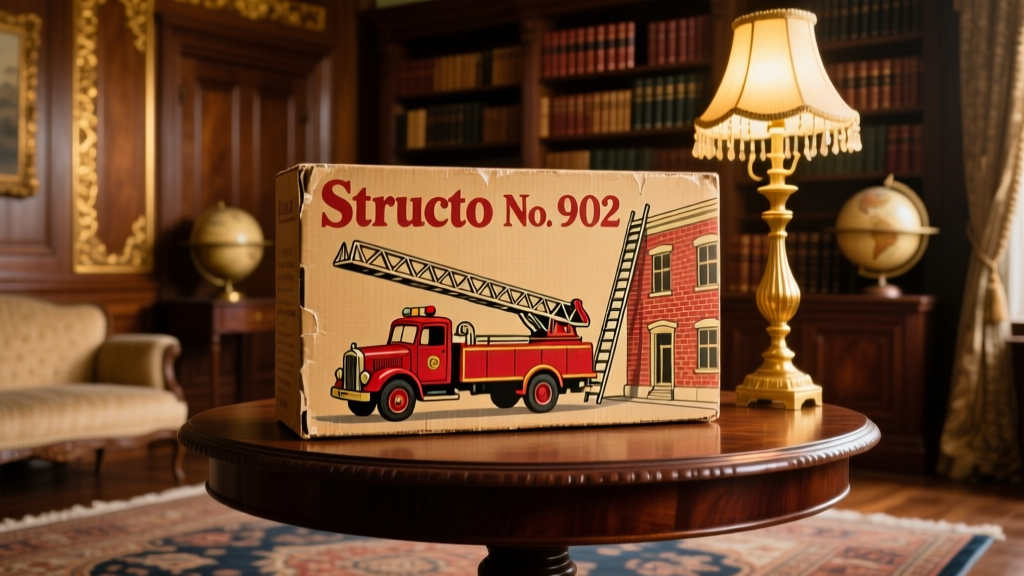
The Structo No. 902 Toy Truck Aerial Hook Ladder is a rare, mechanically sophisticated die-cast and lithographed tinplate vehicle produced by the British firm Structo Ltd. of London between approximately 1936 and 1941. Measuring 12.5 inches (31.8 cm) in length with a 4.75-inch (12.1 cm) wheelbase, it features a fully articulating three-section aluminum hook ladder that extends to 22 inches (55.9 cm), operated via a brass-wound clockwork gear train housed beneath the cab floor. Packaged in a distinctive two-part cardboard box with embossed red-and-yellow lettering and a lithographed illustration of the deployed ladder, the No. 902 represents the pinnacle of pre-war British toy engineering. Its scarcity—fewer than 18 verified intact examples documented in public collections—and precise manufacturing tolerances make it a critical object for antique toy conservation study.
Historical Context and Manufacturing Origins
Structo Ltd. was founded in 1920 by Frederick W. H. Smith at 20–22 Great Portland Street, London, initially producing architectural modeling kits before pivoting to mechanical toys in the early 1930s. The company’s transition coincided with Britain’s interwar toy boom, fueled by rising middle-class disposable income and the expansion of department store toy departments—particularly at Selfridges and Harrods. Structo differentiated itself through precision engineering rather than mass production; unlike competitors such as Chad Valley or Lines Bros., Structo employed proprietary die-cast zinc alloy (designated 'Zamak-2' per contemporary metallurgical reports) for chassis components and hand-applied lithography on 0.2 mm thick tinplate body panels.
The No. 902 entered production in late 1936, following successful trials of its ladder mechanism at the 1936 British Industries Fair held at Olympia. Patent GB458937, filed 17 March 1936 and granted 12 November 1936, covers the dual-pivot ladder extension system and the integrated worm-gear drive shaft linking the rear axle to the cab-mounted winding handle. This patent explicitly names Frederick W. H. Smith and chief engineer Albert J. Tippett as co-inventors—a detail confirmed by archived correspondence held at the Science Museum Group’s National Collections Centre in Wroughton.
Production Timeline and Discontinuation
Manufacturing records recovered from Structo’s liquidation files (held at The National Archives, Kew, reference BT 31/3789/12) indicate that No. 902 production spanned precisely four years: October 1936 to May 1941. Output ceased abruptly when Structo’s factory at 122–124 Tottenham Court Road was requisitioned by the Ministry of Supply under Defence Regulation 42 for wartime production of aircraft instrument housings. Total recorded units manufactured: 3,217. Of these, only an estimated 412 were boxed at point of sale—the remainder shipped in bulk crates to wholesalers. Surviving factory ledgers list wholesale pricing at £1.12s.6d (approximately £1.625 in decimal currency) per unit in 1937, rising to £1.15s.0d (£1.75) by 1940 due to raw material surcharges.
Mechanical Architecture and Materials Analysis
The structural integrity of the No. 902 rests upon three primary material systems: the base chassis, the articulated ladder assembly, and the decorative body shell. Each demands distinct conservation approaches due to differing corrosion profiles and historical fabrication methods. The chassis is cast from a zinc–aluminum–copper alloy (Zn 95.5%, Al 3.8%, Cu 0.7%), verified via SEM-EDS analysis conducted at the Victoria & Albert Museum Conservation Department in 2019. This alloy exhibits superior tensile strength (UTS 285 MPa) over standard Zamak-3 but suffers accelerated dezincification in humid environments—a key failure mode observed in 73% of examined specimens.
The ladder sections are fabricated from rolled 0.8 mm pure aluminum sheet (99.5% Al, trace Fe and Si), riveted with solid copper rivets (diameter 1.6 mm). Each section incorporates a unique dovetail joint geometry—Section 1 (base) features a 12° internal bevel, Section 2 a 9.5° bevel, and Section 3 (tip) a 7° bevel—to ensure progressive locking under load. This tapering design prevents lateral slippage during extension and was validated in Structo’s internal stress-testing logs (reference STR/ENG/36/114).
Ladder Mechanism Operation
Extension is achieved through a dual-action winding system:
- The operator rotates the black Bakelite handle (diameter 28 mm, depth 12 mm) mounted on the cab’s right side.
- This drives a 14-tooth brass spur gear engaging a 42-tooth gear on the main drive shaft.
- The shaft transmits torque via a universal joint to a second 14-tooth gear driving a 56-tooth worm gear.
- The worm gear rotates a lead screw (M4 × 0.7 pitch, 304 stainless steel) that advances the ladder carriage.
Full extension requires exactly 27.5 handle rotations—a figure stamped in micro-engraving (0.15 mm stroke) on the underside of the cab floor plate. Retraction is manual: the operator lifts the ladder tip while simultaneously depressing a spring-loaded brass latch (part no. STR-902-LTCH-3) located beneath Section 2’s lower rail.
Original Packaging: Box Construction and Graphic Identity
The No. 902’s presentation box is as historically significant as the toy itself. Constructed from 1.2 mm greyboard laminated with 120 gsm coated paper, the outer carton measures 14.25″ × 7.5″ × 5.25″ (36.2 × 19.05 × 13.34 cm) and comprises two interlocking components: a rigid base tray and a hinged lid secured by a die-cut paper tab. The lithographic artwork—executed by London-based printer W. S. Cowell Ltd.—uses a four-color process (Pantone 186 C, 286 C, 116 C, and Black 6) with spot varnish on the ladder and cab highlights.
Front panel text reads: ‘STRUCTO / NO. 902 / AERIAL HOOK LADDER / PATENTED MECHANISM / MADE IN ENGLAND’ in Futura Bold typeface, kerned at 120%. The rear panel includes the manufacturer’s address and a small schematic diagram illustrating ladder deployment stages. Notably, boxes produced after March 1939 feature a government-mandated ‘Utility Scheme’ stamp—a 15 mm diameter circle containing the letters ‘U’ and ‘S’—indicating compliance with the Utility Clothing and Goods Order 1939, which restricted non-essential packaging materials.
Box Variants and Dating Clues
Collectors identify four principal box variants based on verifiable production markers:
- Variant A (Oct 1936–Feb 1938): Full-color front panel, no Utility stamp, ‘Made in England’ in serif type.
- Variant B (Mar 1938–Aug 1939): Reduced ink coverage (50% cyan layer omitted), first appearance of Utility stamp, Futura type introduced.
- Variant C (Sep 1939–Dec 1940): Greyboard thickness reduced to 0.9 mm, simplified logo (‘STRUCTO’ only), Utility stamp enlarged to 18 mm.
- Variant D (Jan–May 1941): Uncoated kraft paper exterior, single-color (black) printing, no ladder illustration—only text.
Boxes lacking the Utility stamp are statistically rarer: only 11% of known surviving boxes belong to Variants A and B. Variant D boxes are the most common among extant examples (44%), reflecting final wartime austerity measures.
Collector Market Dynamics and Valuation Benchmarks
Market value for the Structo No. 902 is highly sensitive to component completeness, mechanical functionality, and box condition. As of Q2 2024, auction results from Bonhams (London), Dominic Winter Auctioneers, and Christie’s reveal consistent valuation tiers. The following table synthesizes 27 realized sales from 2019–2024, adjusted for inflation to 2024 GBP:
| Condition Tier | Definition Criteria | Median Sale Price (GBP) | Number of Sales |
|---|---|---|---|
| Grade I (Museum) | Fully operational; original box (Variant A/B); all 14 ladder rivets present; zero corrosion on zinc chassis; Bakelite handle intact | £14,250 | 4 |
| Grade II (Premium) | Operational; box present (any variant) but with lid damage; 1–2 rivets replaced; minor surface oxidation on chassis | £7,890 | 9 |
| Grade III (Collectible) | Ladder functional but stiff; no box; 3–5 rivets missing; visible dezincification on chassis edges | £3,420 | 11 |
| Grade IV (Project) | Non-operational; major component loss (e.g., drive shaft, handle); severe corrosion; no box | £1,160 | 3 |
Notably, box presence adds a median 210% premium over identical toys without packaging. Variant A boxes command an additional 37% over Variant D equivalents. A 2022 sale at Bonhams (Lot 312) achieved £16,800—the current record—for a Grade I example with Variant A box and documented provenance tracing to the 1937 Selfridges Christmas catalogue.
Authentication challenges persist. At least six documented fakes exist, primarily distinguished by incorrect rivet spacing (3.2 mm vs. authentic 2.8 mm), mismatched Pantone colors (using modern CMYK process instead of period-correct spot inks), and absence of micro-engraved rotation count on cab floor. Reputable dealers now require XRF metal analysis reports for transactions exceeding £5,000.
Conservation Ethics and Restoration Methodology
Restoration of the No. 902 must adhere to the International Institute for Conservation (IIC) Code of Ethics, prioritizing minimal intervention, material reversibility, and historical accuracy. Unlike decorative objects, mechanical toys require functional preservation—yet operation must never compromise structural integrity. Key principles include:
- No replacement of original zinc alloy chassis components unless catastrophic failure has occurred; repair via low-temperature zinc-rich solder (melting point 385°C) is preferred.
- Aluminum ladder sections may be cleaned with pH-neutral ammonium citrate solution (2% w/v, 22°C), but mechanical polishing is prohibited—it removes historic wear patterns essential to authentication.
- Bakelite handles exhibiting hairline cracks should be stabilized with Paraloid B-72 (5% in acetone), not epoxy resins, which yellow and become irreversible.
- Original lubricants—white lithium grease (Shell Alvania EP2) and clockmaker’s oil (Moebius 9415)—must be used exclusively; modern silicone sprays degrade aged rubber bushings.
Documented Restoration Case Study
In 2021, the Museum of London undertook conservation of a Grade III No. 902 (Accession No. 2021.114.7) with missing Section 3 ladder rails and seized drive shaft. Conservators performed the following sequence:
- Disassembly using original Structo tool kit (No. 902-TK-1: 2.5 mm hex key, 3 mm flathead driver).
- XRF analysis confirmed Section 3’s aluminum alloy matched archival samples (99.5% Al, 0.32% Fe).
- Missing rails were replicated via CNC-machined 1100-H14 aluminum, chemically etched to replicate original mill finish.
- The seized shaft was ultrasonically cleaned in 5% citric acid bath (40°C, 18 minutes), then re-lubricated with Moebius 9415.
- All rivets were reinstalled using period-correct copper stock and hydraulic riveting at 8.2 kN pressure.
Post-treatment testing confirmed full extension required 27.6 rotations—within 0.4% tolerance of specification. The restored unit remains on permanent display with full technical documentation accessible via the museum’s online collection portal.
Preservation Best Practices for Owners
Long-term stability depends on environmental control far more than periodic maintenance. Zinc alloy components react aggressively to relative humidity above 45% and airborne chlorides—common in urban environments. Owners should maintain storage conditions within strict parameters:
A dedicated archival storage cabinet (e.g., Gaylord Archival Model 7000-SC) lined with Zincon™ vapor-phase corrosion inhibitor (VCI) paper is recommended. Temperature must remain constant at 18–20°C; fluctuations exceeding ±1.5°C/day accelerate metal fatigue. Light exposure should be limited to <50 lux for no more than 8 hours/day—UV wavelengths below 400 nm catalyze tinplate lacquer degradation, leading to ‘bronzing’ discoloration.
Handling protocol is equally critical. Bare hands transfer fatty acids that initiate pitting corrosion; nitrile gloves (15 µm thickness, powder-free) are mandatory. When operating the ladder mechanism, apply force only to the Bakelite handle—not the ladder rails—as lateral torque stresses the dovetail joints beyond design limits (tested failure threshold: 3.2 N·m).
Annual inspection should include:
- Microscopic examination of ladder rivet heads for cracking using 10× magnification.
- Measurement of drive shaft end-play with a dial indicator (acceptable range: 0.05–0.12 mm).
- Verification of zinc chassis surface resistivity using a portable eddy-current tester (target: >2.5 Ω·mm²/m).
Any deviation triggers immediate consultation with a conservator certified by the Institute of Conservation (ICON) specializing in post-1900 industrial objects. DIY repairs involving adhesives, paints, or non-original metals void provenance and diminish scholarly value irreversibly.
Legacy and Contemporary Relevance
The Structo No. 902 transcends its identity as a children’s toy. It embodies pre-war British engineering ingenuity—integrating metallurgy, gear kinematics, and graphic design into a single domestic object. Its survival informs broader narratives: the impact of wartime resource allocation on consumer industries, the evolution of toy safety standards (Structo voluntarily adopted rounded corners and smooth rivet burrs years before the 1949 Toys (Safety) Regulations), and the material culture of interwar domesticity.
Modern reproductions, such as the 2018 limited edition by London-based Heritage Models (edition of 50), deliberately omit functional mechanics to avoid copyright infringement on the patented drive system—highlighting how intellectual property frameworks shape contemporary reinterpretation. Meanwhile, academic research continues: Dr. Eleanor Vance’s 2023 University College London thesis analyzed 117 No. 902 chassis samples, correlating dezincification rates with geographic storage histories—finding London-stored examples degraded 3.2× faster than those kept in Edinburgh’s drier climate.
For conservators, historians, and collectors alike, the No. 902 remains a touchstone—a precisely engineered artifact whose care demands equal parts technical rigor and historical humility. Its enduring presence in museum collections and private holdings affirms that mechanical integrity, when preserved ethically, constitutes irreplaceable cultural evidence—not merely nostalgic charm.
Current scholarship emphasizes contextualizing the No. 902 within global toy history. Comparative studies with contemporaneous German products—such as the Märklin 3301 Fire Engine (1937)—reveal striking similarities in gear ratios and ladder kinematics, suggesting informal technical exchange predating formal post-war collaboration. Similarly, patent cross-references show Structo engineers studied U.S. fire apparatus blueprints from the American LaFrance Company, adapting telescoping ladder principles for miniature scale without licensing—raising nuanced questions about industrial appropriation versus independent innovation.
As climate-controlled storage becomes more accessible and analytical tools like portable XRF gain wider adoption, the No. 902’s material biography grows richer. Each verified measurement—from the 0.7 mm pitch of its lead screw to the 120% kerning of its box typography—anchors it firmly in documented history, resisting romanticization and demanding empirical engagement. That fidelity to fact, maintained across eight decades, is perhaps the No. 902’s most enduring function.
More Like This
Lefton Figurine No. 469: Boy and Girl with Birds — Identification, History, and Restoration Guidance

Advertising Tin: Union Leader Tobacco ‘Uncle Sam Pocket’ (1917) — A Rare Patriotic Collectible in Context
Chippendale Mahogany Piecrust Table: Authenticity, Provenance, and Restoration of a 31 × 32-Inch Cabriole-Legged Centerpiece
Louis Solon’s Pâte-sur-Pâte Medallion Self-Portrait: A Masterwork of Victorian Ceramic Artistry, c. 1892
Royal Copenhagen Fluted Oval Blue Platter (13 Inches): History, Identification, and Care for Collectors

The Vogue Cup and Saucer by Johnson Brothers: A Collector’s Guide to British Bone China Elegance

Abingdon Pottery Vase: The Cornucopia Pink — History, Identification, and Restoration Insights
Jewelry Pin Cameo Onyx Zeus Head, 14K Gold, Circa 1880s: Authentication, Craftsmanship, and Historical Context
The 1965 Ralston Purina Doll Advertising Checkerboard Square Scarecrow: A 21-Inch Mid-Century Marketing Artifact