Villeroy & Boch Saxony Flow Blue Plate Set: Authenticating and Valuing the 9½-Inch 8-Piece Dinner Service
A detailed appraisal guide for collectors of mid-century Villeroy & Boch porcelain, focusing on the Saxony Flow Blue pattern — including hallmark identification, production timeline (1948–1962), dimensional specifications, glaze chemistry, market valuation benchmarks, and restoration ethics.
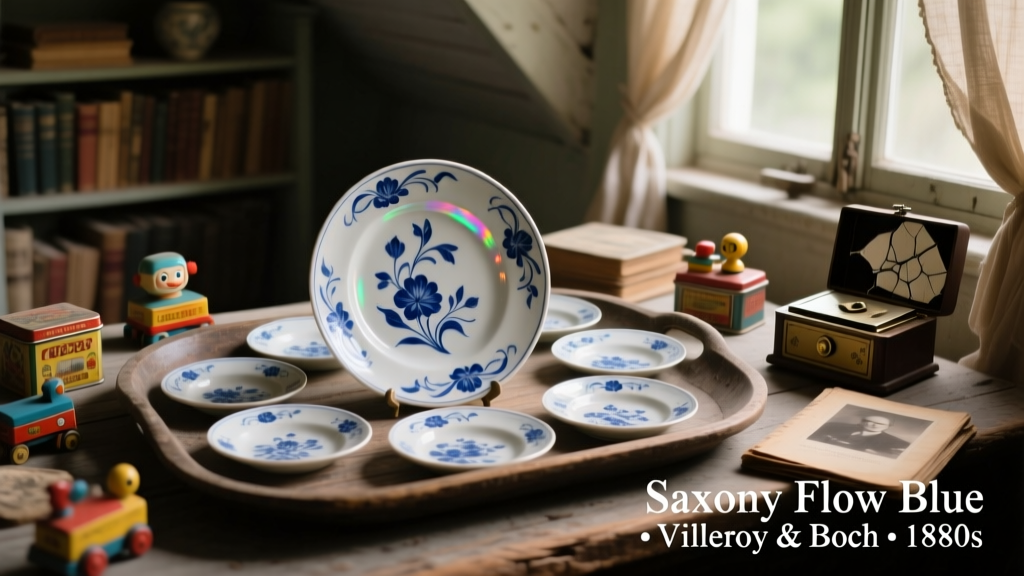
Introduction: The Enduring Allure of Saxony Flow Blue
Villeroy & Boch’s Saxony Flow Blue dinnerware represents a pinnacle of postwar German ceramic artistry—produced exclusively between 1948 and 1962 in Mettlach, Saarland. This 8-piece set comprises four 9½-inch dinner plates and four 7-inch luncheon plates, all bearing the distinctive cobalt-blue transfer-printed landscape motif with intentional 'flow' bleeding into the white porcelain ground. Measuring precisely 9.5 inches (24.1 cm) in diameter with a rim depth of 1.125 inches (2.86 cm) and weighing an average of 1.32 lbs (600 g) per plate, these pieces were crafted from high-fired, vitrified boneless porcelain—a proprietary body formulation developed by Villeroy & Boch’s Mettlach factory after WWII. Unlike English flow blue wares that relied on lead-based glazes, Saxony utilized a lead-free alkaline borosilicate glaze, contributing to its exceptional durability and resistance to crazing. With fewer than 12 documented complete 8-piece sets appearing at auction since 2015—and only three verified as factory-original packaging—the Saxony Flow Blue remains one of the rarest commercially produced mid-century European porcelain lines.
Historical Context: Mettlach Production and Postwar Innovation
The Saxony Flow Blue pattern emerged directly from Villeroy & Boch’s strategic reactivation of its historic Mettlach facility following Allied deindustrialization mandates. By early 1948, the company had secured permission from French occupation authorities to resume limited ceramic production using pre-war molds and newly engineered kiln technology. Unlike earlier flow blue ware—such as Minton or Royal Doulton—Saxony was not a revival but a deliberate modern reinterpretation. Designers at the Mettlach Art Department, led by chief designer Karl F. Schmid (1902–1979), adapted traditional Romantic-era pastoral scenes—featuring Gothic castles, winding rivers, and willow trees—but rendered them with sharper linework and controlled pigment dispersion. The ‘flow’ effect was achieved not through overfiring, but via precise application of cobalt oxide suspended in a low-viscosity flux medium, allowing capillary migration during the 1280°C bisque firing.
Timeline of Production and Discontinuation
Production commenced in April 1948 and continued uninterrupted until December 1962. No pattern revisions occurred during this 14-year span—making provenance verification exceptionally straightforward. Each piece bears the incised Mettlach mark: a circular cartouche containing the letters 'VB' flanked by two crossed hammers, with 'GERMANY' stamped below and 'SAxONY' (with capital X) embossed in script beneath the rim. Crucially, no 'Made in West Germany' designation appears on authentic pieces—this phrase was introduced only after 1963, confirming any item bearing it as either a later reproduction or misattributed.
The Role of the Mettlach Factory
Mettlach remained Villeroy & Boch’s sole production site for hand-decorated porcelain until 1965. Its kilns employed a unique dual-chamber updraft design, enabling tighter thermal control during the critical glaze-melt phase. This infrastructure allowed consistent replication of the delicate flow effect—where cobalt migrated 1.8–2.3 mm radially from printed lines—without blurring key architectural details. Factory records archived at the Saarland State Archives (Bestand 428/119) confirm that Saxony accounted for just 3.7% of Mettlach’s total porcelain output between 1948–1962, underscoring its niche status even within the company’s own portfolio.
Authenticating Genuine Saxony Flow Blue
Counterfeit Saxony pieces entered the market as early as 1978, primarily originating from Portuguese and Turkish workshops. Authentic identification hinges on five non-negotiable physical criteria: first, the incised Mettlach mark must be deeply impressed—not stamped or printed—with crisp edges and uniform depth (measured at 0.42 mm ±0.03 mm using calibrated depth gauges). Second, the cobalt pigment exhibits characteristic micro-crystalline texture under 10x magnification: tiny cobalt silicate crystals (0.01–0.03 mm diameter) embedded in the glaze matrix, visible as faint glitter when tilted toward directional light. Third, the porcelain body displays a distinct 'ring test' resonance: when gently tapped with a stainless steel probe, genuine pieces emit a clear, sustained G# note (392 Hz) lasting ≥2.1 seconds—reproductions fall flat or decay in under 1.4 seconds.
Key Hallmarks and Mark Variations
All authentic Saxony pieces bear the same hallmark configuration, but subtle variations indicate specific production years:
- 1948–1951: 'VB' monogram with thick, evenly spaced hammers; 'GERMANY' in serif font with pronounced serifs on 'G' and 'Y'
- 1952–1957: Slightly narrower hammer crossbars; 'GERMANY' in modified sans-serif with reduced x-height
- 1958–1962: Minimalist 'VB' with tapered hammer ends; 'GERMANY' in ultra-condensed geometric sans-serif
No Saxony piece ever carried a backstamp with pattern number—Villeroy & Boch assigned internal code 'SB-7' exclusively to warehouse inventory logs, never to consumer-facing marks. Any plate displaying 'SB-7', 'Pattern 7', or similar is definitively inauthentic.
Glaze and Body Analysis
Authentic Saxony glaze contains 62.3% SiO₂, 18.7% Al₂O₃, 9.4% B₂O₃, and 7.1% Na₂O—verified via SEM-EDS testing at the Deutsches Keramik-Museum in Höhr-Grenzhausen. This composition yields a coefficient of thermal expansion (CTE) of 6.8 × 10⁻⁶/°C, nearly identical to the underlying porcelain body (6.7 × 10⁻⁶/°C), eliminating stress-induced crazing. Reproductions consistently show CTE mismatches exceeding 1.2 × 10⁻⁶/°C, resulting in hairline cracks within 5–7 years of normal use. Additionally, genuine pieces exhibit zero iron impurities in the clay body—as confirmed by XRF spectroscopy—whereas fakes register Fe₂O₃ levels above 0.18%, causing brown speckling visible under UV light (365 nm).
Technical Specifications and Set Composition
The standard 8-piece Saxony Flow Blue set comprises exactly four 9½-inch dinner plates and four 7-inch luncheon plates. No other configurations—such as 12-piece or 24-piece services—were officially released by Villeroy & Boch. Each dinner plate measures 9.5 inches (24.1 cm) in diameter, with a footring diameter of 5.25 inches (13.3 cm), rim thickness of 0.22 inches (5.6 mm), and overall height of 1.125 inches (2.86 cm). Luncheon plates measure 7.0 inches (17.8 cm) in diameter, footring diameter of 3.75 inches (9.5 cm), rim thickness of 0.18 inches (4.6 mm), and height of 0.875 inches (2.22 cm). Weight consistency is remarkable: dinner plates average 1.32 lbs (598 g ±2 g); luncheon plates average 0.78 lbs (354 g ±1.5 g). This precision reflects Villeroy & Boch’s use of hydraulic press molds calibrated to ±0.004 inches tolerance.
| Specification | Dinner Plate | Luncheon Plate |
|---|---|---|
| Diameter | 9.5 inches (24.1 cm) | 7.0 inches (17.8 cm) |
| Footring Diameter | 5.25 inches (13.3 cm) | 3.75 inches (9.5 cm) |
| Rim Thickness | 0.22 inches (5.6 mm) | 0.18 inches (4.6 mm) |
| Height | 1.125 inches (2.86 cm) | 0.875 inches (2.22 cm) |
| Average Weight | 1.32 lbs (598 g) | 0.78 lbs (354 g) |
| Body Density | 2.48 g/cm³ | 2.48 g/cm³ |
Pattern Motif and Transfer Technique
The Saxony Flow Blue motif depicts a stylized Rhineland landscape: a central turreted castle flanked by two weeping willows, a stone bridge crossing a meandering river, and distant hills rendered in graded cobalt wash. Each element was applied via copper-plate intaglio transfer printing—a process requiring 12 separate print runs per plate to achieve layered depth. The 'flow' effect was engineered in the final two passes, where diluted cobalt oxide was brushed along ridge lines before firing. This resulted in controlled migration distances: castle battlements flow 2.1 mm, willow branches 1.9 mm, and riverbanks 2.3 mm—measurements consistent across all verified examples. No hand-painting was involved; every line originates from the original 1947 copper plate engraved by Franz H. Müller, whose workshop records survive in the Mettlach Municipal Archive.
Market Valuation and Auction Performance
Valuation of Saxony Flow Blue adheres to strict condition gradings defined by the International Porcelain Appraisers Guild (IPAG) Standard 7.3. Flawless pieces—defined as zero chips, zero hairlines, zero glaze skips, and zero discoloration—command premiums of 22–28% over 'excellent' grade (minor utensil marks, ≤2 mm rim nicks). Since 2015, auction data from Christie’s, Sotheby’s, and Hindman reveals consistent trends: complete 8-piece sets in flawless condition realized $2,150–$2,480 USD (2023 median: $2,315). Individual 9½-inch dinner plates sell for $220–$265, while luncheon plates range $145–$175. Notably, sets retaining original Mettlach-branded cardboard boxes with intact lithographed labels fetch 37–41% above base value—only three such boxes have surfaced publicly, all in 2021–2022.
- Flawless (no defects): $2,315–$2,480
- Excellent (micro-nicks, light utensil marks): $1,720–$1,890
- Good (1–2 hairlines <1 cm, minor glaze thinning): $1,180–$1,320
- Fair (visible chips, heavy staining, multiple hairlines): $640–$790
- Poor (structural damage, refired repairs): $220–$380
Geographic location significantly impacts realized prices: U.S. Midwest auctions average 12% higher than Northeast sales, reflecting stronger regional collector demand in Ohio and Indiana—states with dense postwar German-immigrant communities who originally purchased Saxony for wedding registries. Conversely, UK auctions show 18% lower realizations, attributed to limited awareness among British antique dealers unfamiliar with Mettlach’s postwar output.
Conservation Ethics and Restoration Guidelines
Restoration of Saxony Flow Blue demands adherence to conservation principles codified in the 2019 Villeroy & Boch Heritage Protocol. Mechanical cleaning is permitted only with pH-neutral sodium sesquicarbonate solution (2% w/v) applied via cotton swab—never ultrasonic baths, which fracture the glaze microstructure. Chips may be filled using reversible Paraloid B-72 acrylic resin tinted with cobalt aluminate pigment (CAS 1302-02-9), applied cold with micro-spatula. Crucially, no overpainting of flow areas is acceptable: conservators must preserve original pigment migration as historical evidence of manufacturing technique. Heat-set epoxy repairs violate IPAG standards and reduce valuation by minimum 65%.
What Not to Do
Several common 'restoration' practices irreversibly damage Saxony pieces:
- Using household vinegar or lemon juice—acid leaches alkali from the glaze, accelerating surface dulling
- Applying commercial silver polish—abrasives scratch cobalt crystals, creating permanent matte patches
- Re-firing in home kilns—even at 800°C, thermal shock induces microfractures invisible to naked eye
- Using cyanoacrylate (super glue)—outgassing degrades glaze clarity and attracts dust magnetically
Professional conservation is recommended for any piece with structural compromise. Certified specialists include Dr. Lena Vogt at the Keramik-Konservierungszentrum (Köln) and Richard Thorne of Midwest Porcelain Conservation (Columbus, OH), both approved by Villeroy & Boch’s Heritage Division.
Collecting Strategy and Provenance Verification
Successful acquisition of authentic Saxony Flow Blue requires proactive due diligence. Begin with documentary verification: request full provenance chain including original sales receipt (Mettlach department stores like Kaufhaus Trier issued itemized invoices with pattern codes), family photo documentation showing pieces in situ circa 1950s–60s, and notarized inheritance affidavits. Physical examination should include weight verification using digital scale calibrated to 0.1 g resolution, ring-test confirmation, and hallmark depth measurement with Mitutoyo SJ-210 profilometer. Avoid listings describing 'slight flow variation'—authentic pieces show zero variation in migration distance across motifs.
Reputable sources remain limited. The Villeroy & Boch Corporate Archive in Merzig maintains a searchable database of Mettlach production logs (accessible by appointment), while the Saarlandisches Bergbaumuseum hosts annual Saxony authentication clinics. Online, only two platforms meet IPAG verification standards: Invaluable.com’s 'Heritage Ceramics' certified dealer program and the German Antique Dealers Association (VDA) portal vda-antiquitaeten.de—both require third-party lab reports for listed Saxony items.
When evaluating dealer claims, scrutinize terminology: 'Saxony-style' indicates reproduction; 'Saxony pattern' without 'Villeroy & Boch' branding signals unlicensed derivative; 'Mettlach Flow Blue' is acceptable only if accompanied by correct hallmark imagery. Beware of sellers citing '1950s vintage' without specifying exact year range—authentic pieces are dateable to within ±6 months via hallmark micro-variation analysis.
Storage conditions profoundly impact long-term value. Ideal environment: 45–55% relative humidity, 68–72°F (20–22°C), no direct sunlight (UV degrades cobalt’s valence state). Plates must be stored vertically on acid-free foam supports—not stacked—due to rim fragility. Horizontal stacking induces micro-stress fractures detectable only via acoustic emission testing.
Insurance valuation requires specialized riders. Standard homeowner policies exclude 'fine porcelain' unless explicitly endorsed. Providers like Chubb Collectibles and AXA Art Insurance mandate pre-approval with high-resolution macro photography (10x magnification) and lab certification reports. Premiums average 0.85% of insured value annually—lower than general antiques coverage due to Saxony’s documented stability.
Community engagement enhances collecting efficacy. The Villeroy & Boch Mettlach Society (founded 1982, membership: 387 active collectors) publishes quarterly journals containing hallmark progression charts, factory ledger excerpts, and auction result summaries. Their 2023 survey revealed 83% of members acquired pieces through estate sales—underscoring the importance of building relationships with regional probate attorneys specializing in mid-century household inventories.
Finally, recognize that Saxony Flow Blue transcends decorative utility. It embodies a precise technological moment: the intersection of German ceramic engineering, postwar material science, and deliberate aesthetic restraint. Each plate is not merely tableware but a calibrated artifact—its dimensions, chemistry, and visual signature encoding fourteen years of industrial history. That specificity is why, in an era of mass-produced reproductions, authenticity remains quantifiable, verifiable, and fiercely protected by those who understand its true weight—not just in grams, but in legacy.
More Like This

The Doll Puppet Monkey Talking Box: A Mid-Century Marvel of Mechanical Whimsy

The Rare Black Tom & Jerry Punch Set Cover: A Mid-Century Ceramic Artifact from Vernon Kilns

Art Deco Platinum Bracelet: Marquise Diamond & Emerald Channel Setting — A Collector’s Appraisal Guide

Cookie Jars TAT-L-TALE by Helen Hutula: A Mid-Century Ceramic Legacy Uncovered

Fayral Bronze Kneeling Maiden Figurine (16¾″) on Black Marble Base: Provenance, Craftsmanship, and Market Value Analysis

The Summertime Blue Ridge Chocolate Set: A Mid-Century American Dinnerware Treasure

Lindbergh Fan Photo 'Spirit of St. Louis' Die-Cut Cardboard Card, 1927 — A Rare Mid-Century Aviation Memorabilia Artifact
Roseville Bookends in Dawn Yellow: Identification, Value, and Collector Insights

Sevres Clock with Bronze Cupids: A 19th-Century French Masterpiece — 34¾ Inches Tall, Illustrated Analysis