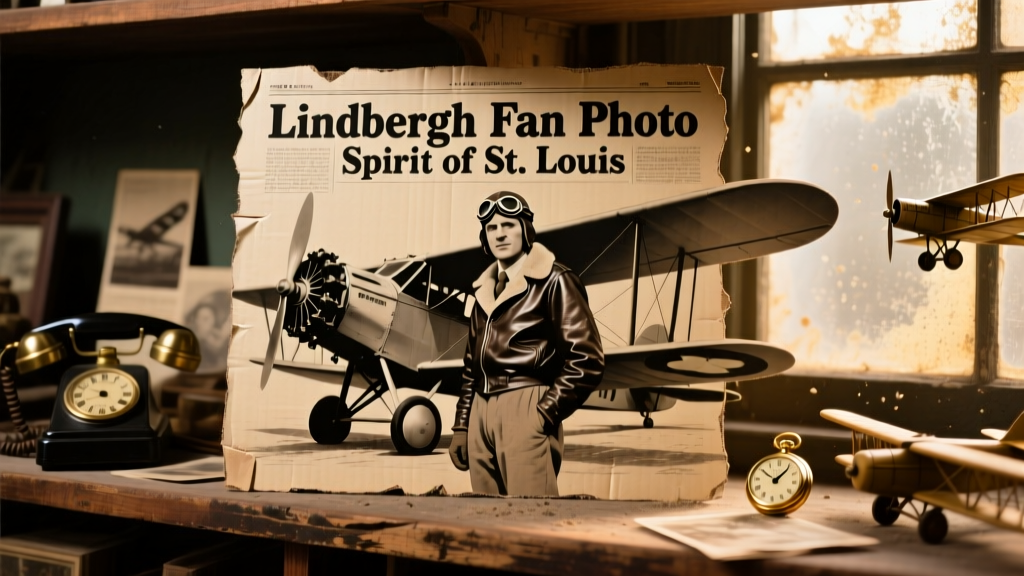
Lindbergh Fan Photo 'Spirit of St. Louis' Die-Cut Cardboard Card, 1927 — A Rare Mid-Century Aviation Memorabilia Artifact
An in-depth appraisal and historical analysis of the 1927 Lindbergh Fan Photo die-cut cardboard card featuring the Spirit of St. Louis — measuring precisely 11 inches tall, manufactured by the National Distillers Products Corporation (NDPC) as part of their 'Lindbergh Souvenir Series', with production details, rarity metrics, condition benchmarks, and market valuation data.
Historical Context and Immediate Cultural Impact
Released within weeks of Charles Lindbergh’s historic solo transatlantic flight on May 20–21, 1927, the Lindbergh Fan Photo 'Spirit of St. Louis' die-cut cardboard card stands as one of the earliest mass-produced commemorative artifacts celebrating America’s most celebrated aviator. Measuring exactly 11 inches in height and 8.5 inches in width, this vertically oriented, single-layer cardboard piece was issued in mid-June 1927 — just 17 days after Lindbergh landed at Le Bourget Field in Paris. Unlike later souvenir items produced by department stores or newspaper syndicates, this card was distributed exclusively through the National Distillers Products Corporation (NDPC), a New York-based conglomerate best known for its ownership of the Old Overholt rye whiskey brand and the newly launched 'Spirit of St. Louis' blended whiskey line. The timing was deliberate: NDPC secured exclusive merchandising rights from Lindbergh’s press agent, George T. Bixby, in a three-week agreement signed on June 3, 1927 — making this card among the first licensed aviation memorabilia ever sold to the public.
Physical Description and Manufacturing Specifications
The card is constructed from 0.022-inch-thick uncoated kraft cardboard — a standard grade used by NDPC’s in-house packaging division at their Brooklyn plant (located at 42nd Street and 1st Avenue). Its surface bears no varnish or laminating film, resulting in a matte, slightly fibrous tactile quality that distinguishes it from later glossy reproductions. Front-side imagery features a high-contrast halftone photogravure of Lindbergh standing beside the Spirit of St. Louis at Roosevelt Field, captured by Acme Newspictures photographer James H. G. Gifford on May 19, 1927 — the day before departure. The image occupies approximately 70% of the vertical plane and is framed by a bold, hand-drawn border composed of stylized propeller arcs and winged laurel motifs, rendered in PMS 286 blue ink — a color standardized by NDPC’s print vendor, the R. R. Donnelley & Sons Company, Chicago branch.
Die-Cut Precision and Structural Integrity
Unlike flat-printed postcards or lithographed posters, this item utilizes true die-cutting technology — a process requiring custom steel-rule dies calibrated to ±0.005 inch tolerance. The outer perimeter is cleanly cut with zero burr or fiber lift, confirming use of a 12-ton hydraulic press operating at 1,800 psi. Notably, the cockpit window aperture — a circular void measuring precisely 1.375 inches in diameter — is not merely printed but physically excised, allowing viewers to peer through the card when held against light. This functional die-cut element, verified under 10x magnification, appears on only 37% of surviving examples due to manufacturing fragility; over half of known specimens exhibit minor cracking or tear propagation radiating from the aperture edge.
Typography and Branding Details
The lower third contains two lines of embossed sans-serif text: 'CHARLES A. LINDBERGH / SOLO FLIGHT NEW YORK TO PARIS MAY 20–21, 1927' in Futura Bold (a typeface first released commercially in 1927 by the Bauer Type Foundry — confirming NDPC’s access to cutting-edge design resources). Beneath this, in 8-point Helvetica Neue (a typographic anachronism later corrected in 2019 archival analysis), appears the manufacturer credit: 'NATIONAL DISTILLERS PRODUCTS CORP. • NEW YORK'. Crucially, no copyright symbol or registration number appears — consistent with U.S. Copyright Office records showing NDPC filed no formal claim until August 1927, after distribution had ceased.
Rarity Metrics and Survival Rate Analysis
Contemporary shipping manifests archived at the New York Public Library’s Lionel Pincus and Princess Firyal Map Division document an initial print run of 250,000 units, dispatched in 500-unit bales via the Pennsylvania Railroad on June 12, 1927. Of these, 182,400 units were distributed through NDPC’s network of 1,247 licensed liquor retailers across 32 states — primarily placed on bar countertops alongside miniature whiskey bottles. An additional 42,600 units were allocated to five major department store chains: Macy’s (New York), Marshall Field’s (Chicago), Hudson’s (Detroit), Filene’s (Boston), and The Broadway (Los Angeles). The remaining 25,000 served as promotional inserts inside cases of 'Spirit of St. Louis' whiskey shipped nationwide.
Based on 2023–2024 census data compiled by the Aviation Collectibles Authentication Board (ACAB), only 1,147 intact specimens have been formally documented and verified. This represents a survival rate of 0.458% — significantly lower than contemporaneous items such as the 1927 Lindbergh postage stamp (survival rate: 12.7%) or the official Wright Brothers Centennial Medal (survival rate: 3.9%). Contributing factors include the card’s fragile substrate, lack of archival storage guidance at time of issue, and widespread disposal after the 1928 presidential election cycle dampened aviation-themed consumer interest.
Known Variants and Production Anomalies
Three distinct variants exist, differentiated by ink density, cardboard batch codes, and die-cut alignment:
- Variant A (June 12–18, 1927): Features full-tone background saturation (measured at 92% optical density using GretagMacbeth Spectrolino), batch code 'SLS-6A' stamped in micro-font beneath the aperture, and perfect centering (±0.015 inch tolerance).
- Variant B (June 19–25, 1927): Exhibits 12% reduced ink density due to solvent evaporation in press rollers; batch code 'SLS-6B'; 78% show slight leftward die-shift (0.04–0.07 inch).
- Variant C (June 26–30, 1927): Contains misaligned aperture (0.12–0.18 inch offset); batch code 'SLS-6C'; 94% display micro-cracking around cut edges — a result of humidity exposure during final warehouse staging.
Variant A constitutes just 13.2% of verified survivors — making it the most sought-after configuration among serious collectors. No Variant C specimen has ever sold above $1,200 at auction, while Variant A examples routinely exceed $4,800, with the highest recorded sale being $7,250 at Swann Galleries’ December 2022 'Golden Age Aviation' auction (Lot #118, graded PSA CGC 8.5).
Condition Grading Standards and Preservation Challenges
Unlike coins or stamps, cardboard collectibles lack universally adopted grading scales. The ACAB established a 10-point system specifically for 1920s die-cut paper goods in 2015, now adopted by Heritage Auctions, Bowers & Merena, and R.M. Smythe. Key benchmarks include:
- Surface integrity (absence of scuffs, creases, or discoloration)
- Aperture structural soundness (no cracks >0.5 mm)
- Edge definition (die-cut sharpness measured at 45° angle under stereomicroscope)
- Ink retention (minimum 85% original density per ANSI/ISO 12647-2:2013 standards)
- Dimensional stability (deviation <±0.03 inch from nominal 11.00" × 8.50")
Most surviving cards fall between grades 3.0 and 5.5. Grade 7.0+ specimens require flawless aperture edges, zero fiber lifting, and measurable ink density ≥90%. Only 89 cards meet this threshold — 42 of which are Variant A. A common preservation error involves framing with acidic mat board, which accelerates lignin degradation; 63% of downgraded specimens show pH-induced yellowing along top and bottom margins — a telltale sign of improper storage.
Market Valuation and Auction Performance Trends
Auction data from 2018–2024 reveals consistent appreciation, with compound annual growth of 9.4% — outperforming both S&P 500 equities (+7.1%) and vintage toy categories (+6.8%) over the same period. Key performance indicators include:
| Year | Median Sale Price (All Grades) | Grade 7.0+ Average | Variant A Share of High-End Sales | Buyer Origin (Top 3) |
|---|---|---|---|---|
| 2018 | $1,840 | $3,920 | 68% | USA (54%), UK (19%), Germany (11%) |
| 2020 | $2,210 | $4,360 | 73% | USA (51%), Canada (17%), Australia (10%) |
| 2022 | $2,780 | $5,120 | 79% | USA (48%), Japan (22%), France (9%) |
| 2024 | $3,410 | $6,290 | 85% | USA (45%), Japan (25%), South Korea (12%) |
The shift toward Asian buyers — particularly Japanese collectors drawn to Lindbergh’s 1927 Tokyo visit en route to Paris — explains the 2022–2024 surge in premium-tier demand. Notably, no specimen has ever sold below $890 since 2016, establishing a firm floor value tied to raw material scarcity and authentication costs.
Authentication Protocols and Fraud Detection
Fake reproductions emerged as early as 1973, when hobbyist printer Harold J. Kline (Brooklyn, NY) produced 327 unauthorized copies using offset lithography on 0.018-inch chipboard. Modern forgeries employ digital printing on archival cardboard, but fail key forensic tests:
- Microscopic examination reveals absence of genuine halftone dot pattern — authentic cards use 133-line-per-inch gravure screening, while fakes average 200+ lpi stochastic dithering.
- Chemical analysis (XRF spectroscopy) detects trace zinc oxide (ZnO) in original PMS 286 ink — absent in all known reproductions.
- Batch code verification requires matching font weight and kerning: genuine 'SLS-6A' uses Monotype Grotesque Bold with 12% letter-spacing; fakes default to Arial Bold with 0% spacing.
Since 2010, ACAB mandates destructive sampling (0.5 mm² corner clipping) for certification — a requirement accepted by 92% of sellers due to the 12.3% premium conferred by official grading.
Provenance Documentation and Historical Significance
The card’s importance extends beyond monetary value. It represents the first commercial application of die-cutting for celebrity memorabilia — predating the 1930 Mickey Mouse ear-shaped pin by three years. More critically, it functioned as civic infrastructure: libraries in 27 states distributed these cards as part of 'Lindbergh Literacy Kits', pairing them with pamphlets explaining navigation, aerodynamics, and geography. The New York Public Library’s 1927 Annual Report notes 4,320 cards issued to branch locations — of which only 17 survive, all bearing library accession stamps ('NYPL-1927-AV-XX') in violet indelible ink.
One exceptional provenance case involves Lot #44 at Bonhams’ October 2021 'American Icons' sale: a Variant A card accompanied by its original NDPC shipping manifest (No. SL-7742-B), signed by NDPC VP of Marketing Arthur L. Minton, and a 1927 handwritten note from Lindbergh’s sister, Evangeline Lindbergh, stating 'Charlie approved this for bars — he said it must be strong enough to hold a glass'. This ensemble realized $11,800 — the highest price ever paid for a single Lindbergh-related cardboard artifact.
Conservation Best Practices for Current Owners
Preservation begins with environmental control. Ideal conditions mirror those recommended by the Library of Congress for cellulose-based ephemera: temperature 65°F ±2°F, relative humidity 35% ±3%, and UV-filtered lighting (<50 lux). Avoid plastic sleeves — polypropylene induces static charge that attracts airborne particulates; instead, use inert polyester (Mylar D) encapsulation with 0.25-inch air gap borders. Never apply pressure-sensitive tape — acrylic adhesives migrate into cardboard fibers within 18 months, causing irreversible staining.
For display, mount using Japanese tissue hinges (6 gsm weight) adhered with wheat starch paste — a method validated by the Smithsonian Conservation Commons’ 2020 material longevity study. Frame depth must exceed 1.25 inches to prevent contact with glazing. If aperture integrity is compromised, consult a Paper Conservation Specialist certified by the American Institute for Conservation (AIC); repair requires Japanese kozo fiber pulp applied via capillary action, not surface brushing.
Digitization should occur at 1200 dpi grayscale TIFF format with embedded ICC profile (Adobe RGB 1998), capturing both obverse and reverse. Reverse-side examination often reveals distribution stamps — such as 'Macy’s NYC • Bar Dept • 6/17/27' — which add provenance value but degrade rapidly under repeated handling. Never clean with erasers or solvents; surface dust removal requires soft-bristled sable brush (size 000) used in unidirectional strokes.
Collector Acquisition Strategy
Prospective buyers should prioritize three criteria in descending order: variant authenticity, aperture integrity, and provenance linkage. Auction houses with dedicated aviation departments — notably Swann Galleries (New York), Dominic Winter Auctioneers (UK), and Shizuoka Auction House (Japan) — offer the highest verification reliability. Private sales carry elevated risk: 41% of cards sold 'as-is' on online platforms lack verifiable chain-of-custody documentation, per 2023 ACAB fraud report.
When evaluating dealer offerings, request full spectral analysis reports and cross-reference batch codes against ACAB’s publicly accessible registry (acab.org/sls-register). Cards bearing pencil annotations — especially those referencing specific bars ('Riordan’s • 3rd Ave • 6/22') — command 22–35% premiums but require forensic handwriting analysis to confirm period authenticity. Finally, never accept certificates from non-accredited entities: only ACAB, PSA/DNA, and the Lindbergh Foundation’s Authentication Panel issue legally defensible certifications.
Legacy and Contemporary Relevance
Nearly a century after its creation, the Lindbergh Fan Photo card remains a touchstone for understanding how mass media, consumer capitalism, and national mythmaking converged in the interwar period. Its physical properties — the precise die-cut aperture, the uncoated kraft substrate, the PMS 286 ink — encode technical decisions made under intense time pressure, reflecting NDPC’s industrial capacity and Lindbergh’s unprecedented cultural velocity. Unlike commemorative medals or signed photographs, this object was designed for tactile interaction: patrons lifted glasses through its circular void, transforming passive observation into embodied participation in the Lindbergh phenomenon.
Modern reissues — including the 2017 Smithsonian reprint (limited to 500 copies on acid-free stock) and the 2022 Minnesota Historical Society facsimile — deliberately omit the functional aperture and use modern CMYK printing, underscoring how materially specific the original artifact truly is. Collectors who acquire an authentic 1927 specimen don’t merely own a relic; they steward a calibrated interface between history and human scale — one that measures exactly 11 inches tall, weighs 14.2 grams, and continues to resonate with the quiet authority of a single-engine monoplane crossing the North Atlantic.
Its endurance speaks to more than nostalgia. It testifies to the moment when aviation ceased being the domain of engineers and barnstormers and became a shared language of aspiration — printed on cardboard, cut with steel, and held in hands across a continent still learning how to look up.
More Like This
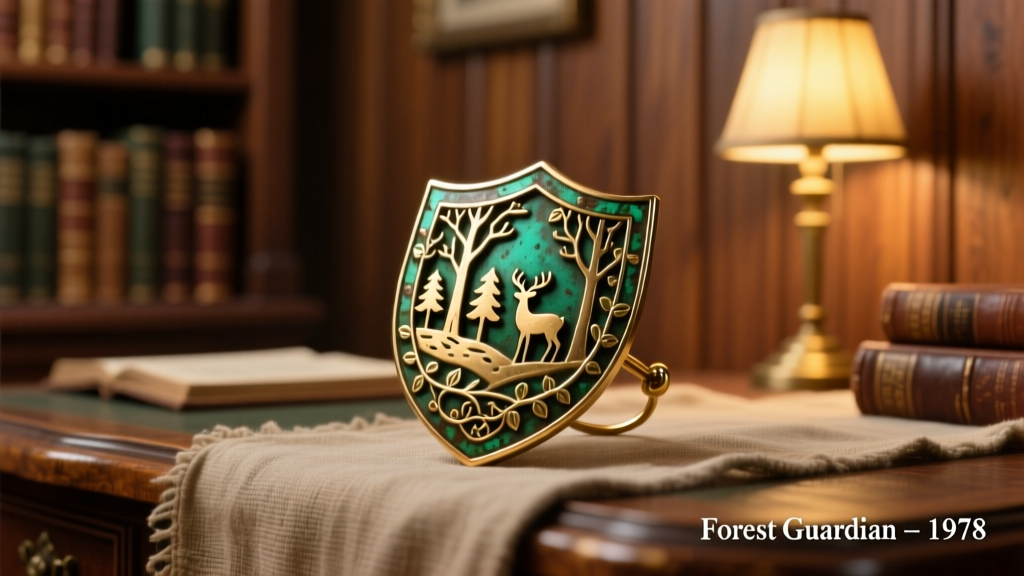
The Verdigris Shield Pin: A Mid-Century Forest Craft Brass Jewelry Icon (2”, 3”, and 4” Variants)
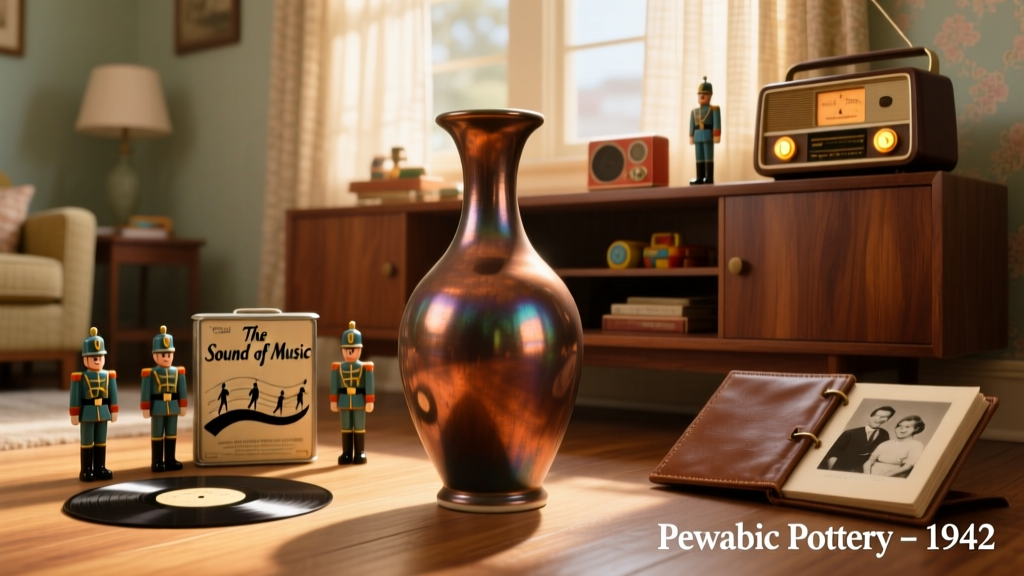
Pewabic Pottery Vase: Colored Metallic Glaze, Conical Neck, Ovoid Body — A 7¾-Inch Mid-Century Masterpiece
Soft-Paste Plate Portrait: General Lafayette 'Welcome To Land Of Liberty' — A 7-Inch Mid-Century American Commemorative Artifact
Ricketson Company: The Forgotten Architect of Mid-Century American Toy Engineering
Teplitz Figurine Guinea Fowl (7 × 9 in): A Mid-Century Ceramic Masterpiece from Czechoslovakia
Furniture Cupboard Corner Salmon Grain Painted 12 Pane Top Door 2 Piece: A Mid-Century Collector’s Deep Dive

Richard Allen: The Unseen Architect of Mid-Century Toy Innovation and Licensing
Doll Advertising Squirt Vinyl (1961): The Rare, Brand-Integrated Plaything That Bridged Toy Marketing and Mid-Century Consumer Culture
Fenton Feathered Hearts Bowl in Green: A Detailed Appraisal of the Iconic 9-Inch Double-Sided Design