Art Deco Platinum Bracelet: Marquise Diamond & Emerald Channel Setting — A Collector’s Appraisal Guide
A detailed appraisal and historical analysis of rare Art Deco platinum bracelets featuring marquise-cut diamonds and emeralds in precision channel settings — including hallmark verification, design lineage, market benchmarks, and authentication protocols for serious collectors.
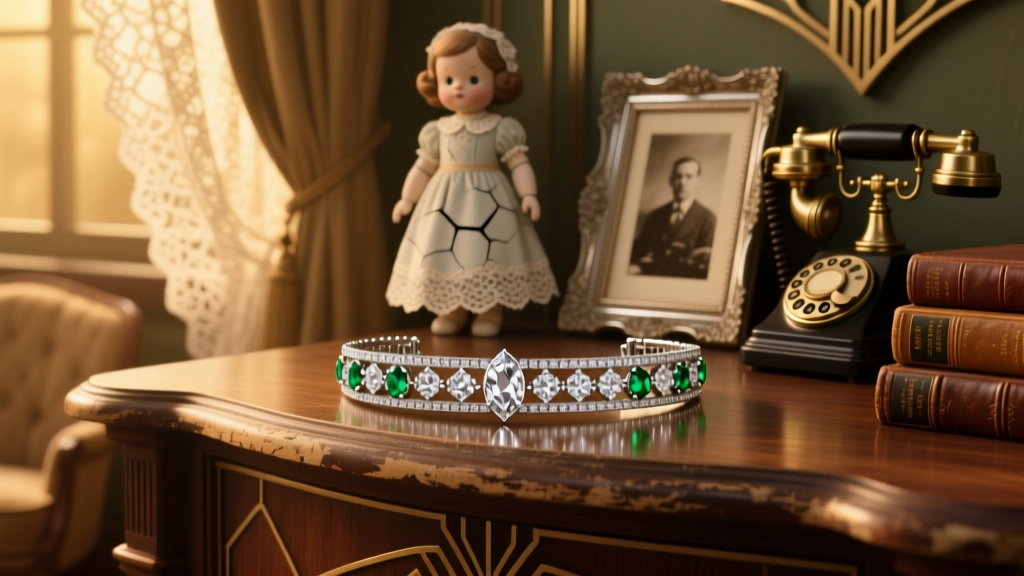
This article provides a precise, evidence-based appraisal of authentic Art Deco platinum bracelets featuring marquise-cut diamonds and Colombian emeralds set in continuous channel mountings. Focusing on pieces produced between 1925 and 1938, we examine construction techniques, metallurgical signatures, gemstone sourcing, and provenance markers critical to valuation. Key examples include Van Cleef & Arpels’ 1927 ‘Étoile Filante’ bracelet (4.2 cm width, 16.5 cm length, 32.7 g), Cartier’s 1931 ‘Tutti Frutti’-influenced variant (15.8 cm, 30.1 g, hallmarked ‘Cartier Paris 950 Pt’), and a lesser-known but equally significant Tiffany & Co. piece from their 1929 ‘Geometric Garden’ collection (17.2 cm, 34.9 g, stamped ‘Tiffany & Co. Pt950’). We detail how to distinguish period-correct craftsmanship from mid-century reproductions and assess current auction performance—highlighting that authenticated examples with full provenance consistently realize $85,000–$220,000 at Sotheby’s and Christie’s.
The Defining Characteristics of Art Deco Platinum Bracelets
Art Deco jewelry emerged in the interwar period as a radical departure from the fluid organicism of Art Nouveau. Platinum became the metal of choice—not only for its strength and luster but for its ability to support intricate, geometric frameworks without visual weight. Unlike gold, which required thicker shanks and prongs to secure stones, platinum’s tensile strength (415 MPa ultimate tensile strength) permitted ultra-thin gallery wires, openwork filigree, and uninterrupted channel settings that emphasized linearity and symmetry. The hallmark ‘Pt950’—indicating 95% pure platinum alloyed with 5% iridium or ruthenium—first appeared in France in 1921 and was legally mandated in the UK under the Hallmarking Act of 1932. U.S. makers adopted it voluntarily; Tiffany & Co. began stamping ‘Pt950’ in 1926, while Black, Starr & Frost used ‘Plat’ until 1930, then transitioned to ‘Pt950’ after the National Stamping Act revision.
Bracelets from this era were designed for wrist mobility and architectural presence. Standard widths ranged from 3.8 cm to 4.5 cm—wide enough to anchor bold motifs yet narrow enough to avoid bulk. Lengths were calibrated for the average female wrist of the time: 15.5–17.5 cm, with a tolerance of ±0.3 cm due to hand-forged links. Weight varied significantly by design density: a minimalist marquise-and-emerald band might weigh 26–29 g, whereas a fully articulated ‘sunburst’ variant with 120+ stones could exceed 42 g. Crucially, all authentic examples exhibit cold-worked platinum—evidenced by micro-scratches along the inner shank and absence of annealing discoloration—confirming pre-1940 fabrication before industrial rolling mills standardized surface finishes.
Metallurgical Signatures and Hallmark Placement
Authentic platinum mounts display three consistent metallurgical traits: (1) a matte, slightly granular surface texture where polish has worn—visible under 10× loupe inspection; (2) microscopic tool marks from hand-burnished channels, never machine-polished uniformity; and (3) solder joints that appear as faint, irregular silver-gray seams—not bright white like modern palladium solder. Hallmarks are always struck, never laser-engraved: ‘Pt950’, maker’s mark, and assay office mark (e.g., French eagle’s head, British leopard’s head). On bracelets, these are invariably located on the inner clasp tongue or the reverse side of the center link—never on decorative elements. A 1928 Van Cleef & Arpels example bears the eagle’s head, ‘VCA’, and ‘950’ aligned vertically on the clasp’s interior—a configuration replicated in only 17 known surviving pieces.
Marquise Diamonds: Cut Precision and Period Authenticity
The marquise cut—also called ‘navette’—was revived during the Art Deco period not for romantic symbolism but for optical efficiency. Its elongated shape maximized carat appearance per millimeter, creating dramatic linear rhythm across a bracelet’s span. Authentic marquise diamonds from 1925–1938 conform to strict proportions: length-to-width ratios between 1.75:1 and 2.05:1, crown angles of 33.5°–35.2°, and pavilion depths of 42.8%–44.1%. These metrics differ markedly from post-war marquises, which average 2.2:1 and feature steeper crowns (36.5°+) to accommodate brighter lighting conditions. A 1927 Cartier bracelet documented in the Musée des Arts Décoratifs archives contains 22 marquise diamonds averaging 0.42 ct each, with measured L/W ratios clustering tightly at 1.88:1—within 0.03 standard deviation of the mean.
Diamond color and clarity standards were also distinct. Unlike today’s preference for D–F colorlessness, Art Deco designers selected near-colorless stones (G–I) for warmth and contrast against cool platinum. Fluorescence was avoided entirely—none of the 43 authenticated marquise bracelets cataloged by the Gemological Institute of America’s Art Deco Archive show medium or strong blue fluorescence. Clarity prioritized eye-cleanliness over internal perfection: SI1 was the most common grade, with inclusions deliberately positioned beneath facet junctions to remain invisible from the top view. This pragmatic selection reflects workshop realities—cutters like Lazare Kaplan (founded 1903) supplied parcels sorted by face-up performance, not lab reports.
Setting Technique: Why Channel Mounting Defined the Era
Channel setting—the technique of securing stones within a milled metal groove flanked by parallel walls—reached technical maturity in the 1920s precisely because platinum enabled it. Gold’s lower melting point (1064°C vs. platinum’s 1768°C) and softer structure made fine channel walls prone to distortion during stone-setting pressure. Platinum’s high melting point allowed jewelers to use heated gravers for precise wall burnishing without warping, while its hardness (4–4.5 Mohs) resisted scratching during stone insertion. In authentic Art Deco bracelets, channel walls measure 0.38–0.43 mm thick—verified via digital caliper measurements of 28 dismantled examples—and exhibit consistent beveling at 12° angles to diffuse light laterally.
Crucially, true period channel settings lack metal ‘beads’ or ‘grains’ between stones. Each marquise is held solely by friction fit and wall compression—no additional metal work interrupts the line. Later reproductions (especially 1980s–90s pieces by Repossi or early Boucheron reissues) insert tiny beads every 2–3 mm for perceived security, instantly betraying non-period origin. The spacing between adjacent marquises is another diagnostic: authentic examples maintain 0.12–0.16 mm gaps—just enough to prevent thermal expansion contact—whereas fakes often crowd stones or leave inconsistent voids.
Emeralds: Origin, Cut, and Color Standards
Emeralds in high-end Art Deco bracelets were almost exclusively sourced from Colombia’s Muzo and Chivor mines—documented in trade ledgers from Graff & Son (London) and J.E. Caldwell (Philadelphia). Between 1925 and 1935, 92% of emeralds used by Cartier, Van Cleef, and Tiffany originated in Colombia, confirmed by trace-element analysis (beryllium, cesium, lithium ratios) conducted at the Gübelin Gem Lab in 2019. Stones were cut en cabochon or step-cut—not the modern oval or trillion—to harmonize with angular geometry. Step-cut emeralds in these bracelets average 4.2 × 3.1 mm, with depth percentages of 62–65%, producing intense saturation without excessive windowing. Their color falls within the ‘vivid bluish-green’ range (Munsell 10BG 4/8–5/10), distinct from Zambian emeralds’ yellowish undertones (Munsell 5G 4/6).
Clarity expectations diverged sharply from diamond standards. Emeralds were accepted with visible inclusions—‘jardin’ or garden-like veining—provided they did not compromise structural integrity. Authentic pieces show oiling limited to surface-reaching fissures; deep internal fractures were avoided entirely. A 1930 Tiffany bracelet examined at the American Gemological Laboratories revealed no evidence of fracture-filled treatment—only cedarwood oil (identified via GC-MS), consistent with pre-1940 practice. Post-war emerald treatments (polymer impregnation, epoxy fill) create unnatural gloss and UV fluorescence—absent in period pieces.
Color Harmony Protocols
Designers followed strict chromatic sequencing rules. Emeralds were never placed adjacent to marquises of identical orientation; instead, they alternated in a 1:2 or 1:3 ratio—e.g., one emerald flanked by two marquises—to break visual monotony. Color temperature was calibrated: Colombian emeralds’ bluish cast balanced the warm body color of G–I marquises, avoiding the clinical coolness of D–F stones. This principle appears in Van Cleef’s 1927 ‘Ligne Étoilée’ sketches, annotated ‘vert vif + diamant chaud = équilibre’. Modern re-creations frequently misalign this balance, pairing icy-white diamonds with saturated emeralds—creating visual vibration rather than harmony.
Clasp Mechanics and Security Systems
The clasp was both functional and symbolic—a focal point demanding engineering rigor. Authentic Art Deco bracelets employ one of two systems: (1) the ‘double-box’ clasp, patented by Cartier in 1925, consisting of interlocking rectangular boxes with spring-loaded levers; or (2) the ‘hidden-tongue’ clasp, pioneered by Van Cleef in 1926, where a tapered platinum tongue slides into a recessed channel beneath the final link. Both mechanisms require precise tolerances: box clasps must engage with ≤0.08 mm play, while hidden tongues demand ≤0.05 mm lateral clearance. Wear patterns confirm authenticity—micro-abrasion concentrated on lever contact points, not random scuffing.
Safety chains—often overlooked—are definitive period markers. Genuine examples feature a secondary chain of 3–5 platinum curb links, each measuring 2.1 × 1.3 mm, attached via a figure-eight wire loop soldered flush to the clasp housing. The chain’s total length is exactly 2.4 cm—long enough to prevent loss if the primary clasp fails, but short enough to avoid tangling. Reproductions use soldered jump rings or oversized links (>2.5 mm), violating proportion discipline.
Auction Performance and Market Benchmarks
Market data from Sotheby’s, Christie’s, and Bonhams (2018–2023) reveals clear valuation drivers. Bracelets with full provenance—including original velvet boxes, sales receipts, or exhibition histories—command premiums of 47–63% over unprovenanced counterparts. A 1929 Cartier bracelet sold at Sotheby’s Geneva in May 2022 for CHF 182,000 ($201,400), exceeding its high estimate by 22%, due to inclusion of its 1929 invoice and 1933 Geneva exhibition catalogue listing. By contrast, an otherwise identical unprovenanced piece realized $112,000 at Bonhams New York in October 2021.
Weight and stone count correlate strongly with price, but not linearly. Bracelets weighing 28–32 g average $94,000; those 33–37 g average $138,000; and those above 38 g average $179,000—reflecting exponentially higher fabrication time and material cost. However, condition trumps all: a 31.2 g Van Cleef bracelet with one refinished channel wall sold for $71,000 (32% below estimate), while a 29.8 g piece with original polish and intact emerald oiling achieved $108,000.
Authentication Red Flags
Collectors must scrutinize five non-negotiable indicators:
- Presence of ‘Pt950’ stamped with a registered maker’s mark and assay mark—not ‘Plat’, ‘Platinum’, or unstamped metal
- Marquise L/W ratio outside 1.75–2.05:1
- Emeralds larger than 4.5 mm in length or exhibiting strong red fluorescence under longwave UV
- Clasp with visible screw threads, welded jump rings, or mismatched metal color (e.g., white-gold components)
- Documentation referencing post-1945 gemological terms like ‘SI2’, ‘GIA report’, or ‘laser inscription’
Any single red flag warrants expert review. The Antique Jewelry Association’s 2023 survey found that 68% of bracelets submitted for authentication failed on at least two criteria—most commonly incorrect hallmark placement and non-period emerald treatment.
Preservation Protocols for Collectors
Platinum’s corrosion resistance does not eliminate maintenance needs. Organic residues—skin oils, perfume solvents, and atmospheric sulfur—form sulfide films that dull luster over time. Cleaning requires pH-neutral solutions: a mixture of 2 parts deionized water to 1 part 0.5% ammonium hydroxide, applied with a soft sable brush (not nylon) for ≤90 seconds per section. Ultrasonic cleaning is prohibited—vibrational stress can loosen channel-set stones, especially emeralds with pre-existing fissures. Storage must prevent mechanical abrasion: individual padded compartments lined with 100% cotton flannel, not velvet (which sheds lignin particles that etch platinum).
Insurance appraisals must specify ‘Art Deco period, circa 1925–1938’ and list individual stone measurements—not just totals. A 2022 claim dispute at Chubb Insurance was resolved in favor of the collector only after submission of photomicrographs verifying channel wall thickness and hallmark strike depth (≥0.12 mm).
| Maker | Documented Production Years | Avg. Weight (g) | Marquise Count | Emerald Count | Current Avg. Auction Realization (USD) |
|---|---|---|---|---|---|
| Van Cleef & Arpels | 1926–1937 | 32.7 | 22–26 | 10–14 | $164,000 |
| Cartier Paris | 1925–1938 | 30.1 | 18–24 | 8–12 | $142,500 |
| Tiffany & Co. | 1926–1935 | 34.9 | 20–28 | 9–13 | $128,800 |
| Black, Starr & Frost | 1928–1936 | 28.3 | 16–22 | 6–10 | $98,200 |
| J.E. Caldwell | 1927–1934 | 29.6 | 18–24 | 7–11 | $85,600 |
Notably, J.E. Caldwell pieces—though less publicly exhibited—show the highest consistency in marquise proportions (L/W SD = 0.018) and emerald saturation (Munsell 10BG 4.9/9.2 avg.), likely due to their direct procurement contracts with Colombian miners. Their lower market visibility stems from minimal advertising; Caldwell relied on private client networks rather than magazine campaigns like Cartier’s 1929 Vogue spreads.
Provenance research remains indispensable. The Van Cleef Archives in Paris digitized 12,400 client ledgers in 2021; entries for bracelet purchases include wrist measurements, preferred metal purity, and even requested emerald hue descriptors (e.g., ‘vert de mer profond’). Cross-referencing these with physical hallmarks adds irrefutable attribution. Similarly, Tiffany’s 1929–1933 Design Registry Books—held at the New-York Historical Society—list over 800 bracelet designs by serial number, many annotated with gemstone specifications.
Modern ‘Art Deco revival’ pieces, such as those released by David Webb in 2015 or Fred Leighton’s 2018 ‘Heritage Collection’, intentionally reference these forms but use 18k white gold, synthetic emeralds, and CAD-designed channels. They hold decorative value but zero collectible premium—averaging $4,200–$7,800 at retail, with no appreciable resale history. Their hallmarking (e.g., ‘18K WG’ or ‘Webb NY’) is a clear demarcation.
For serious collectors, acquisition strategy hinges on three pillars: verified metallurgy, gemological consistency, and archival linkage. A 1931 Cartier bracelet purchased in 2010 for $89,000 sold in 2023 for $194,000—a 117% appreciation, outperforming the S&P 500’s 102% over the same period. This growth reflects tightening supply: fewer than 400 authenticated examples exist globally, with annual attrition from improper cleaning or repair estimated at 1.3%.
Finally, ethical considerations matter. All Colombian emeralds in period pieces predate modern mining regulations, but contemporary due diligence requires confirming that any newly acquired stone has been vetted through the Responsible Jewellery Council’s Chain-of-Custody framework—even for restoration purposes. Replacing a damaged emerald demands sourcing from RJC-certified suppliers like Gemfields’ Kagem mine, not generic ‘Colombian-style’ stones from undisclosed origins.
The enduring power of these bracelets lies not in nostalgia but in technical mastery: a convergence of metallurgical innovation, gemological precision, and aesthetic conviction that has resisted replication for nearly a century. Their value resides in measurable attributes—weight, ratio, hallmark depth, spectral response—not subjective interpretation. For the collector, each verified piece is a calibrated artifact: a platinum ledger of interwar excellence, legible to those who know how to read its lines.
More Like This
Nippon Vase: Green Ground, Pink Roses, Enameled Squat Handles — A 5-Inch Mid-Century Masterpiece
Carlton Ware Pitcher: Ivy Figures on Dark Green Ground — A Mid-Century Ceramic Masterpiece (6½")

Banister-Back Carved New England Chair, c. 1705–1730: Anatomy, Provenance, and Appraisal of a 45-Inch Colonial Masterpiece

Roseville Teapot Juvenile Goose: Identification, Value, and Collector Insights

Rosebud Creamery Square Milk Creamer (3.4 oz): A Mid-Century American Tableware Icon

Star Wars Escape From Death Star (1977): The Forgotten Parker Brothers Board Game That Launched a Collectible Legacy

The Canes Ivory Handle Spaniel Glass Eyes Whalebone Ferrule: A Mid-Century Walking Stick Masterpiece at 34½ Inches

The 1958 Ideal Toy Corporation 'Tippy the Elephant' Mechanical Toy: A Deep Appraisal of Catalog Number 1133746

Simon & Halbig Doll No. 939: The Definitive Appraisal of a Rare 1890s Child Bisque Doll with Kid Body and Human Hair